

The Complete Birth Center Water Birth Plan Template Every Natural Mama Needs
Welcome to Your Empowered Water Birth Journey, Mama
Take a deep, grounding breath. You are preparing for one of the most transformative, awe-inspiring days of your life. If you are reading this, you are likely dreaming of a peaceful, dimly lit room, the soothing embrace of warm water, and a gentle transition for your baby from the womb to the world. Water birth—often lovingly referred to in the birth community as the ‘aquadural’—is a beautiful, evidence-based way to manage the intense sensations of labor and bring your baby earthside. But as any experienced doula will tell you, a beautiful birth doesn’t just happen by accident; it is built on a foundation of preparation, education, and clear communication.
As your virtual doula, pediatric sleep consultant, and postpartum recovery nurse all rolled into one, I am here to tell you that while birth is wild, primal, and inherently unpredictable, having a solid, well-thought-out water birth plan template is your ultimate anchor. A birth plan is not a rigid contract; rather, it is a communication tool. It tells your midwives, nurses, and birth team exactly what your preferences are, how you wish to be supported, and what environment makes you feel safest. When you feel safe, your body produces abundant oxytocin—the hormone responsible for effective contractions—and naturally suppresses adrenaline, which can stall labor.
In this comprehensive guide, we are going to dive deep into the mechanics of hydrotherapy. We will cover exactly what you need to include in your birth center water birth plan, how to advocate for your sacred space using proven communication scripts, and what physical items will make your time in the tub pure magic. Whether you are a first-time expectant mother or a seasoned mama aiming for a healing VBAC (Vaginal Birth After Cesarean), this template is designed to wrap you in comfort, practical knowledge, and fierce sisterly support. Let’s prepare your mind, your body, and your birth bag for the incredible journey ahead.
The Physiology of Hydrotherapy: Why and When to Enter the Tub

Before we start filling out your birth plan template, it is crucial to understand exactly how water transforms the labor experience. Hydrotherapy is not just about feeling nice; it is a profound physiological tool. When you step into a birthing tub filled with water kept at a precise temperature (usually between 97 and 100 degrees Fahrenheit), your body experiences immediate buoyancy. This weightlessness reduces the gravitational pull on your muscles, allowing your pelvic floor to relax and making it significantly easier to try upright, gravity-positive positions that might feel too exhausting on dry land.
Furthermore, the warm water acts as a sensory distraction. According to the Gate Control Theory of Pain, the soothing temperature and pressure of the water travel to your brain faster than the pain signals from your contracting uterus, effectively ‘closing the gate’ and reducing your perception of pain. This encourages a massive release of endorphins—your body’s natural painkillers. However, the timing of when you enter the tub is one of the most critical factors in a successful water birth.
Step-by-Step Guide to Utilizing the Birthing Tub
- Wait for Active Labor: This is the golden rule of water birth. Resist the urge to enter the tub before you are at least 5 to 6 centimeters dilated and experiencing strong, consistent contractions (usually lasting 60 seconds and coming every 3 to 4 minutes). Entering the water too early during early labor can sometimes relax your body so deeply that contractions space out and labor stalls.
- Hydrate Continuously: The warm water will naturally raise your core temperature and make you sweat, even if you don’t realize it. Have your birth partner offer a sip of electrolyte-rich fluid or coconut water after every single contraction. Dehydration can lead to a tired uterus and fetal distress.
- Utilize Buoyancy for Frequent Position Changes: Do not just sit in one spot! Every 20 to 30 minutes, shift your body. Move from a deep squat to hands-and-knees, or lean over the side of the tub. The water makes these transitions practically weightless and helps the baby navigate the pelvis.
- Focus on Downward, Low-Pitch Breaths: As you ride the peak of a contraction, avoid high-pitched screaming, which tenses the jaw and, consequently, the pelvic floor. Instead, blow out slowly through relaxed lips (like blowing out a candle) into the water if you are low enough, or vocalize with low, deep moans like a cow or a foghorn.
By including a specific note in your birth plan that you wish to wait until active labor to enter the tub, you show your midwives that you are educated and committed to keeping your labor progressing beautifully.
Structuring Your Water Birth Plan Template: What to Include
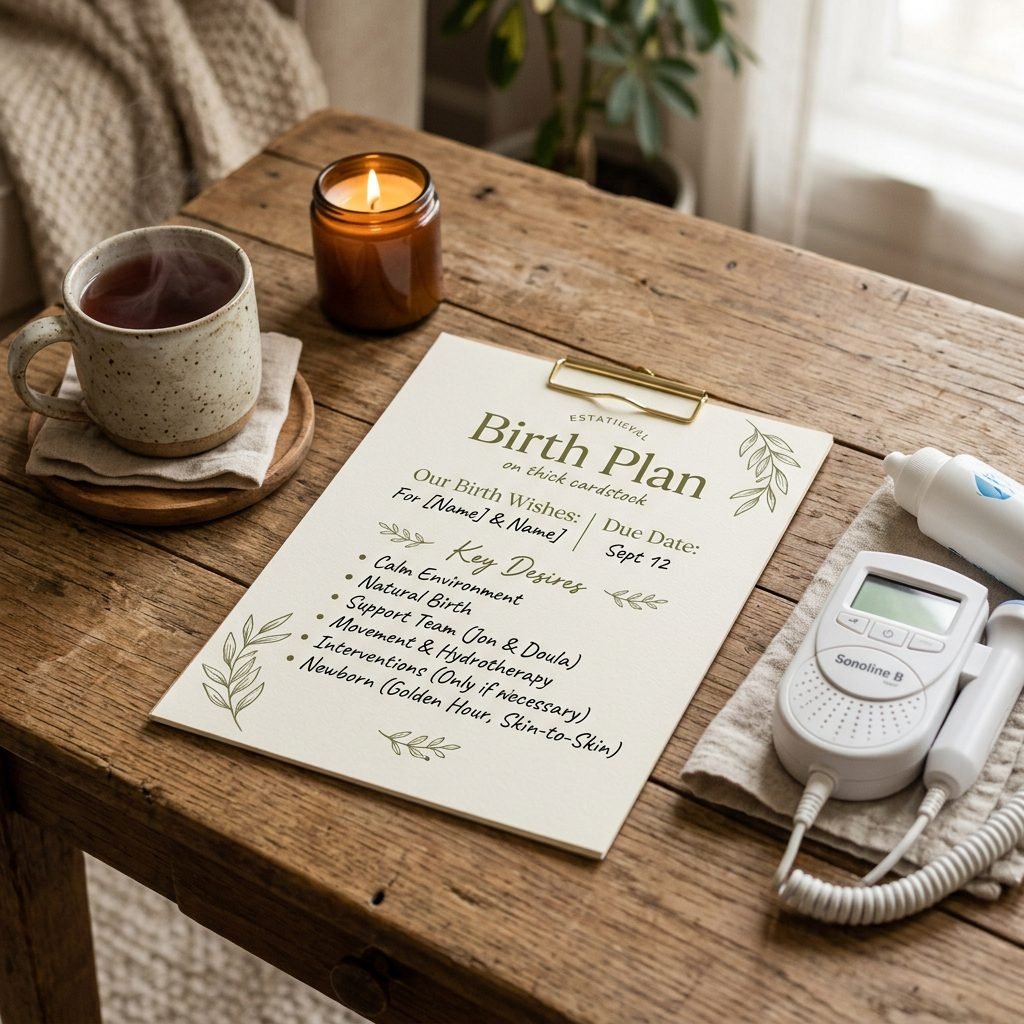
Now, let’s get down to the practical magic of drafting your actual birth plan. A great birth plan should ideally fit on a single page. Midwives and birth assistants are busy, and a concise, bulleted list is much easier to digest than a five-page essay. Your water birth plan should be divided into clear sections: Environment, Labor Preferences, Pushing/Delivery, and Immediate Postpartum.
1. The Birth Environment
Your environment dictates your hormones. Specify that you want the lights dimmed, LED candles turned on, and a specific playlist playing softly in the background. Mention who is allowed in the room—perhaps just your partner, your doula, and the necessary medical staff. You can also request that voices be kept low and that unnecessary chatter is taken out in the hallway.
2. Labor Preferences & Monitoring
In a birth center, intermittent monitoring is usually the standard of care, but it is always good to put it in writing. State that you prefer the use of a waterproof handheld Doppler to monitor the baby’s heart rate while you remain in the tub, rather than being asked to step out of the water for monitoring. You should also explicitly state your preferences regarding cervical checks.
Optimal Water Labor Positions by Phase
To help you and your birth team stay on the same page, include a mental (or written) toolkit of positions you want to try in the water. Here is a breakdown of how different positions serve different phases of labor:
| Labor Phase & Dilation | Optimal Water Birth Positions & Techniques |
|---|---|
| Active Labor (5-7 cm) | Kneeling forward over the edge of the tub, resting your head on folded towels. This allows your partner to easily apply hip squeezes and counter-pressure to your lower back. |
| Transition (8-10 cm) | Deep squatting while holding the sides of the tub, or asymmetrical kneeling (one foot flat, one knee down). This opens the pelvic outlet significantly to help baby descend. |
| Pushing (Second Stage) | Semi-reclined in your partner’s arms, or hands-and-knees. This allows the midwife easy visual access to guide the baby’s head and monitor progress without disturbing your rhythm. |
| Placental Delivery (Third Stage) | Often done outside the tub on a comfortable bed to allow midwives to monitor blood loss accurately, though some birth centers permit physiological third stage in the water. |
Essential Advocacy Scripts: Using Your Voice in the Birth Room

Mama, let’s have a real, sisterly talk. Even in the most supportive, holistic birth centers, labor can be overwhelming, and standard protocols can sometimes interrupt your zen. True empowerment comes from knowing how to advocate for yourself, or having your partner/doula advocate for you. When you are deep in ‘Laborland,’ you will likely not want to speak in full sentences. That is why having pre-rehearsed scripts—and including them as the philosophy of your birth plan—is an absolute game-changer.
We use the BRAIN acronym (Benefits, Risks, Alternatives, Intuition, Nothing) to make decisions during labor. If a midwife suggests an intervention, such as breaking your water artificially (AROM) or getting out of the tub to speed things up, you or your partner can use these gentle but firm templates to maintain control of your birth space.
Copy-Paste Scripts for Your Birth Team
“I am feeling very safe and coping well with the sensations right now in the water. Unless there is a direct medical indication regarding my baby’s heart rate, I would like to decline this cervical check and continue laboring undisturbed.”
“We understand that labor has slowed down slightly. We are going to take the next 15 to 20 minutes to labor quietly, hydrate, and try a new asymmetrical position in the tub before discussing any further interventions. Please give us some privacy.”
“I prefer to catch my own baby if possible. Please guide my hands when the head is born, and allow me to bring the baby up to my chest through the water myself.”
Print these scripts out. Have your partner memorize them. A doula’s secret weapon is the phrase, ‘Is baby okay? Is mama okay? Then we need some time.’ Remember, your care providers are there to ensure safety, but you are the CEO of your birth. Setting these boundaries respectfully ensures that your birth center team knows you are an active participant in your care, not just a passive patient.
The Ultimate Water Birth Packing List: Comfort and Practicality

Packing for a birth center water birth is slightly different than packing for a standard hospital bed birth. Because you will be submerged in water, and because birth centers generally discharge you much faster (often within 4 to 6 hours after birth), your bag needs to be highly strategic, focusing on hydro-comfort and immediate postpartum coziness. Let’s look at exactly what you need to bring to make your water birth experience seamless and stylish.
What to Wear in the Tub
- 2 to 3 Dark-Colored Sports Bras or Bikini Tops: Many mamas choose to labor completely naked, which is beautiful and highly encouraged! However, if you want some coverage, pack dark colors. Light colors will become sheer, and birth is a messy, bodily-fluid-rich process. Having multiples is key because you may get out of the tub to use the toilet or walk around, and putting a cold, wet bra back on is incredibly uncomfortable.
- Swim Trunks for Your Partner: If you want your partner in the tub with you to provide physical support, they need to be prepared! Pack a pair of quick-dry swim trunks and a dark t-shirt for them.
Hydration and Energy Essentials
- A Large 32-Ounce Insulated Cup with a Flexible Straw: This is a non-negotiable. When you are on your hands and knees in the water, you cannot tip your head back to drink from a bottle. A bendy straw allows your partner to slip the water right to your lips without you breaking your focus.
- Quick-Energy Snacks: Unlike hospitals, birth centers encourage eating. Pack honey sticks, bone broth in a thermos, coconut water, and easily digestible fruits like watermelon or applesauce pouches. You need easily accessible calories to fuel the marathon of labor.
Post-Tub Comfort
- 3 Extra Plush, Dark Towels: Birth centers provide towels, but they are often thin. Bring your own thick, luxurious towels to wrap yourself in the moment you step out of the water.
- A Cozy, Easy-Access Postpartum Robe: After the baby is born, you will transition to a bed for skin-to-skin and the delivery of the placenta. A soft, stylish robe that opens easily for breastfeeding and skin-to-skin contact is the ultimate comfort garment.
- Waterproof Sandals or Slides: For walking the halls or pacing the room when you are in and out of the tub.
Navigating the “What Ifs”: Flexibility and Transfer Contingencies

My sweet friend, if there is one thing I want you to take away from this guide, it is this: flexibility is a superpower, not a failure. When we write a birth plan, we are mapping out our deepest desires for a perfect day. But birth is a force of nature. Sometimes, despite all our planning, the journey takes a different path. It is absolutely vital that your birth plan includes a section on contingencies, and that you wrap your mind around the possibility of a change in plans with immense self-compassion.
There are several reasons why you might need to leave the birthing tub, or even transfer from the birth center to a hospital. Sometimes, the baby releases meconium (their first poop) into the amniotic fluid, and the midwives need you on the bed for better visibility and to have the neonatal resuscitation team on standby. Sometimes, maternal exhaustion sets in after 24 hours of labor, and a hospital transfer for an epidural is the most loving, empowering choice you can make for your body. Sometimes, the baby’s heart rate indicates they need continuous fetal monitoring, which cannot be done effectively in the water.
Re-framing a Change in Plans
If you have to get out of the water, it does not mean your natural birth is ruined. You can still utilize the shower, the birth ball, the peanut ball, and movement. If you transfer to a hospital, your doula and partner will bring your LED candles, your playlist, and your fierce advocacy scripts right along with you. Include a brief note in your birth plan that says:
“If a hospital transfer becomes medically necessary, I request that my birth team helps me maintain a calm, quiet environment. I wish to continue making informed choices using the BRAIN acronym, and I request immediate skin-to-skin in the operating room if a Cesarean becomes necessary.”
Postpartum recovery is deeply tied to how you feel about your birth. By acknowledging the ‘what ifs’ ahead of time, you remove the fear of the unknown. You are strong enough to handle whatever birth throws at you. Your body is wise, your baby is working with you, and no matter how your baby arrives—in a serene tub of warm water or in a bright surgical room—you are a warrior, and your birth is sacred.
Conclusion
Final Thoughts for Your Sacred Birth
Creating your Complete Birth Center Water Birth Plan Template is the first beautiful step in taking ownership of your maternal experience. By understanding the profound physiological benefits of hydrotherapy, knowing exactly when to enter the water, packing strategically, and equipping yourself with fierce advocacy scripts, you are setting the stage for an incredibly empowering birth. Remember to discuss every point on your template with your midwives during your prenatal visits so that on the big day, you can completely surrender to the process.
You are stepping into a lineage of millions of women who have labored before you. Trust the water. Trust your baby. Most importantly, trust your own innate, beautiful power. You have got this, Mama, and we are all cheering you on as you prepare to meet your precious little one.