

The Ultimate Unmedicated Hospital Birth Plan Checklist For First-Time Moms
Welcome, beautiful mama. If you are reading this, you are likely preparing to welcome your sweet baby into the world and exploring the empowering, deeply transformative path of an unmedicated hospital birth. First, let me wrap you in a massive, sisterly hug and tell you this: You can absolutely do this. Your body was brilliantly designed for this exact process, and with the right preparation, mindset, and support team, an unmedicated birth in a hospital setting is not just possible—it can be a profoundly beautiful experience.
As a first-time mom, the hospital environment can feel a little clinical and overwhelming. Bright lights, beeping monitors, and medical protocols can sometimes disrupt the natural, physiological flow of labor. That is exactly why having an airtight, well-thought-out birth plan is your greatest tool. It acts as a communication bridge between your vision and your medical team, ensuring your space is protected, your wishes are respected, and your mind can fully surrender to the work of bringing your baby earthside.
In this comprehensive, doula-approved guide, we are going to break down everything you need to include in your ultimate unmedicated hospital birth plan. From creating an oxytocin-rich environment to specific pain-coping techniques, partner scripts, and the essential items you need in your hospital bag, we are leaving no stone unturned. Grab a cup of warm raspberry leaf tea, take a deep, grounding breath, and let’s build your perfect birth plan together.
Creating Your Oxytocin Bubble: The Mindset and Environment

Before we even touch the actual checklist, we need to talk about the most important hormone in your labor toolkit: oxytocin. Oxytocin is the hormone of love, bonding, and contractions. It is shy, meaning it flows best when you feel safe, unobserved, warm, and loved. Hospitals, by nature, can trigger the opposite hormone: adrenaline. Adrenaline activates the ‘fight or flight’ response, which can slow down or stall labor. Your birth plan must prioritize transforming a clinical hospital room into a safe, dim, and cozy sanctuary.
Setting the Scene
When drafting your birth plan, your first section should address the environment. You want your nurses and care providers to understand that you are treating this space as a sacred birthing room. Keep your requests polite, clear, and concise. Remember, nurses love a well-organized plan!
- Lighting: Request that the main fluorescent lights remain off. Bring your own battery-operated warm fairy lights or LED candles to create a calm, soothing glow.
- Sound: Specify that you will be playing a birth playlist or hypnobirthing tracks. Request that hospital staff keep voices low and minimize unnecessary interruptions.
- Monitoring: Request intermittent fetal monitoring (using a doppler or brief monitor checks) rather than continuous electronic fetal monitoring (CEFM), assuming you and baby are healthy. This allows you to remain mobile.
- Vitals: Ask for a saline lock (heplock) rather than continuous IV fluids, which keeps your hands free and prevents you from being tethered to an IV pole.
I am capable, I am strong, and I trust my body to know exactly what to do. My baby and I are working together in perfect harmony.
Write affirmations like the one above on sticky notes and place them around your room. Your environment is the foundation of your unmedicated birth. When you feel physically and emotionally safe, your cervix can dilate, your muscles can relax, and your baby can navigate their way down.
The Core Elements of Your Unmedicated Birth Plan Document
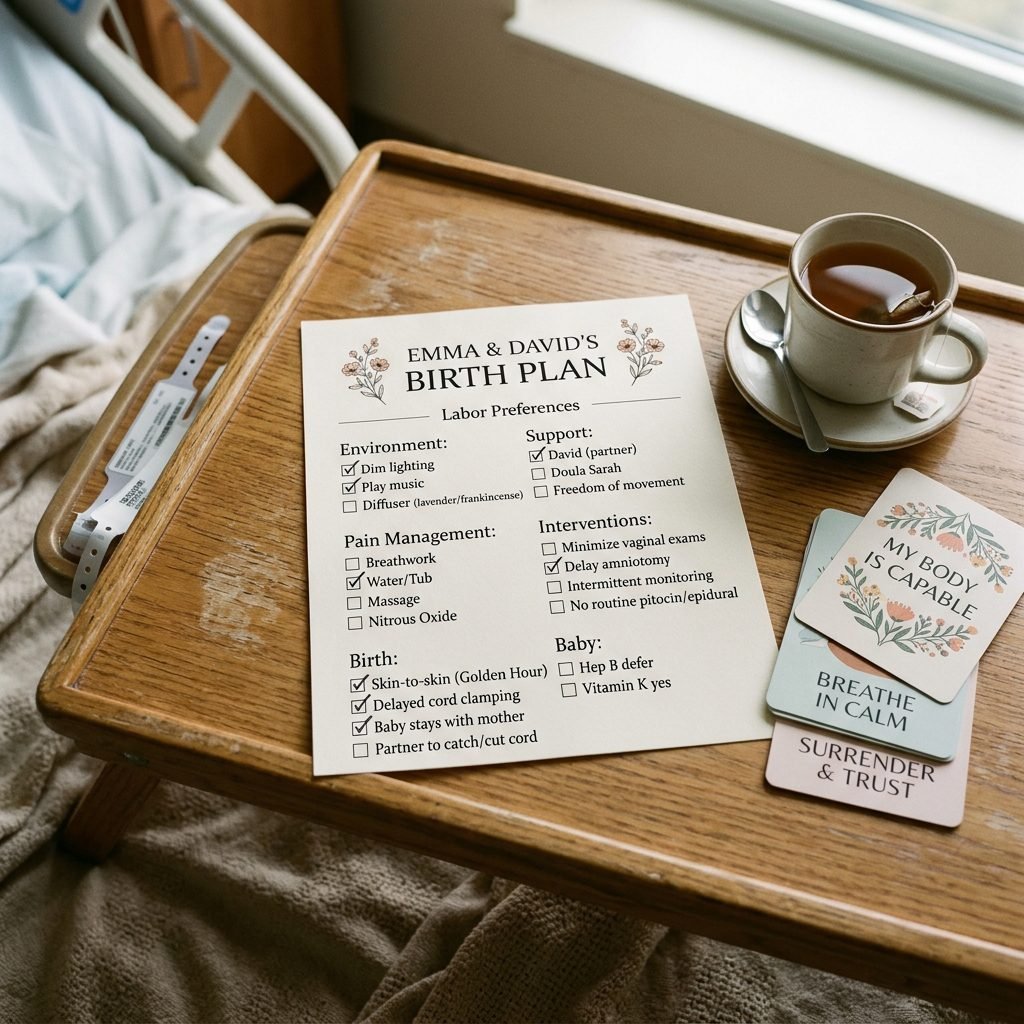
Now, let’s get down to the actual document. Your birth plan should be no longer than one page. Medical professionals are incredibly busy, and a visually appealing, bulleted, one-page document is much more likely to be read and respected than a multi-page essay. Use bold headings and keep your tone collaborative but firm.
Labor and Contraction Preferences
This section outlines how you want to be treated while you are actively laboring. Since you are aiming for an unmedicated birth, you need to clearly state your preferences regarding pain management and cervical checks.
- Pain Relief: Explicitly state: ‘Please do not offer me an epidural or pain medication. I will ask for it if I decide I need it.’ This prevents the staff from interrupting your focus during a difficult contraction to offer drugs.
- Cervical Checks: Request minimal cervical checks. Cervical checks can be discouraging if you haven’t dilated as much as you hoped, and they carry a risk of introducing bacteria. State that you will request a check if you feel a change in pressure or want to know your progress.
- Movement: State your intention to move freely, use the shower or tub, and utilize birthing balls.
- Hydration: Request permission to drink clear fluids (like coconut water or electrolyte drinks) and eat light snacks (like honey sticks or dates) for energy.
Pushing and Delivery Preferences
The pushing phase (the second stage of labor) is where you want to rely heavily on your body’s natural instincts. Directed pushing (purple pushing) where you hold your breath and count to ten is falling out of favor in physiological birth circles.
- Spontaneous Pushing: Request to wait for the ‘Ferguson Reflex’—the overwhelming, uncontrollable urge to push—rather than being told to push just because you are 10 centimeters dilated.
- Pushing Positions: State that you wish to push in whatever position feels best for you (e.g., hands and knees, side-lying, squatting) rather than strictly on your back.
- Perineal Support: Request warm compresses on your perineum during pushing to help the tissues stretch naturally and reduce the risk of tearing.
Phase-by-Phase Labor Positions & Physical Comfort Measures
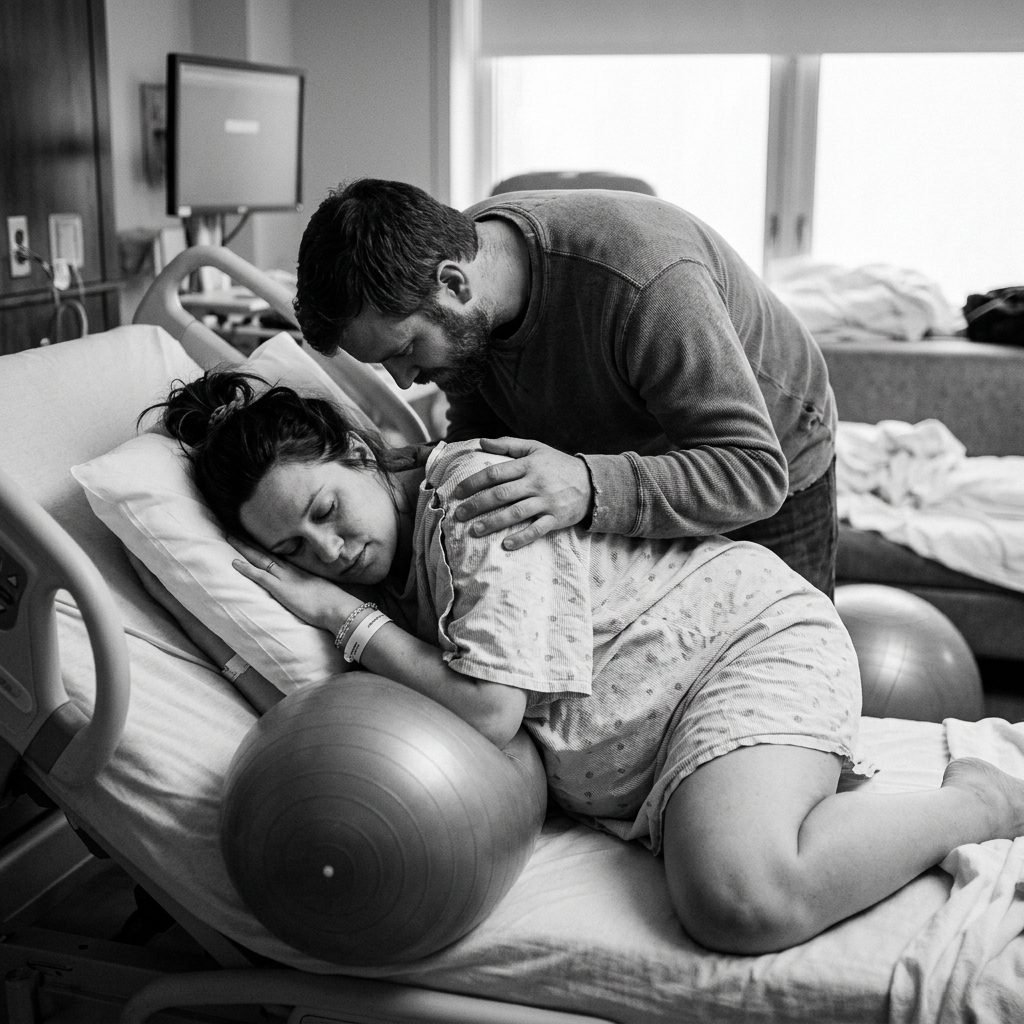
An unmedicated birth is a highly physical event. You are an athlete running a marathon, and you need a playbook of positions and comfort measures to help you cope with the intensity of contractions. Movement helps the baby navigate the pelvis, finding the optimal position for birth. Here is a step-by-step guide to the physical techniques you and your partner should practice.
The Double Hip Squeeze
This is arguably the most effective pain relief technique for back labor and intense active labor contractions. It helps open the pelvic inlet and relieves pressure on the sacrum.
- Have the birthing person lean forward over the raised head of the hospital bed, a birthing ball, or a wall.
- The partner stands directly behind the birthing person.
- The partner places the palms of their hands on the fleshy part of the birthing person’s glutes, right over the hip bones.
- As the contraction begins, the partner applies firm, inward, and upward pressure, squeezing the hips together.
- Hold this firm pressure for the entire duration of the contraction, releasing slowly as the contraction fades.
The Peanut Ball
If you need to rest, or if you are required to be in bed for monitoring, the peanut ball is your best friend. It keeps your pelvis open even while lying down.
- Lie on your left side (this promotes optimal blood flow to the baby).
- Have your partner or nurse place the peanut ball between your legs.
- Your bottom leg should be relatively straight, and your top leg should be draped over the ball, opening your hips wide.
- Adjust the size of the ball so your hip, knee, and ankle are aligned and comfortable.
| Labor Phase | Best Positions & Movements | Why It Works (The Science) |
|---|---|---|
| Early Labor (0-6cm) | Walking, swaying, slow dancing with partner, curb walking. | Gravity encourages the baby to drop deeper into the pelvis, applying pressure to the cervix to promote dilation. |
| Active Labor (6-8cm) | Sitting on a birthing ball, hands and knees (tabletop), pelvic tilts. | Opens the mid-pelvis. Hands and knees take the pressure off the spine, providing immense relief for back labor. |
| Transition (8-10cm) | Leaning over the bed, sitting in the shower, deep vocalization (moaning). | This is the most intense phase. Forward-leaning positions allow the sacrum to move freely while water provides sensory distraction. |
| Pushing (Second Stage) | Deep squatting, side-lying with leg raised, kneeling. | Squatting opens the pelvic outlet by up to 28%. Side-lying preserves energy and slows down a fast descent to protect the perineum. |
The Ultimate Unmedicated Hospital Bag Checklist
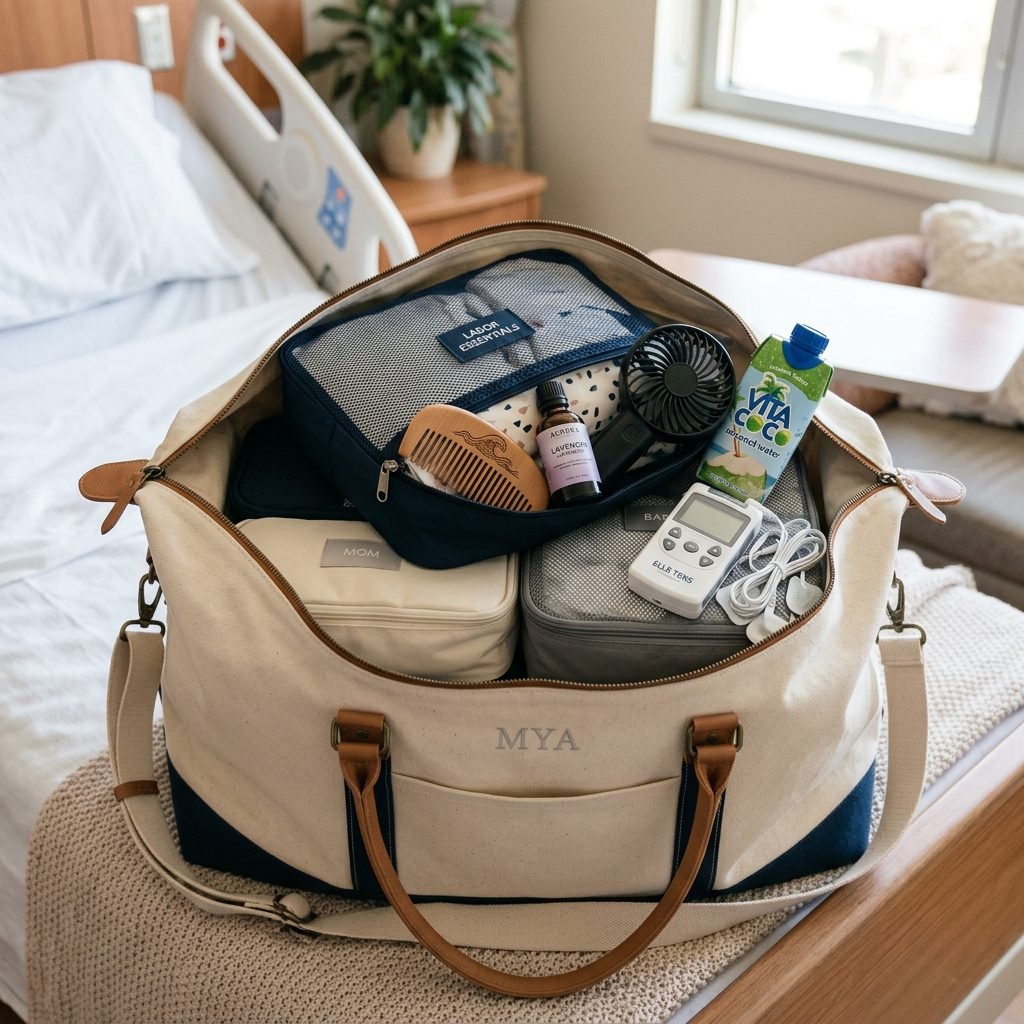
When you are planning an unmedicated birth, your hospital bag is less about cute matching robes (though those are wonderful for postpartum!) and more about packing a comprehensive sensory toolkit. You need items that address your senses of touch, smell, sight, and sound to distract your brain from the pain signals and keep you grounded in your body.
The Sensory Pain-Management Toolkit
Do not rely on the hospital to provide these items. Pack them in a specific, easily accessible tote bag and make sure your partner knows exactly where everything is.
- A Birthing Comb: This is a powerful acupressure tool. When you grip a wooden comb in the palm of your hand during a contraction, the teeth hit acupressure points that signal the brain. Thanks to the Gate Control Theory of Pain, the brain focuses on the sensation in your hand rather than the contraction in your uterus.
- TENS Machine: A Transcutaneous Electrical Nerve Stimulation machine sends tiny, safe electrical pulses through pads placed on your lower back. It feels like a buzzing massage and is incredible for early and active labor.
- Massage Oil or Lotion: Pack a warming massage oil (unscented or lightly scented with lavender) for your partner to use during lower back massages and counter-pressure.
- Portable Stroller Fan: Labor is sweaty work. A small, bendable fan that can attach to the hospital bed rails will be a lifesaver during transition when you might experience hot flashes.
- Hydration and Energy: Pack a large water bottle with a straw. Your partner should be offering you a sip between every single contraction. Bring honey sticks, liquid IV or electrolyte packets, and dates for quick, easily digestible sugar and energy.
- Heating Pad or Rice Sock: Heat is incredibly soothing for lower back pain and uterine cramping. A microwaveable rice sock or a plug-in heating pad can bring immense comfort.
Partner Scripts and Advocacy: How Your Support Team Can Help
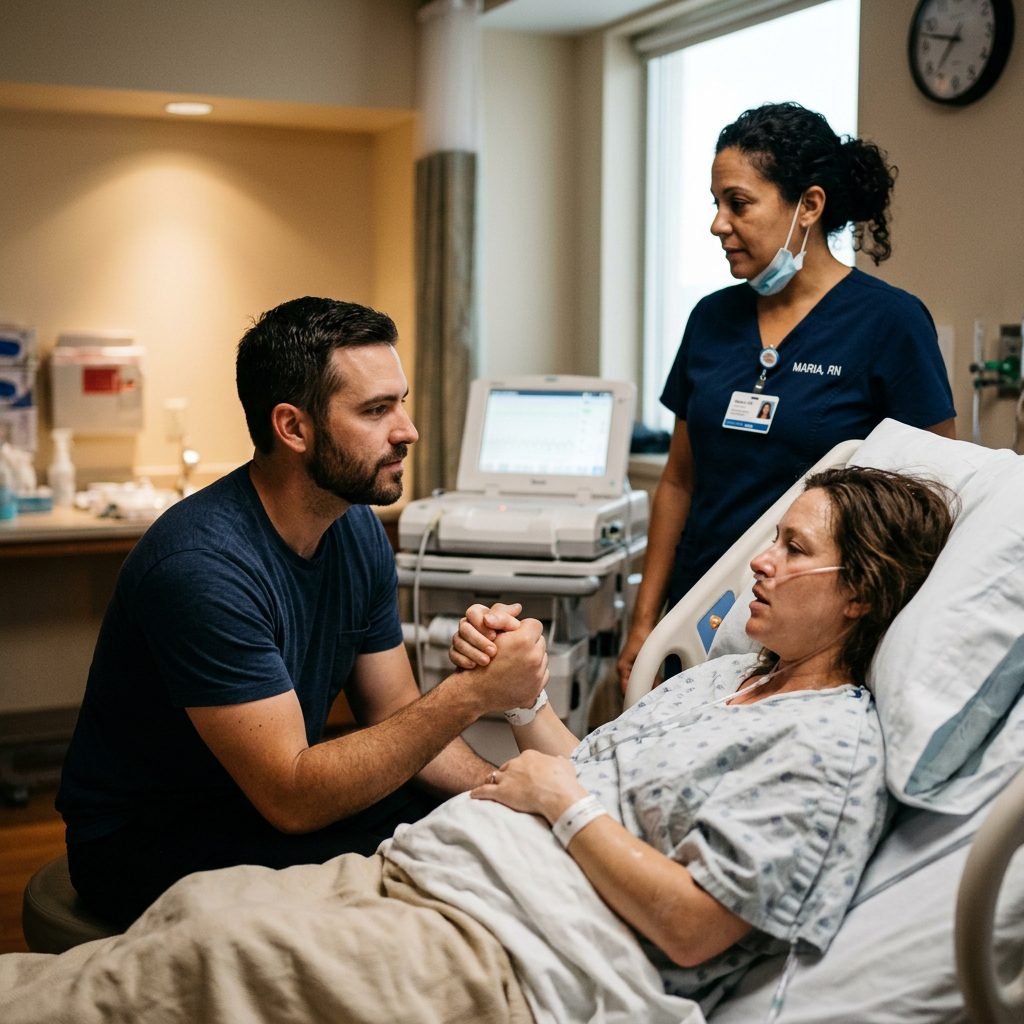
Your partner (or doula, sister, or friend) is the guardian of your birth space. When you are deep in ‘laborland’—eyes closed, breathing heavy, fully internalized—you cannot be expected to answer medical questions or advocate for your birth plan. Your support person must know your wishes inside and out and be prepared to speak up politely but firmly.
The BRAIN Acronym
If a doctor or nurse suggests an intervention (like breaking your water, administering Pitocin, or continuous monitoring), your partner should use the BRAIN acronym to gather information before making a decision:
- B – Benefits: What are the benefits of doing this procedure right now?
- R – Risks: What are the risks associated with this procedure?
- A – Alternatives: Are there any alternative options we can try first?
- I – Intuition: What is my gut feeling telling me about this?
- N – Nothing: What happens if we do nothing and wait an hour?
Advocacy Scripts for Your Partner
It can be intimidating to speak to medical professionals. Equip your partner with these exact scripts so they feel confident protecting your unmedicated birth plan:
‘She is doing beautifully coping with the contractions right now. We would like to decline the epidural offer at this time. We will let you know if her preferences change.’
‘Could we have 30 more minutes of privacy to try different positions before we discuss augmenting labor with Pitocin?’
‘She requested intermittent monitoring in her birth plan so she can stay mobile. Can we use the wireless monitors or the doppler instead of the wired ones?’
Empower your partner to be your voice. Their primary job is to keep you feeling safe, hydrated, and focused on your breath. Remind them that it is okay to ask questions and take time to make informed decisions unless it is a true medical emergency.
Conclusion
Preparing for an unmedicated hospital birth is a journey of deep self-discovery, strength, and immense love for your baby. By creating a thoughtful, concise birth plan, practicing your comfort measures, packing a sensory toolkit, and empowering your partner to advocate for your space, you are setting yourself up for an incredibly beautiful physiological birth experience. Remember that birth is unpredictable, and true empowerment comes from making informed choices every step of the way, no matter how your labor unfolds. If medical interventions become necessary, it does not mean you failed; it means you are making the best decisions for the safety of you and your little one. Trust your body, trust your baby, and know that you are surrounded by a sisterhood of mothers who have walked this path before you. You are strong, you are capable, and you are going to be an amazing mother.
Medical Disclaimer: The information provided in this article is for educational and informational purposes only and is not intended as medical advice. Always consult with your OB/GYN, midwife, or qualified healthcare provider regarding your birth plan, labor preferences, and any medical decisions. Every pregnancy and delivery is unique, and medical guidance should be tailored to your specific health needs.