

How to Use a Rebozo for Gentle Pelvic Relaxation and Active Labor Prep
Welcome to Your Sacred Birth Tool: The Rebozo
Hello, sweet Mama. As you journey through the final weeks of your pregnancy, your body is doing the most incredible work. You might be feeling the weight of your growing baby, the tightening of your ligaments, or perhaps a little anxiety about the ‘big day.’ That is where the Rebozo comes in—a traditional Mexican shawl that is so much more than a piece of fabric. It is a bridge between ancient wisdom and modern comfort, a tool of empowerment that has been used for centuries by parteras (midwives) to support mothers through the transitions of pregnancy and birth.
In my years as a doula, I have seen the Rebozo transform a tense, stalled labor into a rhythmic, productive dance. It isn’t magic, though it feels like it; it is physics and love combined. By using the Rebozo for pelvic relaxation and active labor prep, you are helping your baby find the optimal path while giving yourself the gift of relief. In this guide, we will explore how to choose your Rebozo, master the art of ‘sifting,’ and use this beautiful tool to navigate labor with grace and strength. Lean in, breathe deep, and let’s explore this together.
The Rebozo Toolkit: Choosing the Right Fabric and Length

Before we dive into the techniques, we need to talk about the ‘why’ and ‘what’ of the Rebozo itself. A true Rebozo is hand-woven, typically from 100% cotton or a cotton-silk blend. This is crucial because the fabric needs to have ‘grip’ and ‘breathability.’ A stretchy wrap or a thin pashmina won’t provide the structural support needed for deep pelvic work. You want a fabric that feels sturdy but soft against your skin.
Selecting Your Length
Rebozos come in various lengths, but for labor work, you generally want something between 2 to 2.7 meters (about 6.5 to 9 feet). This length allows your partner to hold the ends comfortably without straining their own back. When you hold a high-quality Rebozo, you are holding a piece of cultural history. Treat it with respect, and it will support you through your most transformative moments.
| Feature | Traditional Rebozo | Standard Scarf/Wrap |
|---|---|---|
| Material | Woven Cotton (Non-stretch) | Knit or Silk (Slippery/Stretchy) |
| Grip | High (Secure for lifting) | Low (Slips during use) |
| Durability | Designed for weight-bearing | Designed for fashion only |
| Breathability | High (Natural fibers) | Variable (Often synthetic) |
The Manteo Technique: Sifting Your Way to Pelvic Peace

The most iconic use of the Rebozo is the Manteo, often called ‘sifting.’ This technique is like a gentle massage for your internal ligaments. During pregnancy, the uterosacral and broad ligaments can become tight or asymmetrical, which might lead to discomfort or a baby who is ‘stuck’ in a less-than-ideal position. Sifting helps these tissues relax, creating more space for your baby to rotate and descend.
How to Perform the Manteo (Step-by-Step)
- The Position: Get into a comfortable ‘tabletop’ position on your hands and knees. Use pillows under your knees for extra cushioning.
- The Drape: Your partner drapes the Rebozo over your belly, ensuring it covers from just under the breasts to the pubic bone.
- The Grip: Your partner stands over you (straddling or to the side) and gathers the ends of the Rebozo firmly in each hand, taking up the slack until they feel the weight of your belly in the cloth.
- The Lift: Your partner gently lifts the Rebozo so it supports the full weight of the baby, taking the pressure off your lower back.
- The Sift: With a tiny, micro-movement, your partner begins to jiggle the Rebozo rhythmically. It should be a very small, fast vibration—like sifting flour.
“Breathe into the vibration, Mama. Let your belly hang heavy like a hammock and trust the support of the cloth. Your only job is to let go.”
Do this for 2 to 5 minutes at a time. It is incredibly grounding and can be done daily in the third trimester to encourage optimal fetal positioning.
Active Labor Support: Using the Rebozo for Strength and Mobility

When labor begins, the Rebozo moves from a relaxation tool to an active support system. It can be used to provide leverage during contractions, help you maintain difficult positions, or even provide a ‘counter-pressure’ that dulls the intensity of back labor. The goal during active labor is mobility; a moving pelvis is a productive pelvis.
Position vs. Labor Phase Matrix
| Labor Phase | Technique | Benefit |
|---|---|---|
| Early Labor | Standing Pelvic Sift | Calms the nervous system and eases mild cramping. |
| Active Labor | The Belly Lift & Tuck | Relieves heavy pressure on the cervix and eases back pain. |
| Transition | Head Sifting | Provides a sensory distraction and grounding focus. |
| Pushing | The Rebozo Tug-of-War | Gives the mother downward leverage and something to pull against. |
One of my favorite active labor moves is the Rebozo Squat. Your partner loops the Rebozo around a sturdy door handle or a birth bar, and you hold onto the ends. This allows you to sink into a deep, open-pelvis squat while feeling completely secure. It takes the strain off your arms and lets you focus entirely on your breath and the downward movement of your baby.
Optimal Fetal Positioning: Helping Baby Find the Perfect Path
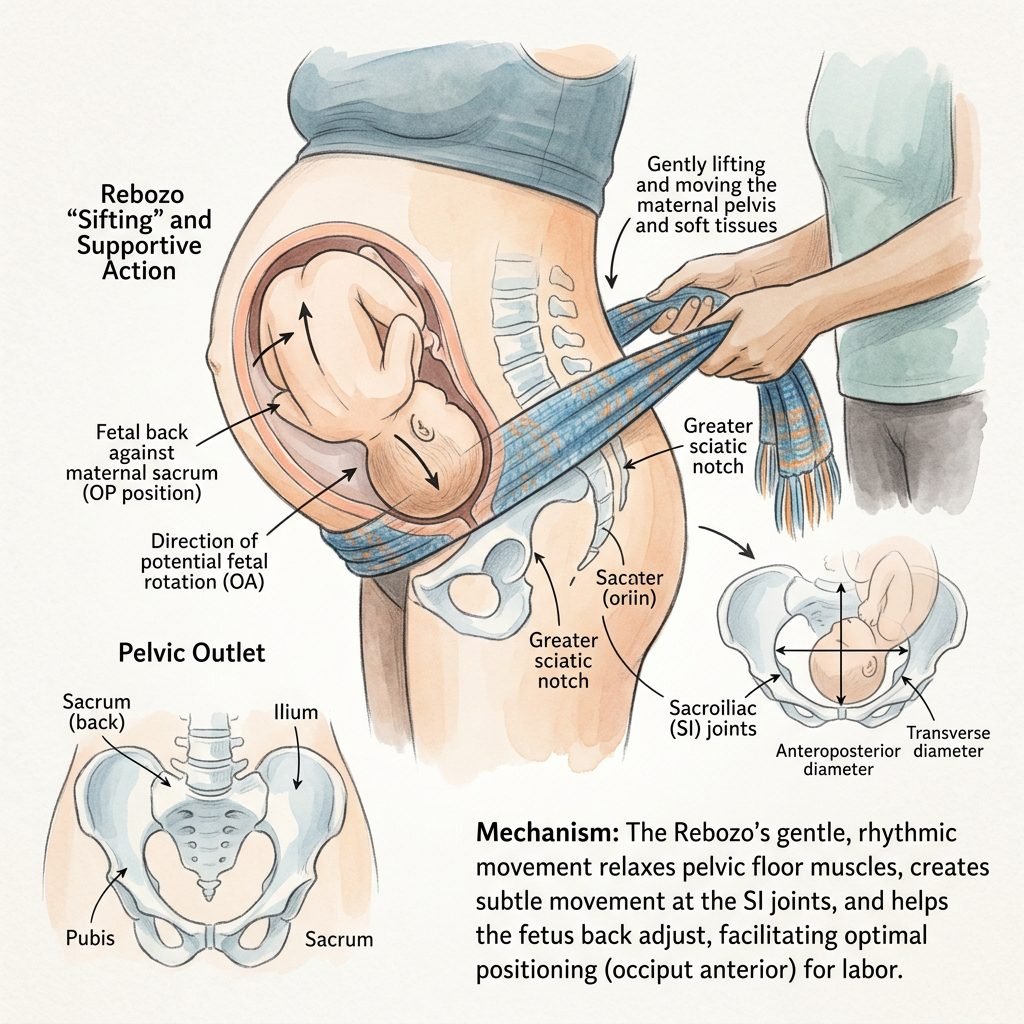
Is your baby ‘sunny-side up’ (OP position)? Or perhaps they are sitting high and haven’t quite engaged in the pelvis? The Rebozo is a master at encouraging Optimal Fetal Positioning (OFP). By relaxing the pelvic floor and the surrounding fascia, we remove the ‘roadblocks’ that might be preventing the baby from turning.
The ‘Shake the Apples’ Technique
This sounds funny, but it is incredibly effective! While you are in an Open Knee-Chest position (bottom in the air, chest on the floor), your partner uses the Rebozo to gently jiggle your gluteus muscles. This vibration travels deep into the pelvis, encouraging the baby to back out of the pelvis slightly and rotate into a better position. Strongly consider doing this if you are experiencing ‘back labor,’ as it often indicates the baby is trying to turn.
- Frequency: 3 rounds of 10 minutes, with breaks in between.
- Hydration: Drink plenty of water after these sessions to flush out any released toxins from the fascia.
- Listen: If anything feels sharp or ‘wrong,’ stop immediately. This should always feel like a relief.
Partner Connection: The Rebozo as a Bridge of Support

Labor is a team sport, and the Rebozo is the ultimate teammate for your birth partner. Often, partners feel helpless during labor, unsure of where to put their hands or how to help. The Rebozo gives them a tangible task and a physical connection to you. It acts as an extension of their arms, allowing them to support your weight without getting tired as quickly.
Communication is Key
During labor, your sensory needs will change. What felt good ten minutes ago might feel irritating now. Use these scripts to help your partner adjust:
“Faster sifting, please. I need more vibration.”
“Lighter touch. Just hold the weight of my belly without moving.”
“Pull harder during the contraction; I need the leverage.”
This physical ‘bridge’ fosters a deep sense of intimacy and trust. When your partner holds the Rebozo, they are literally holding you up, allowing you to surrender to the process of birth.
Postpartum Healing: The Ritual of Closing the Bones

The Rebozo’s journey doesn’t end when the baby arrives. In Mexican tradition, the ‘Cerrada’ or ‘Closing the Bones’ ceremony is a vital part of postpartum recovery. During pregnancy, your body physically opens—your hips widen, your ribs expand, and your spirit opens to bring a new soul into the world. The Closing ceremony is designed to ‘bring the mother back to herself.’
The Gentle Wrap
While a full ceremony involves multiple Rebozos and several practitioners, you can do a simple version at home. Have your partner wrap the Rebozo snugly around your hips (over your clothes) and apply a firm, steady squeeze. This provides stability to the pubic symphysis and the sacroiliac (SI) joints, which can feel ‘loose’ or unstable after birth due to the hormone relaxin. It is a moment of quiet, a moment of being held after you have spent months holding everyone else.
| Do’s | Don’ts |
|---|---|
| Do use 100% woven cotton. | Don’t use jerky or fast movements. |
| Do communicate clearly with your partner. | Don’t use during high-risk complications like abruption. |
| Do keep your knees soft and unlocked. | Don’t hold your breath during the move. |
| Do wash your Rebozo in cold water. | Don’t pull with excessive or painful force. |
Conclusion
Mama, you are built for this. Whether you use the Rebozo for a few minutes of relief during early labor or it becomes your primary tool for the entire birth, know that you are tapping into a legacy of maternal strength. The Rebozo is a reminder that you don’t have to do this alone. It provides the physical support your body craves and the emotional connection your spirit needs. As you pack your birth bag, tuck your Rebozo right on top. It is more than just a shawl—it is your partner in the beautiful, rhythmic dance of bringing your baby into the world. You’ve got this, and your body knows exactly what to do. Breathe, sift, and surrender to the power within you.