

How to Use Asymmetric Lunges to Help Your Baby Descend Faster in Active Labor
Hello, beautiful mama. If you are reading this, you are likely preparing for one of the most transformative days of your life: the day you meet your baby. As a doula and maternal wellness expert, I know that stepping into the unknown of labor can feel incredibly daunting. You might be wondering how you will handle the intensity, or how you can actively help your baby make their journey into the world. Take a deep, slow breath. You are in exactly the right place, and your body was brilliantly designed for this.
When we talk about labor, we often picture a woman lying in bed, waiting for her cervix to dilate to that magic number of 10 centimeters. But birth is not a passive event! It is a dynamic, physical, and deeply intuitive dance between you and your baby. Your baby is not just dropping straight down; they are navigating a complex, curved path through your pelvis. To help them find the best angle, we need to create space. This is where the magic of movement comes in, specifically a technique that doulas and labor nurses absolutely swear by: the asymmetric lunge.
An asymmetric lunge is exactly what it sounds like—a lunge where one leg is elevated or positioned differently than the other. While symmetrical positions like deep squats are wonderful for opening the pelvic outlet during the pushing phase, asymmetrical positions are your secret weapon during active labor. They shift the bones of your pelvis just enough to help a baby who might be slightly stuck, asynclitic (tilted), or simply needing a little extra room to descend through the mid-pelvis.
In this comprehensive guide, we are going to walk through exactly why asymmetric lunges work, when to use them, and step-by-step instructions for doing them safely—whether you are laboring unmedicated in your living room, or resting in a hospital bed with an epidural. Grab a cup of red raspberry leaf tea, get cozy, and let’s empower you with the tools you need for a smoother, faster descent.
The Biomechanics of Birth: Why Asymmetric Lunges Work Wonders
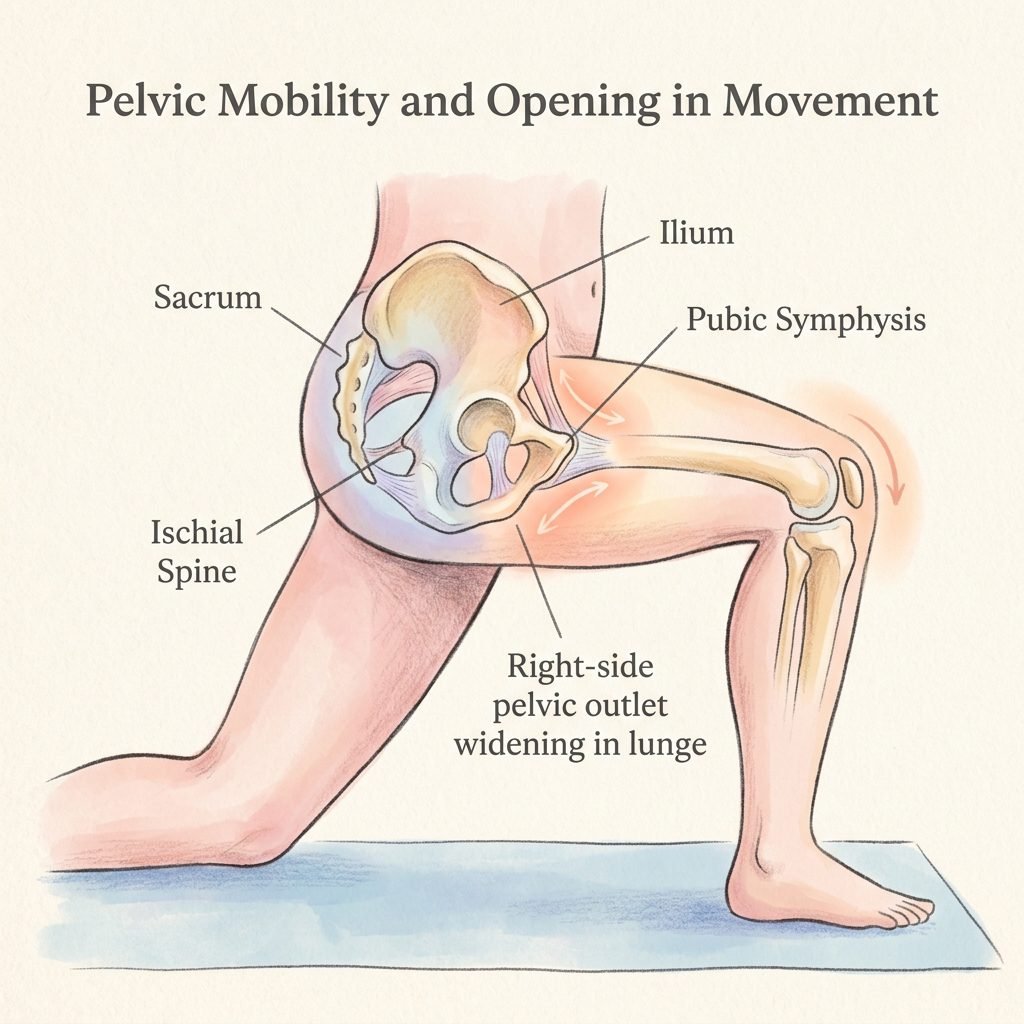
To understand why the asymmetric lunge is such a powerhouse move, we need to talk a little bit about your beautiful, miraculous pelvis. During pregnancy, your body releases a hormone called relaxin, which softens the ligaments and joints in your pelvis. This means your pelvic bones are not fixed; they are flexible and capable of shifting to accommodate your baby.
The Three Levels of the Pelvis
Your baby has to navigate three distinct levels of the pelvis to be born:
- The Pelvic Inlet: The top opening. Babies usually enter this space in early labor.
- The Mid-Pelvis: The middle section, which is the narrowest part. This is often where babies need to do complex rotations during active labor.
- The Pelvic Outlet: The bottom opening where your baby crowns and is born.
During active labor (typically when you are dilated between 6 and 8 centimeters), your baby is usually navigating the mid-pelvis. If your baby is slightly off-center, facing your front (sunny-side up), or just taking their time, an asymmetric lunge is the perfect intervention. By elevating one leg, you physically open up one side of the pelvis more than the other. This creates a temporary asymmetry that slightly shifts the pelvic bones, giving your baby the exact pocket of space they need to wiggle down and rotate.
“Think of your pelvis like a lock, and your baby’s head as the key. Sometimes, you just need to jiggle the lock slightly to get the key to turn. The asymmetric lunge is how you jiggle the lock.”
When to Use the Asymmetric Lunge During Labor

Timing is everything in labor. While you can certainly practice lunges during your third trimester to encourage your baby to engage, they become incredibly strategic once active labor begins. You will know you are in active labor when your contractions are consistently 3 to 5 minutes apart, lasting about 60 seconds, and require your complete focus.
Signs Your Baby Needs Help Descending
- You feel a lot of pressure or pain primarily on one side of your lower back or pelvis.
- Your labor has stalled, or your dilation has not changed for several hours.
- Your care provider mentions your baby is “high” (at a negative station, like -2 or -1).
- You are experiencing intense back labor, which often indicates the baby is in a posterior (sunny-side up) position.
To help you and your birth team know exactly when to pull this tool out of your doula bag, I’ve created a matrix that breaks down the best positions for each phase of labor.
| Labor Phase | Cervical Dilation | Baby’s Station | Ideal Positioning Strategy |
|---|---|---|---|
| Early Labor | 0 to 5 cm | High (-3 to -2) | Rest, hydrate, gentle walking, slow dancing with partner. Keep the pelvis balanced. |
| Active Labor | 6 to 8 cm | Mid-Pelvis (-1 to 0) | Asymmetric Lunges, curb walking, side-lying with peanut ball. Focus on opening the mid-pelvis. |
| Transition | 8 to 10 cm | Low (0 to +1) | Hands and knees, leaning forward over a birth ball. Focus on coping and breathing. |
| Pushing (2nd Stage) | 10 cm | Crowning (+2 to +3) | Deep squats, side-lying, or hands and knees. Symmetrical positions to open the outlet. |
Step-by-Step Guide: How to Perform an Asymmetric Lunge Safely

Now that we know the why and the when, let’s talk about the how. Safety and comfort are our top priorities. You should never feel sharp pain in your joints when doing this; only the intense, productive muscle work of a contraction. Here is the exact step-by-step method to perform a standing asymmetric lunge during a contraction.
The Standing Supported Lunge (The “Captain Morgan”)
- Find your prop: You will need a sturdy chair, a low stool, a stack of firm pillows, or even a hospital bed lowered to knee-height. The prop should be about 12 to 18 inches off the ground.
- Position your base: Stand facing your prop. Keep your standing leg straight but with a soft, unlocked knee. Plant your foot firmly on the ground.
- Elevate your lunging leg: Lift your other foot and place it flat on your prop. Your knee and hip should both be bent at approximately a 90-degree angle.
- Open your hip: Gently rotate your elevated knee outward, away from the midline of your body. This external rotation is what opens the mid-pelvis.
- Lean into the contraction: As a contraction builds, slowly lean your body weight into the elevated leg. Keep your chest lifted and your spine long. Do not hunch over.
- Breathe and release: Send your breath deep into your belly and intentionally relax your pelvic floor. Imagine your baby melting down into the space you are creating. Hold this lunge for the duration of the contraction (usually 60 to 90 seconds).
- Rest and switch sides: When the contraction ends, step down, shake out your legs, and rest. For the next contraction, switch legs. Always do both sides evenly to ensure the pelvis remains balanced overall!
Birth Affirmation to repeat during your lunge:
“I am opening. I am making space. My baby knows exactly what to do. I trust my body’s wisdom.”
Variations and Modifications: Epidurals, Bed Rest, and Exhaustion
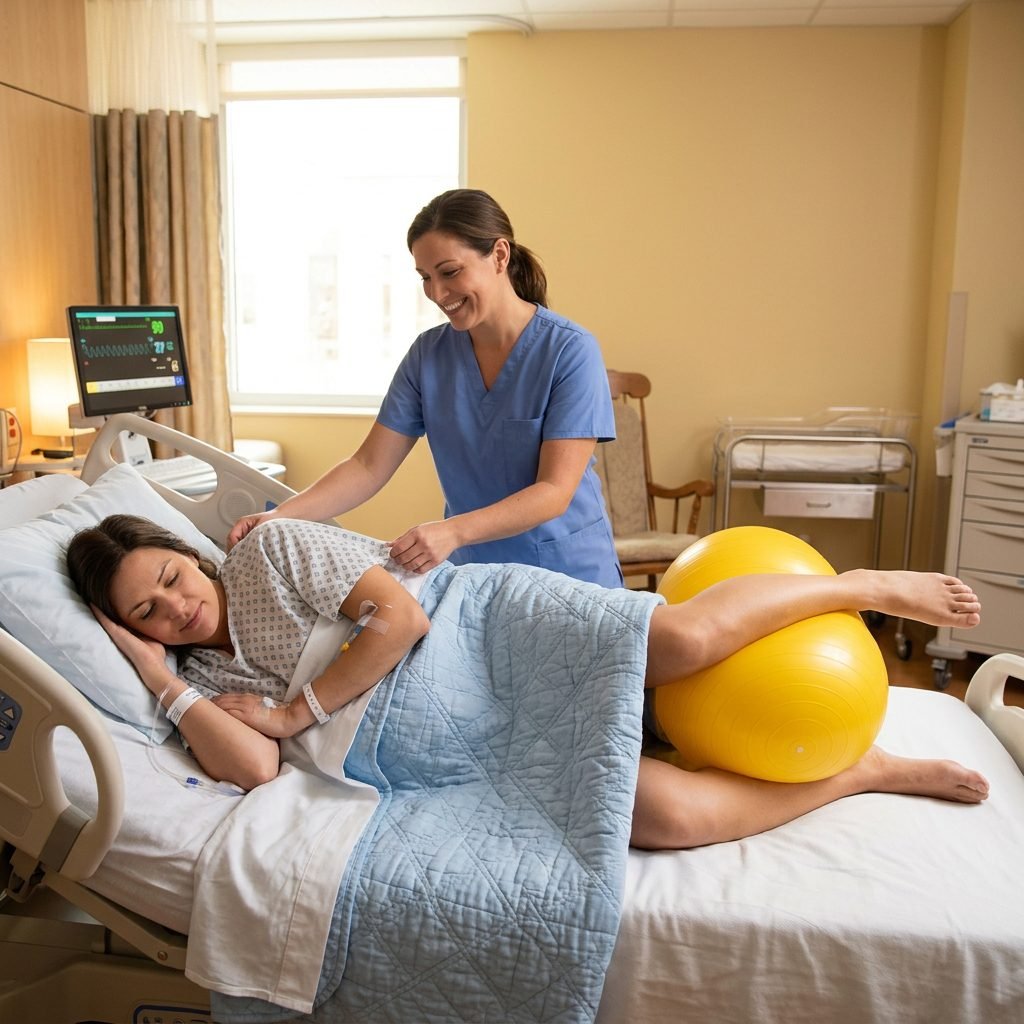
Mama, I want to be very clear about something: there is no “right” way to labor. If you are exhausted, if your water has broken and you are required to stay in bed, or if you have chosen the beautiful tool of an epidural, you can absolutely still use asymmetric lunges! We just have to bring the lunge to the bed.
The Epidural-Friendly Lunge (Side-Lying with a Peanut Ball)
If your legs are numb from an epidural, you cannot safely stand. Enter the doula’s best friend: the peanut ball. This is a large, peanut-shaped inflatable ball that fits perfectly between your legs.
- Step 1: Have your nurse or partner help you roll safely onto your side.
- Step 2: Keep your bottom leg relatively straight, extending down the bed.
- Step 3: Lift your top leg and place the peanut ball underneath it. Wrap your leg around the ball so your knee is bent and elevated high, mimicking a lunge.
- Step 4: Adjust the bed. Ask your nurse to lower the foot of the bed slightly if possible, allowing gravity to assist.
- Step 5: Switch sides every 30 to 45 minutes. This is crucial for epidural moms to ensure the baby descends evenly.
The Kneeling Lunge (For Extreme Fatigue)
If you are unmedicated but simply too tired to support your own standing weight, move to the floor. Kneel on a soft yoga mat or thick blankets. Bring one foot forward and plant it flat on the ground, keeping the other knee on the floor. Lean your upper body onto a birth ball or a pile of pillows on the bed. This gives you the exact same pelvic opening benefits while allowing your upper body to completely rest.
| Situation/Constraint | Best Lunge Variation | Prop Needed |
|---|---|---|
| Unmedicated, High Energy | Standing Supported Lunge | Chair, Stool, or Hospital Bed Edge |
| Unmedicated, Exhausted | Kneeling Lunge | Floor Mat + Birth Ball for upper body |
| Epidural / Bedbound | Side-Lying Lunge | Peanut Ball or Stack of Firm Hospital Pillows |
| Back Labor / Posterior Baby | Standing Lunge + Hip Squeezes | Stool + Partner for Counter-Pressure |
Partner and Doula Support: How Your Birth Team Can Help

To the partners, husbands, mothers, and friends reading this: you have a vital role to play here! A laboring mother is doing the hardest physical work of her life, and she needs her team. When she is performing an asymmetric lunge, she is vulnerable and expending a lot of energy. Here is exactly how you can support her through this powerful movement.
Physical Support During the Lunge
- Provide an Anchor: Stand facing her while she lunges. Let her wrap her arms around your neck or hold your hands. As she leans into the lunge during a contraction, lean back slightly to bear her weight. Be her sturdy tree.
- Double Hip Squeezes: If she is experiencing back labor, get behind her while she lunges. Place the heels of your hands on the fleshy part of her glutes (right over the SI joints) and press inward and upward with firm pressure during the contraction. This counter-pressure feels heavenly when the pelvis is opening.
- Manage the Props: It is your job to move the stool, adjust the peanut ball, or raise the hospital bed. Anticipate her needs so she doesn’t have to break her focus to ask.
Emotional and Practical Support Scripts
Sometimes it is hard to know what to say when seeing someone you love in intense labor. Memorize these scripts, or keep them on your phone. Speak them softly, confidently, and close to her ear.
What to say during the lunge:
“You are doing so beautifully. Lean into me, I’ve got you.”
“Breathe low and deep. Send that breath right down to our baby.”
“Your body is opening perfectly. This contraction is bringing our baby lower.”
“Let your shoulders drop. Relax your jaw. You are safe.”
Hydration Check: Every time she finishes a lunge and steps down to rest, immediately hand her a straw with ice water, coconut water, or an electrolyte drink. Labor is an athletic event, and she is losing fluids rapidly. Aim for her to take a sip every 10 to 15 minutes.
Conclusion
Oh, mama, you are so incredibly capable. The journey of labor is wild, unpredictable, and profoundly beautiful. By understanding your body and utilizing tools like the asymmetric lunge, you are actively participating in your baby’s birth story. Remember that every single contraction is functional; it is not just pain, it is purpose. Every surge is bringing your baby closer to your chest.
Whether you use the lunge standing by a sunny window, kneeling on the floor in the middle of the night, or resting with a peanut ball in a hospital bed, know that you are doing the hard, holy work of motherhood. Trust your instincts. If a position feels wrong, change it. If it feels intensely productive, lean into it. Surround yourself with a birth team that believes in you, keep your jaw soft and your breath low, and know that millions of women have walked this path before you, and we are all cheering you on.
You’ve got this, and you are going to be an amazing mother.