Do You Have The “Mom Pooch”? How to Check for Abdominal Separation in 60 Seconds
Hello, sweet mama. If you are reading this, perhaps you are standing in front of the mirror, gently touching your belly and wondering why things feel… different. Maybe you are months, or even years, out from giving birth, but you still feel like you have a ‘pooch’ that just won’t budge, no matter how many salads you eat or walks you take. First, I want you to take a deep, nourishing breath. That belly of yours? It was a home. It stretched, shifted, and performed the most incredible miracle of life. It is okay if it looks and feels different now.
Many women are told that the ‘mom pooch’ is just part of the package, but often, that lingering bulge is actually a common condition called Diastasis Recti Abdominis (DRA), or abdominal separation. It happens when the connective tissue between your six-pack muscles stretches thin to make room for your growing baby. Understanding your body is the first step toward healing it. Today, I am going to walk you through exactly what this separation is, how you can check for it in just 60 seconds from the comfort of your own rug, and how we can start the journey of knitting your core back together with love and patience.
Understanding the “Gap”: What is Diastasis Recti?

To understand Diastasis Recti, we have to look at the anatomy of your beautiful core. Your abdomen is made up of several layers of muscle, but the one we often focus on is the rectus abdominis—those two parallel bands of muscle that run down the front of your stomach. These bands are held together by a sturdy band of connective tissue called the linea alba.
During pregnancy, your body produces a hormone called relaxin, which does exactly what its name suggests: it relaxes your ligaments and tissues to allow your ribcage to expand and your pelvis to open. As your baby grows, the rectus abdominis muscles naturally pull apart, and the linea alba stretches and thins. This is a completely normal and necessary adaptation! However, for about 60% of women, these muscles don’t automatically spring back into place after the ‘fourth trimester.’ When the tissue remains overstretched and loses its tension, it can result in that visible ‘pooch’ or a feeling of core weakness.
Why Does It Matter?
Diastasis Recti is more than just a cosmetic concern. Your core is the powerhouse of your body. When it is compromised, you might experience:
- Lower back pain because your spine lacks support.
- Pelvic floor dysfunction, including leaking when you sneeze or jump.
- Poor posture and a feeling of ‘instability’ in your midsection.
- Digestive issues like bloating or constipation.
The 60-Second Self-Check: A Step-by-Step Guide for Mamas
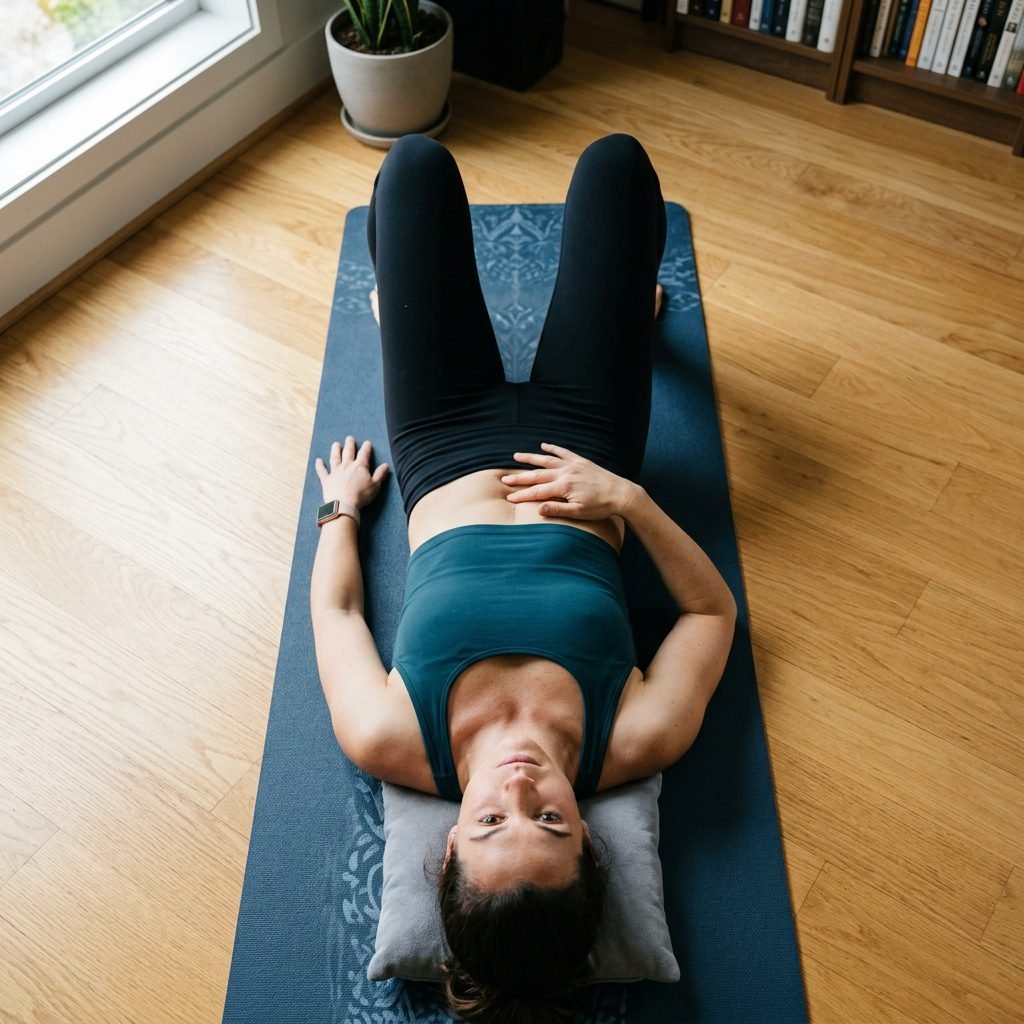
Are you ready to get to know your body a little better? This check is quick, but it requires you to be very still and mindful. I recommend doing this on a firm surface, like a yoga mat or a carpeted floor, rather than a soft bed.
“Checking your body isn’t about looking for ‘flaws’—it’s about gathering information so you can provide the care you deserve.”
- Lie down on your back with your knees bent and your feet flat on the floor, about hip-width apart.
- Place one hand behind your head for support, and the other hand on your belly, with your fingers pointing toward your toes, right over your belly button.
- Relax your abdominal muscles completely. Take a deep breath in and exhale fully.
- Slowly lift your head and neck just an inch or two off the floor, as if you were starting a very tiny crunch. Do not lift your shoulders. This action engages the rectus abdominis.
- Press your fingers gently into the midline of your belly. You are looking for two things: width (how many fingers fit in the gap) and depth (how deep your fingers sink).
- Check three spots: at the belly button, two inches above it, and two inches below it.
If you feel a gap where your fingers sink in, or if you see a ‘dome’ or ‘coning’ shape rising up along the midline, you likely have some degree of separation. Don’t panic! This is simply your starting point.
Beyond the Width: Why Tension and Depth Matter More

In the past, we used to focus almost entirely on how many ‘fingers wide’ the gap was. We thought a 2-finger gap was the magic number for diagnosis. However, modern pelvic health research tells us that tension is actually more important than the width of the gap itself.
Think of the linea alba (that connective tissue) like a trampoline. If the trampoline mat is firm and bouncy, it can support weight, even if there’s a small space between the frame. But if the mat is thin, mushy, and saggy, it doesn’t matter how close the frame is—it can’t support you. When you do your self-check, pay attention to the ‘floor’ of the gap. Does it feel firm like the tip of your nose, or soft and squishy like your cheek? Healing involves re-tensioning that tissue so it can once again transfer load across your core.
The “Coning” Sign
One of the most important things to watch for during daily life—whether you’re sitting up in bed or lifting your car seat—is coning or doming. This looks like a little ridge or ‘bread loaf’ popping up down the center of your stomach. This is a sign that your internal abdominal pressure is pushing against the weak connective tissue rather than being managed by your muscles. When you see this, it’s your body’s way of saying, ‘Hey, I need a little help with this movement!’
Your Healing Roadmap: Safe Movements and What to Pause
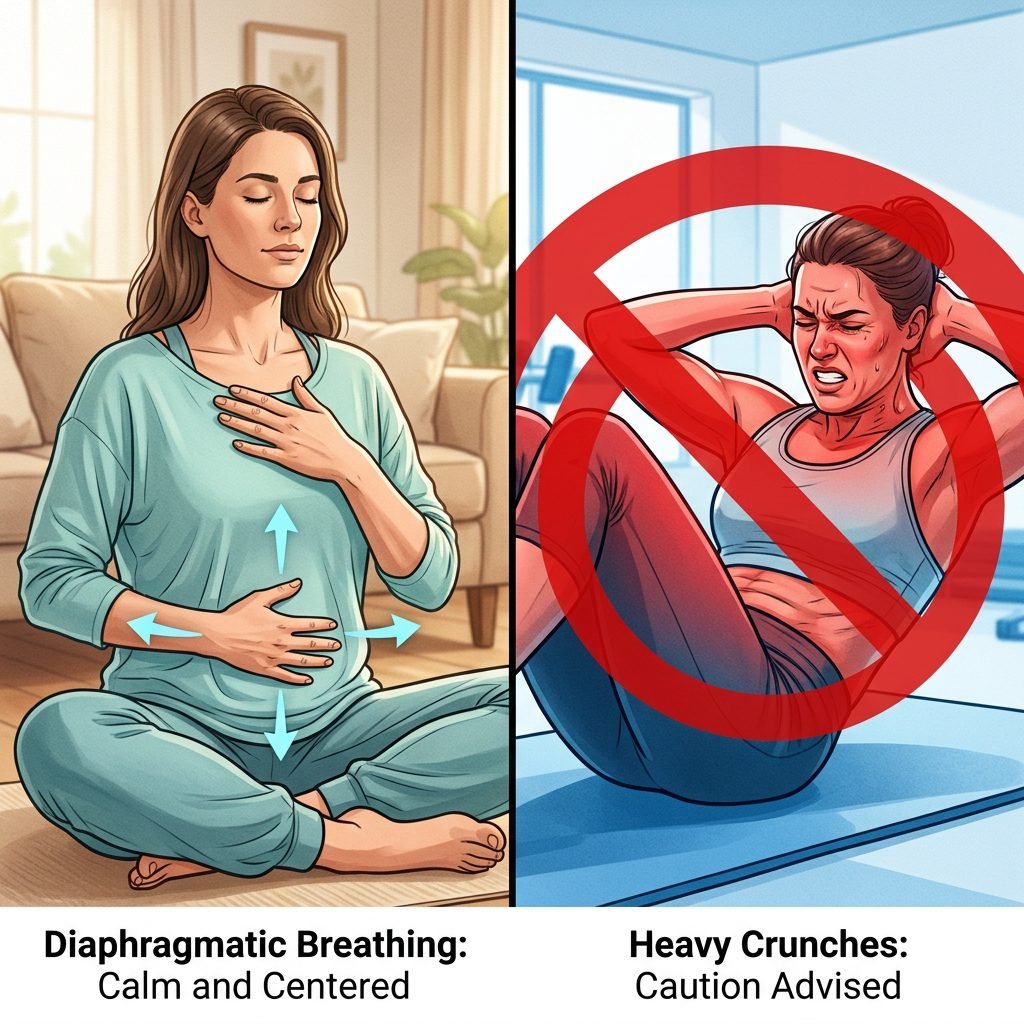
Healing a ‘mom pooch’ isn’t about doing 100 crunches a day. In fact, traditional crunches can often make the separation worse by putting too much outward pressure on the linea alba. We want to focus on ‘closing the gap’ from the inside out by engaging the transverse abdominis (TVA)—your body’s natural internal corset—and the pelvic floor.
| Movement Category | What to Embrace (Safe) | What to Pause (Avoid for Now) |
|---|---|---|
| Core Exercises | Pelvic tilts, Heel slides, Diaphragmatic breathing | Crunches, Sit-ups, Full Planks, V-sits |
| Daily Activity | Rolling to your side to get out of bed | Jack-knifing straight up from a lying position |
| Lifting | Exhaling on the lift, engaging the TVA | Holding your breath while lifting heavy strollers |
| Fitness Classes | Postnatal-specific Pilates or Yoga | High-impact HIIT, heavy twisting, or Bootcamps |
The goal is to rebuild the foundation. Start with 360-degree breathing. As you inhale, feel your ribs expand like an umbrella. As you exhale, imagine gently zipping up a pair of high-waisted jeans, pulling your belly button toward your spine and lifting your pelvic floor. This subtle engagement is the ‘gold’ of postpartum recovery.
You Are Not Alone: Embracing Your Postpartum Power

Sister, I want to take a moment to look you in the eyes—metaphorically—and tell you something vital: You are not broken. We live in a culture that expects women to ‘snap back’ as if we didn’t just spend nine months rearranging our internal organs to grow a soul. The ‘mom pooch’ is not a failure of willpower or a lack of gym time. It is a physical manifestation of the space you made for your child.
It is very normal to feel frustrated or even a little disconnected from your body during this phase. You might feel like your midsection belongs to someone else. But healing is not just physical; it is emotional. When you do your self-check or practice your breathing, try to do it with gratitude. Your body did something impossible. It deserves your patience, not your punishment.
“Your body is a map of your journey into motherhood. Every stretch, every mark, and every soft curve tells the story of your strength. Treat it with the same tenderness you show your baby.”
Thousands of mothers are feeling exactly what you feel right now. Whether you are 6 weeks postpartum or 6 years, your body still has the capacity to heal and grow stronger. You are part of a massive, beautiful sisterhood of women learning to inhabit their ‘new’ bodies with pride.
Finding Your Village: When to Seek Professional Support
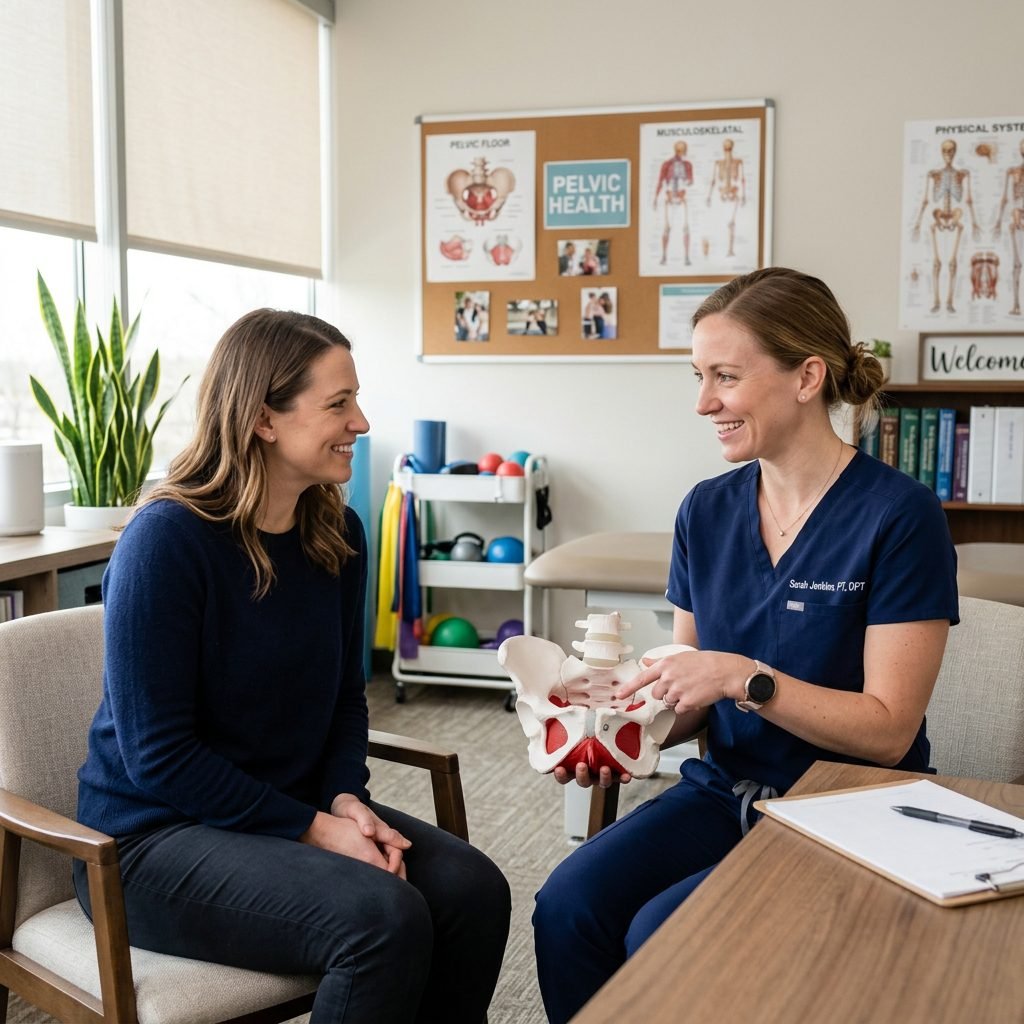
While self-checks and gentle home exercises are a wonderful start, sometimes we need a guide to help us navigate the complexities of postpartum healing. If you find that your gap isn’t improving, or if you are experiencing symptoms like urinary incontinence, pelvic pain, or a feeling of heaviness ‘down there,’ it is time to call in the experts.
The Magic of Pelvic Floor Physical Therapy
I cannot recommend Pelvic Floor Physical Therapy (PFPT) enough. These specialists are the ‘secret weapon’ of postpartum recovery. They can perform a much more detailed assessment of your muscle function, internal pressure management, and tissue health. They can provide manual therapy and a customized exercise plan that is specific to your body’s needs.
Don’t be afraid to advocate for yourself at your 6-week checkup. If your provider says ‘everything looks normal’ but you don’t feel normal, ask for a referral. You deserve to feel strong, functional, and confident in your skin. Healing is a marathon, not a sprint, and having a professional coach in your corner can make all the difference.
Conclusion
Knowing if you have abdominal separation is the first step in reclaiming your core strength and confidence. Remember, mama, that 60-second check is just a data point—it doesn’t define your beauty or your worth. Whether you have a one-finger gap or a four-finger gap, the path forward is the same: gentle movement, consistent breathwork, and radical self-compassion. You have the power to heal, to strengthen, and to feel like yourself again. Take it one breath at a time, and know that I am cheering you on every step of the way. You’ve got this!