

The Ultimate Guide to Newborn Wake Windows: How to Prevent an Overtired Baby
Welcome to the Sweet Science of Sleep, Mama
Hello, lovely. If you are reading this through bleary eyes, perhaps with a sleeping (or crying) newborn nestled against your chest, please take a deep, grounding breath. You are doing an incredible job. As a doula and sleep consultant, I have sat in those dimly lit rooms with countless mothers, navigating the beautiful, exhausting puzzle of infant sleep. One of the most transformative tools we have in our ‘mothering toolkit’ is the concept of wake windows.
Understanding wake windows is like learning your baby’s secret language. It’s the bridge between a fussy, overstimulated afternoon and a peaceful, restorative nap. In this guide, we aren’t looking for rigid perfection—we are looking for rhythm. We are going to dive deep into the biological needs of your newborn, how to spot their subtle ‘I’m tired’ whispers before they become ‘I’m overtired’ screams, and how to structure your day so both you and your little one can find some much-needed rest.
Remember, Mama: Your baby isn’t giving you a hard time; they are having a hard time. You are their safe harbor in this brand-new world.
The Biology of Sleep: What Exactly is a Wake Window?

A wake window is simply the amount of time your baby is awake between one nap and the next. It includes everything: feeding, diaper changes, tummy time, and even that sweet gazing into each other’s eyes. For a newborn, these windows are remarkably short—often much shorter than new parents expect.
The science behind this involves sleep pressure (adenosine). From the moment your baby wakes up, adenosine begins to build in their brain. For adults, this takes 16 hours. For a newborn, their tiny system can only handle about 45 to 90 minutes of stimulation before their brain becomes overwhelmed. If we miss the window to put them down, their body triggers a stress response, releasing cortisol and adrenaline. This is the ‘second wind’ that makes them appear hyper-alert but actually makes it significantly harder for them to fall—and stay—asleep.
Why Newborns Are Different
- Underdeveloped Circadian Rhythm: Newborns don’t produce their own melatonin until around 8 to 12 weeks.
- Tiny Tummies: They need to wake frequently to eat, which naturally limits their sleep duration.
- Rapid Brain Development: Their brains are processing a world of new sensory input, which is incredibly tiring.
The Wake Window Cheat Sheet: Age-by-Age Breakdown

Every baby is unique, but biological milestones give us a very reliable roadmap. Use the table below as your ‘north star’ rather than a set of ‘rules.’ If your baby seems tired at 50 minutes but the chart says 60, always trust the baby over the chart!
| Age of Baby | Recommended Wake Window | Average Number of Naps |
|---|---|---|
| 0-4 Weeks | 35-60 Minutes | 5-8 (Very erratic) |
| 4-8 Weeks | 60-70 Minutes | 4-6 Naps |
| 8-12 Weeks | 60-90 Minutes | 3-5 Naps |
| 3-4 Months | 75-120 Minutes | 3-4 Naps |
Notice how quickly these windows change? In those first 3 months, you are constantly recalibrating. This is why staying observant is your greatest superpower. As your baby nears the 12-week mark, you’ll notice they can handle a bit more ‘play’ time before the fatigue sets in.
Deciphering the Code: Early vs. Late Tired Cues

Waiting for your baby to cry before putting them down is like waiting for a car to run out of gas before looking for a station. Crying is a late tired cue. Our goal is to catch the ‘early’ whispers. When you see these, it’s time to start your soothing routine immediately.
The ‘I’m Getting Tired’ Whispers (Early Cues)
- The Long Stare: Baby loses interest in toys or your face and stares fixedly into space (the ‘thousand-yard stare’).
- Red Eyebrows: The skin around the eyebrows and eyelids may turn a slight pink or red.
- Turning Away: They physically turn their head away from stimulation or light.
- Jerky Movements: Their limbs might become a bit more frantic or uncoordinated.
The ‘I’m Overtired’ Emergency (Late Cues)
- Pulling Ears: A classic sign of frustration and fatigue.
- Arching Back: This is often mistaken for gas, but it frequently signifies a cortisol spike.
- Frantic Crying: Hard to soothe, high-pitched, and inconsolable.
- Rooting: Sometimes babies root for comfort when tired, even if they aren’t hungry.
Pro-Tip: If you see a late cue, don’t panic! Skip the long bath or the 10-minute book. Go straight to the ’emergency’ soothe: a dark room, white noise, and a snug swaddle.
The ‘Emergency Protocol’ for an Overtired Baby

We’ve all been there. You were at a family gathering, or the grocery store line was too long, and now your baby is ‘over the edge.’ Their brain is flooded with cortisol, making them act like they’ve had a double espresso. Here is how to bring them back to center:
- Lower the Sensory Input: Immediately take them to a pitch-black room. Even a little light can keep that adrenaline pumping.
- The 5 S’s: Utilize Dr. Harvey Karp’s methods: Swaddle (snug!), Side/Stomach position (while holding), Shush (loud white noise), Swing (gentle rhythmic motion), and Suck (pacifier or clean finger).
- Skin-to-Skin: If they are truly inconsolable, strip them down to a diaper and lay them on your bare chest. Your heartbeat and oxytocin will help regulate their nervous system.
- The ‘Reset’ Feeding: Sometimes a short ‘comfort’ nurse or bottle can lower their heart rate enough to drift off, even if they just ate an hour ago.
“Mama, if the crying feels like too much, it is okay to put the baby in a safe space like their crib, walk out of the room, and breathe for five minutes. A regulated mother is the best tool for a dysregulated baby.”
Sample Rhythm: A Day in the Life (8 Weeks Old)

While newborns don’t thrive on a rigid clock-based schedule, they do thrive on a predictable sequence. Most experts recommend the ‘Eat, Wake, Sleep’ cycle. This ensures baby gets a full feeding upon waking, has time to digest during ‘wake’ time, and doesn’t necessarily rely on a bottle or breast to fall asleep (though comfort nursing is always okay in the early days!).
| Time | Activity | Notes |
|---|---|---|
| 7:00 AM | Wake & Feed | Open the curtains, let in natural light to set the clock. |
| 7:45 AM | Quiet Play | Tummy time or high-contrast cards. |
| 8:00 AM | Nap 1 | Watch for red eyebrows! Aim for 60-min wake window. |
| 9:30 AM | Wake & Feed | Full feeding, diaper change. |
| 10:30 AM | Nap 2 | Perhaps a stroller nap or babywearing. |
| 12:00 PM | Wake & Feed | Interaction time. |
| 1:15 PM | Nap 3 | The ‘long’ afternoon nap. |
Important Note: This is a dream scenario. In reality, some naps will be 20 minutes and others will be 2 hours. That is normal! If a nap is short, the next wake window will likely be shorter too.
Nursery Hacks for Better Sleep Windows
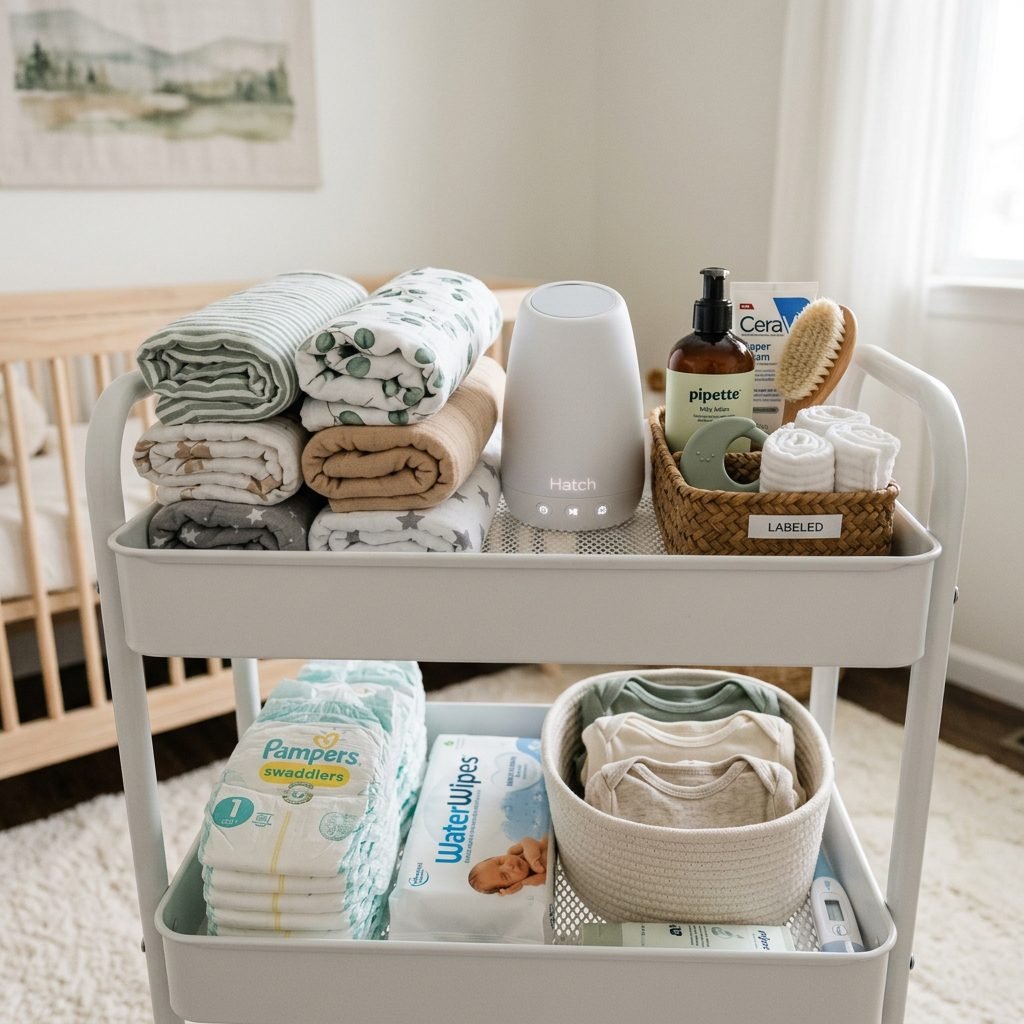
Your environment is your silent partner in managing wake windows. If the nursery is too bright or too loud, baby won’t be able to drop into sleep when that window closes. Here are my top doula-approved nursery organization tips:
- Blackout Everything: Use blackout curtains or even travel suction cups for windows. If you can see your hand in front of your face, it’s too bright.
- The White Noise ‘Wall’: Place the sound machine between the baby and the loudest door/window. It should be about the volume of a running shower (around 50-60 decibels).
- The ‘Sleep Station’ Organization: Keep your swaddles, pacifiers, and burp cloths in an easy-to-reach IKEA Raskog cart or acrylic bin. When the tired cues hit, you don’t want to be hunting for a clean swaddle.
- Temperature Control: Aim for 68-72°F (20-22°C). A slightly cool baby sleeps better than a slightly warm one.
Conclusion
You’ve Got This, Mama
Mastering newborn wake windows is a journey, not a destination. Some days, you will nail every window and feel like a sleep goddess. Other days, the ‘witching hour’ will win, and that’s okay too. The goal isn’t to be a slave to the clock, but to use these windows as a guide to help your baby feel their best.
As you get to know your little one, you’ll start to see the patterns. You’ll recognize that specific ‘yawn’ or that certain ‘gaze’ that means it’s time for bed. Trust your instincts, lean into the rhythm, and remember that this season—though intense—is fleeting. You are doing the beautiful work of helping a new human learn how to rest. Sleep well, sweet Mama.