

5 Safe Ab Workouts To Keep Your Core Strong (And Prevent Diastasis Recti)
Welcome to Your Strongest Self, Mama
Hello, sweet friend. If you are reading this, you are likely navigating the incredible, body-altering journey of pregnancy or the tender early days of postpartum. As a doula, I have sat beside hundreds of women as they marvel at their growing bellies, but I have also seen the worry in their eyes when they ask, ‘Will my stomach ever be the same?’ or ‘How do I stay strong without hurting my baby or myself?’ I want you to take a deep breath and let that tension go. Your body is doing something miraculous, and your core is the literal center of that miracle. Strengthening your abdominals during this time isn’t about vanity or ‘snapping back’—it is about functional health, reducing back pain, and preparing your body for the marathon of labor and the heavy lifting of motherhood. We are focusing on the transverse abdominis (TVA), your body’s natural ‘inner corset,’ to ensure you stay stable and minimize the risk of Diastasis Recti (DR), which is the separation of the abdominal muscles. Let’s walk through this together, safely and with so much love.
Understanding the ‘Inner Corset’: Why Your Core Matters Now
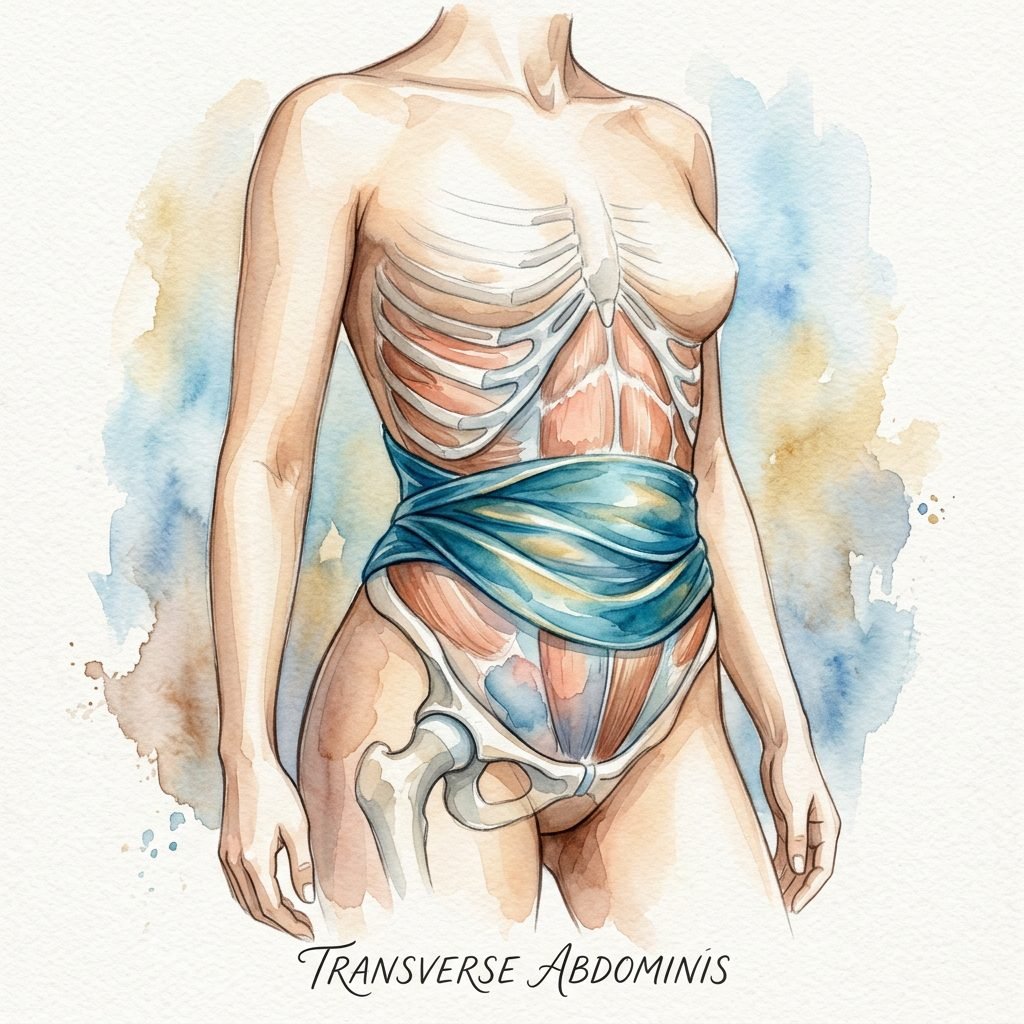
When we talk about ‘abs’ in the fitness world, people often think of the ‘six-pack’ muscles, the rectus abdominis. But during pregnancy, those muscles naturally lengthen and move aside to make room for your growing little one. The real hero of your pregnancy and postpartum journey is the transverse abdominis (TVA). This muscle wraps around your midsection like a wide supportive belt. When the TVA is strong and functional, it provides the necessary tension to keep the rectus abdominis from separating too far—a condition known as Diastasis Recti. Diastasis Recti occurs in roughly 60% of pregnancies, and while some separation is normal and necessary, we want to prevent the kind of deep gap that leads to pelvic floor dysfunction or chronic lower back pain. Traditional exercises like crunches or full sit-ups actually create ‘intra-abdominal pressure’ that pushes outward against your abdominal wall, which can worsen the gap. Instead, we focus on ‘drawing in’ and stabilizing. Think of your core not as a wall to be hardened, but as a flexible, supportive hug for your baby.
The Foundation: Diaphragmatic Breathing and TVA Engagement

Before we move a single limb, we have to master the breath. This is the most important ‘workout’ you will ever do. In the doula world, we call this ‘Connection Breathing.’ It bridges the gap between your breath, your deep core, and your pelvic floor. To do this, sit tall on a birth ball or a firm chair. Place your hands on your ribs. As you inhale through your nose, feel your ribs expand 360 degrees—not just in the front, but into your back and sides. As you exhale through your mouth (like you’re blowing through a straw), imagine gently lifting your pelvic floor and pulling your belly button toward your spine. You aren’t sucking in; you are ‘hugging’ your baby with your muscles.
Your breath is the remote control for your core. Before every movement, exhale to engage.
Practice this for 5 to 10 minutes daily. It sets the neurological pathway for your muscles to protect you during more strenuous activities, like lifting a toddler or a heavy grocery bag.
The Big 5: Safe and Effective Ab Workouts for Every Stage
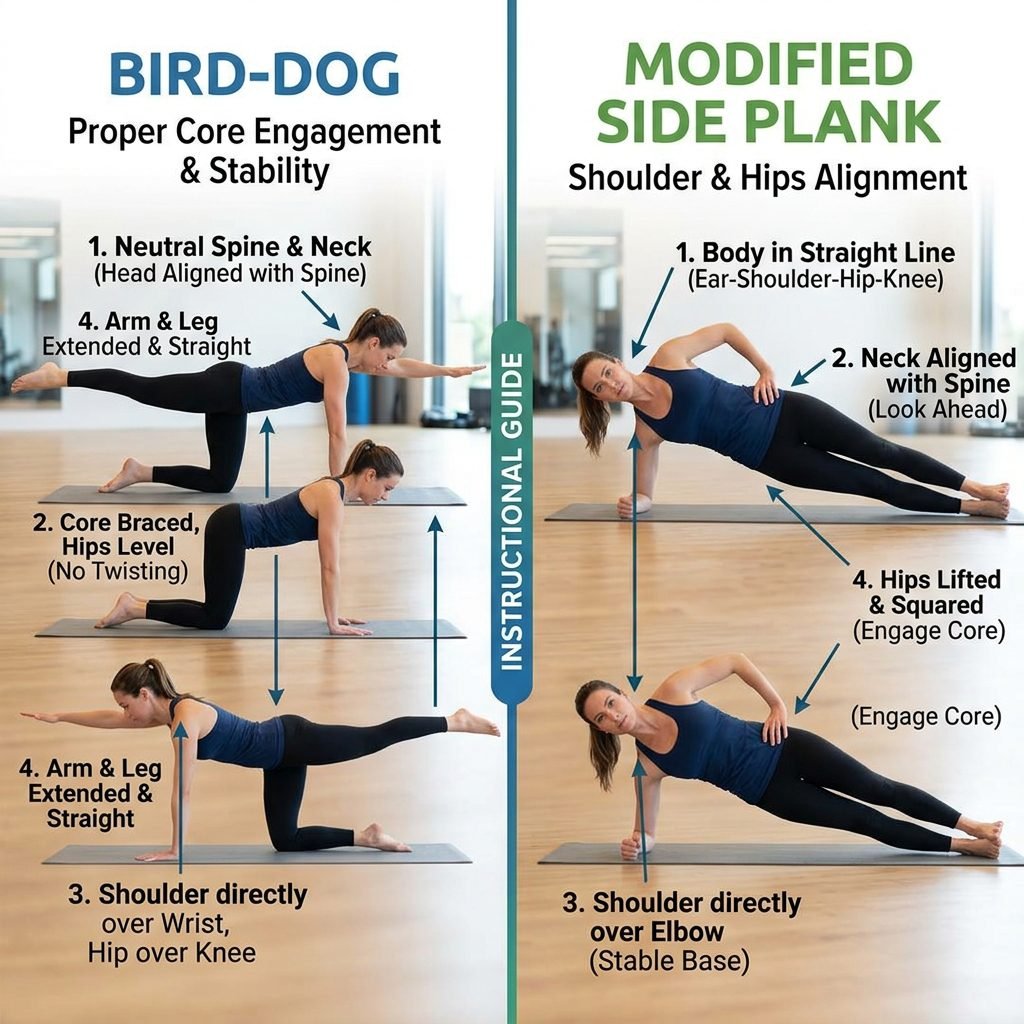
These five exercises are designed to be low-impact but high-reward. They focus on stability and control rather than ‘the burn.’ You can perform these 3 to 4 times a week, provided you have been cleared by your healthcare provider.
- The Bird-Dog: Start on your hands and knees in a tabletop position. Ensure your wrists are under your shoulders and knees under your hips. As you exhale and engage your TVA, slowly extend your right arm forward and your left leg back. Keep your hips level—imagine there is a cup of tea resting on your lower back that you cannot spill. Hold for 3 seconds, then switch. This builds incredible spinal stability.
- Modified Side Plank: Lie on your side with your knees bent at a 90-degree angle. Prop yourself up on your elbow. Lift your hips off the floor so your body forms a straight line from head to knees. This targets the obliques without the intense pressure of a full plank. Hold for 20 to 30 seconds per side.
- Heel Slides: Lie on your back with knees bent and feet flat (if you are in your third trimester, prop yourself up on pillows to avoid lying flat). Exhale, engage your core, and slowly slide one heel away from you until the leg is straight, then pull it back. The key is to keep your lower back glued to the floor; if it arches, you’ve gone too far.
- Standing Core Rotations: Stand with feet hip-width apart, holding a light weight or even a water bottle with both hands. Extend your arms in front of you. Slowly rotate your torso to the right, then back to center, then left. Use your core to initiate the move, not your arms. This mimics the functional movements of motherhood.
- Cat-Cow with TVA Lift: In tabletop, inhale as you drop your belly and look up (Cow). As you exhale, round your back (Cat) and focus intensely on pulling your baby ‘up and in’ toward your spine. This provides a beautiful stretch for the back while waking up the deep core.
Protecting Your Abdominal Wall: What’s Safe vs. What’s Risky
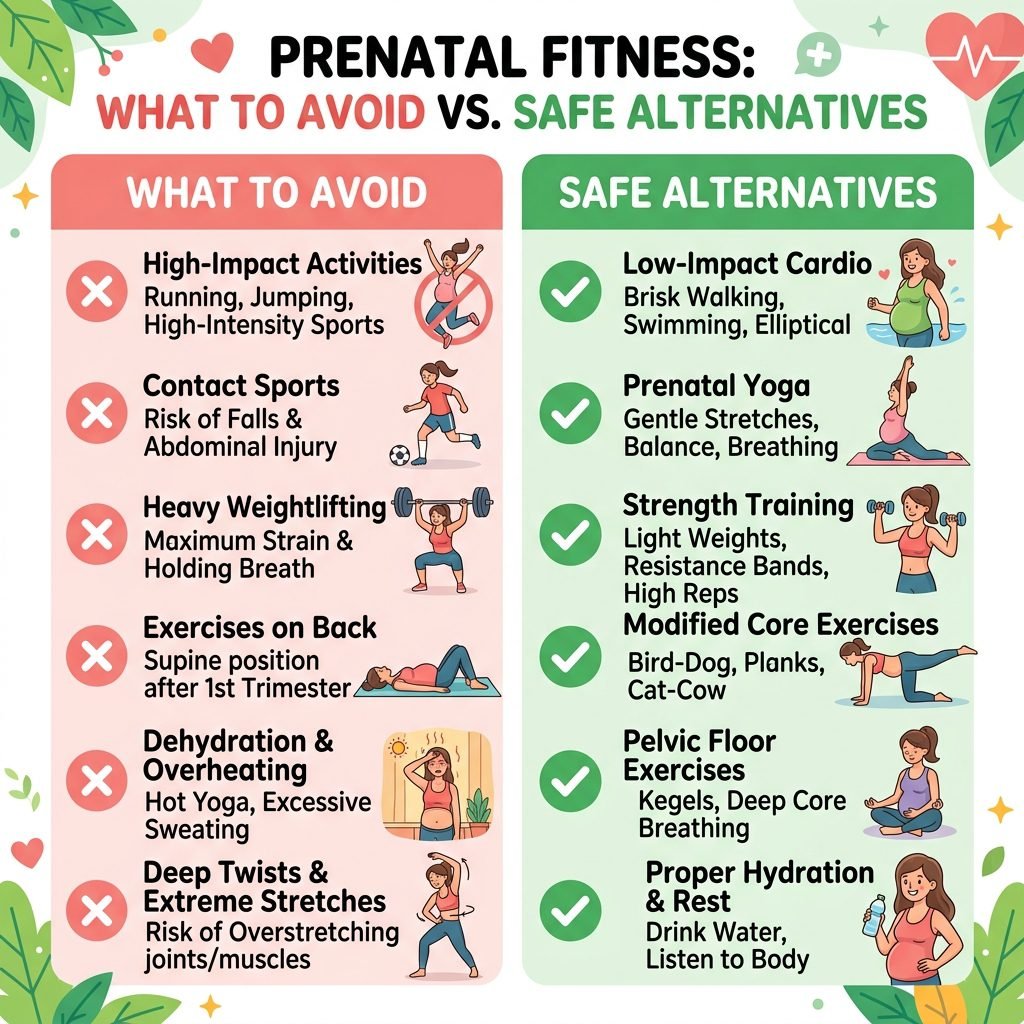
Knowing what not to do is just as vital as the exercises themselves. During pregnancy and the ‘fourth trimester,’ your body produces a hormone called relaxin, which softens your ligaments. This makes it easier for your joints to become misaligned and for your abdominal midline (the linea alba) to overstretch. We want to avoid any movement that causes ‘coning’ or ‘doming’—that’s when your belly pooches out into a bread-loaf shape during exercise. If you see coning, stop immediately; it means the pressure is too much for your current core strength.
| Movement Type | What to Avoid | Safe Alternative |
|---|---|---|
| Forward Flexion | Crunches & Sit-ups | Pelvic Tilts & Cat-Cow |
| Planking | Full Front Planks | Modified Side Planks or Wall Planks |
| Leg Lifts | Double Leg Raises | Single Heel Slides |
| Twisting | Deep, Rapid Russian Twists | Slow, Controlled Standing Rotations |
| Pressure | Holding Breath (Valsalva) | Exhale on the Effort |
Always remember, Mama: quality over quantity. Ten slow, perfectly engaged repetitions are worth more than fifty rushed ones that strain your tissues.
Beyond the Mat: Daily Habits to Prevent Diastasis Recti
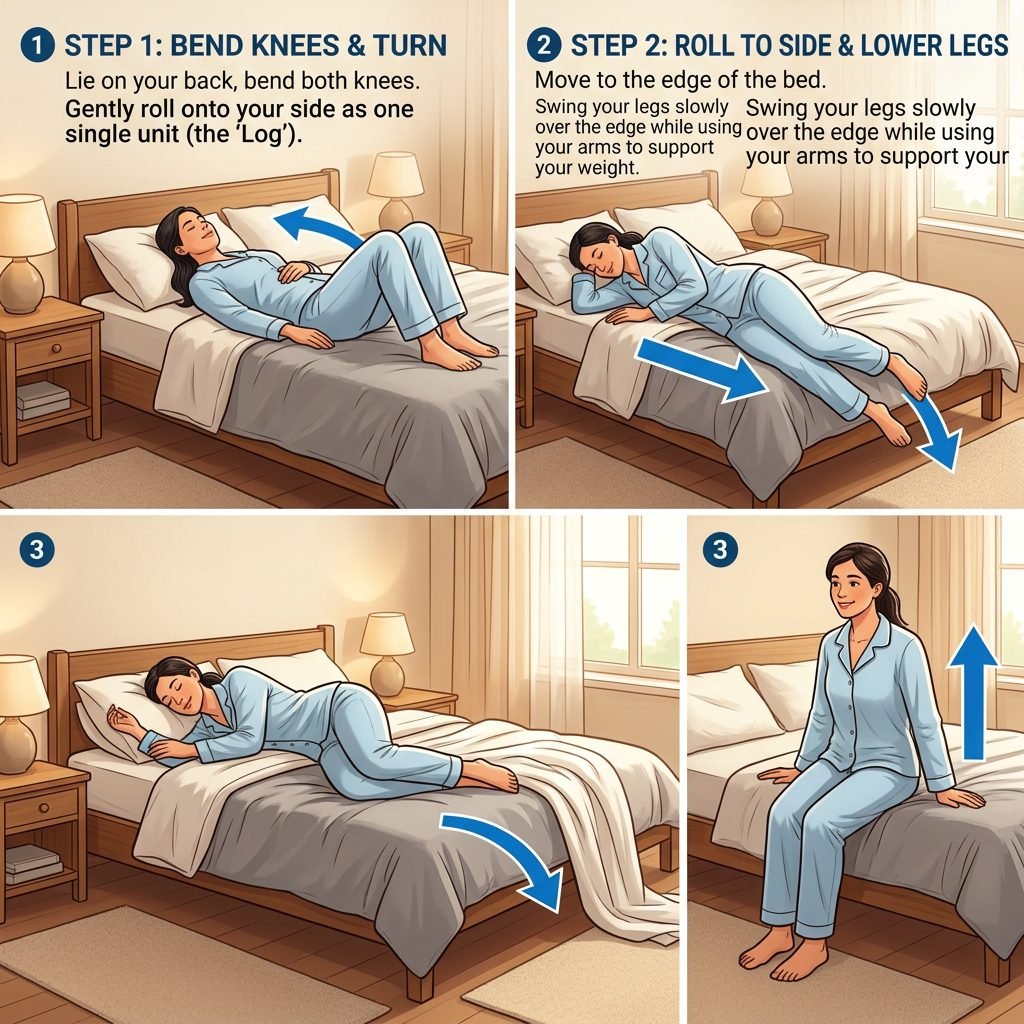
Fitness doesn’t just happen during your ‘workout’ time; it happens in the hundreds of movements you make throughout the day. To truly protect your core and prevent Diastasis Recti, you need to bring that doula-expert awareness into your daily routine. One of the biggest culprits of abdominal strain is how we get out of bed. Stop doing a ‘straight-up’ sit-up to get out of bed! Instead, use the ‘Log Roll’ technique. Roll onto your side, drop your legs off the edge of the bed, and use your arms to push yourself up to a sitting position. This protects the midline of your stomach from unnecessary shearing forces.
- Posture Check: Avoid the ‘maternal swayback’ where your pelvis tilts forward and your lower back arches excessively. Try to keep your ribs stacked over your hips.
- Lifting Strategy: When picking up a car seat or a laundry basket, exhale before you lift. This pre-activates the TVA and pelvic floor to take the brunt of the weight.
- Sneezing & Coughing: It sounds silly, but ‘blow as you go.’ If you feel a sneeze coming, engage your core and exhale to prevent a sudden burst of pressure from pushing against your abdominal wall.
Listening to Your Body: When to Consult a Professional

While these exercises are generally safe, every body is unique. You are the world’s leading expert on your own body. If you feel any sharp pain, pelvic heaviness, or notice significant ‘doming’ that doesn’t resolve with better breathing, it is time to seek a specialist. I always recommend that my clients see a Pelvic Floor Physical Therapist (PFPT) at least once during pregnancy and once at six weeks postpartum. These specialists can do an internal assessment to see exactly how your muscles are firing. You don’t have to suffer in silence with leaks, pain, or a gap that won’t heal. A PFPT can provide a tailored plan that works alongside these foundational moves to ensure you are healing from the inside out. Remember, motherhood is a marathon, and every athlete needs a coach sometimes!
Conclusion
You Are Doing an Amazing Job
Mama, as we wrap up this guide, I want you to remember that your core is more than just muscle—it is the home where your baby is growing and the strength that will carry you through the years of lifting, rocking, and playing. By practicing these 5 safe ab workouts, you are giving your body the gift of longevity and health. Be patient with yourself. Some days you will feel strong and connected; other days, a few deep breaths and a ‘log roll’ out of bed will be all you can manage. Both are enough. You are building a foundation of strength that will serve you long after your baby is in your arms. Stay warm, stay hydrated, and keep breathing through it all. You’ve got this!