
How to Help Your Partner Through Contractions: A Guide for Dads and Birth Partners
The Anchor in the Storm: Your Role as a Birth Partner
Welcome to one of the most transformative roles you will ever step into. If you are reading this, you are likely preparing to support someone you love through the powerful, raw, and life-changing experience of childbirth. As a doula, I often tell partners: You are the guardian of the birth space. While the medical team focuses on the safety of the mother and baby, your focus is on her heart, her mind, and her physical comfort. You aren’t just a spectator; you are her anchor. Contractions can feel like overwhelming waves, but with your help, she can ride them rather than being pulled under by them.
Labor is as much a mental game as it is a physical one. When a laboring person feels safe, seen, and supported, her body produces oxytocin—the ‘love hormone’ that drives labor forward. When she feels scared or unsupported, her body produces adrenaline, which can actually slow things down. Your presence is literally a physiological catalyst for a smoother birth. This guide is designed to give you the practical, hands-on tools you need to be the best support system possible, from the first flutter of early labor to the intense peaks of transition.
Decoding the Wave: Understanding Contractions
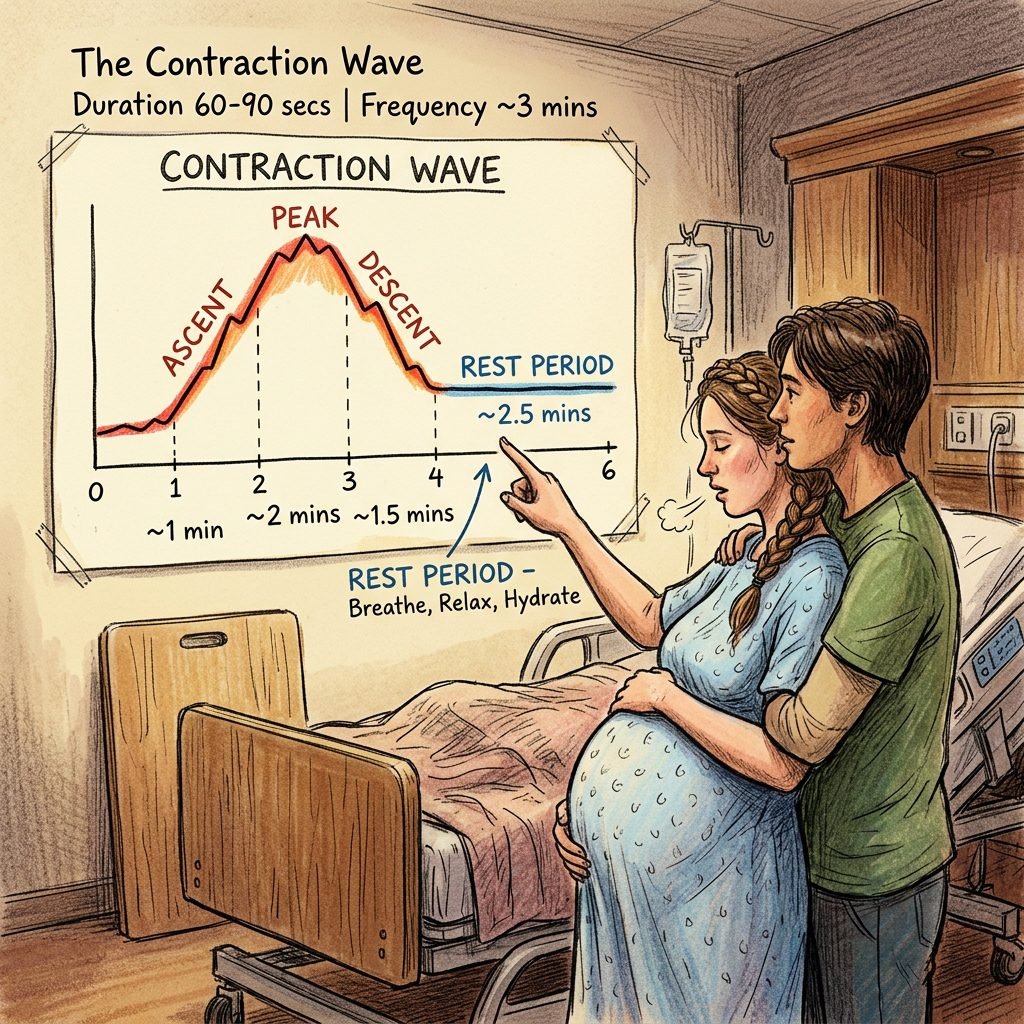
To help her, you first need to understand what is happening inside her body. A contraction is the muscle of the uterus tightening to thin and open the cervix. Think of it like a wave: it starts small, builds to a powerful peak, and then fades away completely, leaving a period of total rest. Your job is to help her navigate the peak and maximize the rest.
The Anatomy of a Contraction
Every contraction has a beginning, a middle (the peak), and an end. During the peak, the intensity is at its highest. This is when she needs you most. Between contractions, her body is flooded with natural endorphins that are 10 to 20 times stronger than morphine. Encourage her to use the breaks for total relaxation.
| Labor Phase | Frequency | Duration | Partner Focus |
|---|---|---|---|
| Early Labor | 5-20 mins apart | 30-45 seconds | Distraction, rest, hydration |
| Active Labor | 3-5 mins apart | 60 seconds | Physical support, breathing |
| Transition | 2-3 mins apart | 60-90 seconds | Intense focus, affirmations |
During early labor, the best thing you can do is not over-analyze. If she can still talk through them, keep the mood light. Go for a walk, watch a movie, or finish packing the bag. Once she can no longer talk or laugh during a contraction, you have entered active labor, and it is time to pull out your toolkit.
Hands-On Healing: Physical Support Techniques

Physical touch is one of the most powerful ways to mitigate labor pain. Many women experience ‘back labor,’ where the baby’s head presses against the sacrum. This is where your strength comes in. Here are the most effective doula-approved moves:
Counter Pressure and the Hip Squeeze
- The Sacral Press: Use the heel of your hand or a tennis ball to press firmly into the small of her back (the sacrum) during a contraction. Ask her to guide you: ‘Higher? Lower? Harder?’ Usually, the harder the better.
- The Double Hip Squeeze: While she is leaning forward on a bed or ball, place your hands on the fleshy part of her hips (the iliac crests) and squeeze inward toward her spine and slightly upward. This physically opens the pelvic outlet and relieves pressure.
- The Knee Press: If she is sitting upright, sit in front of her and push her knees back toward her hip sockets. This helps ground her and can alleviate lower abdominal pressure.
“You are doing the work, and I am right here with you. Let my strength be your strength during this wave.”
Pro Tip: Watch her body language. If she pulls away or says ‘don’t touch me,’ do not take it personally. Labor is sensory-overload. Sometimes the best physical support is simply holding a cold washcloth to her forehead or offering a sip of water.
The Breath Connection: Anchoring Through the Peak

When pain intensifies, the natural human reaction is to hold the breath and tense the shoulders. This creates a ‘fear-tension-pain’ cycle. Your goal is to keep her breathing deeply and rhythmically. If she loses her rhythm, she may start to panic. This is when you step in as her ‘breath pacer.’
How to Lead the Breath
- Get Eye-to-Eye: If she is panicking, get close—into her personal space—and ask her to look at you. Say, ‘Look at me, breathe with me.’
- Exaggerate Your Own Breath: Don’t just tell her to breathe; do it with her. Make your inhalations and exhalations audible.
- Low Tones: Encourage low, guttural moans or ‘horse lips’ (blowing air through relaxed lips). High-pitched screaming tightens the pelvic floor, while low sounds help it relax.
Use a 4-count inhale and a 6-count exhale. The long exhale is the key to triggering the parasympathetic nervous system, which tells the body it is safe to open up. If she begins to hyperventilate, stay calm. Slow your own breath down even further, and use a firm, grounding touch on her shoulders to help them drop.
Creating the Sanctuary: Environmental Support

The environment plays a massive role in how a woman perceives pain. Hospitals can be bright, loud, and clinical—the opposite of what a laboring brain needs. You are the ‘Interior Designer’ of the birth sanctuary. Your goal is to minimize adrenaline and maximize oxytocin.
The Birth Sanctuary Checklist
| Element | Action for Partner | Benefit | |
|---|---|---|---|
| Lighting | Dim the overheads; use battery-powered tea lights. | Triggers melatonin and relaxation. | |
| Sound | Manage the playlist; keep voices low and ‘church-like’. | Reduces ‘fight or flight’ response. | |
| Scent | Use lavender or peppermint essential oils (on a cotton ball). | Nausea relief and calming. | |
| Temperature | Ask for extra blankets or a fan; she will fluctuate. | Maintains physical comfort. |
Be the gatekeeper of the room. If a nurse or doctor enters and begins talking loudly, it is okay to gently ask them to keep the volume down or dim the lights again after they finish their check. Your partner needs to feel like she is in a safe ‘cave’ where she can let go of her inhibitions.
Advanced Labor Tools: Peanut Balls and Rebozo Techniques

If your partner is using an epidural or needs to stay in bed, you can still be incredibly active in her physical support. This is where tools like the peanut ball and the Rebozo come into play. These aren’t just for doulas; you can master them too!
The Peanut Ball (The Epidural’s Best Friend)
The peanut ball is a peanut-shaped exercise ball used between the legs. It helps open the pelvis even when she can’t stand up. Rotate her every 30 to 60 minutes from her left side to her right side, placing the ball between her ankles and knees to keep the hips wide. This can significantly shorten the second stage of labor.
Rebozo Sifting
If you have a long scarf or a Rebozo, you can perform ‘sifting.’ While she is on hands and knees, wrap the scarf under her belly. Hold the ends and gently jiggle her belly from side to side. This isn’t a lift; it’s a vibration. It helps relax the abdominal muscles and the uterine ligaments, allowing the baby to find an optimal position. Do this between contractions to provide a soothing, massage-like sensation.
The Mental Game: Transition and Affirmations

There will come a moment—usually around 8-10 centimeters—called ‘Transition.’ This is the most intense part of labor. She might say, ‘I can’t do this,’ ‘I want to go home,’ or ‘Just give me a C-section.’ This is your cue that the baby is almost here. Do not panic when she does. Instead, double down on your support.
What to Say vs. What Not to Say
| Instead of… | Try Saying… |
|---|---|
| “Relax, you’re fine.” | “Your body is doing this perfectly. Let it happen.” |
| “Is it over yet?” | “That wave is done. It’s never coming back. Rest now.” |
| “You’re being too loud.” | “Bring that sound down into your chest. I’m right here.” |
| “The nurse said…” | “You are safe. I am watching everything. Just breathe.” |
Use affirmations that focus on her strength. Remind her that every contraction is a step closer to meeting the baby. If she gets ‘the shakes’ (uncontrollable shivering), tell her it’s normal—it’s just her hormones working. Hold her hands firmly and remind her: ‘You can do anything for 60 seconds.’
Conclusion
You Were Made for This
Supporting a partner through labor is one of the most profound acts of love you will ever perform. You might feel helpless at times because you cannot take the physical pain away, but remember: suffering is often the result of pain plus fear. By removing the fear through your presence, your touch, and your encouragement, you are fundamentally changing her birth experience. Trust your instincts, stay hydrated yourself, and remember to take a few deep breaths too. You are a team, and very soon, that team is getting a brand-new member. You’ve got this, partner!