
How To Use Rebozo Techniques For Active Labor Progression And Pain Relief
Welcome to Your Empowered Birth Journey, Mama
Hello, beautiful mama. If you are reading this, you are likely preparing for one of the most profound physical and emotional marathons of your life: bringing your sweet baby into the world. Whether you are a first-time mom anxiously packing your hospital bag, an expectant parent planning a serene home birth, or a doula looking to expand your toolkit, you are in exactly the right place. Labor is a wild, magnificent ride, but let us be completely honest—it is also intense work. The good news? You do not have to do it alone, and you do not have to rely solely on medical interventions for comfort.
Enter the Rebozo. This simple, stunningly effective tool has been used for centuries by traditional Mexican midwives (parteras) to comfort, support, and empower women during pregnancy and childbirth. A Rebozo is a long, woven shawl that acts as an extension of your support team’s hands. It is like a warm, supportive hug that can literally shift the trajectory of your labor.
As your virtual doula, I am here to walk you through exactly how to harness the magic of Rebozo techniques for active labor progression and deep, natural pain relief. We are going to blend ancient wisdom with evidence-based biomechanics to help you and your partner feel confident, connected, and ready to meet your baby. Grab a cup of red raspberry leaf tea, get cozy, and let us dive into the comforting, transformative world of the Rebozo.
What Is A Rebozo And Why Is It A Labor Game-Changer?

Before we get into the physical techniques, it is essential to understand and honor what a Rebozo is. Originating in Mexico, the Rebozo is a traditional woven garment used by women for everything from carrying babies to providing warmth. In the context of birth, traditional Mexican midwives have long used the Rebozo to help balance the mother’s pelvis, soothe tight ligaments, and encourage the baby into an optimal position for birth.
The Biomechanics of Comfort
So, how does a simple piece of fabric offer so much relief? During active labor, your uterus is working incredibly hard, and the ligaments supporting it (like the round and broad ligaments) can become tight and fatigued. When a partner or doula wraps the Rebozo around your belly or hips and applies gentle, rhythmic movement, it acts as a hammock. This takes the heavy weight of your baby off your pelvic floor and lower back.
Here is the evidence-based magic: The gentle shaking or “sifting” motion relaxes the fascia (the connective tissue surrounding your muscles). When the fascia relaxes, your pelvic muscles soften. A softer pelvis allows your baby to navigate the birth canal more easily, which can actively speed up labor progression and significantly reduce the sensation of pain. It also triggers your parasympathetic nervous system, lowering adrenaline and boosting oxytocin—the hormone you desperately need to keep contractions strong and effective.
The Rebozo Labor Matrix: Matching Techniques to Your Labor Phase
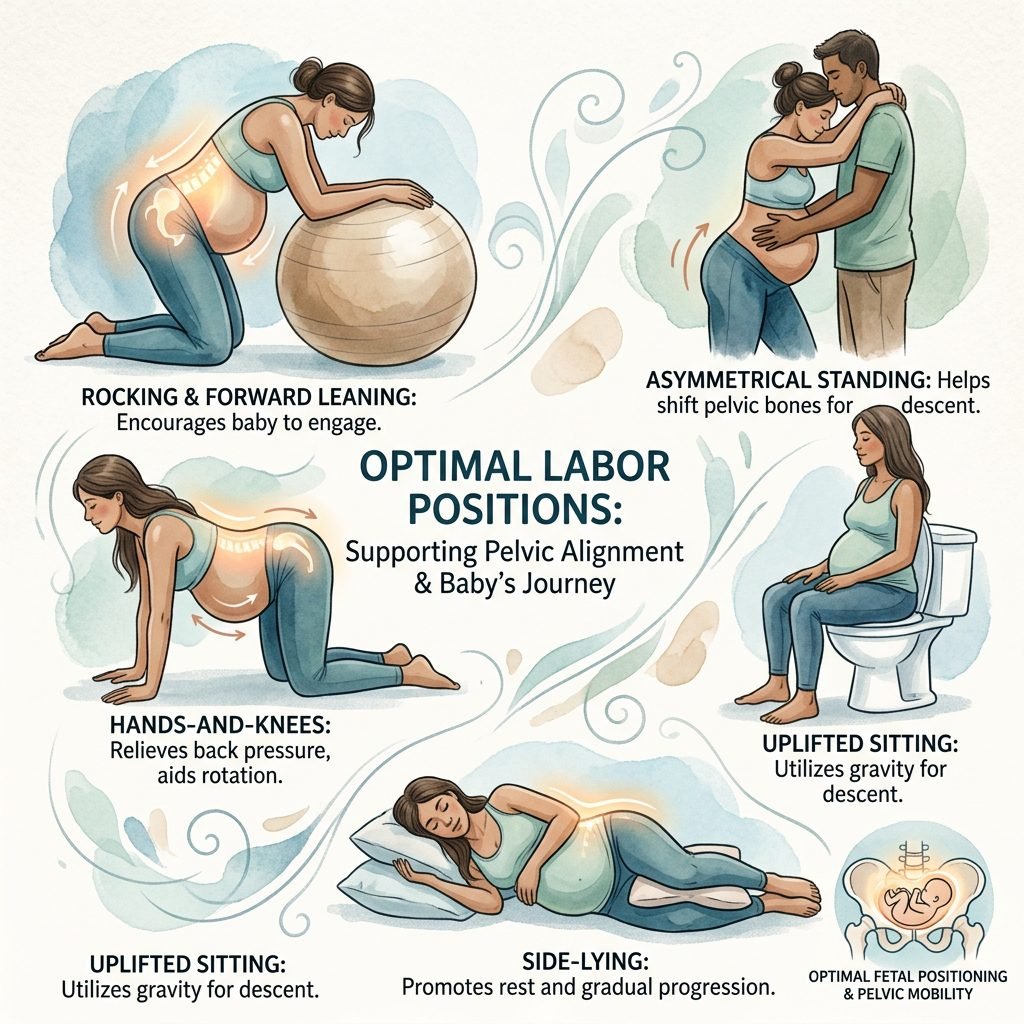
Not all Rebozo techniques are created equal, and timing is everything. What feels amazing during early labor might feel overwhelming during transition. As a doula, I always teach partners to read the room and match the technique to the mother’s current labor phase. Below is a practical, quick-reference guide to help you and your birth team know exactly which Rebozo technique to deploy and when.
| Labor Phase | Recommended Rebozo Technique | Primary Benefit & Purpose |
|---|---|---|
| Early Labor (0-5cm) | Gentle Belly Sifting (Mada) | Relaxes tight ligaments, calms the nervous system, and helps baby settle into the pelvis. |
| Active Labor (6-8cm) | Hip Squeeze & Jiggle | Counter-pressure for intense lower back pain and creates space in the mid-pelvis. |
| Transition (8-10cm) | Forehead/Neck Wrap | Grounds the mother, relieves tension headaches, and provides emotional security. |
| Pushing (Second Stage) | Rebozo Tug-of-War (Pulling) | Provides upper body leverage, allowing the mother to bear down effectively in a squat. |
Remember, mama, communication is your superpower here. If a technique feels wrong, your partner needs to stop immediately. Your body knows exactly what it needs, so trust your instincts and vocalize your comfort levels.
Step-by-Step: The Classic Rebozo Belly Sifting (Mada)

This is the holy grail of Rebozo techniques. Belly sifting (also known as the Mada) is incredibly soothing and is highly recommended if you are experiencing back labor or if your baby needs a little help rotating into an anterior position. Partners, this section is for you. Read these steps carefully, practice them during the third trimester, and remember that your energy transfers to the laboring mother. Keep your breathing slow and your movements intentional.
How to Perform Belly Sifting:
- Position the Mother: Have the laboring mother get onto her hands and knees. She can rest her upper body on a birth ball, a pile of pillows on the bed, or the back of a hospital bed raised to a 90-degree angle. Comfort is key.
- Place the Fabric: Unfold the Rebozo completely. Stand over her (straddling her hips or standing right behind her) and drape the fabric under her belly. The fabric should cover her entire abdomen, from the pubic bone up to the breasts, acting like a wide, supportive hammock.
- Gather the Ends: Gather the ends of the Rebozo in your hands, keeping your wrists straight and your elbows tucked in close to your own body to protect your back.
- Lift and Support: Gently lift straight up. You are taking the weight of the baby off her lower back. Ask her, “Does this feel like a relief?” Adjust the tension until she sighs with comfort.
- Begin the Sift: Once you have the weight supported, begin a very small, rhythmic, side-to-side jiggling motion with your hands. The movement should come from your core, not just your arms. It is a vibration, not a violent shake.
- Find the Rhythm: Continue this rhythmic sifting for 1 to 3 minutes, or through a contraction if she prefers. Keep your breathing steady and audible so she can sync her breath with yours.
- Release Slowly: When you are finished, do not drop the fabric suddenly. Slowly, over the course of 5 to 10 seconds, release the tension until the weight of her belly rests naturally again.
The Rebozo Tug-of-War: Empowering Your Pushing Phase
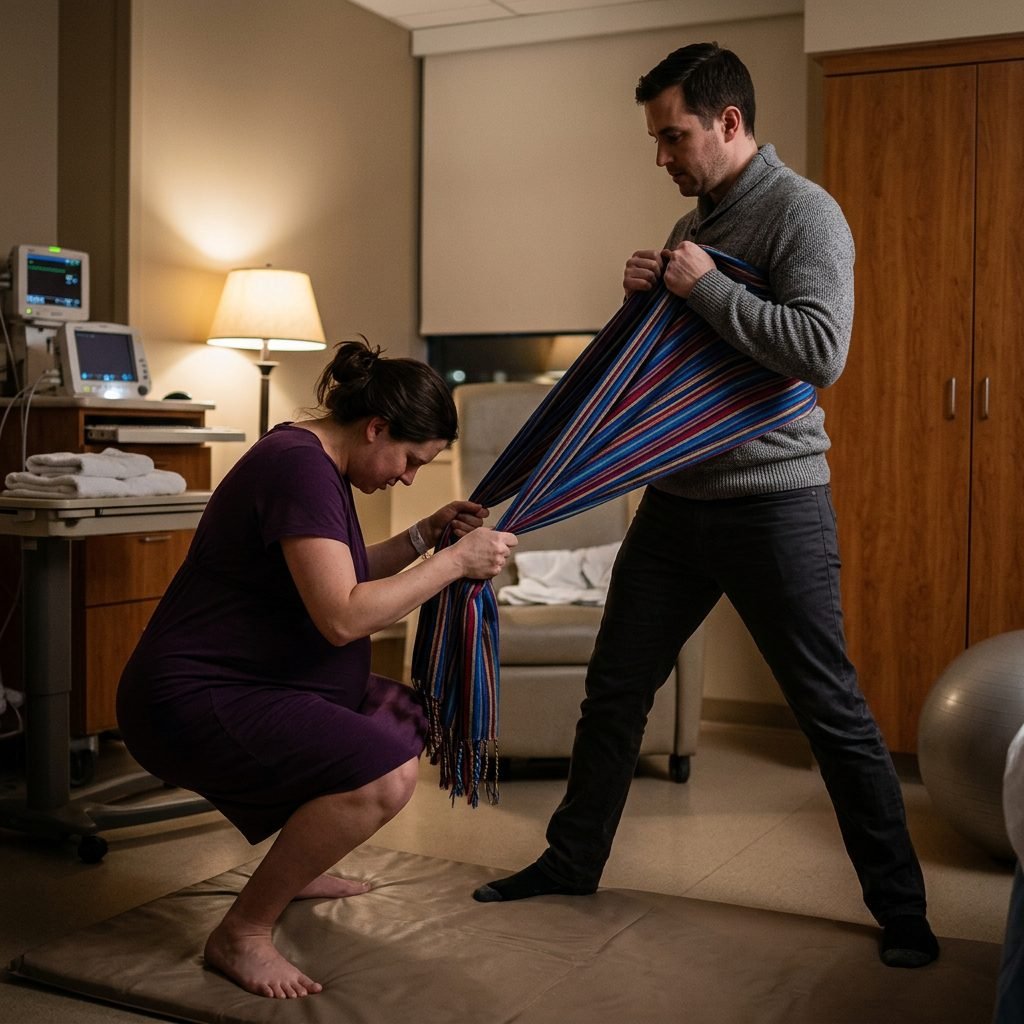
When you reach the pushing stage (the second stage of labor), you might find that you need something to grab onto. While hospital beds have bars, a Rebozo offers a dynamic, flexible, and much more comfortable alternative. The “Tug-of-War” technique uses the Rebozo as a tool for leverage, helping you engage your core and bear down effectively while in an upright or squatting position. Upright pushing uses gravity to your advantage, which can shorten the pushing phase and reduce the risk of tearing.
How to Set Up the Rebozo Pull:
- Anchor the Rebozo: The partner or doula stands firmly in front of the laboring mother. Alternatively, you can securely tie the center of the Rebozo in a thick knot and shut it over the top of a sturdy, solid door (ensure the door pulls away from you so it doesn’t pop open!).
- Position the Mother: The mother gets into a deep squat, sits on a birthing stool, or kneels upright on the bed.
- Grip the Ends: The mother takes one end of the Rebozo in each hand, wrapping the fabric around her wrists once for a secure, non-slip grip.
- The Pull: As a contraction builds and the urge to push takes over, the mother pulls firmly on the Rebozo while the partner (or the door) acts as the solid anchor.
- Bear Down: The mother tucks her chin to her chest, curves her body around her baby (like a “C” shape), and uses the pulling leverage to direct her energy downward into her pelvis.
- Rest and Release: As the contraction fades, the mother releases the tension on the Rebozo, drops her shoulders, and rests completely until the next wave begins.
This technique is incredibly empowering. It allows you to channel the fierce, primal energy of transition into productive, focused movement. Plus, it gives partners a highly active, crucial role during the final moments of birth.
Partner Support: Scripts, Affirmations, and Holding Space

Partners, the Rebozo is only half of the equation; your presence is the other half. When a mother is in active labor, she enters a deeply internal, instinctive state often referred to as “Laborland.” She may not be able to articulate what she needs, which is why your calm, grounded energy is vital. When you are using the Rebozo, you are not just providing physical relief—you are communicating safety, love, and protection.
As you sift, squeeze, or pull, your words can serve as an anchor. Here are some doula-approved scripts and birth affirmations to whisper to her while you use the Rebozo techniques. Feel free to memorize these or write them on index cards to keep in your birth space:
“Breathe with me. I am right here. You are completely safe.”
“Your body knows exactly what to do. Surrender to this wave. Let your jaw go soft.”
“Every contraction is bringing our baby closer to us. You are doing beautiful work.”
“I have got you. Let me take the weight. Rest your body into the fabric.”
Pro-Tip for Partners: Pay attention to her jaw and her hands. The sphincter law in midwifery states that the jaw and the pelvic floor are intimately connected. If her jaw is clenched, her pelvic floor is clenched. While you are using the Rebozo to relax her pelvis, gently remind her to “soften your lips, sigh it out, drop your shoulders.” Sync your breathing with hers—make your exhales long, low, and audible (think of a deep horse-lip flutter or a low “moo” sound). She will naturally match your rhythm.
Conclusion
Embracing the Journey With Confidence
Sweet mama, as you pack your hospital bag or prepare your home birth kit, I highly encourage you to include a Rebozo. It is so much more than a piece of fabric; it is a bridge of connection between you and your partner, a tool for profound physical relief, and a symbol of the ancient lineage of women who have birthed before you. Practice these techniques in your final weeks of pregnancy. Let your body get used to the sensation of being held, sifted, and supported.
Remember that labor is unpredictable, and while we can plan and prepare, the most important thing you can do is remain flexible and deeply compassionate toward yourself. Whether you use the Rebozo for hours or only for a few minutes, you are taking an active, empowered role in your birth story. You are stronger than you know, your body is brilliantly designed, and you are about to do something truly miraculous. I am cheering you on every step of the way!