
Fix Your Postpartum Rib Flare With These 3 Gentle Moves
Hello, sweet mama. First, take a deep breath—and I mean a real, deep, soul-filling breath. If you are looking down at your rib cage and wondering why it looks a little different, or why your favorite pre-pregnancy bras feel uncomfortably tight around the band, please know this: your body is not broken. You have just completed the most miraculous marathon imaginable. During those nine months, your incredible body made room for a growing life, and one of the ways it did that was by physically expanding your rib cage. This expansion, often called postpartum rib flare, is a common and completely natural adaptation. As a doula, I have sat with so many mothers who feel a bit ‘disconnected’ from their midsection, and I want to tell you that we can gently guide those ribs back home. This isn’t about ‘getting your body back’—it’s about helping your body feel like yours again. In this guide, we are going to dive deep into the ‘why’ behind rib flare and walk through three gentle, restorative moves that you can do right in the middle of nap time to help knit your core back together.
Remember, mama: Your body didn’t change overnight, and it doesn’t need to ‘snap back’ overnight. Healing is a holy, slow process.
Understanding the Rib Flare: Why Your Ribs Stayed Wide After Baby
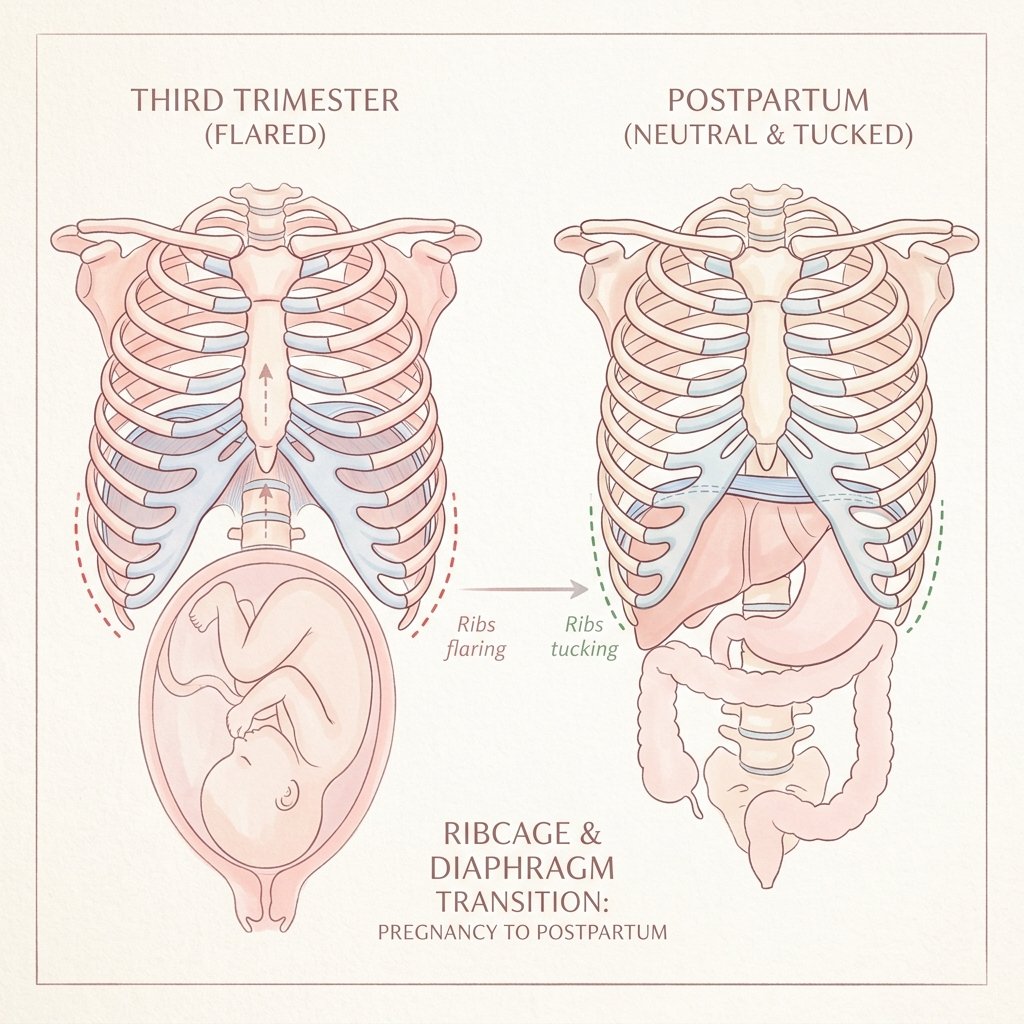
To fix rib flare, we first have to understand why it happened. During pregnancy, your uterus grows significantly, eventually reaching all the way up to your xiphoid process (the bottom of your breastbone). To accommodate this, your internal organs shift, and your diaphragm is pushed upward. Because your body is flooded with the hormone relaxin, your ligaments and cartilage become soft and pliable. This allows the lower ribs—specifically the ‘floating ribs’—to widen outward and upward. This is a brilliant design of nature! Without it, you wouldn’t have had enough room to breathe while carrying your little one.
However, after birth, those ribs don’t always automatically ‘tuck’ back in. Factors like your posture during pregnancy, the way you carry your baby now, and the relative weakness of your deep abdominal muscles can keep the ribs in that flared, open position. When the ribs stay flared, it can affect your breathing mechanics, your pelvic floor health, and even contribute to Diastasis Recti (abdominal separation). It’s all connected in what we call the ‘core canister.’
| Feature | Pregnancy State | Postpartum Goal |
|---|---|---|
| Rib Angle | Wide, flared outward (90+ degrees) | Tucked, narrow angle (approx. 90 degrees) |
| Diaphragm Position | Elevated and compressed | Descending fully on inhale |
| Abdominal Tension | Stretched and lengthened | Functional and supportive |
| Pelvic Floor | High pressure/weight | Coordinated with breath |
The Deep Core Connection: Why It Is Not Just About Your Ribs
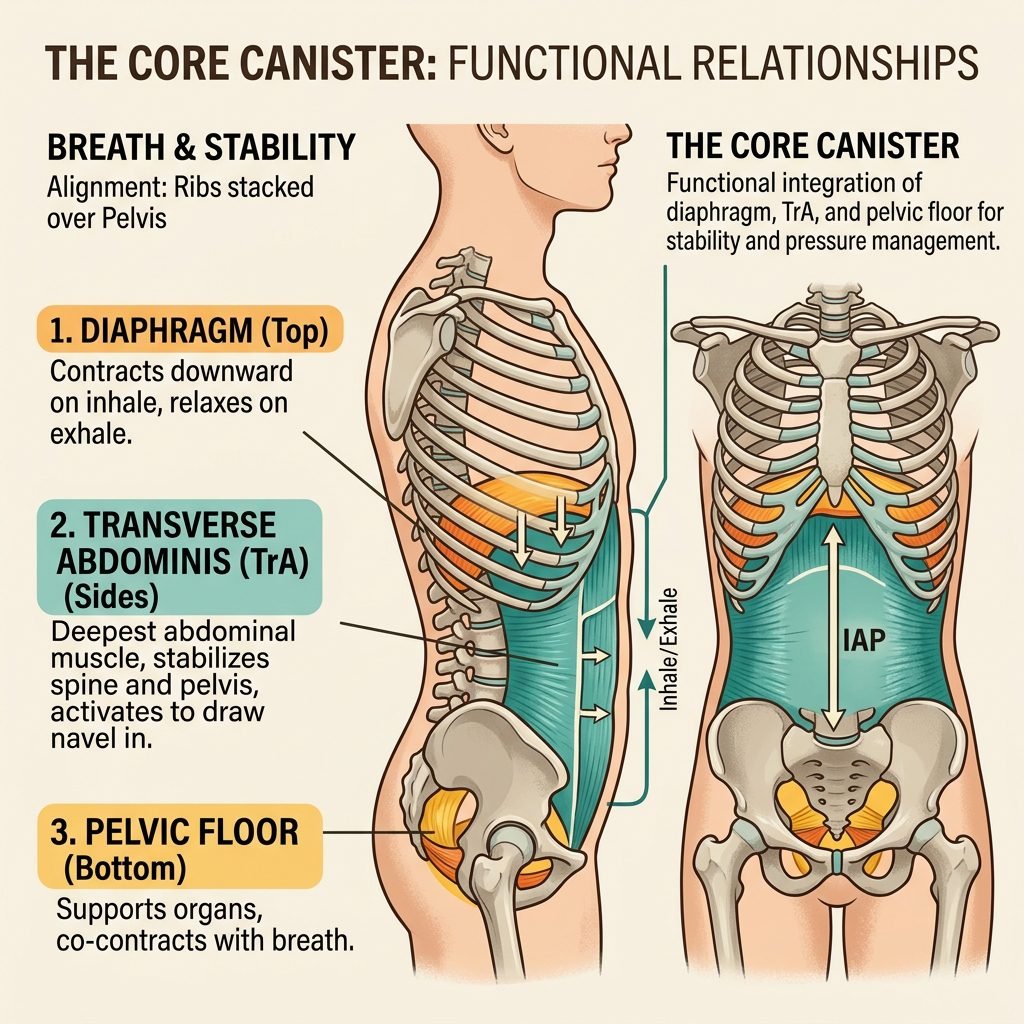
I often tell my clients to think of their torso as a canister. The top of the canister is your diaphragm, the bottom is your pelvic floor, and the sides are your deep abdominal muscles (the transverse abdominis). For this canister to work efficiently and manage internal pressure, the top and the bottom need to be stacked directly over each other. When your ribs are flared, the ‘lid’ of your canister is tilted back. This creates an environment where pressure leaks out the front (contributing to a ‘mummy tummy’ or Diastasis Recti) or pushes down too hard on the ‘bottom’ (contributing to pelvic floor heaviness or leaking).
By addressing rib flare, you are actually doing deep work for your pelvic floor and your back health. We aren’t just looking for an aesthetic change; we are looking for functional synergy. When your ribs are properly positioned, your diaphragm can drop down fully when you inhale, which in turn allows your pelvic floor to relax and lengthen. On the exhale, everything lifts together. It’s a beautiful, rhythmic dance that supports your entire core. If you’ve been feeling ‘weak’ in your core, it might not be a lack of strength—it might just be a lack of alignment.
Common Signs of Rib Flare
- Your lower ribs protrude further than your upper abs when lying flat.
- You feel like you can’t take a deep breath into your back.
- You have persistent mid-back pain or ‘bra-strap’ pain.
- You notice a ‘doming’ or ‘coning’ along your midline when you sit up.
Move 1: 360-Degree Diaphragmatic ‘Umbrella’ Breathing

The first and most important move is actually a breathing technique. I call this ‘Umbrella Breathing’ because I want you to imagine your rib cage is an umbrella opening in every direction—not just pushing out the front. This move retrains your diaphragm to move through its full range of motion and gently encourages the ribs to expand laterally (to the sides) and posteriorly (into your back), rather than just flaring up.
How to Perform 360 Breathing:
- Sit comfortably on a chair or the floor with your spine tall. You can also do this lying on your back with knees bent if that feels more supportive.
- Place your hands around your lower rib cage, with your thumbs wrapping toward your back and your fingers toward the front.
- Inhale slowly through your nose. As you breathe in, feel your ribs expand into your palms. Try to send the air into your side ribs and your back.
- Exhale slowly through pursed lips (like you are blowing through a straw). As you exhale, feel your ribs gently knit together and move down and in toward your belly button.
- Focus on the ‘closing’ sensation of the ribs at the end of the exhale. This is where the magic happens!
Doula Tip: Try to keep your shoulders relaxed. If your shoulders are rising toward your ears, the breath is staying too high. Think ‘wide and low’ instead of ‘up and high.’
Move 2: The Side-Lying Rib ‘Hug’ and Reach

This move is a favorite for mamas who feel ‘stuck’ in their mid-back. By lying on your side, we take the pressure of gravity off your spine and allow you to isolate the movement of the rib cage. This move helps to mobilize the intercostal muscles (the tiny muscles between your ribs) which can become tight and ‘locked’ in a flared position.
How to Perform the Side-Lying Rib Hug:
- Lie on your left side with your knees bent at a 90-degree angle (the fetal position). You can place a pillow under your head for comfort.
- Take your top arm (the right arm) and reach it across your chest, gently cupping your left rib cage.
- Inhale deeply into your right side (the side facing the ceiling). Feel the ribs expand away from each other.
- As you exhale, use your right hand to gently ‘guide’ or ‘hug’ your ribs down and in toward your hip.
- Simultaneously, gently reach your right shoulder slightly forward to create a stretch in the back of the rib cage.
- Repeat for 8-10 breaths, then switch to the other side.
This move is incredibly soothing for the nervous system. It tells your body it is safe to let go of that ‘braced’ flared position. It’s also a wonderful way to check in with which side of your body feels tighter—most of us have one side that flares more than the other!
Move 3: Modified ‘Dead Bug’ with Rib-to-Hip Connection
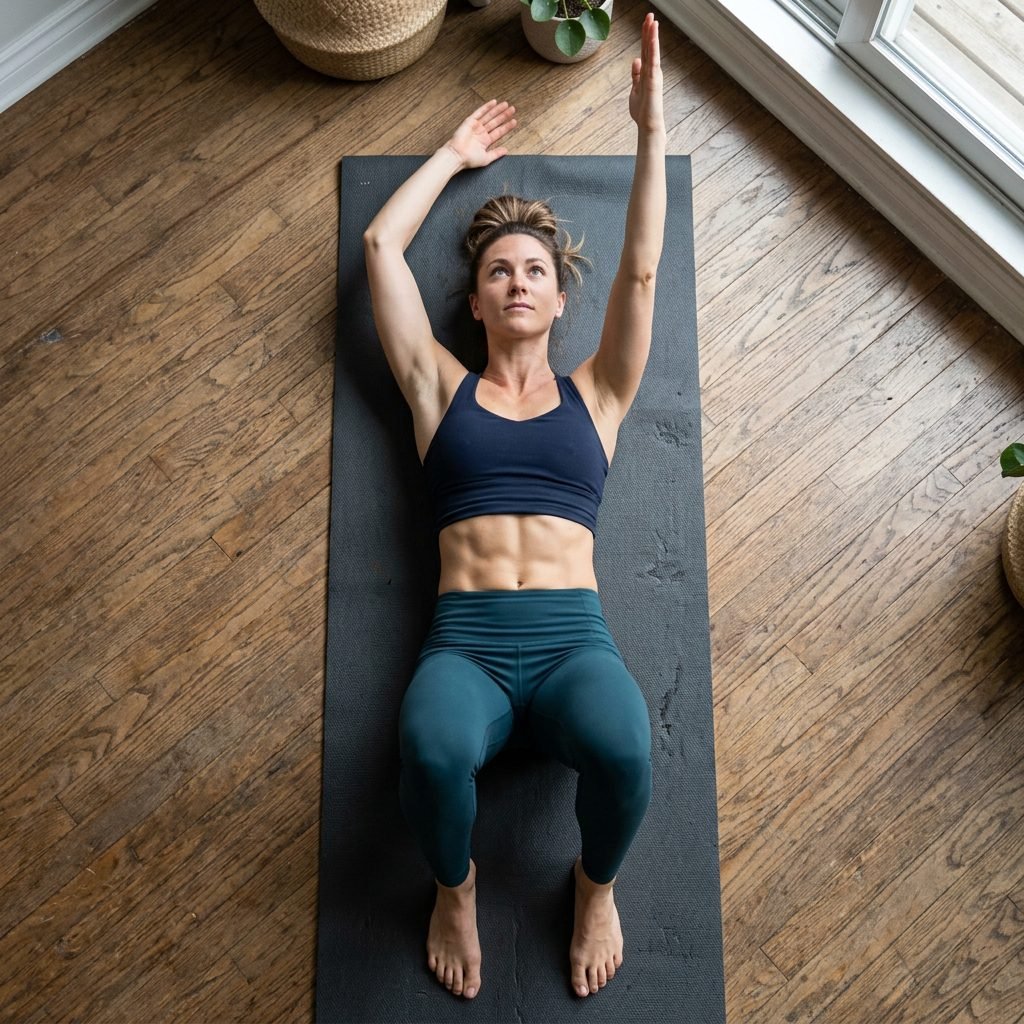
Once you have mastered the breath, we want to add a little bit of ‘functional tension.’ The Dead Bug is a classic core exercise, but for postpartum rib flare, we modify it to focus entirely on the rib-to-hip connection. The goal here is to keep your ribs ‘heavy’ on the floor even as your limbs move. If your ribs pop up as your leg moves, you’ve gone too far!
How to Perform the Modified Dead Bug:
- Lie on your back on a firm surface. Bring your legs into ‘tabletop’ position (knees bent at 90 degrees over your hips).
- Reach your arms straight up toward the ceiling.
- Before you move, take a deep inhale. On the exhale, blow out through your mouth and feel your ribs ‘melt’ into the floor. There should be no space between your mid-back and the mat.
- Slowly lower your right arm behind your head while keeping your ribs tucked down. Only go as far as you can without your ribs flaring up.
- Bring the arm back to center and repeat with the left arm.
- If this feels easy, you can try tapping one toe down to the floor while keeping that rib-to-hip connection strong.
Wait! If you see any ‘doming’ or ‘pooching’ in your midline, stick to just the arm movements for now. We want to build strength from the inside out, not just push through movements that our core isn’t ready for yet.
Beyond the Moves: Posture and Support for Lasting Change
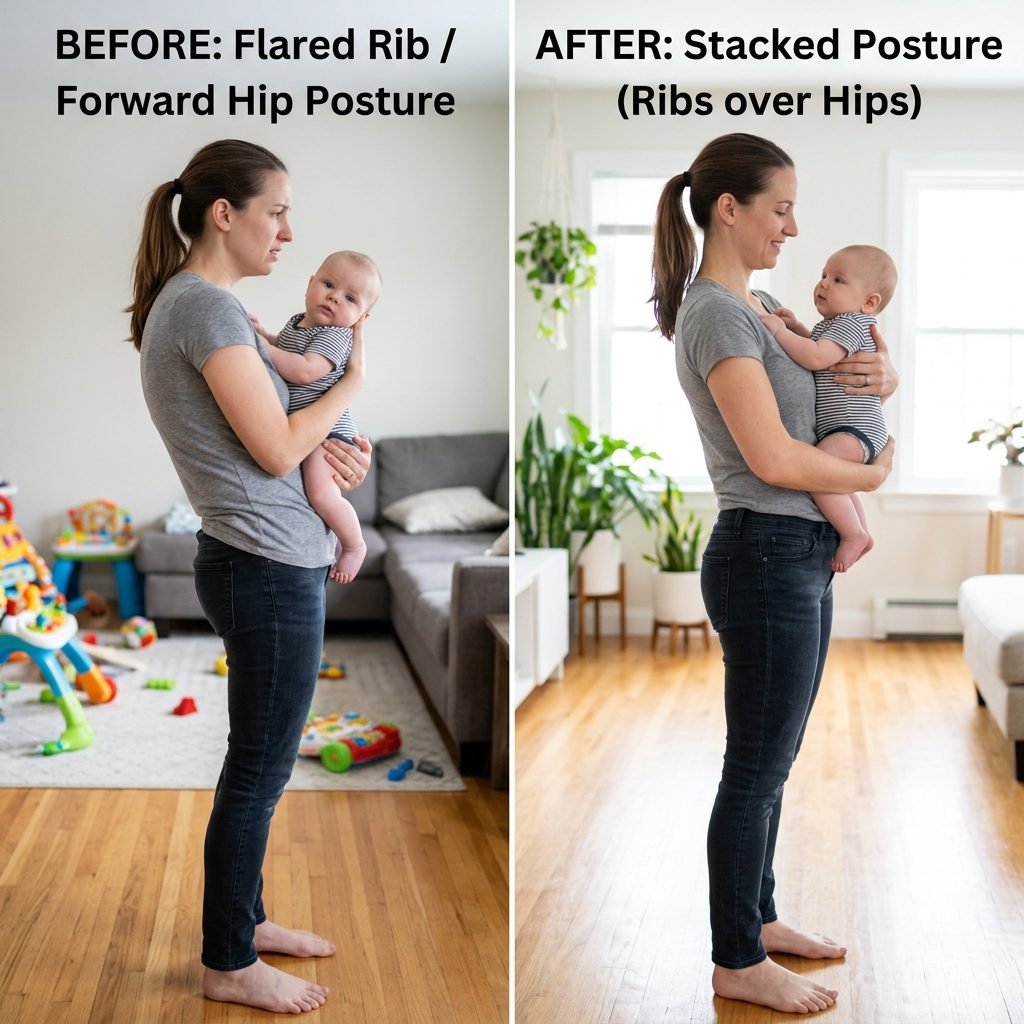
While these three moves are powerful, the way you move throughout the rest of your day matters just as much. Postpartum rib flare is often reinforced by what I call the ‘mom posture’—thrusting the hips forward and flaring the ribs out to balance the weight of a baby on your chest or hip. To truly fix rib flare, we need to bring awareness to our daily habits.
| Daily Activity | The ‘Flare’ Habit (Avoid) | The ‘Stacked’ Habit (Try This) |
|---|---|---|
| Standing/Walking | Hips pushed forward, ribs tilted back | Weight in heels, ribs stacked over pelvis |
| Feeding Baby | Slumping shoulders, arching lower back | Use pillows to bring baby to you; keep ribs down |
| Carrying Car Seat | Leaning to one side, rib popping out | Exhale as you lift; engage core to stay centered |
| Picking up Toys | Rounding the back, holding breath | Hinge at hips, exhale on the way up |
I also want to touch on the emotional side of this. Your ribs expanded to hold your baby’s spirit and body. That is a beautiful thing. If you feel frustrated by how your clothes fit, try to shift your perspective to one of gratitude. Your body is plastic and adaptable; it changed for your baby, and it can change for your health now. Be patient with the process. Consistency beats intensity every single time.
Conclusion
Reclaiming your core after baby is a journey of a thousand tiny breaths. By incorporating these three gentle moves—360 Breathing, the Side-Lying Rib Hug, and the Modified Dead Bug—you are giving your body the cues it needs to realign and heal. Remember that rib flare isn’t just about how you look; it’s about how you function and how you feel from the inside out. You deserve to feel strong, stable, and connected to your center. Take it slow, mama. You are doing an incredible job, and your body is listening to the care you are giving it. Keep breathing, keep tucking those ribs, and keep honoring the amazing vessel that brought your little one into the world.