
How to Do the Caterpillar Crawl Massage to Relieve Stubborn Baby Gas
Embracing the Calm After the Storm of Gas
Oh, mama, I see you. It is 2:00 AM, the house is quiet, but your heart is racing because your sweet little one is arching their back, pulling their tiny legs to their chest, and letting out those high-pitched cries that pull at your very soul. We have all been there—standing in the dim light of the nursery, swaying back and forth, wishing we could simply take the pain away. As a doula, one of the most frequent calls I get isn’t about labor; it is about the ‘witching hour’ and the stubborn, uncomfortable gas that plagues our newest little humans. Their digestive systems are so brand new, like a delicate piece of machinery that is still learning how to operate. Sometimes, they just need a little bit of sisterly guidance and the healing power of your touch to get things moving.
Today, I want to share a technique that has been a total game-changer for the families I support: The Caterpillar Crawl Massage. This isn’t just a random rubbing of the tummy; it is a rhythmic, intentional movement designed to mimic the natural peristalsis of the intestines. It is gentle, it is effective, and most importantly, it creates a moment of deep connection between you and your baby when things feel most chaotic. By the time we are done today, you will feel empowered with a physical tool that can bring peace back to your home and comfort to your baby’s belly. Let’s take a deep breath together, center ourselves, and learn how to help your little one find relief.
Understanding the ‘Why’ Behind the Bubbles
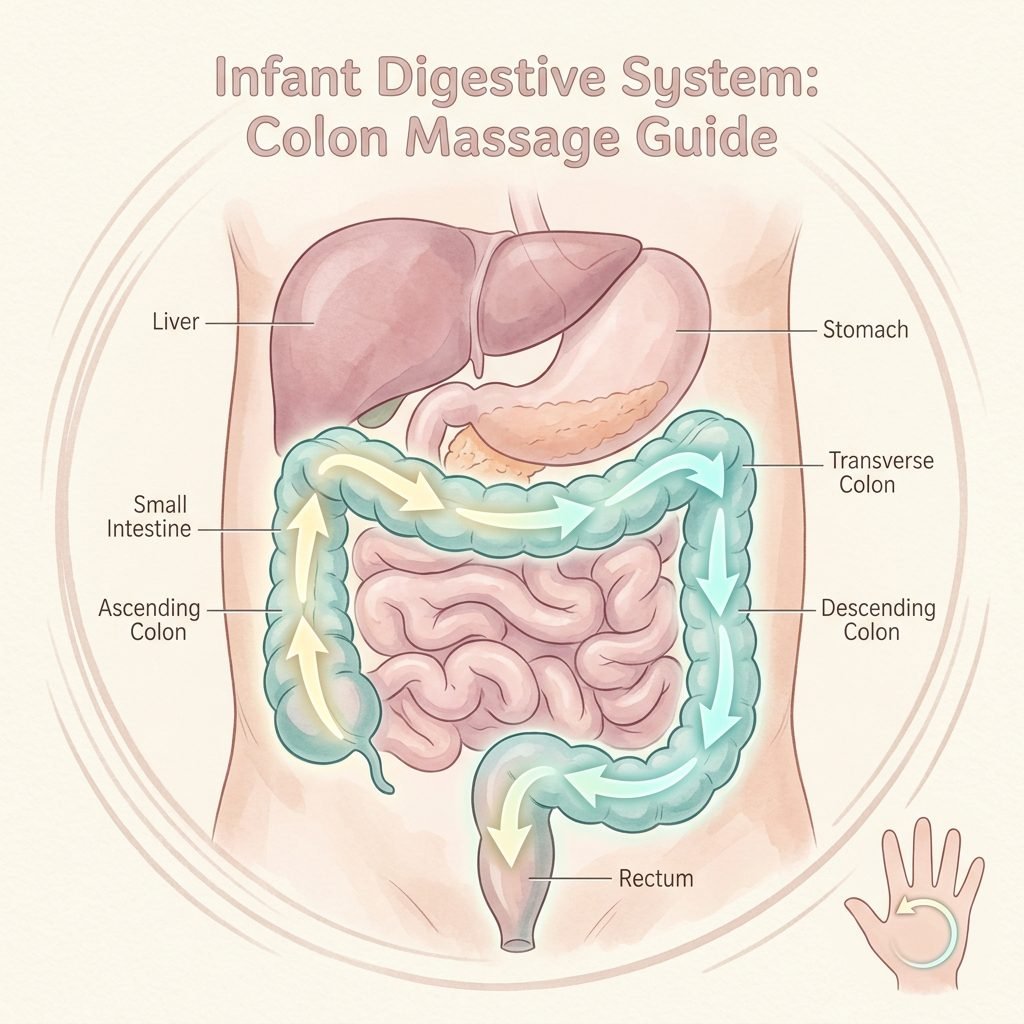
Before we dive into the physical movements, it is so helpful to understand what is actually happening inside that adorable round belly. Babies are born with an immature digestive tract. They are often ‘air swallowers,’ whether they are breastfeeding, bottle-feeding, or simply crying. This air gets trapped in the loops of their intestines, causing pressure and bloating. Because their abdominal muscles are still developing, they often don’t have the strength to push that gas out on their own. That is where we come in.
The Caterpillar Crawl works by applying gentle, rhythmic pressure along the path of the large intestine. Think of the colon as a three-sided frame: it goes up the right side (ascending), across the top (transverse), and down the left side (descending). When we use the Caterpillar Crawl, we are literally helping move those stubborn air bubbles toward the exit. It is like helping a little lost traveler find their way home.
| Symptom | What It Usually Means | Recommended Gentle Action |
|---|---|---|
| Arching back and turning red | Upper or mid-tract gas pressure | Caterpillar Crawl + Burping |
| Pulling legs tightly to chest | Lower intestinal gas or cramping | Bicycle Legs + Caterpillar Crawl |
| Hard, distended abdomen | Significant air trapped in the gut | Full Abdominal Massage Routine |
| Fretful feeding/pulling off latch | Air bubble stuck in the esophagus | Upright positioning and firm patting |
“Your hands are the most sophisticated tools you possess. They carry your love, your warmth, and the intuitive power to heal your baby’s discomfort.”
Setting the Stage: Creating a Healing Environment

You wouldn’t want a massage in a cold, bright, noisy room, and neither does your baby! To make the Caterpillar Crawl most effective, we need to activate the parasympathetic nervous system—the ‘rest and digest’ mode. If your baby is screaming at the top of their lungs, their muscles will be too tense for the massage to work deeply. We want to catch them in a ‘quiet alert’ state or use soothing techniques to bring them down from a peak of crying first.
The Checklist for a Perfect Massage Session:
- Warmth is Key: Ensure the room is toasty. A cold baby is a tense baby. You might even want to warm your hands by rubbing them together or running them under warm water first.
- The Right Surface: Use a changing table or lay a soft blanket on the floor. Make sure you are comfortable too, so you don’t strain your back.
- Safe Lubrication: Use a tiny bit of edible, cold-pressed oil like coconut or grapeseed oil. Avoid essential oils for newborns unless specifically cleared by a professional, as their skin is incredibly permeable.
- Eye Contact: This is a conversation without words. Look into your baby’s eyes and tell them what you are doing. “I’m going to help your tummy feel better now, sweetie.”
Timing is everything, mama. Never perform a deep tummy massage immediately after a full feeding. Wait at least 30 to 45 minutes to avoid accidental spit-ups. We want to move gas, not the milk they just worked so hard to swallow!
The Step-by-Step Caterpillar Crawl Technique

Now, let’s get into the heart of the matter. The Caterpillar Crawl is unique because it uses a specific ‘walking’ motion with your fingers. This creates a wave-like pressure that is much more effective than a simple flat palm rub. Follow these steps carefully, and remember: always move in a clockwise direction from your perspective (which is the baby’s right-to-left).
- The Starting Position: Place your baby on their back. Locate the bottom right of their abdomen (just above the hip bone). This is the start of the ascending colon.
- The Finger Walk: Use your index and middle fingers. Imagine they are the tiny legs of a caterpillar. Press gently but firmly—about the depth you would press on your own closed eyelid—and ‘walk’ your fingers upward toward the ribs.
- The Transverse Bridge: Once you reach the bottom of the ribs on the right side, crawl your fingers horizontally across the top of the belly to the left side.
- The Descending Path: Now, crawl your fingers down the left side toward the left hip bone. This is where the gas is most likely to be ‘ready’ to exit.
- The Flutter Finish: After each full ‘lap’ of the caterpillar, take your flat palm and do a very light, vibrating flutter over the whole belly to help settle the tissues.
Repeat this cycle 6 to 10 times. You might hear some gurgling—that is music to a doula’s ears! It means things are moving. If your baby pulls away or seems in more pain, stop and switch to a more passive hold before trying again.
The ‘Gas-Buster’ Routine: Combining Moves for Maximum Relief

While the Caterpillar Crawl is the star of the show, it works best when paired with other ‘opening’ movements. Think of it as a workout for their digestive tract. When we combine the crawl with leg movements, we create a ‘pump’ action that helps expel the gas we’ve just moved into position.
| Move Name | Physical Action | Benefit | Slowly cycling baby’s legs toward their tummy | Compresses the lower intestines to expel gas | One hand moves in a full circle (Sun), while the other follows in a half-circle (Moon) | Keeps the ‘flow’ moving in a clockwise direction | Tracing the letters I, L, and U on the belly | Specific targeting of the three colon segments | Holding both knees to the belly for 10 seconds | Relaxes the anal sphincter to allow gas to pass |
|---|
A great routine would be: 3 minutes of Caterpillar Crawl, followed by 1 minute of Bicycle Legs, ending with 30 seconds of the Knees-to-Chest hold. Repeat this sequence three times. Don’t be surprised if your baby lets out a big ‘toot’ or even has a bowel movement during this process—that means you are doing it perfectly! Keep a diaper nearby just in case!
When the Gas Won’t Budge: Troubleshooting and Tips

Sometimes, despite our best efforts, that gas feels like it is stuck behind a brick wall. If the Caterpillar Crawl isn’t working after a few rounds, don’t panic. You haven’t failed, mama. It might just mean the gas is higher up or the baby is too tense. Here are my doula-expert ‘pro tips’ for those stubborn moments:
- Try the ‘Tiger in the Tree’ Hold: Lay your baby chest-down along your forearm, with their head near your elbow and their legs straddling your hand. Use your other hand to perform the Caterpillar Crawl on their back! The gravity of them hanging face-down provides natural pressure against their tummy.
- Warm Compress: Place a warm (not hot!) washcloth over the belly for 2 minutes before you start the massage. This helps relax the smooth muscle of the gut.
- Check Your Pressure: Often, parents are too light because they are afraid of hurting the baby. While we must be gentle, a superficial skin rub won’t move gas. You need to feel like you are slightly displacing the soft tissue of the abdomen.
“Remember, your calm is contagious. If you are frustrated, your baby will feel it. Take a breath, sing a low-toned song, and let the massage be a dance, not a chore.”
Knowing the Red Flags: When It’s Not Just Gas

While gas is a normal part of infancy, as your ‘sister-doula,’ I want to make sure you know when to put down the massage oil and pick up the phone to call your pediatrician. Most fussiness is just ‘new baby’ stuff, but we always listen to our gut instincts.
Call the doctor if you notice:
- Projective Vomiting: This is different from a normal spit-up; it is forceful and happens frequently.
- Blood in Stool: This can indicate a food sensitivity or allergy (like a cow’s milk protein allergy).
- Fever: Any fever in a newborn (under 3 months) requires immediate medical attention.
- Inconsolable Crying: If the baby cries for more than 3 hours a day, 3 days a week, it may be colic, and your doctor can help rule out other issues like reflux.
- Lethargy: If your baby is too tired to feed or seems unusually floppy.
But for the vast majority of you, that Caterpillar Crawl is going to be your new best friend. It is a skill you will use for months to come, even as they transition to solid foods and face new digestive adventures.
Conclusion
You’ve Got This, Mama
As we wrap up our time together, I want you to take a moment to look at your hands. They have rocked your baby, fed your baby, and now, they have the power to heal your baby’s tummy troubles. The Caterpillar Crawl is more than just a massage; it is a language of love. It tells your little one, ‘I hear you, I know you are uncomfortable, and I am right here with you.’
Don’t worry if you don’t get the technique ‘perfect’ the first time. The more you do it, the more you will learn the unique landscape of your baby’s belly. You will start to feel exactly where those bubbles are hiding. Trust your intuition, stay consistent, and keep that warm, sisterly love flowing through your fingertips. You are doing an incredible job, and very soon, those gassy cries will be replaced by sweet, milk-drunk sighs of relief. Sleep well (hopefully!), and keep being the amazing mother you were born to be.