
How to Use a Peanut Ball Without an Epidural to Speed Up Labor
Embracing the Power of the Peanut Ball in Your Natural Birth Journey
Oh, mama, I am so glad you’re here. If you are planning an unmedicated birth, you are likely looking for every tool in the shed to help you navigate those powerful waves of labor with grace and efficiency. Enter the peanut ball—the unsung hero of the birth room. While many people associate this uniquely shaped tool with epidural use (where it is a literal lifesaver for keeping the pelvis open while resting), it is an absolute powerhouse for those of us moving through labor without pain medication as well.
As a doula, I’ve seen firsthand how the right position at the right time can transform a labor that feels ‘stuck’ into one that progresses beautifully. The peanut ball isn’t just a piece of equipment; it’s a physical catalyst that uses the laws of gravity and pelvic biomechanics to help your baby navigate the birth canal. In this guide, we are going to dive deep into how you can use this tool to create more space for your baby, manage the intensity of contractions, and potentially speed up your labor significantly.
“My body is wise, my pelvis is open, and my baby and I are working together in perfect rhythm.”
Whether you’re a first-time mom-to-be or a seasoned pro looking for a more comfortable experience, understanding the ‘why’ and ‘how’ of the peanut ball will give you the confidence to own your birth space. Let’s get you ready to use this tool like the birth goddess you are.
The Science of Space: Why the Peanut Ball Works
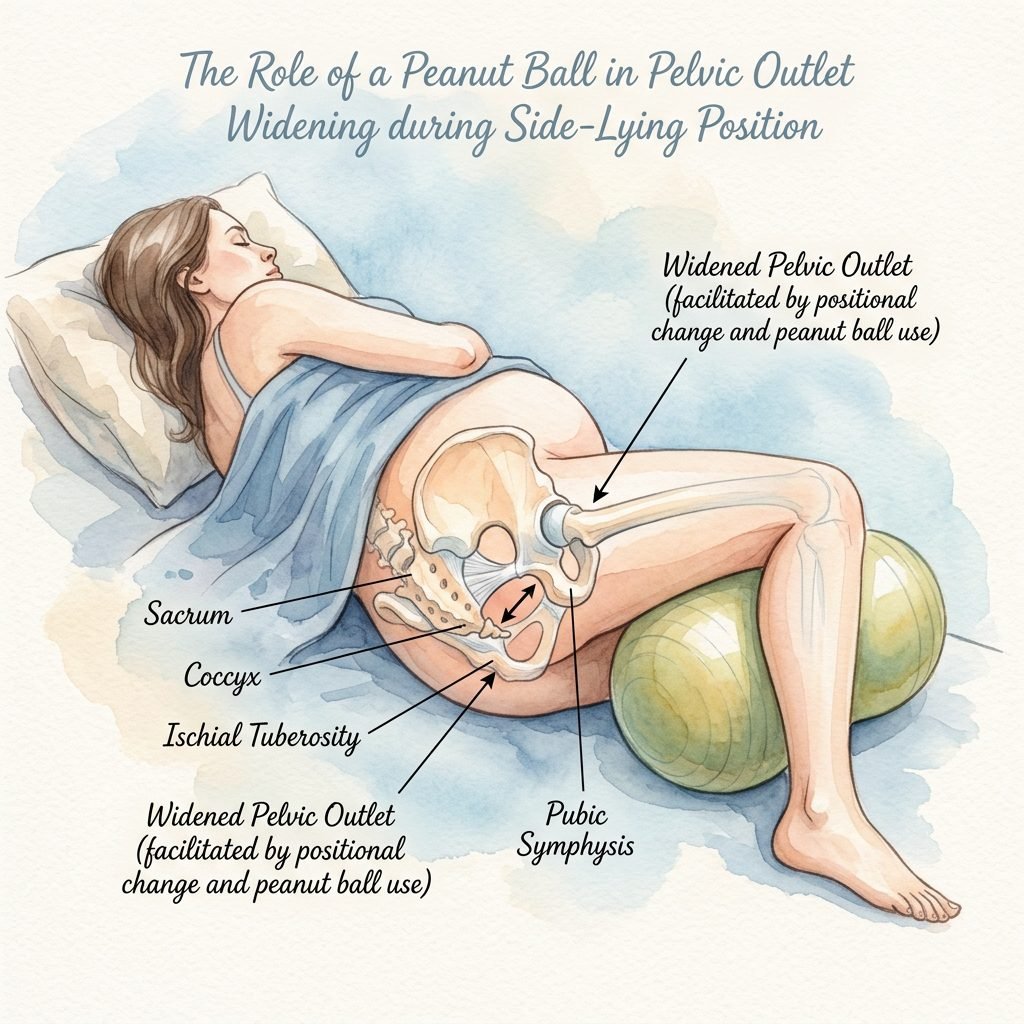
To understand why the peanut ball is so effective, we have to look at the anatomy of the female pelvis. Your pelvis isn’t one solid, unmoving bone; it is a series of joints and ligaments that become incredibly mobile during pregnancy thanks to the hormone relaxin. During labor, the goal is to maximize the diameter of the pelvic inlet, mid-pelvis, and outlet to allow the baby to rotate and descend.
When you use a peanut ball, especially in side-lying or asymmetrical positions, you are effectively widening the pelvic outlet by up to 2 centimeters. That might sound small, but in the world of birth, two centimeters is the difference between a baby who is ‘high and floating’ and a baby who is ‘engaged and ready.’ For those laboring without an epidural, this extra space means less friction, potentially less ‘back labor,’ and a more direct path for the baby to move down.
Benefits of Using a Peanut Ball Without an Epidural
- Enhanced Pelvic Mobility: It allows for movement even when you need to rest your legs.
- Optimal Fetal Positioning: Helps babies rotate from a posterior (sunny-side up) position to an anterior position.
- Reduced Labor Time: Studies have shown that peanut ball use can shorten the first stage of labor by over 90 minutes on average.
- Gravity Advantage: Even when lying down, the ball helps maintain a position that encourages descent.
| Labor Phase | Primary Goal | Peanut Ball Benefit |
|---|---|---|
| Early Labor | Rest and Dilation | Keeps pelvis open while you conserve energy. |
| Active Labor | Descent and Rotation | Encourages baby to turn and drop into the mid-pelvis. |
| Transition | Final Opening | Maximizes the pelvic outlet for the pushing stage. |
Finding Your Perfect Match: Sizing and Setup
Not All Peanut Balls Are Created Equal
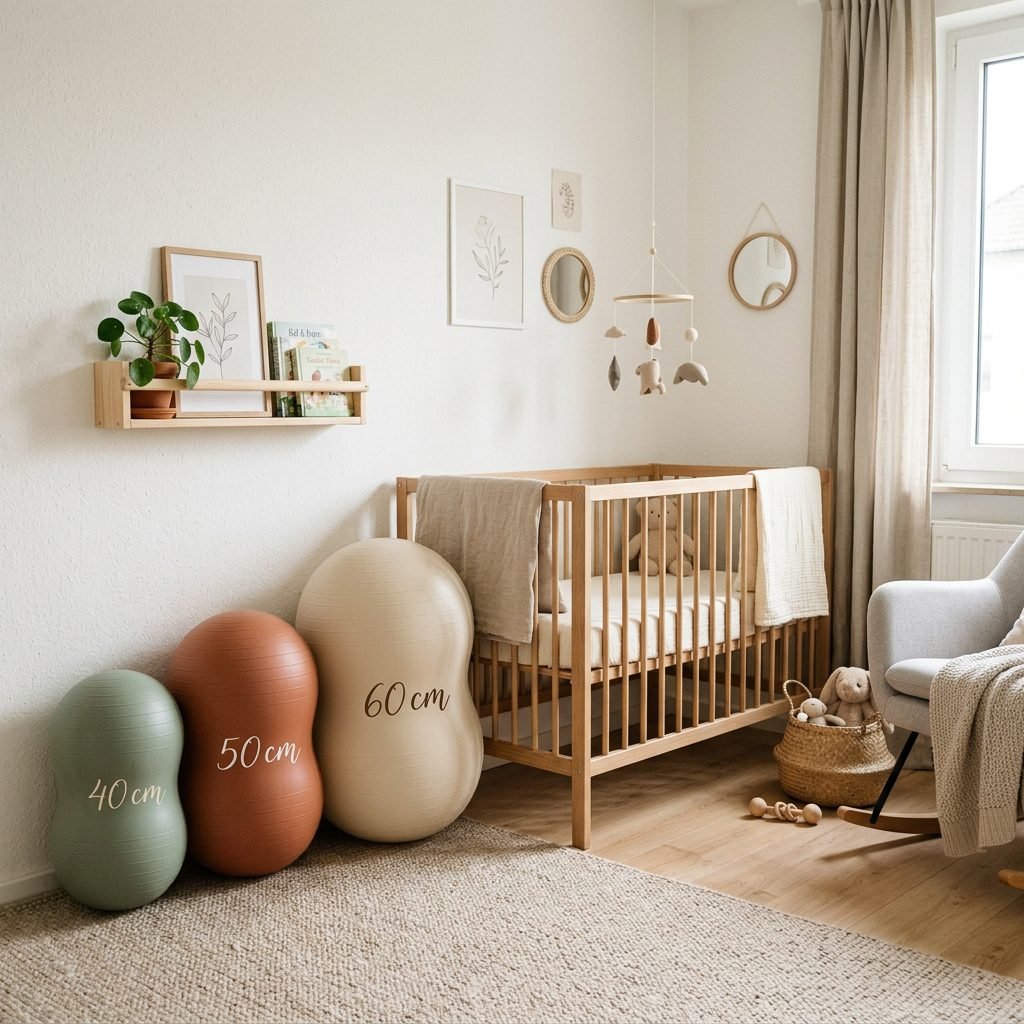
Before you pack your hospital bag or set up your home birth space, we need to make sure you have the correct size. Using a ball that is too big can overstretch your hips and cause discomfort, while a ball that is too small won’t provide enough pelvic opening to be effective. As a general rule, your height determines your ball size.
Size Guide for Mamas
- 40cm Ball (Small): Best for mamas under 5’3″ (160 cm). This is the most common size used in hospitals.
- 50cm Ball (Medium): Ideal for mamas between 5’3″ and 5’6″ (160-168 cm).
- 60cm Ball (Large): Best for mamas 5’7″ (170 cm) and taller.
Pro-Tip: When the ball is inflated, it should feel firm but have a slight ‘give’ when you press into it. If you are using a hospital ball, ask your nurse or doula to check the inflation level. You want your top leg to be supported in a way that your hip is slightly higher than your ankle, creating a downward slope that encourages the baby to move toward the birth canal.
To make the ball more comfortable (because let’s be honest, cold plastic isn’t the vibe), I always recommend wrapping it in a soft pillowcase or a warm towel. This helps with sensory comfort and absorbs any moisture if you are sweating through those powerful contractions.
Step-by-Step: Top 3 Positions for Unmedicated Labor
Mastering the Move: Physical Instructions
Since you are laboring without an epidural, you have the freedom to move! However, labor is an endurance event. Using the peanut ball allows you to get the benefits of an open pelvis while resting your muscles between contractions. Here are the three most effective positions:
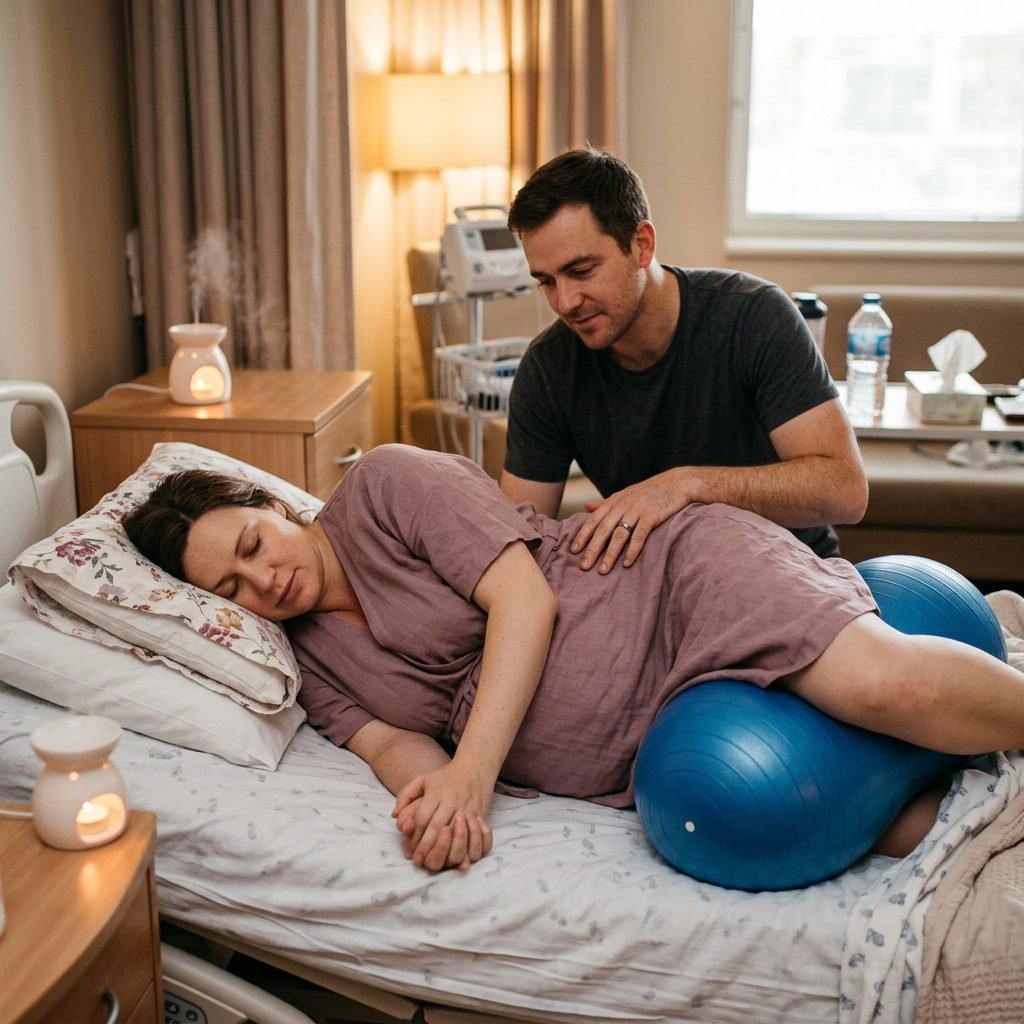
1. The Classic Side-Lying (The Restful Powerhouse)
This is the gold standard for when you need to breathe through contractions but your legs are feeling heavy.
- Lie on your left side (this optimizes blood flow to the placenta).
- Place the peanut ball between your thighs.
- Hook your top leg over the center ‘dip’ of the peanut ball.
- Ensure your top ankle is also supported by the ball or a pillow to keep your hips aligned.
- Hug a pillow to your chest to keep your upper body relaxed.
2. The Fire Hydrant (The Rotation Master)
Use this position if your provider mentions the baby is ‘OP’ (occiput posterior) or if you are feeling a lot of back labor.
- Start on all fours (hands and knees) on the bed or a soft mat.
- Place the peanut ball under one knee, lifting that hip higher than the other.
- Keep your hands or elbows on the bed for support.
- Gently rock your hips back and forth during the contraction.
3. The Forward-Leaning Hug (The Transition Support)
When labor gets intense and you feel the urge to go inward, this position provides a sense of security.
- Sit on the edge of the bed or a birthing stool.
- Place the peanut ball on the bed in front of you.
- Lean forward and ‘hug’ the ball, resting your head on your arms.
- Allow your belly to hang heavy between your knees, which should be spread wide.
“Every contraction is a wave that brings my baby closer to my arms. I am strong enough to ride them.”
Partner and Doula Support: How to Help

The Role of the Support Team
Mama, you are doing the hard work, but your partner or doula can be the ‘anchor’ that keeps the ball in place. Without an epidural, you might be moving quite a bit, and the ball can sometimes slide away. Here is how your support person can help:
- Stabilizing the Ball: Hold the ball steady so it doesn’t roll when you shift your weight.
- Counter Pressure: While you are in the side-lying position with the ball, your partner can apply firm pressure to your lower back or hips (the double hip squeeze) to relieve pressure.
- Hydration Cues: Every time you change positions (every 30-60 minutes), your partner should offer a sip of water or coconut water.
- Affirmations: Remind you that the work you are doing with the ball is opening the path for the baby.
| Position | Partner Action | What to Say |
|---|---|---|
| Side-Lying | Hip Squeeze | “You are opening so beautifully.” |
| Fire Hydrant | Lower Back Counter-Pressure | “The baby is moving down with every breath.” |
| Forward Hug | Shoulder Massage | “Relax your jaw, let the ball take your weight.” |
Tracking Your Progress and Knowing When to Switch
The 30-Minute Rule
In a natural labor, movement is your best friend. Even though the peanut ball is amazing, you don’t want to stay in one single position for hours. I recommend the 30-minute rotation. Spend 30 minutes on your left side with the ball, 30 minutes on your right side, and then perhaps 30 minutes upright or walking.
How do you know if the peanut ball is working? Look for these signs:
- Contraction Pattern: Contractions may become more regular or intense (this is good! It means the baby is pressing on the cervix).
- Pressure: You might feel an increase in rectal pressure, signaling the baby’s descent.
- Emotional Shift: You might move into ‘labor land’—that meditative state where you are less focused on the room and more focused on your body.
| Contraction Intensity | Rest Period | Peanut Ball Strategy |
|---|---|---|
| Mild / Talkative | 5-7 minutes | Gentle side-lying to encourage rest. |
| Strong / Focused | 3-4 minutes | Asymmetrical kneeling (Fire Hydrant) to assist rotation. |
| Intense / Transition | 1-2 minutes | Forward-leaning hug for maximum pelvic outlet opening. |
Common Questions About Peanut Balls in Natural Birth

Expert Tips for a Smooth Experience
Can I use a peanut ball if my water has broken?
Absolutely! In fact, it’s often encouraged to help keep the baby’s head applied to the cervix, which can help prevent the labor from slowing down after the membranes rupture.
What if the ball feels uncomfortable?
If a position feels ‘wrong’ or causes sharp pain (distinct from the intensity of a contraction), listen to your body and move. The peanut ball is a tool, not a requirement. Sometimes a slight adjustment of the ball’s angle is all you need.
Does it work for a fast labor?
If your labor is already moving like a freight train (precipitous labor), you might find the peanut ball too much. In these cases, it can actually be used to slow things down slightly by lying on your side with your knees together, though most mamas use it to keep things moving!
“I trust the rhythm of my labor and the strength of my body.”
Conclusion
You’ve Got This, Mama
Using a peanut ball without an epidural is one of the most proactive steps you can take to support your body’s natural ability to give birth. By understanding the biomechanics of your pelvis and utilizing these simple yet powerful positions, you are shortening the distance between you and your sweet baby. Remember, the goal isn’t just to ‘get through’ labor, but to work with it. The peanut ball is your teammate in that process.
Pack your ball (or make sure your hospital has one!), practice these positions with your partner during the third trimester, and go into your birth space knowing you have the tools to succeed. You are powerful, you are prepared, and you are so close to meeting your little one. Happy birthing!