

The Essential Hospital Birth Plan Checklist Every First-Time Mom Actually Needs
Welcome to Your Empowered Birth Journey, Mama
Hello, sweet mama. If you are reading this, you are likely navigating that beautiful, slightly nerve-wracking transition from pregnancy to parenthood. As your virtual doula and sister-in-arms, I want you to take a deep breath. Your body is capable, your voice matters, and your birth experience belongs to you.
A birth plan is often misunderstood. Some see it as a rigid contract, but in our world, we call it a ‘Birth Map’ or ‘Preferences List.’ It is a communication tool designed to help your medical team understand your values while you are busy doing the hard work of bringing life into the world. For a first-time mom, the hospital environment can feel clinical and overwhelming. This guide is here to soften those edges, providing you with an evidence-based, practical, and stylish approach to preparing for the big day.
We aren’t just checking boxes; we are setting the stage for a transformative experience. Whether you dream of an unmedicated water birth or you are counting down the minutes until your epidural, this checklist ensures your needs are met with dignity and grace.
Setting the Vibe: Creating Your Birth Sanctuary

Hospitals are designed for efficiency, but your birth space should be designed for oxytocin—the shy hormone that drives labor. To keep oxytocin flowing, we want to mimic a ‘nest.’ This means low lights, familiar scents, and a sense of privacy.
Environmental Preferences to Include:
- Lighting: Request that the overhead fluorescent lights be dimmed or turned off. Bringing battery-operated tea lights or fairy lights can transform a sterile room into a glowing sanctuary.
- Sound: Mention your preference for a quiet room or a specific birth playlist. High-fidelity Bluetooth speakers are a must-pack item.
- Scent: If your hospital allows it, specify the use of essential oil diffusers (lavender for calm, peppermint for nausea).
- Clothing: You do not have to wear the hospital gown! Mention if you prefer to wear your own soft nursing gown or a sports bra and skirt.
“I am safe, I am supported, and my birth space is a sanctuary of peace.”
The Movement Map: Labor Positions & Pain Management
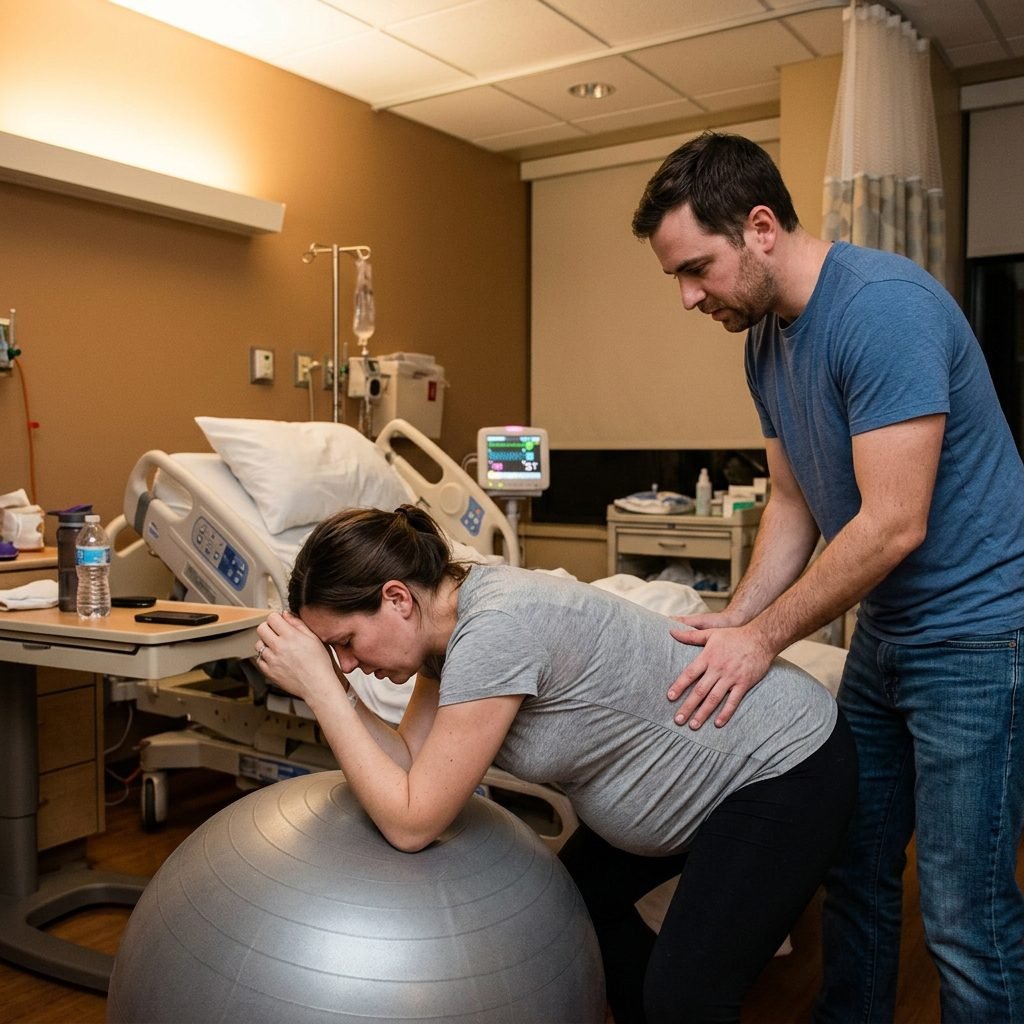
For first-time moms, labor can be a marathon, not a sprint. Staying mobile is one of the best ways to encourage your baby to descend and rotate. Your birth plan should clearly state your desire to move freely.
| Labor Phase | Suggested Position | The Purpose |
|---|---|---|
| Early Labor | The Curb Walk / Rest | Encourages baby to engage while conserving energy. |
| Active Labor | Hands and Knees / Swaying | Relieves back pressure and opens the pelvis. |
| Transition | Peanut Ball (Side-lying) | Opens the pelvic outlet even if you have an epidural. |
| Pushing | Squatting or Side-lying | Uses gravity to assist the baby’s exit. |
Pain Relief Preferences:
Be specific about how you want to handle intensity. You might choose to include a statement like: “Please do not offer me pain medication; I will ask for it if I decide I need it.” This prevents the ‘suggestive’ pressure that can sometimes disrupt a mother’s focus.
- Hydrotherapy: If a tub or shower is available, list this as a primary comfort measure.
- Nitrous Oxide: A great ‘middle ground’ that provides anxiety relief without the numbness of an epidural.
- Epidural: If you want an epidural, specify if you’d like a ‘walking epidural’ (if offered) or if you want to wait until a certain dilation.
Medical Interventions: Navigating the ‘What-Ifs’
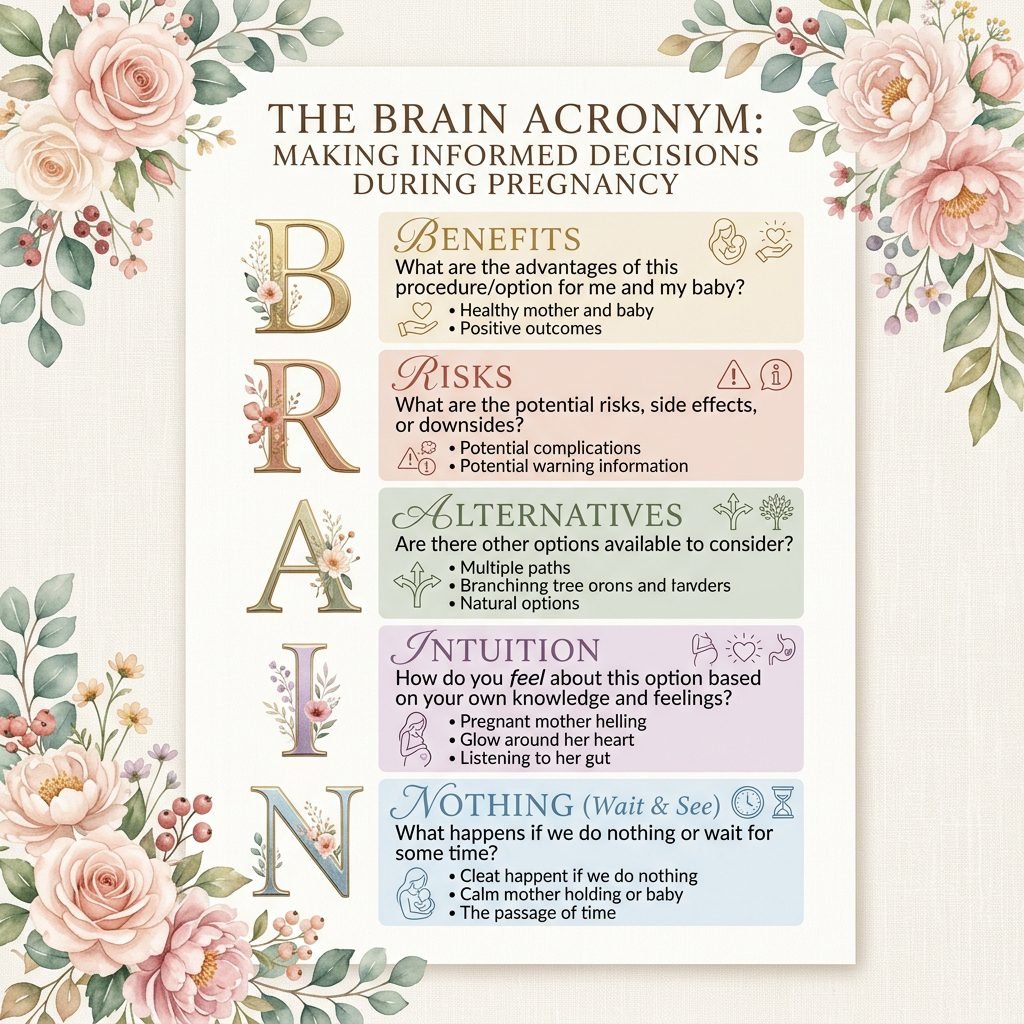
Birth is unpredictable, and sometimes the plan needs to shift. The goal is Informed Consent. You have the right to understand every intervention before it happens. Use the BRAIN acronym to guide your decisions.
- B: Benefits – How will this help me or the baby?
- R: Risks – What are the potential side effects?
- A: Alternatives – Is there another way?
- I: Intuition – What does my gut say?
- N: Nothing – What happens if we wait 30 minutes?
Specific Intervention Preferences:
In your plan, address common procedures such as:
- Continuous vs. Intermittent Monitoring: If you are low-risk, intermittent monitoring allows for more movement.
- Saline Lock: Request a saline lock instead of a continuous IV drip to maintain mobility.
- Episiotomy: State that you prefer natural tearing over a routine episiotomy.
- Assisted Delivery: Express your preference regarding the use of vacuum or forceps if the need arises.
The Golden Hour: Newborn Care & Postpartum

The first 60 minutes after birth are sacred. This is when your baby transition to the outside world and your breastfeeding journey begins. Your birth plan should protect this time fiercely.
| Procedure | Preference | Why It Matters |
|---|---|---|
| Cord Clamping | Delayed (1-3 mins) | Increases baby’s iron stores and stem cell count. |
| Skin-to-Skin | Immediate & Uninterrupted | Regulates baby’s temp, heart rate, and blood sugar. |
| Vitamin K / Erythromycin | After the first hour | Allows for bonding before routine medical checks. |
| Vernix | Do not wipe off | Provides natural antibacterial protection for baby’s skin. |
Feeding and Rooming-In:
Clearly state your feeding intentions. If you are breastfeeding, request that no formula or pacifiers be given without your express consent. Also, request ‘rooming-in,’ which means the baby stays with you 24/7 rather than going to a nursery, allowing you to learn their early hunger cues.
The Partner’s Script: Advocacy and Support

Your partner is your gatekeeper. While you are in ‘labor land,’ they are your voice. Give them the tools they need to protect your birth space. You can include a section in your plan specifically for the staff regarding your partner’s role.
“My partner is my primary support. Please address all non-urgent questions to them first so I can remain focused on my contractions.”
Partner’s Checklist for the Hospital:
- Hydration: Ensure the mama has sips of water or coconut water every 20 minutes.
- Atmosphere: Keep the room dark and the music playing.
- Advocacy: Use the BRAIN acronym if the medical team suggests a change in plan.
- Physical Support: Be ready to provide counter-pressure on the hips or a cold washcloth for the forehead.
Conclusion
Your Birth, Your Power
Mama, as you finalize this checklist, remember that the most important thing you can bring to the hospital isn’t a piece of paper—it’s your intuition and confidence. This plan is a framework, a way to visualize your best-case scenario while remaining flexible enough to dance with the rhythm of labor. You are about to do something miraculous. Trust your body, trust your baby, and know that no matter how the story unfolds, you are a warrior.
Print two copies of your plan: one for your chart and one to tape to the wall of your labor room. You’ve got this!