

8 Non-Pharmacological Pain Relief Techniques Your Doula Wants You to Know
Embracing Your Inner Power: The Doula’s Approach to Comfort
Hello, sweet mama. If you are reading this, you are likely preparing for one of the most transformative journeys of your life. Whether you are planning a completely unmedicated birth or you simply want a robust toolkit of comfort measures to get you through early labor before an epidural, I want you to know one thing: your body was designed for this. As a doula, my goal isn’t just to help you ‘get through’ labor; it’s to help you feel powerful, supported, and in control of your experience.
Labor is often described as a marathon, but I like to think of it as a rhythmic dance between you and your baby. While modern medicine offers many wonderful pharmacological options, there is a deep, ancient wisdom in non-pharmacological techniques. these methods don’t just ‘mask’ the sensation; they work with your body’s physiology to encourage progress, reduce stress hormones, and flood your system with oxytocin—the hormone of love and labor. Today, we are diving deep into the eight essential techniques I share with every client to help them find their flow and meet their baby with grace.
The Power of Pelvic Movement and The Labor Dance

One of the biggest myths about labor is that you have to stay in a bed. In fact, movement is your greatest ally. When you move your hips, you are actively helping your baby navigate the bony pelvis. Think of it as a lock and key—as you sway, tilt, and rock, you are helping the ‘key’ (your baby) find the perfect fit through the ‘lock’ (your pelvic outlet).
How to Perform the Labor Dance
- Wrap your arms around your partner’s neck or shoulders, allowing your upper body to go completely limp and heavy.
- Widen your stance and slightly bend your knees to take the pressure off your lower back.
- Sway your hips slowly from side to side, mimicking a slow dance.
- Let your partner rub your lower back or provide a steady ‘double hip squeeze’ while you move.
- Incorporate ‘The Curb Walk’ if labor stalls, stepping one foot up onto a curb or a low step and back down to create asymmetrical pelvic opening.
“Movement is the medicine for labor. If you feel stuck, change your view, change your position, and let gravity do the heavy lifting.”
Hydrotherapy: The ‘Midwife’s Epidural’

There is a reason why many doulas and midwives call the shower or birth tub the ‘midwife’s epidural.’ Water has a profound effect on the nervous system. The buoyancy of water relieves the weight of the pregnant belly, while the warmth helps muscles relax, breaking the Fear-Tension-Pain cycle.
Using Water Effectively
- The Shower: Aim the warm spray directly onto your lower back or the top of your belly where you feel the most intensity. The rhythmic ‘pitter-patter’ of the water acts as a form of sensory distraction.
- The Birth Tub: Waiting until you are in active labor (usually around 6 centimeters) to enter the tub can provide a dramatic ‘reset’ for your pain management.
- Temperature Control: Ensure the water is warm but not hot (staying under 100 degrees Fahrenheit) to keep both you and baby safe.
| Phase of Labor | Suggested Hydrotherapy | Benefit |
|---|---|---|
| Early Labor | Warm Shower | Relaxation and distraction |
| Active Labor | Deep Immersion Tub | Buoyancy and significant pain reduction |
| Transition | Warm Compresses | Targeted relief for perineal stretching |
The Peanut Ball and Birth Ball: Gravity’s Best Friends

If you find yourself needing to labor in bed—perhaps due to an epidural or simply exhaustion—the peanut ball is your best friend. This peanut-shaped exercise ball is placed between your legs to keep the pelvis open even when you are lying down. For those who are mobile, the standard birth ball (exercise ball) allows for active resting.
Positions to Try
- The Forward Lean: Kneel on a soft mat and lean your chest over the birth ball. This encourages the baby into an Optimal Fetal Position (OA).
- The Pelvic Tilt: Sit on the ball and make small circles or figure-eights with your hips to loosen the lower back.
- The Side-Lying Peanut: While in bed, lie on your side with the peanut ball between your knees and ankles to open the pelvic outlet by up to 30%.
Rhythmic Breathing and Vocalization

When we feel pain, our natural instinct is to hold our breath and tighten our shoulders. In labor, this deprives your uterus of oxygen and slows things down. Doulas teach ‘Low Tones’ to keep the ‘bottom’ open. There is a physiological connection between the jaw and the pelvic floor—if your jaw is tight, your cervix is likely tight too.
The ‘Horse Lips’ Technique
- Inhale deeply through your nose, expanding your ribcage.
- Exhale through loose, floppy lips, making a ‘brrrr’ or ‘pffff’ sound, like a horse.
- Keep your jaw unhinged and your throat open.
- Direct your sound downward. Instead of high-pitched screams, use low, guttural moans like ‘Oooooo’ or ‘Aaaaaa.’
“Keep your face soft, and your bottom will follow. Let the breath carry the contraction away like a wave.”
Counter Pressure and The Double Hip Squeeze
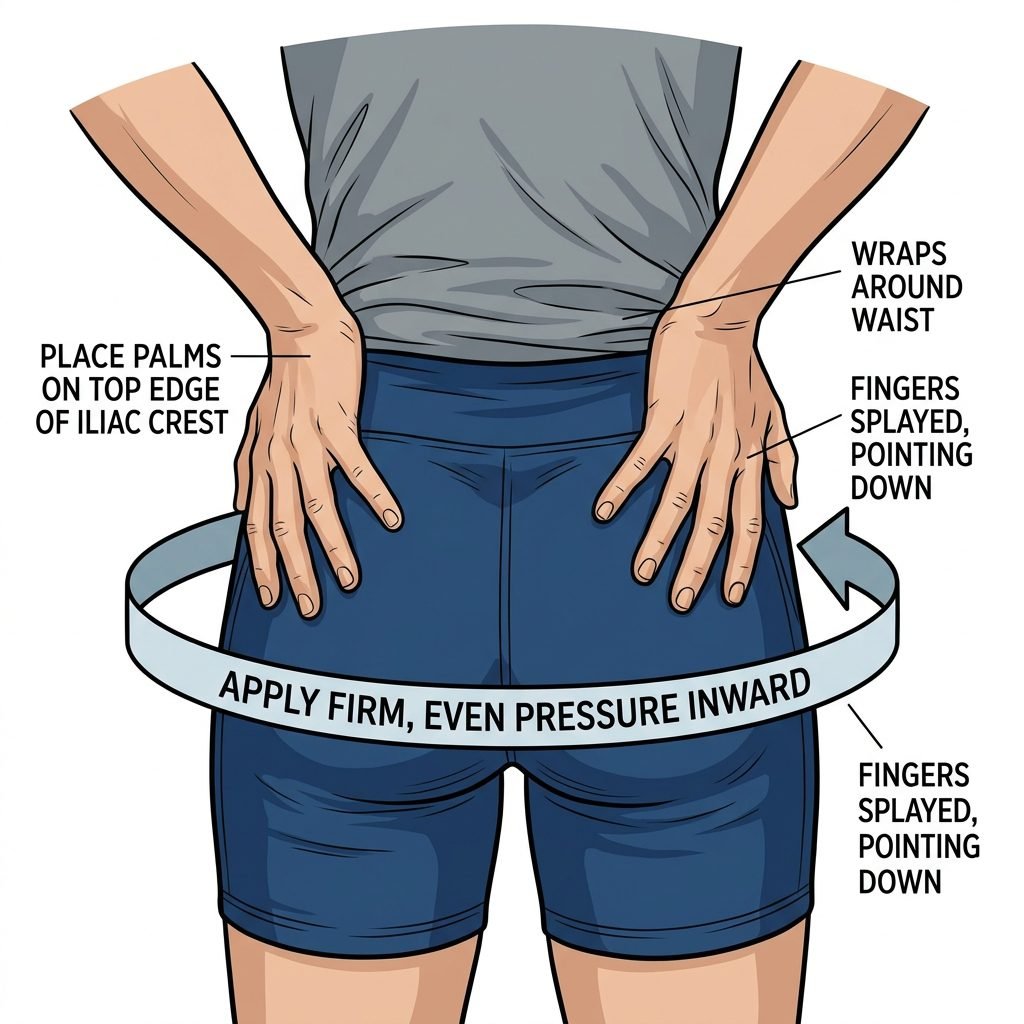
For many women, labor is felt intensely in the lower back (often called ‘back labor’). This is where your partner or doula becomes a physical anchor. Counter pressure involves applying firm, steady force to the sacrum to counteract the internal pressure of the baby’s head.
Step-by-Step Double Hip Squeeze
- The laboring person leans forward onto a bed, counter, or birth ball.
- The partner stands behind and places their hands on the fleshy part of the hips (the iliac crests).
- Apply firm pressure inwards toward the spine and slightly upwards.
- Hold the pressure for the entire duration of the contraction.
- Communicate! Ask “Harder?” or “Lower?” to find the sweet spot.
| Technique | Best For… | Partner Action |
|---|---|---|
| Counter Pressure | Back Labor | Palm of hand pressing on the sacrum |
| Double Hip Squeeze | Pelvic Pressure | Squeezing hips together firmly |
| Knee Press | Sitting labor | Pushing back on knees while sitting |
Aromatherapy and Sensory Mastery

Your environment dictates your safety levels. If the lights are too bright or the room smells like ‘hospital,’ your adrenaline might rise, which can stall labor. Aromatherapy is a powerful way to signal to your brain that you are safe and relaxed.
- Lavender: The gold standard for relaxation and anxiety reduction.
- Peppermint: Excellent for curbing the nausea that often strikes during transition. (Pro-tip: Just sniff the bottle or a cotton ball; don’t diffuse it if you’re sensitive).
- Clary Sage: Known to help strengthen contractions (use only once labor has naturally started).
- Dim Lighting: Use battery-operated tea lights to create a ‘birth cocoon.’
The TENS Machine: High-Tech Distraction
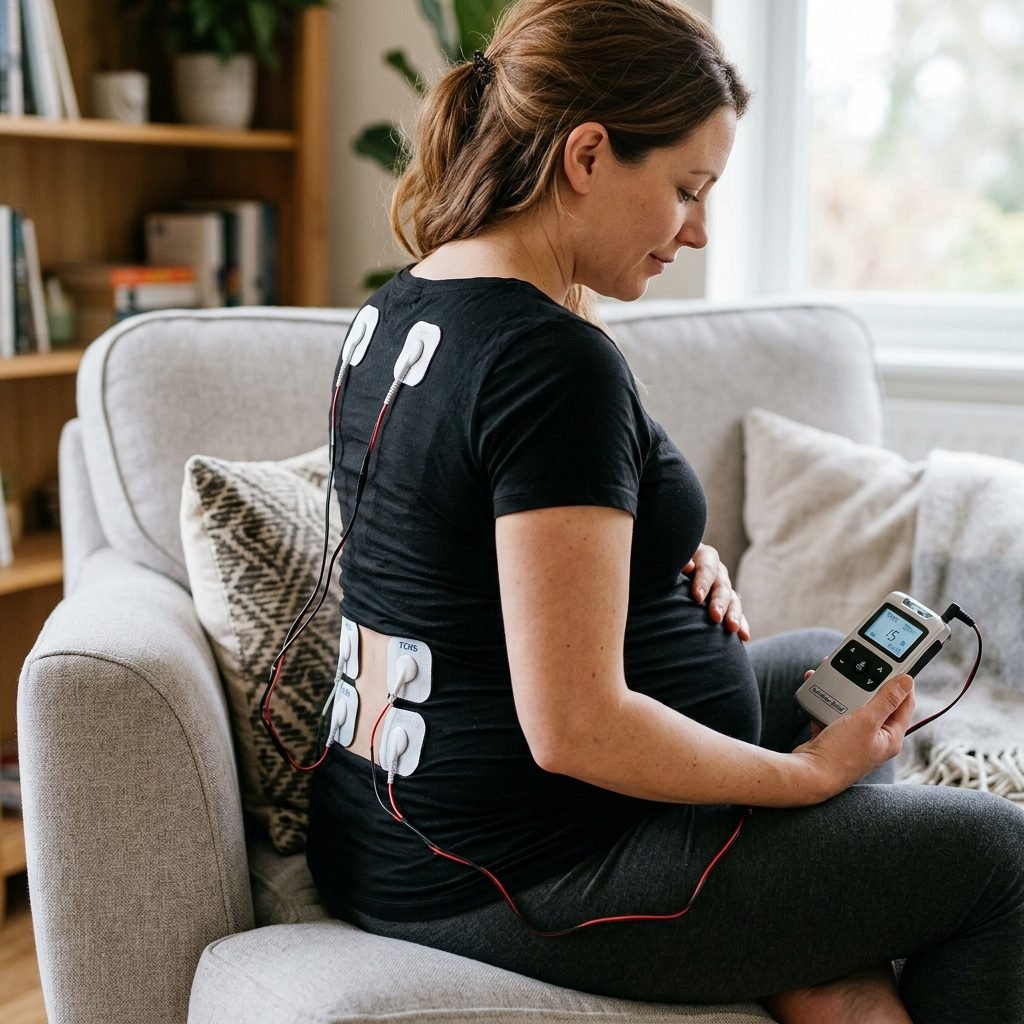
A TENS (Transcutaneous Electrical Nerve Stimulation) machine is a small device that sends tiny electrical pulses through pads placed on your back. It works on the ‘Gate Control Theory’ of pain—the idea that the brain can only process so many signals at once. The tingling sensation of the TENS ‘shuts the gate’ on the slower-moving pain signals from the uterus.
TENS Best Practices
- Start Early: Put the TENS on in early labor to build up your body’s natural endorphins.
- Control the Boost: Most units have a ‘boost’ button for the peak of a contraction.
- Safety Note: Do not use a TENS machine in the water (shower or tub).
Visualization and Birth Affirmations

The mind is the most powerful tool in the birth room. When the intensity peaks, visualization helps you reframe the sensation from ‘pain’ to ‘purposeful work.’ Instead of fighting the contraction, imagine it as a wave bringing you closer to the shore where your baby is waiting.
Affirmations to Repeat
“Each contraction is not stronger than me, because it IS me.”
“My body is opening like a blooming flower.”
“I can do anything for 60 seconds.”
| Negative Thought | Empowered Reframing |
|---|---|
| “I can’t do this.” | “I am doing this right now.” |
| “The pain is too much.” | “These sensations are bringing my baby closer.” |
| “It will never end.” | “Every wave has a peak and a rest.” |
Conclusion
You Are Ready for This
Mama, as you prepare your birth plan, remember that these techniques are not just ‘alternatives’—they are powerful, evidence-based tools that honor the physiological process of birth. Whether you use one or all eight, the most important thing is that you feel supported and heard. Your doula, your partner, and your birth team are there to hold the space for you, but the strength? That is all yours.
Trust your instincts, move your body, and breathe deep. You are about to meet the love of your life, and you have everything you need within you to bring them into the world with peace and power.