
How Deep Squatting Positions Can Shave Hours Off Your Active Labor
“Your body is not a lemon. You are not broken. You are a beautifully designed vessel, and childbirth is the grandest expression of your strength.”
Welcome, mama. If you are reading this, you are likely nearing the finish line of your pregnancy, packing that hospital bag, and wondering exactly what active labor is going to feel like. As a doula and maternal wellness expert, I hear the same whispered fear from almost every expectant mother: “How long is this going to take, and how can I speed it up safely?” While every birth story is uniquely beautiful and unfolds on its own timeline, there are incredible, evidence-based biomechanical tools we can use to encourage your baby’s descent. One of the most powerful tools in your birthing toolkit? The deep squat.
For centuries, women across the globe have instinctively labored and birthed in upright, squatting positions. It is only in recent modern medical history that we shifted to laboring on our backs—a position that actually works against gravity and narrows the pelvic opening. Deep squatting during active labor is not just a fitness trend; it is a physiological masterclass in opening the pelvis, harnessing the earth’s gravity, and guiding your baby down the birth canal. By adopting specific squatting techniques, you can potentially shave hours off your active labor, reduce the need for medical interventions, and feel more empowered and in control of your contractions. Grab a cup of red raspberry leaf tea, get cozy, and let’s dive into the transformative magic of the labor squat.
The Biomechanics of a Deep Squat: Why Your Pelvis Loves It
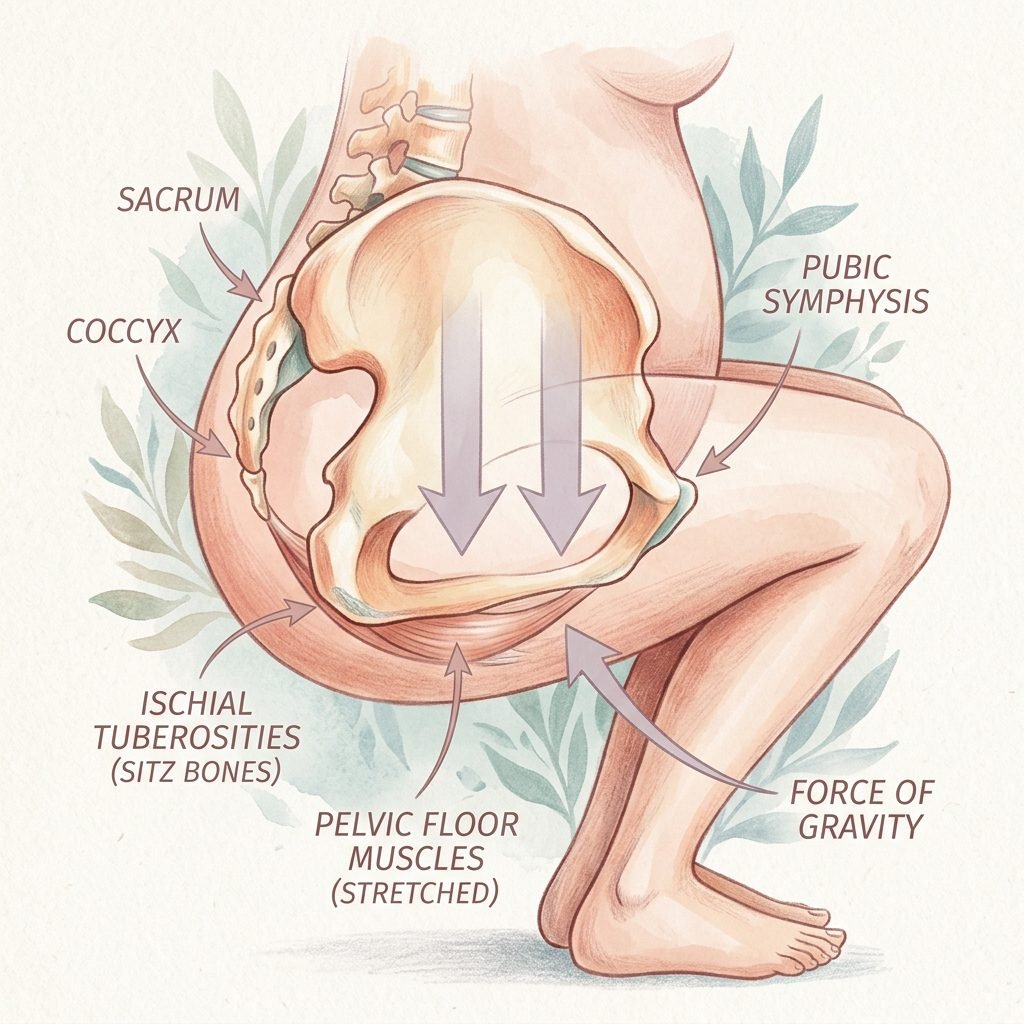
The Anatomy of Opening Up
To understand why deep squatting is so miraculous, we have to look at the beautiful architecture of your pelvis. During pregnancy, your body releases a hormone aptly named relaxin. This hormone loosens the ligaments and joints in your pelvic region, transforming it from a rigid bony structure into a dynamic, flexible passageway. When you lower yourself into a deep squat, your femurs (thigh bones) act as levers. They push the ischial tuberosities—commonly known as your sitz bones—apart.
The 28 Percent Rule
Clinical studies and biomechanical research show that a deep, supported squat can open the pelvic outlet (the bottom of the pelvis where the baby exits) by up to 28% to 30% compared to lying flat on your back. That is a massive amount of extra space for your baby to navigate! Furthermore, squatting shifts the sacrum (the tailbone) backward, giving the baby’s head a clear, unobstructed path to descend.
Gravity is Your Best Birth Partner
When you are upright and squatting, gravity is doing a significant portion of the work for you. The weight of the baby’s head presses firmly against your cervix. This steady, even pressure stimulates the release of oxytocin, the hormone responsible for contractions. More oxytocin means more efficient, productive contractions, which is exactly how you safely accelerate active labor.
Step-by-Step: Mastering the Perfect Supported Labor Squat
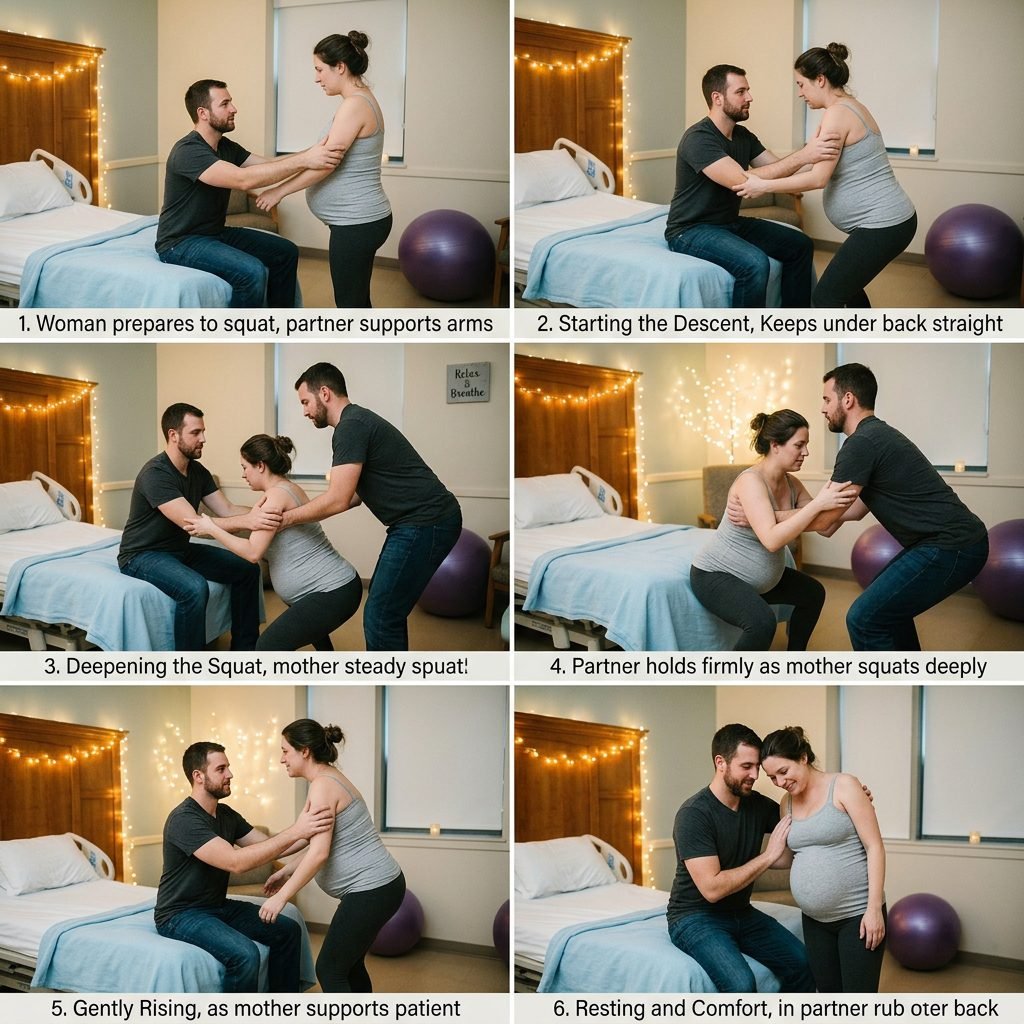
Empowering Physical Preparation
Dropping into a deep squat during the intensity of a contraction requires form, focus, and preferably, a fantastic birth partner. You do not want to waste your precious energy holding yourself up; you want your leg muscles to be supported so your pelvic floor can completely relax. Here is your step-by-step physical guide to executing the perfect supported partner squat during active labor.
The Partner-Supported Deep Squat
- Position the Partner: Have your birth partner sit on the edge of a sturdy bed, a birth stool, or a stable chair with their legs spread wide and their feet firmly planted on the floor.
- Establish the Stance: Stand between your partner’s knees, facing away from them. Keep your feet slightly wider than hip-width apart, with your toes pointed outward at a 45-degree angle.
- The Descent: As a contraction begins, deeply inhale. On the exhale, slowly bend your knees and lower your hips straight down toward the floor, keeping your spine as straight as possible.
- Anchor and Support: Drape your arms over your partner’s thighs, or have your partner wrap their arms securely under your armpits and across your chest to bear the majority of your upper body weight.
- Relax the Pelvic Floor: Crucial step: Do not clench! Visualize your pelvic floor melting like butter. Let your bottom hang heavy. Your partner is holding you; you are safe.
- Breathe Through the Peak: Use low, deep vocalizations (think low “moos” or “ohms” rather than high-pitched screams) to keep the jaw relaxed, which directly correlates to a relaxed cervix.
- The Ascent: As the contraction fades, use your partner’s support to slowly stand back up, or gently lower yourself onto a soft mat or birth ball to rest before the next wave.
“Breathe in strength, breathe out tension. I am opening. My baby is descending. I am safe in this space.” — Your Labor Affirmation
Squatting Variations for Every Phase of Labor
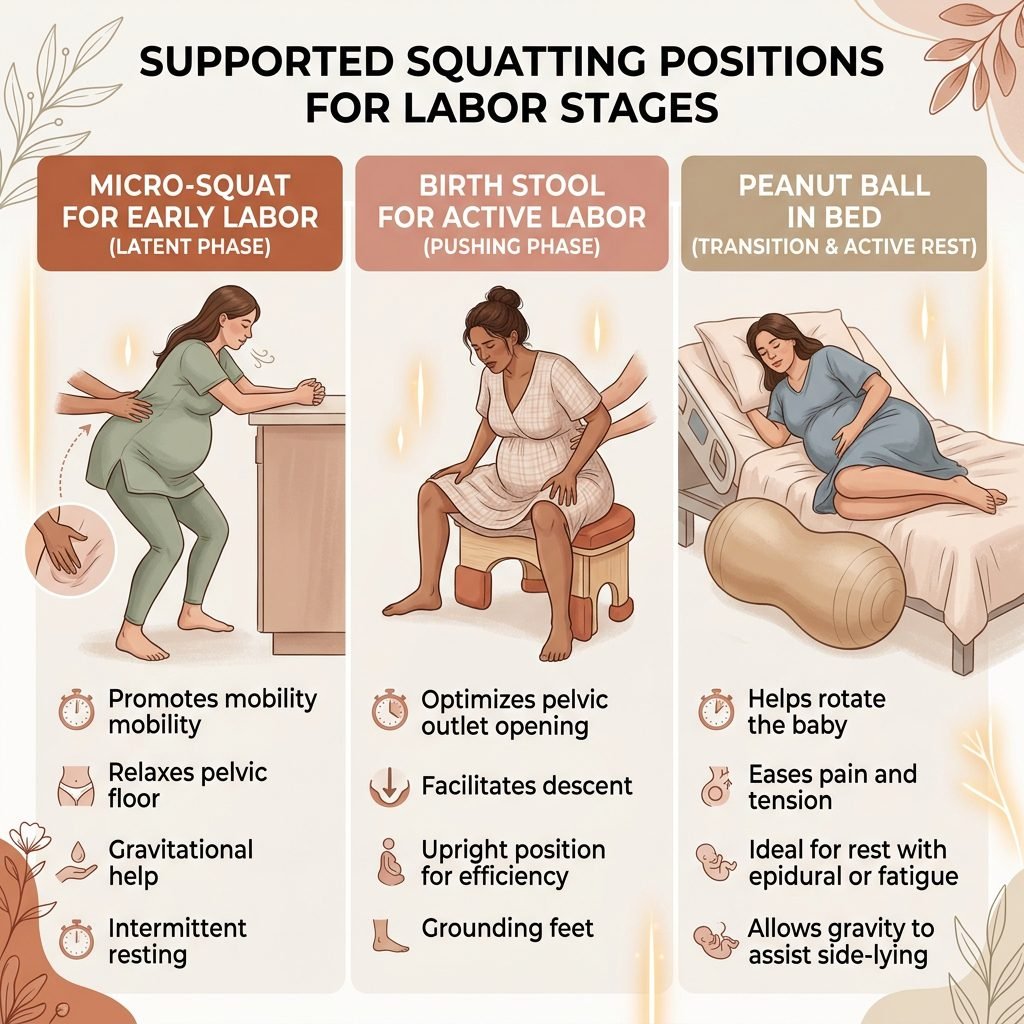
Adapting the Squat to Your Journey
Not all squats are created equal, and what feels amazing in early labor might feel impossible during transition. It is essential to listen to your body and adapt your positions as your baby moves down the maternal stations. Below is a comprehensive guide to matching your squatting variation to your specific phase of labor.
Position vs. Labor Phase Matrix
| Labor Phase | Squat Variation | Why It Works & When to Use It |
|---|---|---|
| Early Labor (0-5cm) | Standing Sway / Micro-Squats | Keeps you mobile without exhausting your leg muscles. Encourages baby to engage in the pelvic brim. |
| Active Labor (6-8cm) | Supported Deep Squat (Partner or Bar) | Maximizes pelvic opening and utilizes gravity during intense contractions. Accelerates dilation. |
| Transition (8-10cm) | Asymmetrical Squat (One foot elevated) | Helps rotate a baby that might be slightly “stuck” or OP (sunny-side up) by opening one side of the pelvis more than the other. |
| Pushing Phase | Birth Stool Squat | Provides a grounded place to rest between pushes while maintaining a 28% wider pelvic outlet for delivery. |
| Epidural Labor | Side-Lying Modified Squat (Peanut Ball) | Mimics the pelvic opening of a squat while lying safely in bed. Crucial for mothers with limited lower-body mobility. |
Tools of the Trade: Squat Bars, Rebozos, and Birth Balls

Setting Up Your Birth Environment
Whether you are birthing at a hospital, a birthing center, or in the comfort of your own home, having the right tools can make squatting infinitely more accessible and comfortable. As a doula, I always ensure my clients have access to these three game-changing props.
The Hospital Bed Squat Bar
If you are delivering in a hospital, ask your nurse to install the squat bar on your bed as soon as you are admitted in active labor. This is a sturdy metal bar that arcs over the lower half of the bed. You can drape a sheet over it, hold onto it, and drop into a deep squat right on the mattress. It is an excellent way to utilize gravity while staying in the immediate vicinity of your medical team.
The Traditional Rebozo
A Rebozo is a traditional Mexican woven shawl that doulas use for comfort measures. Your partner can loop the Rebozo securely around your lower back and hold the ends firmly while you squat, taking the pressure off your lower back and providing a beautiful sense of containment and support. It is stylish, deeply comforting, and incredibly effective.
The Peanut Ball
If you choose to have an epidural, you will not be able to safely stand and do a deep physical squat. Enter the peanut ball! By lying on your side and wrapping your upper leg over a peanut-shaped exercise ball, you mimic the exact biomechanics of a deep squat, opening the pelvic outlet without requiring any leg strength. It is an absolute must-have for a medicated birth.
When NOT to Squat: Listening to Your Body and Your Baby

Safety First: Knowing Your Baby’s Station
As much as I advocate for the deep squat, it is vital to acknowledge that it is not the magical solution for every single moment of labor. There is a very specific time to utilize this tool, and times when it might actually be counterproductive.
The Pelvic Inlet vs. The Pelvic Outlet
Here is a crucial doula secret: while a deep squat opens the bottom of the pelvis (the outlet), it actually slightly narrows the top of the pelvis (the inlet). Therefore, if you are in very early labor and your baby is still “high” (meaning they are at a -3 or -2 station and haven’t fully engaged in the pelvis yet), deep squatting might prevent them from dropping down. In early labor, focus on walking, curb walking, and gentle swaying.
Listen to the Professionals
Save the deep, sustained squats for active labor and pushing, once the baby has engaged and is making their way down. Additionally, you should avoid unsupported deep squats if you have profound pelvic girdle pain (SPD), extreme fatigue, or if your medical provider advises against it due to the baby’s heart rate or position (such as a breech presentation). Always listen to your body—if a position causes sharp, unnatural pain, intuitively shift out of it. Your body knows how to birth this baby.
Conclusion
My beautiful friend, as you prepare for the miraculous journey of bringing your baby into the world, remember that you are equipped with ancient, cellular wisdom. Deep squatting is just one of the many ways you can work in harmony with your body rather than fighting against it. By understanding the biomechanics of your pelvis, utilizing gravity, and leaning on your support team, you can actively participate in shaving hours off your labor and bringing your baby down into your arms.
Practice your squats safely during your third trimester, communicate your desires in your birth plan, and above all, give yourself immense grace. Whether your birth involves unmedicated deep squats, a peanut ball with an epidural, or a beautiful belly birth (C-section), you are doing sacred, monumental work. You are strong, you are capable, and you are going to be an incredible mother.