
5 Gentle Sensory Tricks to Keep Your Sleepy Newborn Awake While Breastfeeding
Welcome to the Sweet, Sleepy Fog of Early Motherhood
Oh, mama, take a deep breath. You are doing an incredible job. If you’re reading this in the middle of the night, or while your little one is currently snoozing away mid-latch, know that you are not alone. The ‘sleepy newborn’ phase is a real, physiological phenomenon. While it seems like a blessing to have a baby who can sleep through a brass band, it can become quite a challenge when those 2:00 AM feedings turn into a twenty-minute nap for the baby and a marathon of frustration for you. As a doula, I’ve sat on many bedsides helping mothers navigate this exact hurdle.
Newborns are biologically wired to be sleepy, especially in the first two weeks of life. They are recovering from the marathon of birth, and their systems are adjusting to the outside world. However, ensuring they stay awake long enough to get a full feeding is crucial for their weight gain, your milk supply, and—eventually—stretching out those sleep intervals. When a baby ‘snack-naps’ (taking just enough milk to take the edge off and then falling asleep), they often wake up hungry again within the hour, leading to the exhausting cycle of cluster feeding. Our goal today is to give you a toolkit of gentle sensory tricks to keep your baby engaged, alert, and full.
The Science of the Sleepy Newborn: Why Do They Drift Off?

Understanding the ‘Milk Coma’
Before we dive into the tricks, let’s talk about why this happens. It’s not just that they’re tired! Breast milk contains a hormone called cholecystokinin (CCK), which induces sleepiness in both the baby and the mother. Additionally, the warmth of your body and the rhythmic sound of your heartbeat act as a natural sedative. For some babies, especially those with physiological jaundice, the sleepiness can be even more pronounced because their bodies are working hard to process bilirubin.
Is My Baby Getting Enough?
It is important to track output during these sleepy days. If your baby is difficult to wake but is meeting their diaper milestones, you are likely doing great. Use the table below as a quick reference guide for what to expect in the first week.
| Baby’s Age | Wet Diapers | Soiled Diapers |
|---|---|---|
| Day 1 | 1+ | 1+ (Meconium) |
| Day 3 | 3+ | 3+ (Transitional) |
| Day 5+ | 6+ | 3-4+ (Yellow/Seedy) |
Mama, remember: a sleepy baby isn’t a ‘lazy’ baby. They are just tiny humans learning a very complex new skill while being incredibly cozy in your arms.
Trick 1: The Tactical Undressing (Temperature Regulation)

Cooling Down the ‘Cuddle Oven’
One of the most common reasons babies fall asleep is that they are simply too warm. We have a natural instinct to bundle our babies in swaddles and hats, but breastfeeding generates a significant amount of body heat. When you combine a warm baby, a warm mama, and a full belly, sleep is inevitable.
The Skin-to-Skin Advantage
- Strip baby down to a diaper: This provides immediate sensory input. The slight coolness of the air on their skin acts as a gentle wake-up call.
- Unbutton your own shirt: Direct skin-to-skin contact releases oxytocin, which helps your milk let down, but the tactile sensation of skin-on-skin also keeps the baby’s nervous system more alert than if they were wrapped in layers of fleece.
- Ditch the hat: Babies release a lot of heat through their heads. Removing the hat during a feeding helps regulate their temperature and keeps them from slipping into a deep sleep state.
Pro-Tip: Keep a cool, damp washcloth nearby. If baby starts to drift, a gentle pat on the forehead or the back of the neck with the cool cloth can provide just enough sensory ‘surprise’ to bring them back to the task at hand.
Trick 2: The Gentle Massage & ‘The C-Shape’ Tickle

Targeting Sensory Hotspots
Babies have specific areas on their bodies that are more sensitive to touch. By stimulating these areas, you can send signals to their brain to stay awake without being jarring or aggressive. We want to be persistent but gentle.
Where to Focus Your Touch:
- The Soles of the Feet: Instead of just rubbing the foot, use your thumb to draw firm circles or a ‘C-shape’ on the bottom of the foot. This is more stimulating than a light tickle, which babies often just ignore.
- The Earlobes: Gently trace the outer rim of the ear or give the lobe a tiny, soft tug.
- The Palms: Newborns have a strong palmar grasp reflex. Stroking their palm can cause them to squeeze your finger, which engages their motor system and helps keep them awake.
- Under the Chin: While they are latched, use your fingertip to gently stroke the area under their chin. This often encourages a swallow reflex.
“If baby’s jaw stops moving, your hands should start moving. Think of yourself as a gentle coach, cheering them on through touch.”
Trick 3: The Mid-Meal Reset (The Diaper Change)

Breaking the Sleep Cycle
If you find that your baby does well for the first 5 to 7 minutes and then falls into a deep slumber, it’s time for the ‘Mid-Meal Reset.’ Most traditional advice suggests changing the diaper before a feeding, but for a sleepy baby, the middle of the feeding is the strategic sweet spot.
How to Execute the Reset:
- Feed on the first side: Let them nurse until they truly drift off and stop active swallowing.
- The Break: Unlatch them, and immediately head to the changing table. The movement, the cool air, and the sensation of the wipe will almost certainly wake them up.
- The Second Half: Once they are alert and perhaps a bit ‘vocal’ about the interruption, bring them back to the second breast. They will likely approach the second side with renewed vigor.
This technique is also excellent for ensuring they get to the hindmilk—the fattier, more calorie-dense milk that comes toward the end of a feeding session, which helps with satiety and longer sleep stretches later.
Trick 4: Breast Compressions & Position Changes
Keeping the ‘Milk Flow’ Interesting
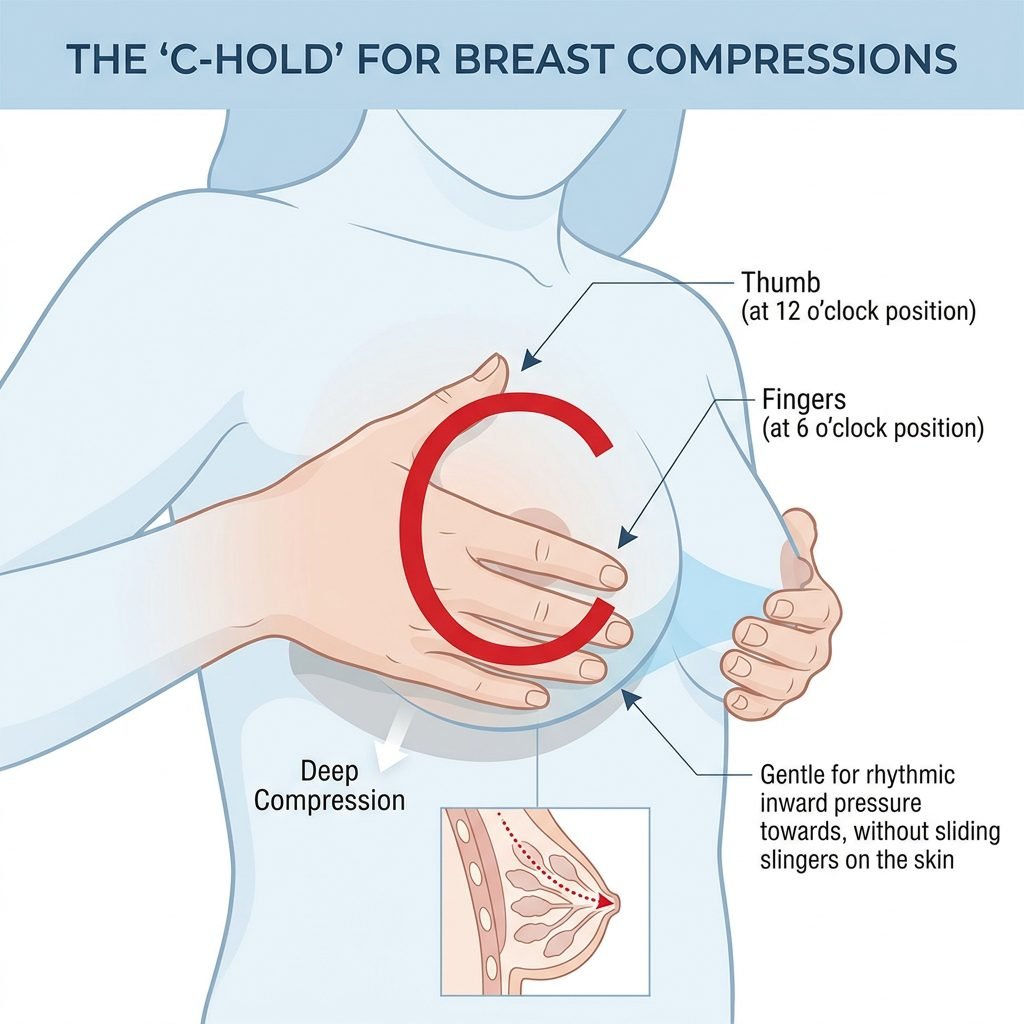
Sometimes babies fall asleep because the milk flow slows down. In the breastfeeding world, we call this ‘the lull.’ To keep them interested, you need to act as a human espresso machine. Breast compressions increase the internal pressure of the breast, sending a fresh burst of milk into the baby’s mouth, which triggers a swallow and wakes them up.
How to Perform Breast Compressions:
- Support your breast with one hand in a C-hold (thumb on top, fingers below, well back from the areola).
- When the baby stops active sucking, squeeze the breast firmly but not so hard that it hurts.
- Hold the squeeze until the baby starts swallowing again.
- Release the pressure when the baby stops, then repeat in a different spot on the breast.
Switching Positions:
If the ‘Cross-Cradle’ hold is too cozy, try the ‘Football Hold’ or the ‘Upright Koala Hold.’ Changing the baby’s orientation to gravity can prevent them from getting too comfortable. Using an upright position is especially helpful for babies with reflux or those who tend to ‘snore’ through their meals.
Trick 5: Social Engagement & Sensory Sounds

Using Sight and Sound to Stay Alert
While we often think of breastfeeding as a quiet, meditative time, a sleepy baby needs a bit of ‘dinner theater.’ Engaging their other senses—sight and sound—can help keep their brain in an active state.
Engaging the Senses:
- Eye Contact: Newborns can see best at a distance of about 8 to 12 inches—which is exactly the distance between your face and theirs while nursing. Make direct eye contact and talk to them. Your voice is their favorite sound.
- Singing and Rhythmic Talking: Use a slightly higher-pitched, melodic voice (often called ‘motherese’). The variation in pitch is more stimulating to a newborn’s brain than a monotonous drone.
- Gentle Blowing: A very soft puff of air on their cheek or forehead can provide a ‘startle’ sensation that isn’t scary but is enough to interrupt a sleep cycle.
- High-Contrast Visuals: If you are nursing in a chair, prop a black-and-white high-contrast card nearby. The visual stimulation can help keep their eyes open.
| Trick Type | Sensory Target | Best For… |
|---|---|---|
| Compressions | Taste/Flow | Increasing milk intake |
| Undressing | Temperature | Deep sleepers |
| Tickling | Touch | Maintaining rhythm |
| Blowing Air | Tactile | Quick interruptions |
When to Stop: Recognizing the ‘Full’ vs. ‘Sleepy’ Cues

The Art of Letting Go
It is important to distinguish between a baby who is sleepy but hungry and a baby who is finished and satisfied. We don’t want to force-feed a baby who has had their fill. If you have tried three of the tricks above and your baby remains a ‘limp noodle’ with relaxed hands and a peaceful expression, they are likely finished.
Signs of Satiety:
- Relaxed Hands: A hungry baby often has clenched fists. A full baby has open, relaxed palms.
- The ‘Nipple Drop’: They let go of the breast spontaneously and don’t try to root back on.
- Deep Sleep: If they don’t wake up even for a diaper change, their body has decided that sleep is the priority, and they are likely satiated.
“Trust your baby and trust your body. Some feedings will be marathons, and some will be sprints. As long as the diapers are wet and the weight is climbing, you are winning.”
Conclusion
You’ve Got This, Mama
Breastfeeding a sleepy newborn is a temporary season, though it feels like an eternity when you’re in the thick of it. By using these 5 gentle sensory tricks—temperature regulation, targeted massage, the mid-meal reset, breast compressions, and social engagement—you are not just feeding your baby; you are helping them wake up to the world. Be patient with yourself and your little one. Before you know it, they’ll be alert, curious, and perhaps a bit too busy to sit still for a feeding! Until then, keep your water bottle full, your heart open, and your sense of humor intact. You are doing the beautiful, hard work of nourishing a life. Stay strong, sister.