
The Upright Collarbone Burping Position for Babies with Severe Acid Reflux
Oh, mama. If you are reading this at 2:00 AM with a baby who is arching their back, crying in pain, and covered in their third outfit change of the night, I want you to take a deep breath. Drop your shoulders. Unclench your jaw. I see you, and you are doing an incredible job.
Navigating severe acid reflux in a newborn is one of the most emotionally and physically draining experiences a new parent can face. You spend hours meticulously feeding your sweet baby, only to watch them writhe in discomfort, followed by a fountain of spit-up that leaves you both in tears. The endless mountains of laundry, the constant worry about their weight gain, and the sheer exhaustion of holding them upright for hours can make you feel incredibly isolated.
But you are not alone, and there is a practical, evidence-based physical technique that can genuinely change your feeding journey: The Upright Collarbone Burping Position.
As a doula and pediatric sleep consultant, I have sat in countless dimly lit nurseries with weeping mothers who feel like they are failing. Let me tell you a secret: you are not failing. Your baby’s digestive system is simply taking a little extra time to mature. While we wait for their tiny bodies to catch up, we have to rethink how we handle their feeds. Traditional burping methods—like slinging them over your shoulder or sitting them hunched on your lap—can actually compress a reflux baby’s stomach, pushing acid right back up their esophagus. Today, we are going to master a gentle, highly effective alternative that keeps their airway clear, their spine straight, and their tummy completely uncompressed.
The Heartbreak of Infant Acid Reflux: What is Actually Happening?
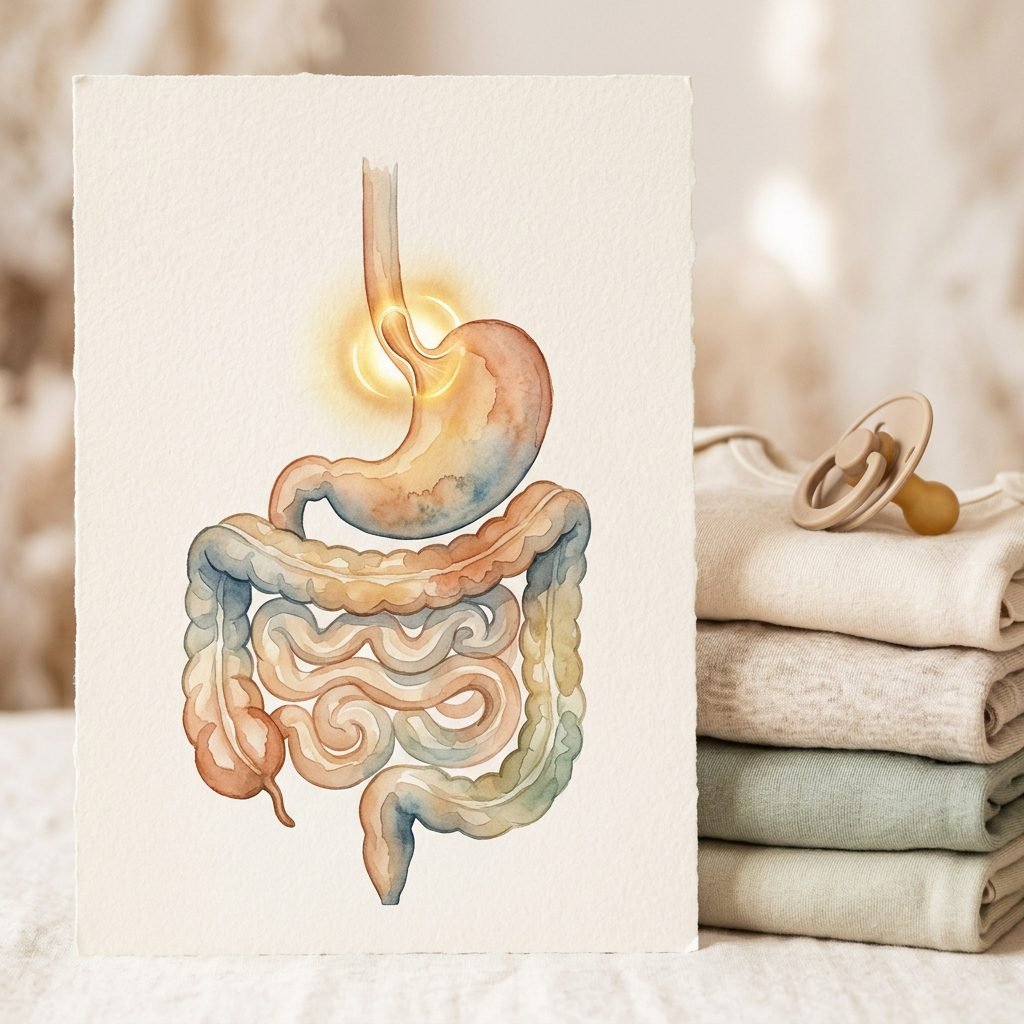
Before we dive into the physical techniques, it is so important to understand what is happening inside your baby’s body. Knowledge is power, and knowing the anatomy of reflux can help alleviate that heavy mom-guilt. Infant acid reflux, medically known as Gastroesophageal Reflux (GER) or the more severe Gastroesophageal Reflux Disease (GERD), occurs because of a tiny, immature muscle called the lower esophageal sphincter (LES).
Think of the LES as a little trapdoor between the esophagus (the food pipe) and the stomach. In healthy adults, this trapdoor opens to let food in and snaps tightly shut to keep stomach acid from splashing back up. In your beautiful newborn, this muscle is still weak and floppy. When their stomach gets full of milk, that trapdoor swings open, and the milk—mixed with painful stomach acid—travels back up into their throat.
Signs Your Baby Has Severe Reflux (GERD)
While “happy spitters” simply drool milk without a care in the world, a baby with severe reflux is in active distress. Look out for these vital signs:
- Arching the back: Your baby may rigidly arch their spine during or immediately after a feed. This is an instinctive attempt to stretch out their esophagus and escape the burning sensation.
- Crying and fussiness during feeds: Pulling off the breast or bottle, screaming, and then frantically rooting again to soothe the burn.
- Sour-smelling breath: A distinct, acidic odor that lingers even hours after a feed.
- Wet burps and coughing: Hearing fluid rumbling in their chest or witnessing sudden, choking-like coughs while lying flat.
- Poor sleep: Waking up crying the moment they are laid flat in their bassinet.
“You are not doing anything wrong. Your milk is not toxic, your formula choice is not a failure, and you are not a bad mother. Your baby is simply dealing with an anatomical immaturity that requires a little extra mechanical support from you.”
Why the Classic “Over-the-Shoulder” Hold Makes Reflux Worse
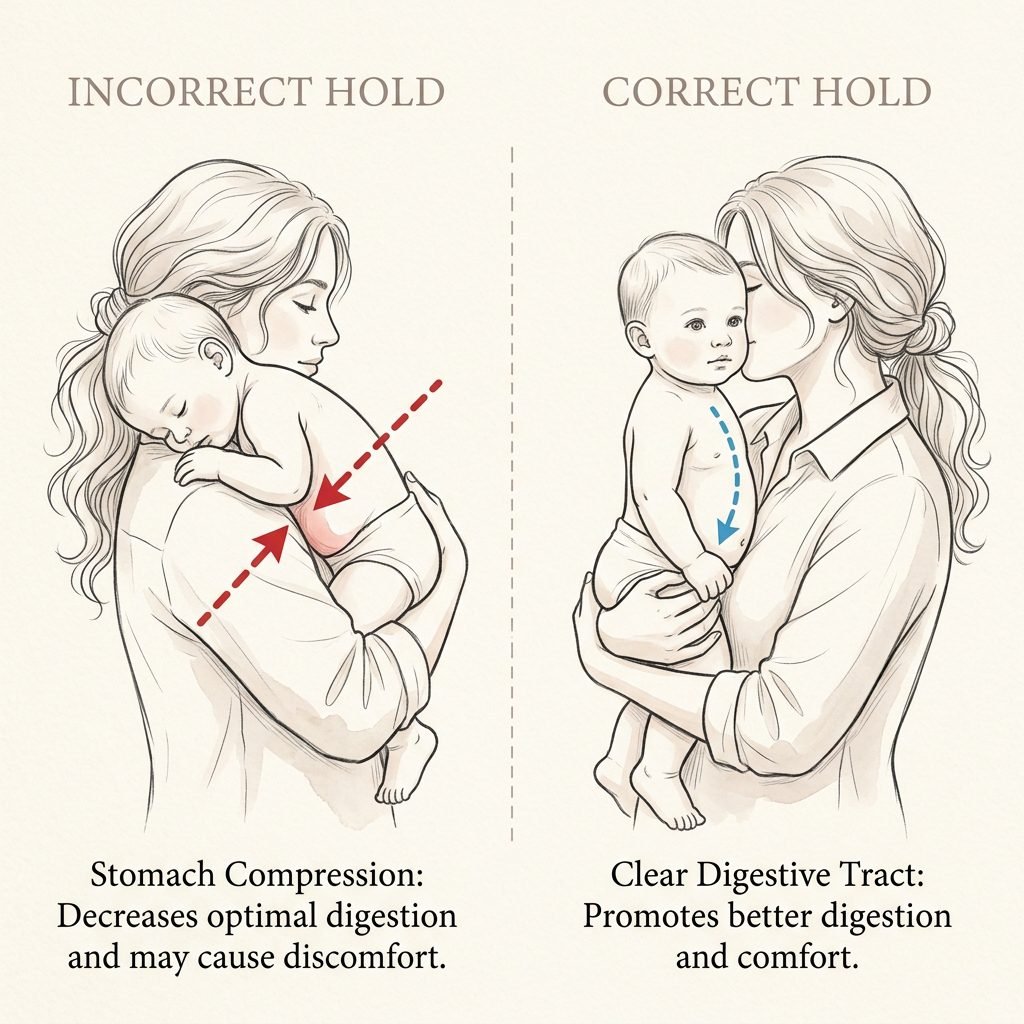
When we picture burping a baby, we all imagine the classic movie trope: tossing the baby over the shoulder and thumping them on the back. For a baby with a mature digestive system, this works just fine. But for a baby with severe acid reflux, traditional burping positions can be a recipe for disaster.
The Problem with Tummy Compression
When you place a baby over your shoulder, their stomach often rests directly on the hard ridge of your collarbone or the ball of your shoulder. What happens when you press on a full water balloon? The water shoots out the top. The same physics apply to your baby’s stomach. That direct pressure forces the acidic milk right past the weak sphincter and up into their throat.
Similarly, the popular “seated lap” burping method—where you sit the baby on your thigh, support their chin, and lean them forward—creates a sharp bend in their abdomen. This hunched posture squishes their stomach, increasing intra-abdominal pressure. For a reflux baby, this almost guarantees a massive spit-up event.
To truly help a baby with GERD, we must adhere to the Golden Rule of Reflux Burping: Zero Tummy Compression and Maximum Spinal Extension. This is exactly where the Upright Collarbone Burping Position becomes your greatest tool.
Mastering the Upright Collarbone Burping Position

This technique is all about alignment, gentle support, and patience. It might feel a bit awkward the first few times you try it, but once you and your baby find your rhythm, it will become second nature. You can do this while standing (which provides a nice, gentle sway) or sitting completely upright in a firm chair.
Step-by-Step Instructions
- Prepare Your Space: Drape a thick, highly absorbent burp cloth completely over your shoulder and collarbone. Reflux babies are unpredictable, and protecting your clothing will help you stay relaxed.
- The Lift and Placement: Slide your hands under your baby’s armpits and lift them up high onto your chest. Their head should be resting above your collarbone, looking over your shoulder. Their chest should be flat against your upper chest.
- The Jaw Support (Crucial Step): Instead of letting their head flop, use the hand on the side they are facing to create a gentle “C-shape” with your thumb and index finger. Gently cup their jawline and cheekbones. Never place pressure on their soft throat or the front of their neck. You are simply providing a shelf for their jaw to rest on, keeping their neck elongated and their airway perfectly straight.
- The Spinal Alignment: Use your other arm to support their bottom and lower back. Ensure their legs are dangling straight down or wrapped gently around your ribcage (if they are a bit older). Their back should be completely straight, not slumped.
- The Gentle Pat and Rub: With the hand supporting their bottom, slide it up to their mid-back (between the shoulder blades). Keep your hand slightly cupped (like you are holding a small pool of water) and deliver firm, but gentle, upward pats. Alternate between patting and rubbing in an upward, circular motion to coax the air bubbles up without jarring their stomach.
“Breathe in, mama. Breathe out. As you pat your baby’s back, regulate your own breathing. Babies co-regulate with us. If your chest is tight with anxiety, they will feel it. Deep, slow breaths will help relax their tiny muscles, making it easier for the burp to escape.”
If you don’t get a burp after 2 to 3 minutes, stop patting. Simply hold them in this upright, elongated position. Sometimes, just the gravity of the position will allow the air to rise naturally without the need for physical percussion.
Burping Method vs. Gas Severity: A Quick-Reference Guide

Not every burp requires the same level of intervention. As you get to know your baby’s unique digestive cues, you can tailor your burping strategy. Here is a practical breakdown of different burping methods, specifically analyzed for babies with severe acid reflux.
| Burping Position | Best For… | Reflux Safety Rating | Pros & Cons for GERD Babies |
|---|---|---|---|
| Upright Collarbone (High Chest) | Severe reflux, frequent spit-ups, crying during feeds. | Excellent | Pros: Zero tummy compression, straight airway, gravity-assisted. Cons: Requires mom to sit up straight or stand; can be tiring for the arms. |
| Seated Lap (Leaning Forward) | Mild gas, older babies with good head control. | Poor | Pros: Easy to see baby’s face, good for getting deep, stubborn burps out. Cons: Compresses the stomach significantly, highly likely to trigger a reflux episode. |
| The Slung-Over-Shoulder | Normal digestion, “happy spitters”. | Moderate | Pros: Comforting for baby, allows mom to have one hand free. Cons: Collarbone often presses directly into the baby’s full stomach. |
| The “Magic Hold” (Tiger in the Tree) | Colic, lower intestinal gas, fussiness. | Moderate to Poor | Pros: Great for lower gas and calming a crying baby. Cons: Laying baby face down across the forearm puts direct pressure on the stomach. Use with caution after a full feed. |
Always prioritize the Upright Collarbone method immediately after a feed. If your baby is still struggling with lower gas (farts) hours later, you can safely transition to tummy-time or the Magic Hold once the milk has had time to leave the stomach.
The 30-Minute Rule: Post-Feed Comfort and Survival Hacks

You did it! You successfully fed your baby, used the Upright Collarbone position, and got a beautiful, dry burp. But for a reflux mama, the work isn’t over yet. Pediatricians and gastroenterologists universally recommend keeping a baby with GERD upright for 20 to 30 minutes after every single feed. At 3:00 AM, thirty minutes can feel like three hours. Here is how we survive the upright hold without sacrificing your own physical health.
Maternal Ergonomics: Saving Your Back
Holding a baby upright for hours a day will destroy your posture, lead to neck pain, and cause severe lower back strain if you aren’t careful. Let’s set up a “Reflux Recovery Station” in your nursery or living room.
- The Pillow Fortress: Invest in a firm reading pillow (a husband pillow with arms) for your bed or glider. When you are doing the 30-minute upright hold, lean back at a slight 45-degree angle. Place your baby on your chest. Gravity will still keep their stomach contents down, but your back will be fully supported.
- Embrace Babywearing: A soft, stretchy wrap (like a Solly Baby or Boba wrap) is a reflux mom’s best friend. After the initial burp, wrap your baby securely in an upright, chest-to-chest position. This keeps them perfectly vertical while giving you your hands back to eat, drink water, or just rest your arms.
- Avoid Car Seats and Bouncers: It is incredibly tempting to place your baby in a bouncer or car seat to keep them “upright.” However, these devices often cause the baby’s chin to drop to their chest and their spine to curve into a “C” shape. This slumping actually increases abdominal pressure and makes reflux worse. If you need to put them down, a flat, firm surface is ironically safer than a slumped, semi-upright device.
When to Seek Medical Help
While the Upright Collarbone position is a powerful tool, it is not a cure for underlying medical issues. You must advocate for your baby if conservative measures aren’t working. Please contact your pediatrician immediately if your baby is refusing to eat, losing weight, having fewer wet diapers, projecting vomit forcefully (like a fountain across the room), or if their spit-up contains blood or looks green/yellow.
Conclusion
My sweet friend, I know how heavy the mental load of a reflux baby is. I know you are tired of smelling like sour milk, tired of doing laundry, and tired of seeing your little one uncomfortable. But I want to reassure you with every ounce of my professional and sisterly heart: this is a season, and it will pass.
As your baby grows, their digestive system will mature. That little lower esophageal sphincter will get stronger, they will start sitting up on their own, and the introduction of solid foods will help keep everything down. Until that magical day arrives, you are equipped with the knowledge and the physical tools to help them through it. By utilizing the Upright Collarbone Burping Position, you are protecting their tiny tummy, keeping their airway clear, and providing the immense comfort of your heartbeat and warmth.
Give yourself grace today. Order takeout, let the laundry sit in the basket for another day, and know that you are exactly the mother your baby needs. You are doing a beautiful job.
Medical Disclaimer: The information provided in this article is for educational and informational purposes only and is not intended as medical advice. I am a certified doula and pediatric sleep consultant, but I am not a doctor. Always consult with your pediatrician or a qualified healthcare provider regarding any concerns about your infant’s health, severe acid reflux, weight gain, or before implementing new feeding or physical routines.