

How to Afford Maternity Leave When You’re Self-Employed (Step-by-Step Guide)
Welcome to Your CEO-Mama Strategy Session
Oh, sweet friend, first of all—congratulations! You are doing something incredible: you are growing a tiny human while simultaneously nurturing a business. As a doula and a fellow entrepreneur, I know that the ‘positive’ on that pregnancy test often comes with a side of ‘Oh my goodness, how am I going to step away from my business without it all falling apart?’
When you are self-employed, there is no HR department to hand you a packet of forms. There is no automatic paid leave. You are the CEO, the intern, and the CFO all at once. But here is the beautiful truth: You have the power to design a maternity leave that fits your soul and your family’s needs perfectly.
In this guide, we are going to walk hand-in-hand through the financial, logistical, and emotional steps of preparing for your leave. We aren’t just talking about ‘surviving’ your time off; we are talking about creating a protected container where you can heal, bond with your baby, and eventually return to your work with fresh inspiration. Let’s get your business baby-ready so you can focus on what matters most.
Phase 1: The ‘Peace of Mind’ Budget Audit

Before we can figure out how to save, we have to know exactly what we are saving for. As a self-employed mama, your ‘maternity leave number’ is actually two numbers: your Personal Survival Number and your Business Maintenance Number.
Calculating Your Personal Survival Number
This is the amount you need to cover your rent or mortgage, groceries, health insurance, and those inevitable late-night diaper deliveries. I recommend looking at your last six months of bank statements to find an honest average of your monthly spending. Don’t forget to add a 15% ‘New Baby’ buffer for those unexpected costs like lactation consultant visits or extra-soft postpartum pajamas.
Calculating Your Business Maintenance Number
Even if you aren’t ‘working,’ your business might have recurring costs. Think about your website hosting, email marketing software, or any virtual assistants you plan to keep on a small retainer while you’re away. Use the table below to visualize your monthly leave goal:
| Expense Category | Monthly Cost (Estimated) | Notes |
|---|---|---|
| Personal Housing & Utilities | $2,500 | Includes mortgage/rent, water, electric. |
| Health & Wellness | $600 | Insurance premiums and postpartum supplements. |
| Business SaaS & Tools | $150 | Website, CRM, and email platform. |
| The ‘New Baby’ Buffer | $400 | Diapers, wipes, and takeout for tired nights. |
| Total Monthly Goal | $3,650 | Multiply this by the number of months you want off. |
Mama, remember: You don’t need to replace your full ‘CEO salary’ to have a successful leave. You just need to cover your peace of mind.
Phase 2: Sourcing Your ‘Maternity Sinking Fund’

Now that we have our number, let’s talk about where that money actually comes from. Since we don’t have traditional corporate benefits, we have to be creative and proactive. There are three primary ‘buckets’ we can draw from.
1. The ‘Sinking Fund’ Strategy
This is the most reliable method. Starting today, set up a separate high-yield savings account and nickname it ‘Baby Moon Fund.’ Every time a client pays an invoice, take a percentage (I suggest 10-20%) and move it immediately to that account. If you are early in your pregnancy, you have 7 to 8 months to build this cushion.
2. State-Funded Programs (Check Your Eligibility!)
Depending on where you live, you might actually be entitled to state benefits even as a freelancer. States like California, New Jersey, New York, and Washington have programs where self-employed individuals can opt-in to disability or family leave insurance. Check your state’s EDD or Paid Leave website immediately, as some require you to have paid into the system for a certain period before you can claim benefits.
3. Short-Term Disability (STD) Insurance
If you aren’t pregnant yet but are planning to be, look into private Short-Term Disability insurance. Crucial Warning: Most private policies consider pregnancy a ‘pre-existing condition’ if you are already pregnant when you sign up, so this is a strategy for the ‘pre-conception’ phase.
| Funding Source | Pros | Cons |
|---|---|---|
| Self-Funded Sinking Fund | Total control, no paperwork, no taxes. | Requires strict discipline and high income. |
| State Paid Leave | Significant monthly payout for 8-12 weeks. | Only available in specific states; involves paperwork. |
| Business ‘Sprint’ | High influx of cash right before leave. | Can lead to pre-baby burnout. |
Phase 3: The ‘Client Conversation’ Scripts

One of the biggest anxieties for self-employed mamas is telling clients. You might fear they will leave you or think you aren’t ‘serious’ about your business anymore. Let me tell you: Your clients want you to be happy and healthy. The key is communicating early and providing a clear plan.
The Timeline for Disclosure
- 12-16 Weeks: Mention it to your long-term, high-touch clients.
- 20-24 Weeks: Send an official ‘Maternity Leave Plan’ to all active clients.
- 32 Weeks: Finalize all projects and set your ‘Hard Stop’ date.
Scripts You Can Use
Feel free to copy and adapt these templates for your emails:
The ‘Announcement’ Script:
“Hi [Client Name], I have some exciting personal news to share! I’ll be welcoming a new addition to my family this [Month]. I am so committed to our work together, so I’ve already drafted a plan to ensure our projects stay on track while I am on leave from [Start Date] to [End Date]. We have plenty of time to wrap up [Project X] before then!”
The ‘Out of Office’ Boundary Script:
“Thank you for your email! I am currently away on maternity leave, soaking up every minute with my new little one. I will not be checking email during this time to ensure a full recovery. If you need immediate assistance, please contact [Name/VA] at [Email]. I look forward to reconnecting with you in [Month]!”
Phase 4: Automating and Batching for a Hands-Off Business
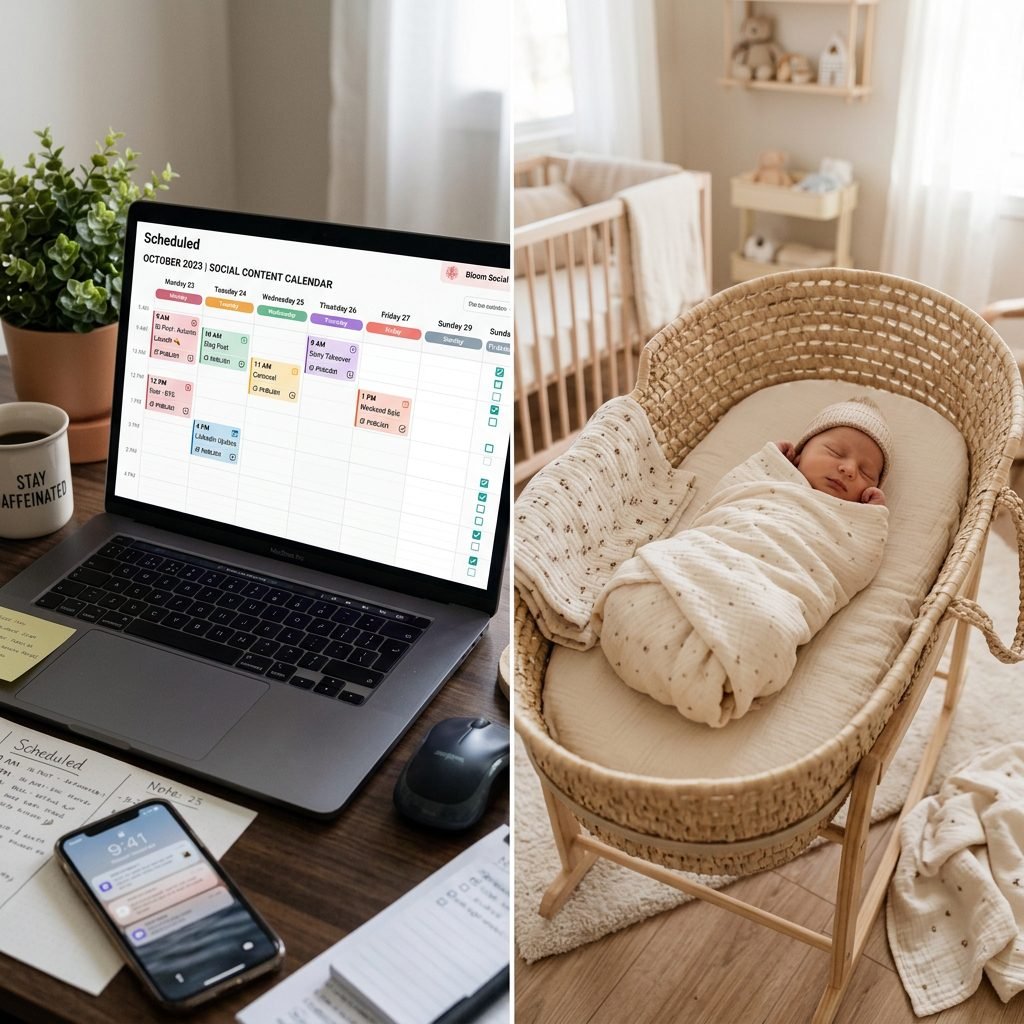
To truly ‘afford’ to be away, your business needs to be able to breathe without you. This is the time to embrace automation and delegation. Think of this as ‘setting the crockpot’ for your business.
1. Content Batching
If your business relies on social media or blogging, spend your second trimester (when that energy burst usually hits!) creating 3 months of content in advance. Use tools like Later, Planoly, or Buffer to schedule everything. Your audience won’t even know you’re busy smelling baby heads!
2. The ‘Mini-Agency’ Model
If you provide a service (like graphic design or copywriting), consider hiring a ‘subcontractor’ for your leave. You can take a 15-20% referral fee or management fee while they do the heavy lifting for your clients. This keeps the client in your ecosystem while you get paid for the infrastructure you built.
3. Passive Income ‘Pushes’
In the months leading up to your leave, focus on ‘low-touch’ revenue. Can you turn your knowledge into a digital download or a pre-recorded masterclass? Selling a $47 ebook while you’re nursing at 3:00 AM is the ultimate self-employed win.
| Task | Automation Tool / Strategy | Benefit |
|---|---|---|
| Social Media | Later / Tailwind | Keeps your brand visible without manual posting. |
| Client Inquiries | HoneyBook / Dubsado | Automatically sends brochures and gathers info. |
| Customer Support | Zendesk / VA Retainer | Ensures clients feel heard while you’re offline. |
Phase 5: The Gradual Re-Entry (The ‘Soft’ Return)

One of the biggest mistakes we make is thinking we can go from ‘Zero’ to ‘CEO’ overnight at the 6-week mark. Your body, your brain, and your baby need a transition period.
The 3-Tiered Return Plan
Instead of a hard start date, I want you to consider a ‘Soft Launch’ back into your business. This prevents the overwhelming ‘inbox shock’ that can trigger postpartum anxiety.
- Week 1-2 of Return: ‘Admin Only’ phase. Check emails for 1 hour a day, twice a week. No calls. No deadlines.
- Week 3-4 of Return: ‘Existing Clients Only.’ Re-engage with old projects. 10-15 hours per week max.
- Week 5+: ‘Full Capacity’ (or your new ‘Mom-Capacity’). Open the doors to new clients and full-scale projects.
Setting Your New ‘Mom-Hours’
Your business will look different now, and that’s okay! You might find that you are more productive in 2-hour ‘nap-time sprints’ than you ever were in an 8-hour office day. Be kind to yourself as you find this new rhythm. Your worth is not measured by your output, especially during this sacred season.
Conclusion
You Are Building a Legacy, Mama
Affording maternity leave when you are self-employed isn’t just about the dollars in your bank account; it’s about the value you place on your own well-being. By following this step-by-step guide, you aren’t just ‘taking time off’—you are investing in the long-term health of your business and your family.
Remember, the world can wait. Your clients can wait. Your inbox can wait. These first few weeks and months with your baby are a one-time-only event. You have worked so hard to build a business that gives you freedom; now is the time to actually use that freedom. You’ve got the plan, you’ve got the scripts, and you’ve got the heart to make this happen. I am so proud of you, CEO-Mama. Now, take a deep breath, and let’s start that ‘Baby Moon Fund’ today!