

The Gentle Pick-Up Put-Down Sleep Training Method for Stubborn 4-Month-Olds
Oh, sweet mama. If you are reading this at 2:00 AM, illuminated only by the harsh glow of your phone screen while a previously perfect sleeper protests in your arms, please take a deep, grounding breath. Drop your shoulders. Relax your jaw. You are in the thick of one of the most notoriously exhausting phases of early motherhood: the 4-month sleep regression.
Perhaps your little one used to drift off peacefully after a feeding, giving you long, luxurious stretches of rest. But suddenly, it feels like a switch has flipped. The moment their back touches the mattress, their eyes snap open, their back arches, and the wailing begins. You are exhausted, your coffee is cold, and you are desperately searching for a solution that doesn’t involve leaving your precious baby to cry alone in the dark.
As a doula, pediatric sleep consultant, and fellow mother, I am here to wrap you in a virtual hug and tell you three things: First, you are not doing anything wrong. Second, your baby is not actually being “stubborn”—they are going through a massive neurological leap. And third, there is a beautiful, gentle, and highly effective middle ground between “cry it out” and rocking your baby all night long. It is called the Pick-Up Put-Down (PU/PD) method.
Pioneered by the late “Baby Whisperer” Tracy Hogg, this method is the ultimate attachment-friendly approach to sleep training. It teaches your baby the vital skill of independent sleep while assuring them that you are always there to offer comfort, safety, and love. In this comprehensive guide, we are going to break down exactly how to execute this method, how to troubleshoot the tears, and how to protect your own postpartum mental and physical health in the process. Grab a fresh cup of tea, and let’s reclaim your nights.
The 4-Month Sleep Regression: Biology Over Stubbornness

Before we can fix the sleep, we have to understand what broke it. It is incredibly easy to view your 4-month-old’s sudden sleep resistance as stubbornness. They fight the swaddle, they fight the rocking, and they absolutely refuse the crib. But in the world of infant development, this “regression” is actually a massive progression.
Around 14 to 16 weeks of age, your baby’s sleep architecture permanently changes. Newborns only have two stages of sleep: active (REM) and quiet sleep. They drift deeply and quickly. But at 4 months, their brains mature to adopt adult-like sleep cycles, cycling through light sleep, deep sleep, and REM sleep. Each cycle lasts about 45 minutes.
Here is the catch: when adults transition between sleep cycles, we wake up slightly, adjust our pillows, realize we are safe in our beds, and go right back to sleep. We don’t even remember it. But your 4-month-old? If they fall asleep in your arms while nursing or rocking, and then wake up 45 minutes later alone in a flat, still crib, they panic. The environment has changed. They don’t know how to bridge that sleep cycle on their own, so they cry out for the exact conditions they had when they fell asleep: you.
“Your baby is not manipulating you. They are simply communicating a biological truth: ‘The last thing I remember was Mom’s warm arms, and now I am alone. I need help getting back to that safe place.'”
The goal of the Pick-Up Put-Down method is not to force your baby to sleep, but to change their sleep association. We want them to fall asleep in the crib, so that when they wake up between cycles, they are exactly where they started and can seamlessly drift back off.
Setting the Stage: Optimizing the Nursery for Sleep Success

As a nursery designer and sleep consultant, I cannot emphasize enough how crucial the physical sleep environment is. You can have the best sleep training technique in the world, but if the room is working against you, your baby will continue to struggle. Before implementing PU/PD, ensure your baby’s room is an optimal sleep sanctuary.
- Pitch Black Darkness: At 4 months, your baby’s circadian rhythm is highly sensitive to light. The room should be so dark that you cannot see your hand in front of your face. Invest in high-quality blackout curtains or travel blackout blinds. Tape down the little glowing lights on monitors or humidifiers.
- Continuous White or Pink Noise: The womb was as loud as a vacuum cleaner. A silent room is unnerving to a baby. Use a sound machine that plays continuous, deep pink or white noise (avoid ocean waves or lullabies with changing pitches). Place it about 3 to 5 feet away from the crib, and keep the volume around 50 to 60 decibels.
- Optimal Temperature: Babies sleep best in a cool room. Aim for a room temperature between 68°F and 72°F (20°C to 22°C). Dress them in a breathable, tog-rated sleep sack to keep them cozy without the risk of overheating.
- Transitioning from the Swaddle: By 4 months, babies are usually showing signs of rolling, meaning the swaddle is no longer safe. If you haven’t already, transition them to a sleep sack. This newfound freedom of their arms will cause some startle reflex wake-ups initially, but it is a necessary milestone.
The Core Philosophy of Pick-Up Put-Down (PU/PD)

The PU/PD method is beautifully simple in theory, though demanding in practice. The core philosophy is this: you are allowed to comfort your crying baby, but you must put them down awake so they do the actual work of falling asleep on their own.
Unlike “Cry It Out” (Extinction) or the Ferber Method (Graduated Extinction), where you leave the room for set intervals, PU/PD requires you to stay right by your baby’s side. You are offering your physical presence as a bridge to independence. It is highly reassuring for the baby, and often much easier on a mother’s heart.
However, this method requires immense patience. On the first night, you might pick your baby up and put them down 50 to 100 times. Yes, you read that right. It is a physical workout and a mental marathon. But if you remain consistent, the number of pick-ups will drastically reduce within 3 to 5 days.
| Sleep Training Method | Level of Parent Involvement | Tear Level (Estimated) | Best For… |
|---|---|---|---|
| Cry It Out (Extinction) | None (Leave room until morning) | High initially, ends quickly | Parents needing fast results, babies who get overstimulated by parent presence |
| Ferber (Check & Console) | Moderate (Timed check-ins) | Medium to High | Babies who are reassured by brief check-ins |
| Pick-Up Put-Down | Very High (Constant physical presence) | Low to Medium | Parents who cannot tolerate leaving baby to cry, anxious babies |
| Chair Method (Sleep Lady Shuffle) | High (Sitting in room, moving away) | Low to Medium | Older babies/toddlers with separation anxiety |
Step-by-Step Execution: The PU/PD Method in Action

Now, let’s get into the exact, step-by-step physical mechanics of the method. Consistency is your best friend here. Do not alter the steps halfway through the night. Put on comfortable clothes, take a deep breath, and follow this script.
- The Bedtime Routine: Start with a calming, consistent 20 to 30-minute routine. Bath, massage, pajamas, feeding, and a book. Ensure the feeding ends at least 15 minutes before they go into the crib to break the feed-to-sleep association.
- The Put-Down (Awake): Place your baby in the crib while they are drowsy but fully awake. Say a consistent sleep phrase, such as,
“It’s time for sleep now, my sweet baby. Mommy loves you. Goodnight.”
- The Pause: If your baby starts to fuss or whine (a mantra cry), do not rush in immediately. Give them a moment. Sometimes babies need to blow off steam. Wait 2 to 3 minutes to see if they settle.
- Shush-Pat (First Intervention): If the fussing escalates to a genuine, distressed cry, step to the side of the crib. Do not pick them up yet. Place a heavy, warm hand on their chest or gently roll them to their side and pat their back rhythmically while making a loud “Shhhhh, shhhhh” sound. Do this for 1 to 2 minutes.
- The Pick-Up: If the crying continues and they are truly upset, pick them up. Hold them horizontally or over your shoulder. Shush them gently in their ear. Crucial rule: You are only picking them up to calm them, not to put them to sleep.
- The Put-Down: The absolute second your baby stops crying, sighs, or relaxes their body—even if it’s only been 5 seconds—you must put them back down in the crib. Do not wait for them to get heavy-eyed or fall asleep on your shoulder.
- The Rinse and Repeat: If they start crying the moment their back touches the mattress (which they will), repeat the process. Shush-pat first. If that fails, pick up. The moment they stop crying, put down. You will repeat this loop until they finally surrender to sleep in the crib.
Troubleshooting the “Stubborn” Resistance

At 4 months old, your baby is getting smarter. They are learning cause and effect. They might quickly realize, “Hey, if I cry, Mom picks me up! This is a fun game!” Or, conversely, the constant picking up and putting down might actually overstimulate them, making them angrier. Here is how to troubleshoot the most common hurdles.
| Baby’s Reaction | Why It’s Happening | How to Pivot Your Strategy |
|---|---|---|
| Arching back and pushing away when picked up | They are overstimulated or angry that you aren’t letting them sleep in your arms. | Stop picking them up. Switch exclusively to the “Shush-Pat” method while they remain in the crib. Keep a heavy, grounding hand on their chest. |
| Smiling or cooing when picked up | They think this is a fun late-night game of up-and-down. | Break eye contact entirely. Keep your face neutral. Put them down immediately the second they smile or stop crying. Do not engage in play. |
| Crying harder the moment they are put down | They are anticipating the separation and have strong FOMO (Fear Of Missing Out). | Hover your hands over them for a few seconds after putting them down. Keep the physical warmth of your hands near their body as you slowly pull away. |
| Spitting out the pacifier repeatedly | The pacifier has become a negative sleep prop that requires your intervention. | Consider ditching the pacifier for night sleep entirely during this training phase, or guide their hand to the pacifier so they learn to replace it themselves. |
Remember, consistency is the key. If you do PU/PD for 45 minutes, get exhausted, and then just nurse them to sleep, you have accidentally taught your baby that they just need to cry for 45 minutes to get what they want. Stay the course, sister. You can do this.
Sample 4-Month-Old Sleep Schedule & Wake Windows
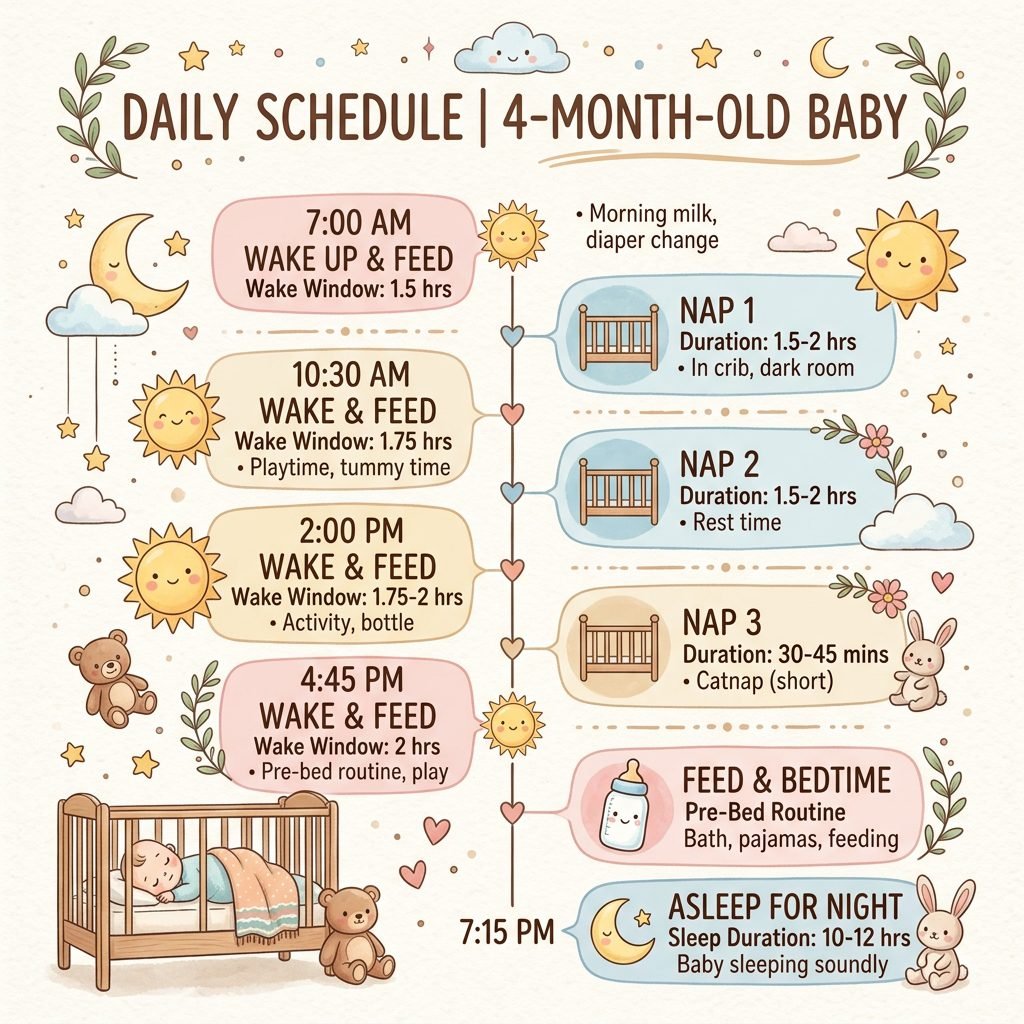
A massive part of sleep training success lies in daytime scheduling. A baby who is overtired will fight sleep with the strength of a thousand suns. A baby who is under-tired simply won’t have the sleep pressure needed to settle. At 4 months old, your baby’s wake windows (the time they are awake between naps) should be strictly between 90 to 120 minutes.
Here is a biologically appropriate, highly structured sample schedule for a 4-month-old. Remember, watch your baby’s cues (yawning, red eyebrows, staring blankly), not just the clock!
| Time | Activity | Important Notes & Wake Windows |
|---|---|---|
| 7:00 AM | Wake Up & First Feed | Open the blinds immediately. Expose to bright morning light to set circadian rhythm. |
| 8:30 AM | Nap 1 | Wake window: 1.5 hours. This is usually the easiest nap of the day. Aim for 1 to 1.5 hours of sleep. |
| 10:00 AM | Wake & Feed | Engage in high-energy sensory play or tummy time. |
| 11:45 AM | Nap 2 | Wake window: 1.75 hours. Aim for 1 to 1.5 hours of sleep. Use PU/PD if they fight the nap. |
| 1:15 PM | Wake & Feed | Run errands, go for a walk outside. Natural daylight is crucial here. |
| 3:15 PM | Nap 3 | Wake window: 2 hours. This nap might be shorter (45 minutes). That is developmentally normal. |
| 4:00 PM | Wake & Feed | Low-key play. Keep the house a bit quieter as the evening approaches. |
| 6:00 PM | Catnap (Optional) | Wake window: 2 hours. A quick 30-minute bridge nap to get them to bedtime without becoming overtired. |
| 6:30 PM | Wake & Top-off Feed | Start the bedtime routine. Dim all lights in the house. |
| 7:30 PM | Bedtime | Wake window: 1.5 to 2 hours. Baby goes into the crib awake. Execute PU/PD as needed. |
Protecting Your Postpartum Body & Mind

As a postpartum recovery nurse, I have to speak to you about the physical toll of this method. Picking up and putting down a 14 to 16-pound baby fifty times in an hour is an extreme strain on your lower back, your shoulders, and your healing pelvic floor. You must protect your body while you are teaching your baby.
- Check Your Ergonomics: When you lean into the crib, widen your stance. Bend at your knees, not your waist. Bring the baby close to your chest before lifting them fully. Do not lift with your arms extended away from your body.
- Lower the Mattress Carefully: If you are short, leaning over a standard crib rail repeatedly can cause severe back spasms. Use a step stool if necessary, or ensure the crib mattress is at the highest safe setting for your baby’s mobility level.
- Tag-Team with Your Partner: You do not have to do this alone. In fact, babies often respond faster to the non-nursing partner during sleep training because they don’t smell milk. Divide the night into shifts. Partner A takes 8:00 PM to 1:00 AM; Partner B takes 1:00 AM to 6:00 AM.
Mentally, this process can be incredibly triggering. Hearing your baby cry, even while you are holding them, spikes your cortisol levels. If you feel your chest tightening, your patience fraying, or postpartum rage bubbling up, put the baby down safely in the crib and step out of the room for 5 minutes. Drink a glass of cold water. Take ten deep breaths. Your baby is safe. You are a wonderful mother. You are teaching them a skill that will benefit their health and development for years to come.
Conclusion
Navigating the 4-month sleep regression is one of the most intense rites of passage in early motherhood. The Gentle Pick-Up Put-Down method is not a magic wand that will fix your baby’s sleep in a single night. It is a process of communication, patience, and profound love. You are telling your baby, “I believe in your ability to sleep, and I will be right here supporting you until you figure it out.”
Expect the first three nights to be incredibly difficult. Expect to feel tired and doubtful. But by night four or five, you will notice the pick-ups decreasing. You will hear that magical, quiet sigh as they settle themselves into the mattress. And soon, you will both be getting the deep, restorative rest you so desperately deserve. Stay strong, sweet mama. You are doing a beautiful job, and this phase will pass.