

How to Write a Hypnobirthing Hospital Birth Plan (Free Printable PDF Checklist)
Take a deep, grounding breath, mama. You are stepping into one of the most transformative seasons of your life, and the fact that you are here, researching how to advocate for your mind, body, and baby, means you are already doing an incredible job. Bringing a hypnobirthing philosophy into a traditional hospital setting can sometimes feel like trying to mix oil and water. Hospitals are inherently clinical, fast-paced, and focused on protocols. Hypnobirthing, on the other hand, is rooted in deep physiological trust, uninterrupted peace, and the profound belief that your body knows exactly how to birth your baby.
But here is the beautiful truth from a doula’s perspective: You do not have to choose between medical safety and a peaceful, empowering birth. You can absolutely bridge the gap. The secret lies in a meticulously crafted, positively framed hypnobirthing hospital birth plan—or, as we prefer to call it in the hypnobirthing world, your Birth Preferences.
A hypnobirthing birth plan does more than just list what you do or do not want. It serves as a communication bridge between you, your birth partner, and your medical care team. It sets the tone for your room, establishes boundaries around language, and protects the delicate bubble of oxytocin you need to labor comfortably. In this comprehensive guide, we are going to walk through exactly how to structure your preferences, how to equip your partner to be your ultimate advocate, and how to maintain your calm even if your birth takes an unexpected detour. Plus, we have structured this so you can easily adapt it into our free printable PDF checklist.
Shifting the Mindset: Birth Preferences vs. Birth Plans
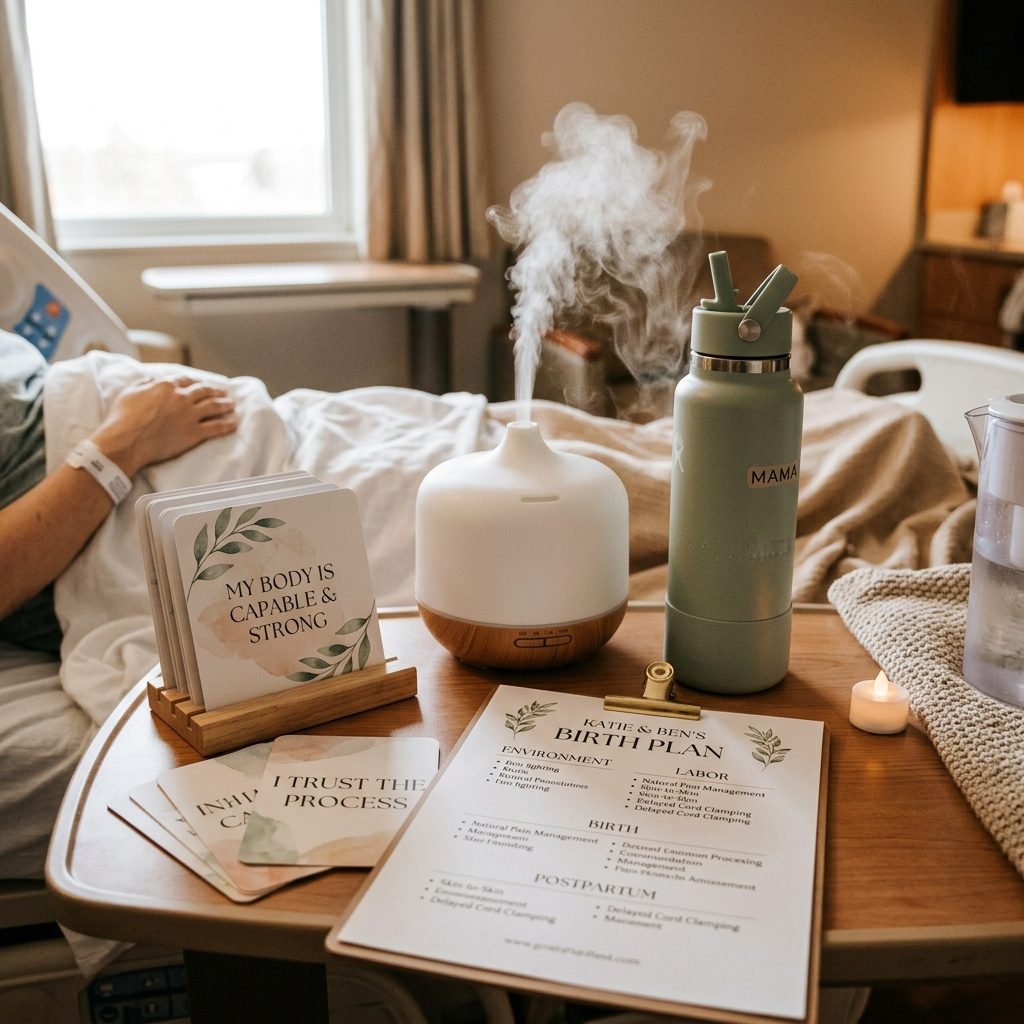
Before we put pen to paper (or fingers to keyboard), we need to talk about the psychology of the birth plan itself. In traditional settings, a birth plan can sometimes be viewed by medical staff as a rigid list of demands. As hypnobirthing mamas, we know that birth is beautifully unpredictable. If we hold too tightly to a rigid plan, any deviation can cause a spike in adrenaline—the exact hormone we are trying to keep at bay.
This is why we shift our language to Birth Preferences. This subtle change communicates to your care team that you are educated, flexible, and collaborative, but that you have strong desires for how your physiological birth is supported. Your preferences should be a maximum of one to two pages, highly visual, and easy for a busy triage nurse or on-call obstetrician to scan in under sixty seconds.
“We are so thrilled to welcome our baby today and are grateful for your expertise. We have prepared using hypnobirthing techniques. Our primary goal is a calm, unmedicated physiological birth, but we understand that birth is unpredictable. If medical intervention becomes necessary, we ask that you discuss our options with us using the B.R.A.I.N. framework so we can make informed decisions together. Thank you for helping us protect our birthing space.”
Using a warm, collaborative opening statement like the script above instantly disarms any potential tension and invites your medical team to be part of your peaceful journey.
Curating Your Sensory Space: The Hospital Room Transformation
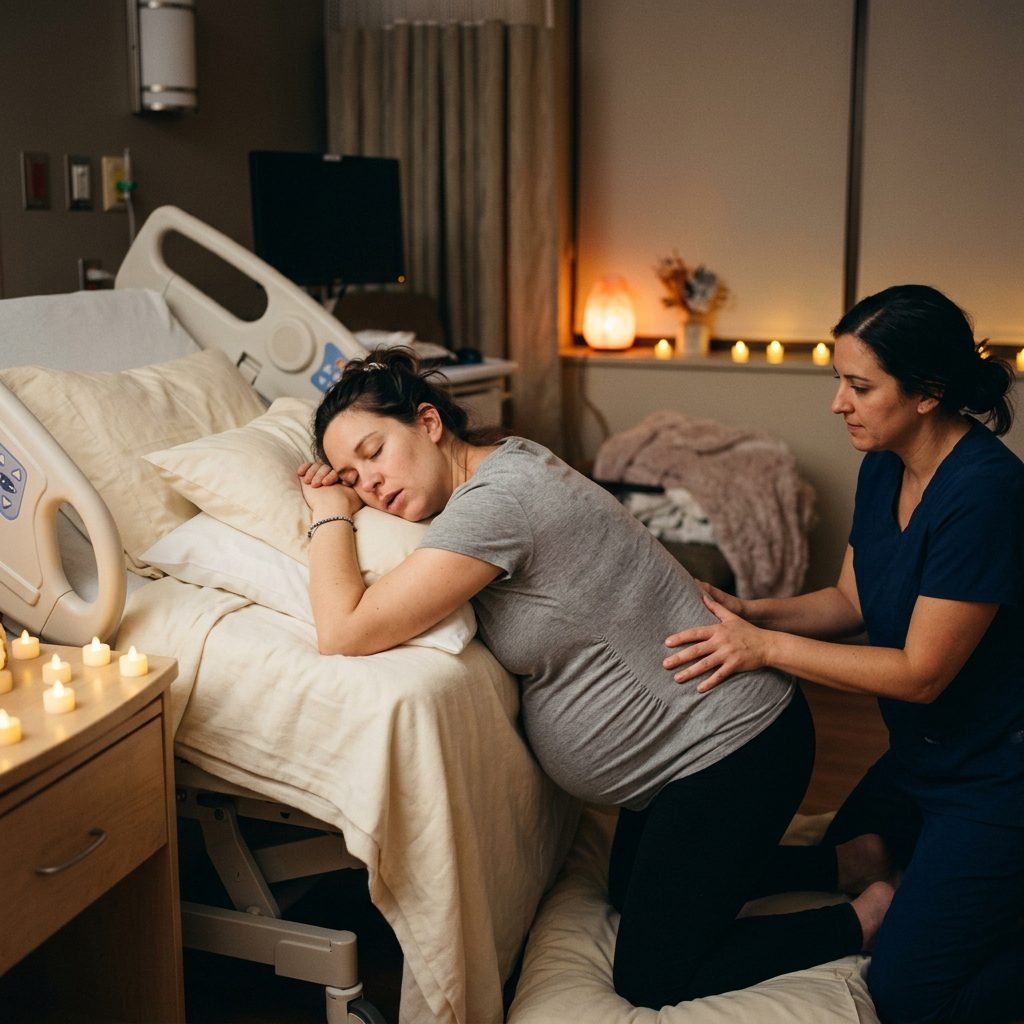
Your environment dictates your hormones. To keep oxytocin (the love and labor hormone) flowing and endorphins (nature’s pain relief) high, your hospital room needs to feel as close to a cozy, safe cave as possible. Bright fluorescent lights, loud monitors, and constant interruptions trigger the neocortex (the thinking brain) and release adrenaline, which can actually slow down or stall your surges.
When writing the Environment section of your hypnobirthing birth plan, focus on the five senses. Here is how you can outline your requests for the nursing staff:
- Sight: Request that the main overhead fluorescent lights remain off. Use natural window light during the day, and rely on battery-operated fairy lights, LED candles, or a small Himalayan salt lamp that you bring from home at night.
- Sound: Ask for voices to be kept low and hushed. State that you will be playing your hypnobirthing relaxation tracks or a calming playlist via a Bluetooth speaker. Request that the door remain closed to hallway noise.
- Touch: Specify if you prefer light touch massage from your partner, counter-pressure, or if you prefer not to be touched during a surge. Mention your desire to wear your own comfortable labor gown or oversized t-shirt rather than a stiff hospital gown.
- Smell: Note that you will be using a cool-mist essential oil diffuser (lavender, clary sage, or sweet orange are wonderful for labor) or utilizing aromatherapy inhalers.
| Standard Hospital Protocol | Hypnobirthing Alternative to Request |
|---|---|
| Bright overhead lighting | Dimmed lighting, LED candles, drawn blinds |
| Continuous fetal monitoring (in bed) | Intermittent monitoring or wireless telemetry monitors |
| Routine cervical checks every 2 hours | Cervical checks only when requested by the mother |
| Coached, purple-pushing (holding breath) | Mother-led, physiological breathing down (J-breathing) |
Protecting Your Peace: Language, Monitoring, and Interventions

In hypnobirthing, words matter immensely. The medicalized language of birth can be inherently frightening. Words like “pain,” “complication,” “failure to progress,” or “contractions” can subconsciously tense your muscles. In your birth plan, include a brief Language & Communication section.
Hypnobirthing Vocabulary Requests
Politely ask your care team to adopt your terminology, or at the very least, to avoid speaking negatively. You can request:
- Use the word “Surge” or “Wave” instead of “Contraction.”
- Use “Pressure” or “Sensation” instead of “Pain.”
- Ask the team not to offer pain medication unless you explicitly ask for it using a predetermined safe word (e.g., “epidural” or “apples”).
- Request that any discussions about interventions happen quietly with your birth partner first, outside of your hearing if possible, so you do not have to leave your hypno-bubble.
Navigating Interventions with B.R.A.I.N.
Even in the most straightforward physiological births, a medical provider might suggest an intervention, such as breaking your waters (artificial rupture of membranes) or administering Pitocin to speed things up. Equip your birth partner to be your voice. Include the B.R.A.I.N. acronym in your birth plan so the staff knows how you expect to be consulted:
- B – Benefits: What are the benefits of this proposed intervention for baby and me?
- R – Risks: What are the risks or potential side effects?
- A – Alternatives: Are there any natural or less invasive alternatives we can try first?
- I – Intuition: Give us a moment so I can check in with my gut feeling.
- N – Nothing: What happens if we do nothing and wait an hour?
Moving Through Surges: Active Labor Positions and Partner Advocacy

A cornerstone of hypnobirthing is working with your body, not against it. Lying flat on your back (the lithotomy position) reduces the size of the pelvic outlet by up to 30 percent and forces you to push uphill against gravity. Your hospital birth plan must explicitly state your desire for freedom of movement and active labor positions.
Step-by-Step Active Labor Positions to Include:
Detail the tools you are bringing and the positions you plan to use, so the nursing staff can support your mobility, even if you are being monitored.
- The Forward-Leaning Inversion: Request that the head of the hospital bed be raised as high as it goes. Stand or kneel beside the bed, drape your arms and upper body over the raised mattress, and sway your hips in deep, slow circles or figure-eights during a surge. This takes the pressure off your lower back and encourages the baby to rotate into an optimal anterior position.
- The Asymmetrical Peanut Ball: If you are required to be in bed for monitoring, or if you choose an epidural later on, request a peanut ball. Lay on your side, placing the peanut ball between your legs with your top leg hiked high over the ball and your bottom leg straight. This opens the pelvic mid-plane beautifully.
- Supported Squat or Slow Dancing: Wrap your arms around your partner’s neck. Have your partner wrap their arms around your waist, supporting your weight. As a surge peaks, sink into a deep, supported squat, allowing your partner to bear your upper body weight while gravity does the work of bringing baby down.
“To my Birth Partner: Your job is to guard the door, manage the music, keep my water straw at my lips, and whisper my affirmations. When a surge peaks, remind me to drop my shoulders, unclench my jaw, and breathe my baby down.”
Welcoming Your Baby: The Golden Hour and Immediate Postpartum

The moments immediately following birth are critical for postpartum recovery, hormone regulation, and establishing a breastfeeding relationship if you choose to nurse. In standard hospital settings, babies are often quickly taken to a warmer for weighing and measuring. In your hypnobirthing plan, you will want to advocate fiercely for an uninterrupted “Golden Hour.”
Structuring Your Postpartum Preferences
Your postpartum recovery begins the second your baby is born. Outline the following evidence-based requests to ensure a gentle transition for both you and your newborn:
| Postpartum Preference | Why It Matters for Hypnobirthing Mamas |
|---|---|
| Immediate Skin-to-Skin | Regulates baby’s heart rate, temperature, and breathing. Floods the mother with oxytocin to aid in the delivery of the placenta. |
| Delayed Cord Clamping | Waiting until the cord is completely white and stops pulsing ensures baby receives up to 30% more of their blood volume and essential iron stores. |
| Physiological Third Stage | Allowing the placenta to detach and deliver naturally without the routine injection of synthetic oxytocin (unless medically indicated for hemorrhage). |
| Delayed Routine Procedures | Postponing weighing, measuring, eye ointment, and Vitamin K injections until after the first breast crawl and initial feeding. |
| Vernix Preservation | Requesting that the baby is not bathed or vigorously rubbed down. The creamy vernix acts as a natural antimicrobial barrier and moisturizer. |
Remind your team that unless the baby needs immediate medical resuscitation, all newborn assessments (APGAR scores) can be done while the baby is resting quietly on your chest.
Conclusion
Writing your hypnobirthing hospital birth plan is not about predicting the future; it is about preparing your mindset, educating your partner, and setting a standard of respect and communication with your medical team. Remember, sweet mama, your birth is your own. Even if your journey requires medical support, an induction, or a cesarean birth, you can still utilize your deep breathing, your affirmations, and your profound mind-body connection. Hypnobirthing is not about a perfect, unmedicated birth—it is about a calm, informed, and empowering birth, no matter how your baby arrives.
Be sure to download our Free Printable PDF Hypnobirthing Hospital Birth Plan Checklist to help you easily format these preferences. Print three copies: one for your doula or partner, one for your labor nurse, and one to tape to the door or whiteboard in your room. You are strong, you are prepared, and your body was brilliantly designed for this exact moment. Trust your intuition, lean into your surges, and get ready to meet the love of your life.
Medical Disclaimer: The information provided in this article is for educational and informational purposes only and is not intended as medical advice. Always consult with your obstetrician, midwife, or qualified healthcare provider regarding your specific pregnancy, labor, and birth plan. Every pregnancy is unique, and medical interventions may be necessary for the health and safety of both mother and baby.