How to Hang High-Contrast Visual Cards from a Baby Gym to Extend Tummy Time
Welcome to the Tummy Time Transformation, Mama
Oh, mama. If you are reading this while bouncing a fussy baby who just screamed their way through a two-minute tummy time session, take a deep, grounding breath. Drop your shoulders. You are doing a beautiful job, and you are absolutely not alone. As a doula and pediatric sleep specialist, I hear the same exhausted confession from nearly every new parent: ‘My baby hates tummy time.’
We know that tummy time is non-negotiable. It is the foundational physical therapy of infancy, essential for building the neck, shoulder, and core strength required for rolling, sitting, and eventually crawling. It also helps prevent plagiocephaly (flat head syndrome) and aids in digestion for our gassy little ones. But knowing the benefits doesn’t make it any easier when your sweet baby is face-planting into the playmat in tears.
Sisterly Reminder: Tummy time is a marathon, not a sprint. Your baby isn’t crying because you are doing something wrong; they are crying because gravity is heavy, and holding up a newborn head is the equivalent of an adult doing an intense plank workout!
So, how do we shift tummy time from a tearful chore to an engaging, peaceful stretch of the day? We distract, we engage, and we captivate. Enter the absolute magic of high-contrast visual cards. By leveraging your baby’s natural visual development, you can turn a dreaded exercise into an immersive sensory experience. Today, we are going to walk through exactly how to safely and stylishly hang high-contrast cards from your baby gym to drastically extend your little one’s tummy time tolerance.
The Science of Sight: Why High-Contrast Works
Understanding Your Newborn’s Vision
To understand why high-contrast cards are like magic for tummy time, we have to look at the fascinating biology of infant vision. When your baby is born, their visual system is the least developed of all their senses. The retina is not fully mature, and the brain is just beginning to learn how to process visual data. For the first few months, the world is a blurry, gray place.
The 8 to 12 Inch Rule
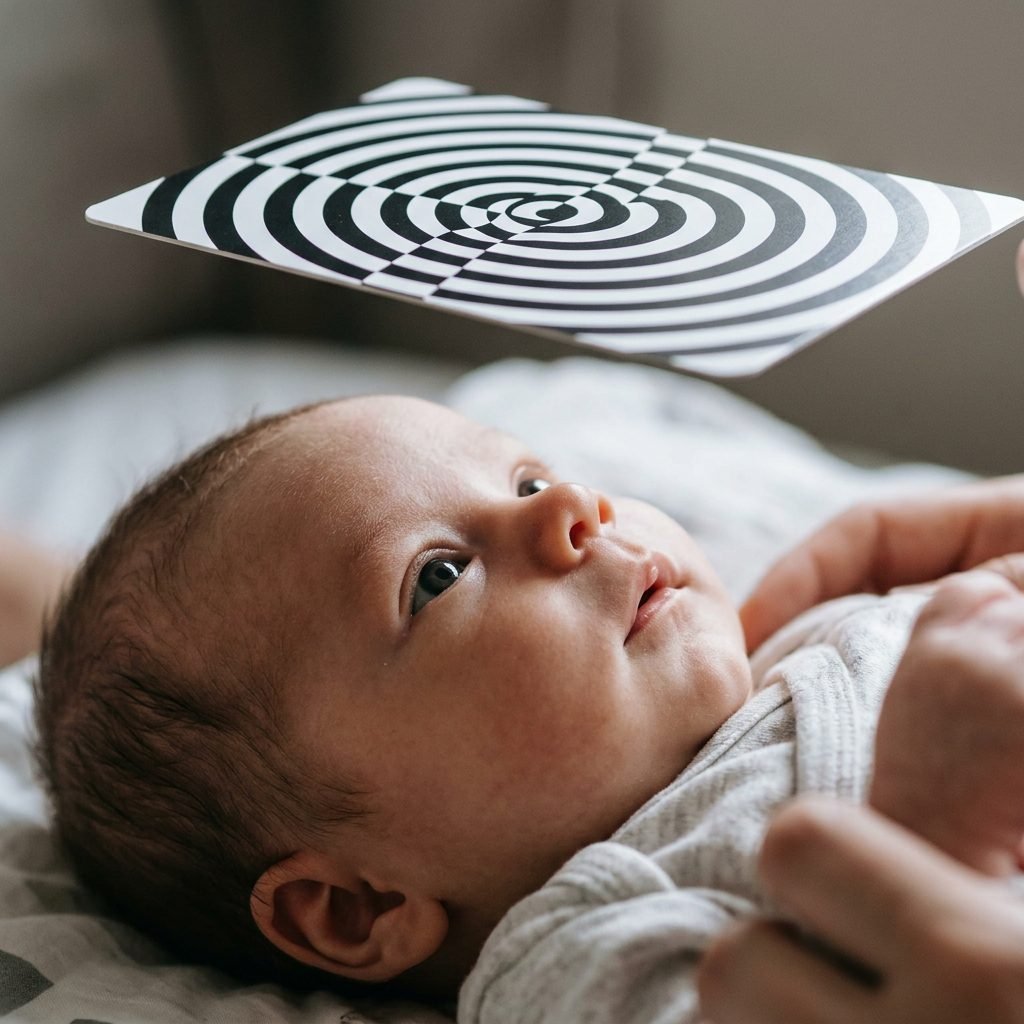
A newborn’s focal length is incredibly short. They can only clearly see objects that are exactly 8 to 12 inches away from their face. Beautifully enough, this is the exact distance between your face and theirs during feeding! Anything beyond that distance is a soft blur.
Why Black, White, and Red?
Because their color vision is not yet developed, pastel pinks, soft blues, and muted nursery neutrals—while aesthetically pleasing to us—are virtually invisible to a newborn. The photoreceptors in their eyes (the rods and cones) respond best to stark, dramatic contrasts. Black and white patterns send the strongest visual signals to the baby’s brain. This intense visual stimulation is captivating. It involuntarily draws their focus, effectively distracting them from the physical exertion of lifting their head.
- 0-2 Months: Stick strictly to black and white geometric patterns.
- 2-3 Months: Introduce bold reds, as red is the first color their eyes begin to register.
- 3-5 Months: Begin incorporating simple primary colors and more complex shapes (like animal silhouettes).
Gathering Your Materials: Safe, Stylish, and Sensory-Rich
Curating Your Tummy Time Setup
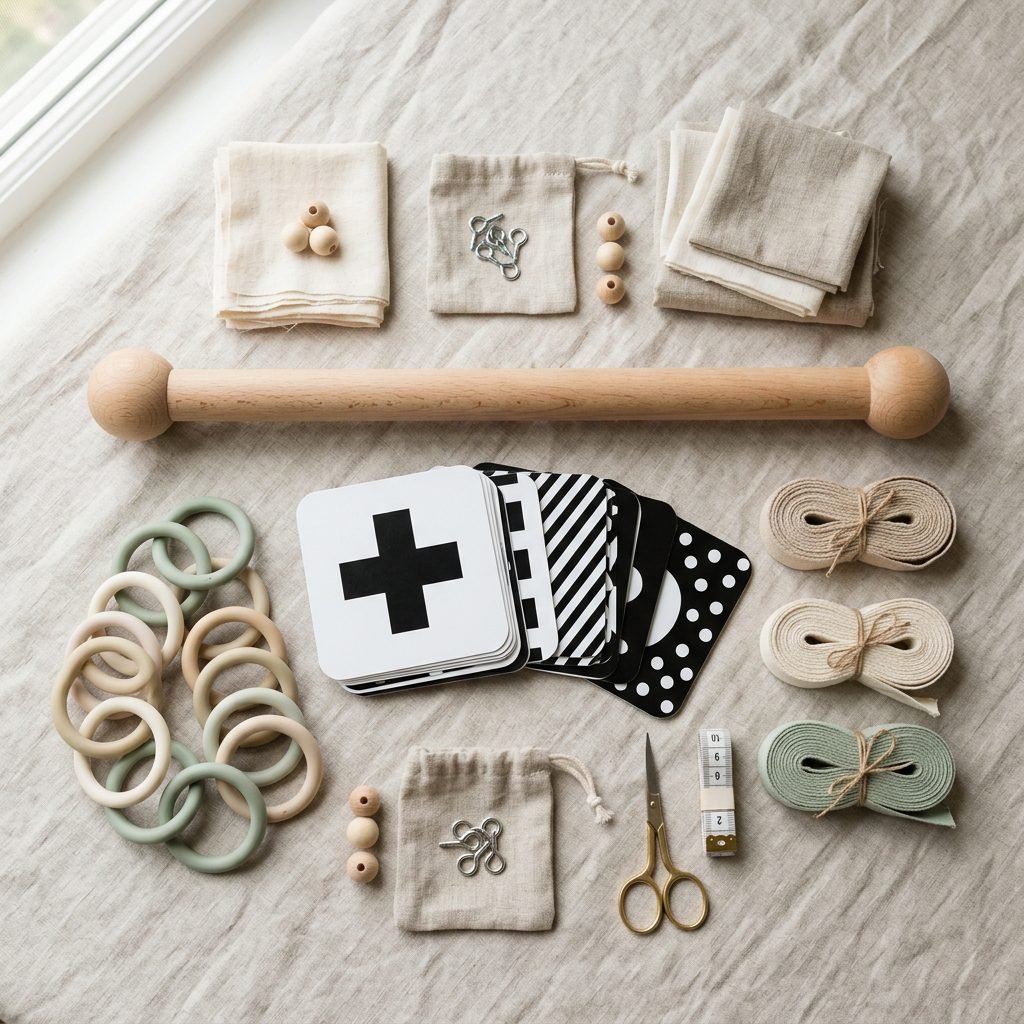
Before we start hanging anything over your precious baby, we need to gather materials that are not only beautiful and functional but, most importantly, rigorously safe. As a nursery designer and postpartum nurse, I always prioritize non-toxic, secure items that blend seamlessly into your home’s aesthetic.
What You Will Need
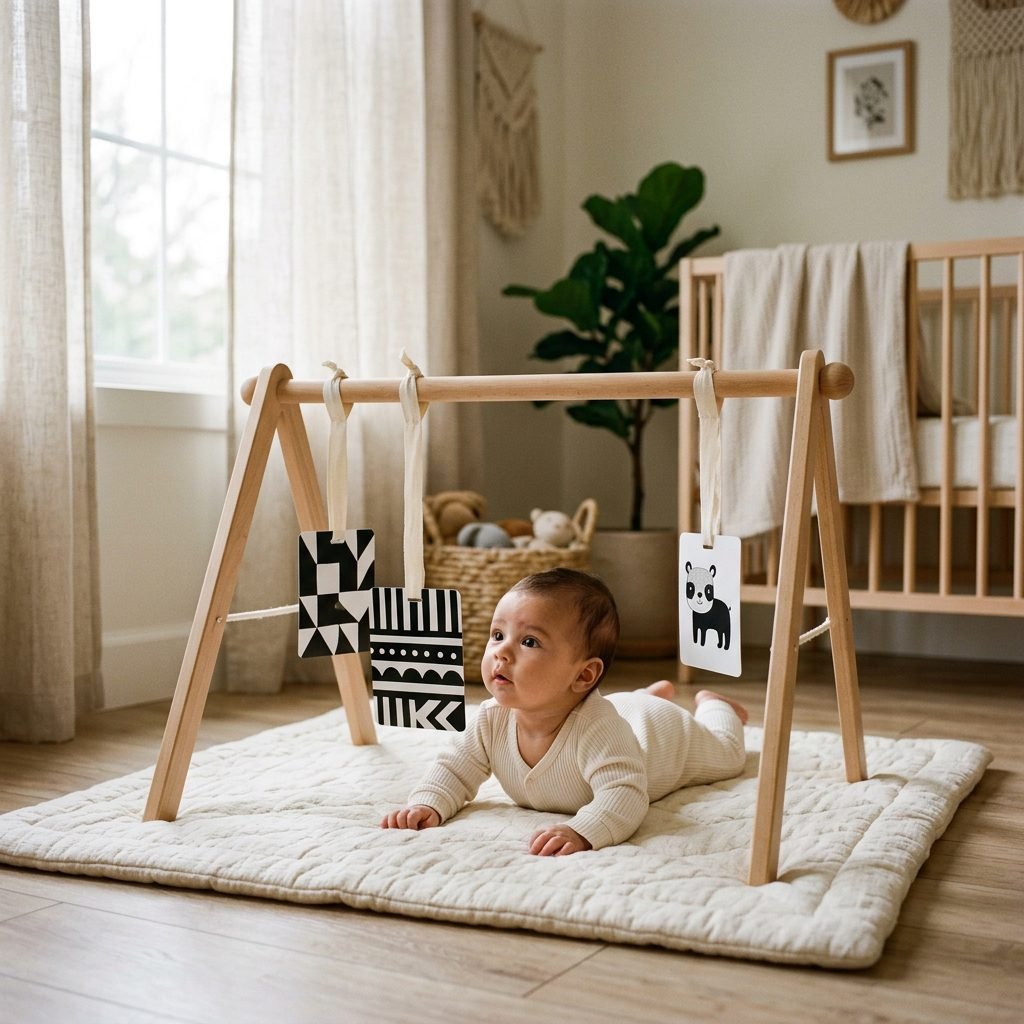
- A Sturdy Baby Gym: I highly recommend a minimalist wooden baby gym (like an A-frame style). They are stable, visually calming, and provide a perfect structural base for hanging items without overstimulating the baby with flashing lights or plastic music boxes.
- High-Contrast Art Cards: Look for cards printed on thick, durable cardstock with rounded corners (to prevent eye pokes). Ensure they are printed with non-toxic, soy-based inks.
- Safe Connectors: You have a few stylish and safe options here. 1. Silicone linking rings: These are fantastic because they are flexible, safe for chewing later, and easy to adjust. 2. Organic cotton ribbon: Perfect for a soft, boho aesthetic, but requires secure double-knotting. 3. Wooden pacifier clips: These can safely grip the cards and loop around the gym bar.
- A Plush, Supportive Playmat: Comfort is key. An organic cotton or non-toxic foam mat provides the necessary cushioning for those inevitable face-plants.
Safety Warning: Never use thin strings, loose threads, or easily breakable plastic clips. Anything suspended above your baby must be rigorously pull-tested to ensure it cannot fall or become a strangulation hazard.
Step-by-Step: Safely Hanging Visual Cards for Maximum Engagement
The DIY Setup Guide
Now that we have our beautiful materials, let’s assemble the gym. The goal here is to create a ‘visual arc’ that encourages your baby to lift their head, turn their neck from left to right, and gradually increase their stamina.
Step-by-Step Instructions
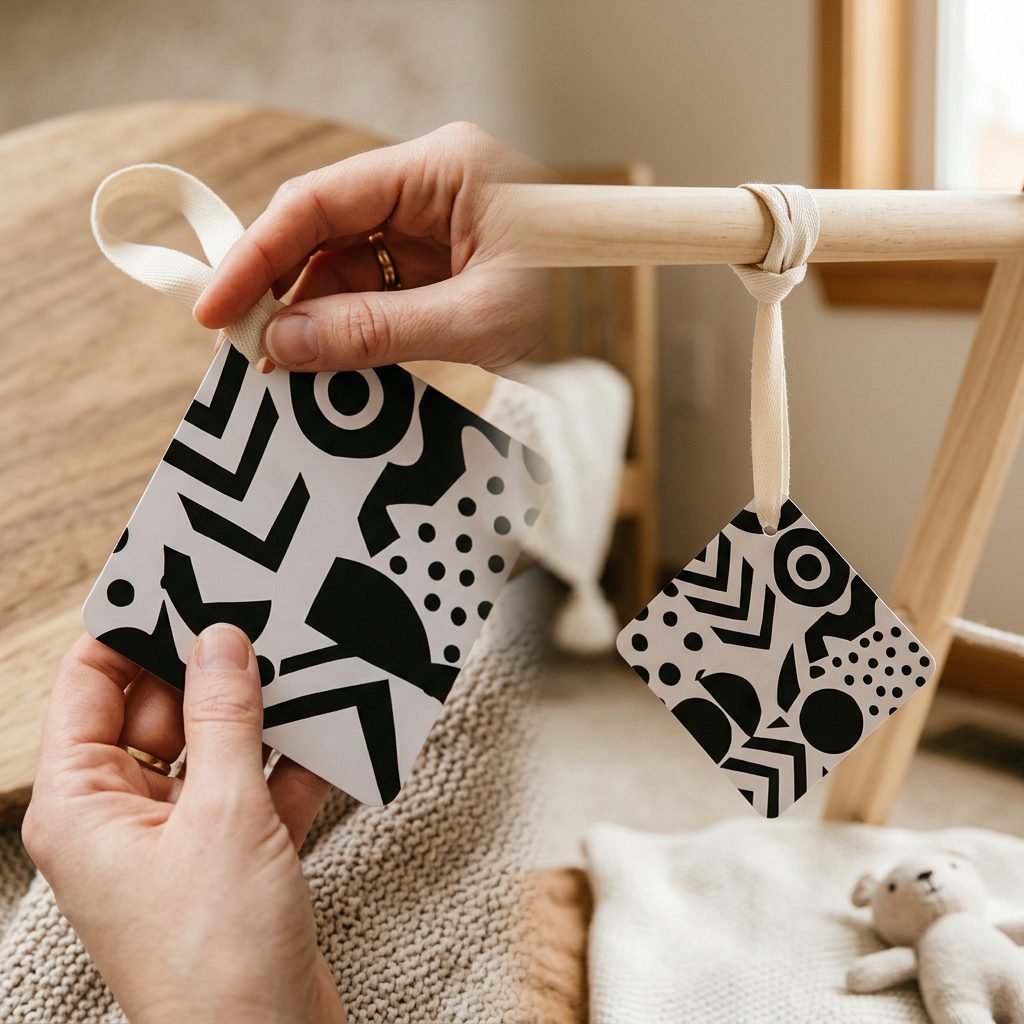
- Measure the Focal Distance: Lay your baby on their tummy on the playmat. Gently measure the distance from their eye level to the hanging bar of the gym. You want the bottom edge of the cards to hang exactly 8 to 12 inches from their face.
- Prepare the Cards: If your cards do not come pre-punched, use a standard hole punch to create a single hole at the top center of each card. Ensure the hole is at least a half-inch from the edge so the cardstock doesn’t tear.
- Thread the Connectors: If using silicone links, loop one link through the card, and use additional links to create a chain that reaches the desired length. If using organic ribbon, cut a length of ribbon, thread it through the card, and tie a secure double knot around the gym bar.
- Create a Visual Arc: Do not hang all the cards at the exact same height or in a straight line. Hang the center card slightly lower, and angle the outer cards slightly inward. This encourages the baby to sweep their gaze from side to side, promoting symmetrical neck muscle development and preventing torticollis.
- The Ultimate Tug Test: Before placing your baby underneath, give each card and connector a firm, confident tug. If anything slips, re-tie or re-secure it immediately.
By hanging the cards rather than just propping them on the floor, you are forcing your baby to lift their chin slightly higher, which deeply engages the upper back and shoulder muscles.
Tummy Time Milestone Matrix & Troubleshooting Tears
Setting Realistic Expectations
As a doula, I always remind parents to manage their expectations. A newborn is not going to happily do tummy time for 20 minutes straight. It is a progressive skill. We are looking for small, incremental wins. If your baby cries the second you put them down, try rolling them onto their tummy from their back, rather than placing them face-down like an airplane. The transition is much less jarring for their nervous system.
Tummy Time & Visual Milestone Matrix
Use this evidence-based guide to understand what is normal for your baby’s age, how long to aim for, and what visual milestones they are hitting.
| Baby’s Age | Tummy Time Goal (Per Session) | Daily Frequency | Visual & Physical Milestones |
|---|---|---|---|
| 0 – 2 Weeks | 1 to 2 minutes | 2 to 3 times a day | Focuses 8-10 inches. Loves simple black & white. Will mostly rest cheek on mat. |
| 1 – 2 Months | 3 to 5 minutes | 3 to 4 times a day | Begins tracking horizontally. Lifts head briefly to 45 degrees to view hanging cards. |
| 3 – 4 Months | 10 to 15 minutes | 4 to 5 times a day | Introduces red/primary colors. Pushes up on forearms. Reaches for dangling cards. |
| 5 – 6 Months | 15 to 20+ minutes | Throughout wake windows | Full color vision emerging. Pushes up on straight arms, pivots, and attempts to grab or roll towards the cards. |
Troubleshooting the Tears
- The Roll Trick: Roll them gently into position while talking softly.
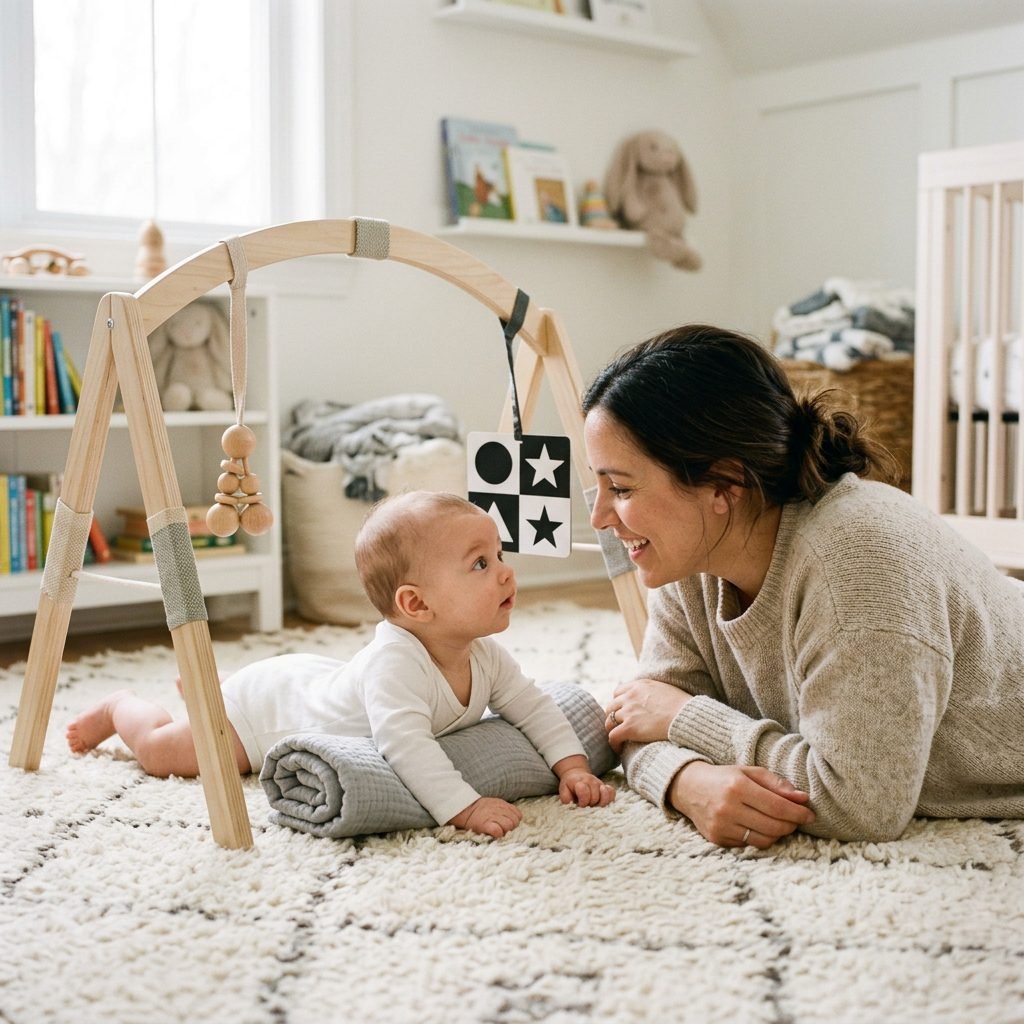
- Change the Angle: If flat on the floor is too hard, use a rolled-up receiving blanket or a nursing pillow under their chest to elevate them slightly. This reduces the gravitational pull and makes viewing the cards easier.
- Get Down With Them: Your face is their favorite high-contrast object! Lay on the floor opposite the cards so they can see you through the gym.
Beyond the Gym: Integrating Contrast Cards into Daily Routines
Maximizing the Magic All Day Long
The beauty of high-contrast cards is their incredible versatility. Once you see how effectively they capture your baby’s attention, you will want to use them in every room of the house. Extending tummy time doesn’t just have to happen under the baby gym.
Creative Ways to Use Your Cards
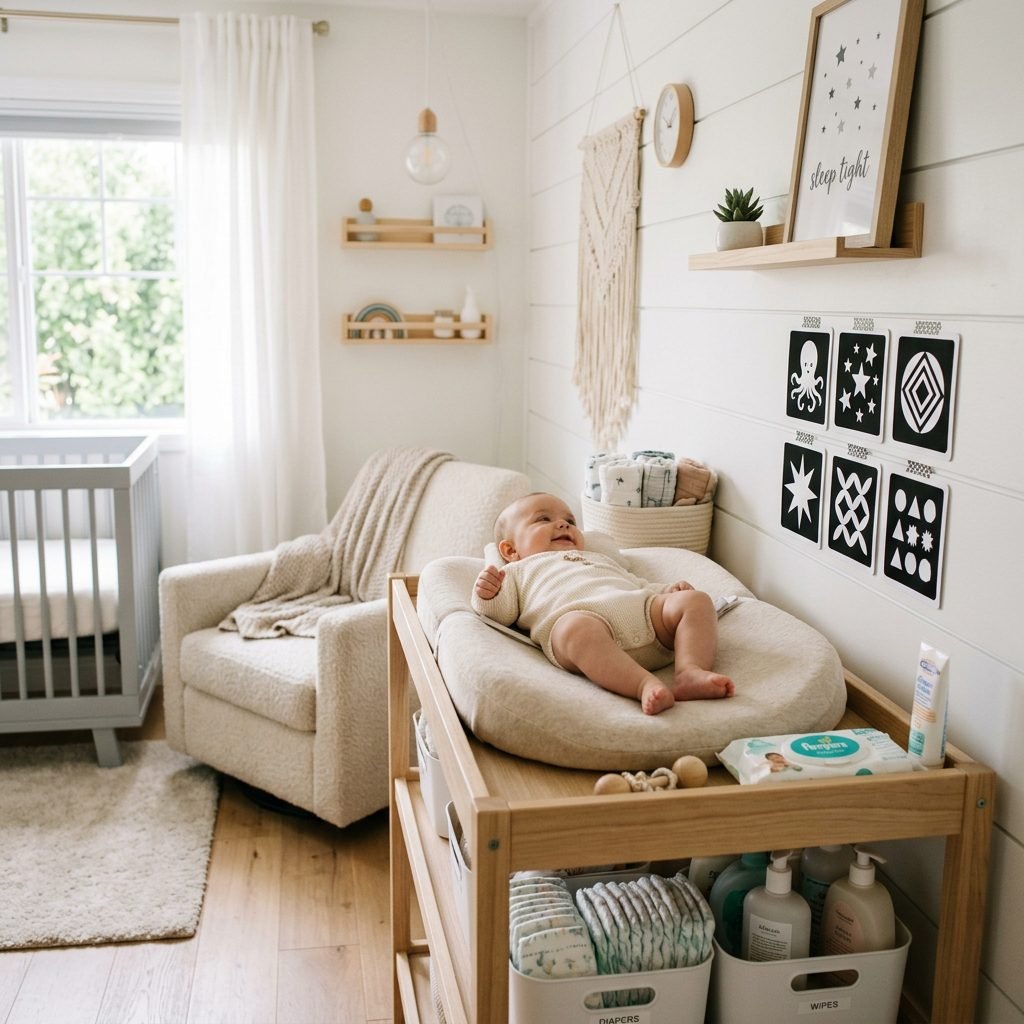
- The Diaper Change Distraction: Keep a few cards taped to the wall next to your changing pad. If you have a baby who alligator-rolls during diaper changes, a strategically placed high-contrast card can keep them wonderfully still and focused.
- Chest-to-Chest Tummy Time: This is a favorite for the early postpartum days. Recline on your pillows at a 45-degree angle and lay baby on your chest. Hold a contrast card just behind your head or to the side. They get the comfort of your heartbeat while doing their physical therapy.
- The Car Seat Saver: Use a safe, flexible silicone link to attach one card to the handle of the infant car seat (only when the car seat is clicked into the stroller, never while driving). It provides excellent visual stimulation during neighborhood walks.
- Side-Lying Play: Tummy time’s gentle cousin! Lay your baby on their side, supporting their back with a rolled towel. Prop a contrast card in front of them. This is excellent for babies recovering from torticollis or those who are overly fatigued from being on their stomach.
Remember, sensory play at this age doesn’t require expensive, flashing toys. The simple, elegant contrast of black and white is exactly what their developing brain craves.
Conclusion
You’ve Got This, Mama
Incorporating high-contrast visual cards into your baby gym setup is one of the simplest, most effective, and aesthetically pleasing ways to support your baby’s development. By understanding the biology of their vision and safely organizing their play space, you are empowering them to build strength without the overwhelming frustration. Remember, some days will be better than others. If today’s tummy time lasted exactly 45 seconds before the tears started, gracefully scoop your baby up, offer a cuddle, and try again tomorrow. You are providing a rich, loving, and stimulating environment, and that is exactly what your baby needs most.
Medical Disclaimer: The information provided in this article is for educational and informational purposes only and is not intended as medical advice. Always supervise your baby closely during tummy time and sensory play. Ensure all hanging objects are securely fastened and out of reach of grasping hands to prevent strangulation or choking hazards. Consult with your pediatrician or a licensed pediatric physical therapist if you have concerns about your baby’s physical development, neck strength, or visual acuity.