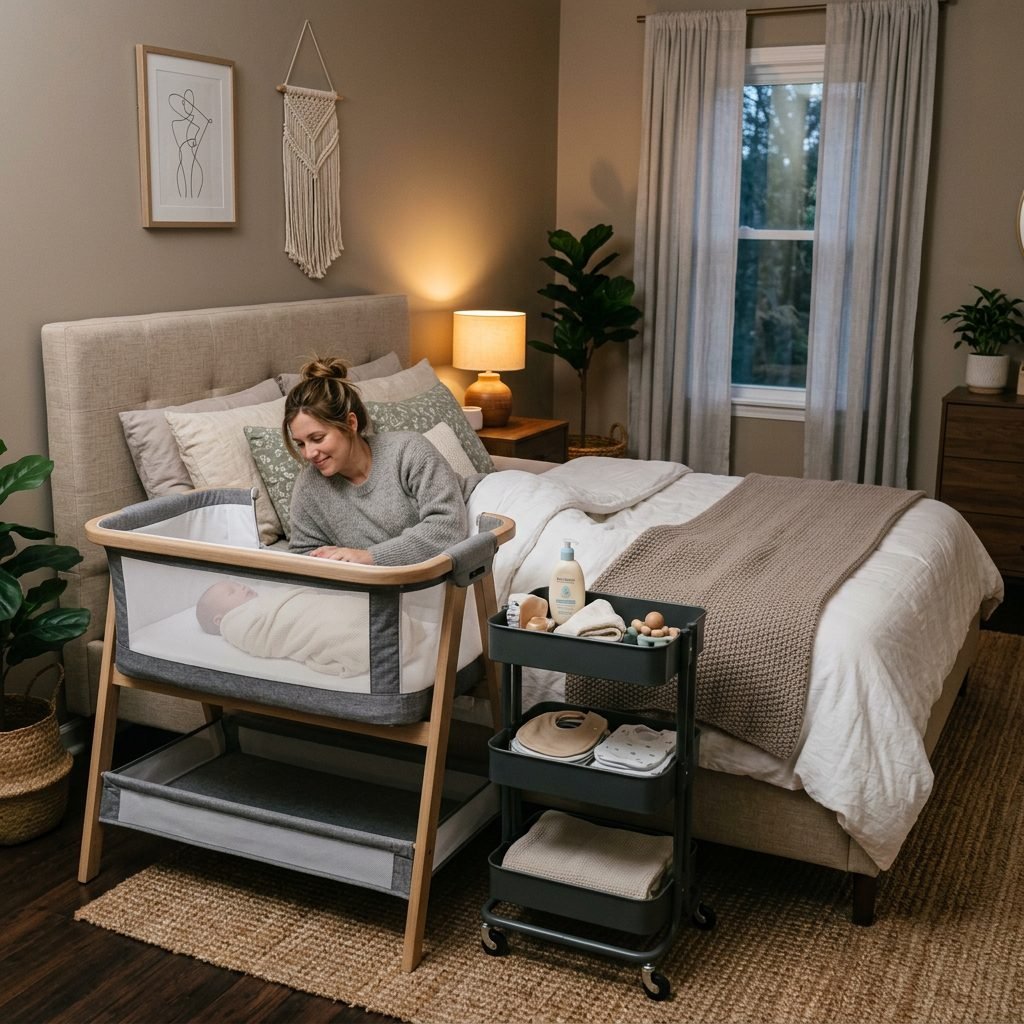
How to Style and Safely Set Up a Co-Sleeping Bassinet in Your Master Bedroom
Hello, beautiful mama. If you are reading this, you are likely in the thick of the nesting phase—folding tiny onesies, washing impossibly small socks, and looking around your master bedroom wondering how on earth a baby is going to fit into your sanctuary. As a doula, a postpartum nurse, and a fellow mother who loves a beautifully organized space, I am here to wrap a reassuring arm around your shoulders. You do not have to sacrifice your bedroom’s aesthetic to create a functional, safe space for your newborn. You can have both.
Bringing your baby into your room for the first six to twelve months is highly recommended by pediatricians to reduce the risk of SIDS and to make those frequent midnight feedings just a little bit easier on your recovering body. But integrating a co-sleeping bassinet into your adult space requires a delicate balance of strict safety protocols and clever design hacks. We want your room to feel like a serene, restful haven for postpartum recovery, not a cluttered baby gear explosion.
In this comprehensive guide, we are going to walk through exactly how to set up your bedside bassinet. We will cover the non-negotiable safety rules, strategic room placement, aesthetic styling tips to blend the baby’s nook with your decor, and the ultimate storage hacks for your 3 AM survival station. Take a deep breath, grab a cup of red raspberry leaf tea, and let’s create a beautiful, safe nest for your little one.
The Golden Rules of Safe Sleep (Before We Decorate!)
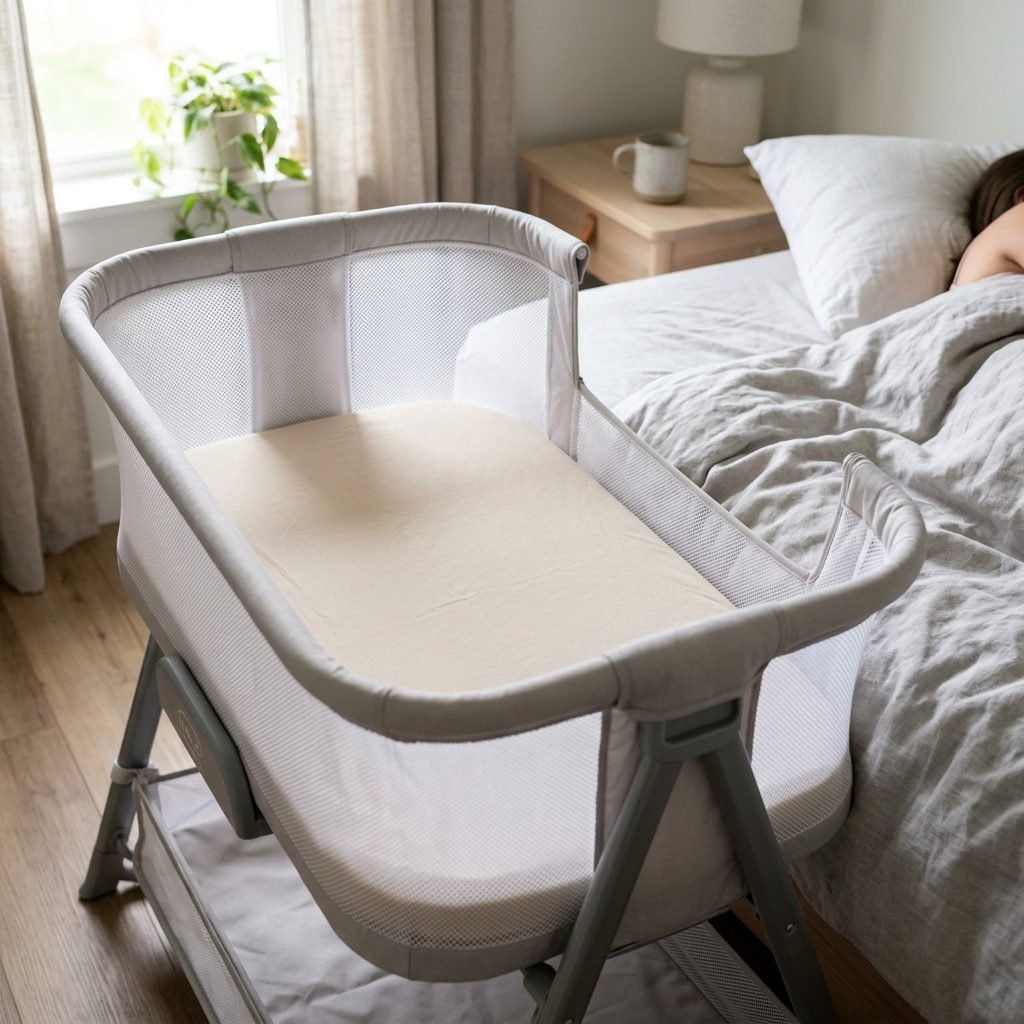
Before we even think about matching wood tones or selecting the perfect organic cotton sheets, we must address the absolute foundation of your baby’s sleep space: safety. As an evidence-based care provider, I cannot stress enough that when it comes to the inside of the bassinet, boring is best. The American Academy of Pediatrics (AAP) has clear, non-negotiable guidelines for infant sleep, and these must be your north star.
The ABCs of Safe Sleep
- A – Alone: Your baby should sleep alone in their bassinet. No stuffed animals, no sleep positioners, no dock-a-tots, and no loose blankets.
- B – Back: Always place your baby on their back to sleep. This is the safest position to keep their airway clear.
- C – Crib or Bassinet: The sleep surface must be firm and flat. If your bassinet has an incline, it is not safe for unsupervised sleep.
Mama, I know those plush, ruffled bassinet bumpers and cozy quilts look adorable on Pinterest, but your baby’s safety is the true masterpiece. A bare bassinet is a beautiful bassinet.
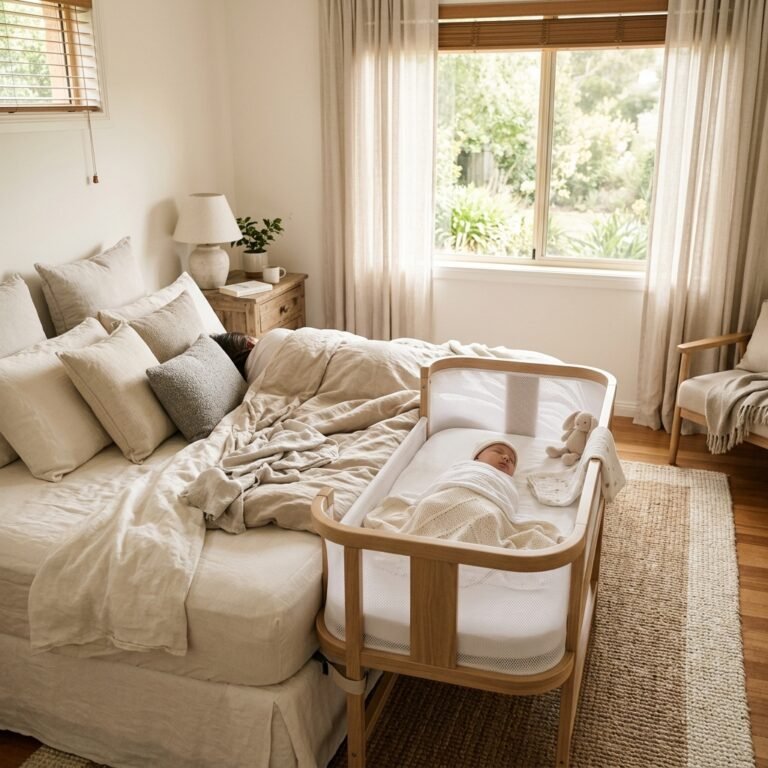
When choosing a co-sleeping bassinet (one that pulls right up to your bed), ensure it meets current CPSC (Consumer Product Safety Commission) standards. The mattress should be firm—so firm that it might feel uncomfortable to you, but it is exactly what your baby’s developing spine and airway need. The fitted sheet should be tight, with absolutely no bunching.
| Safe Sleep Setup | Unsafe Sleep Setup (Avoid!) |
|---|---|
| Firm, flat mattress provided by the manufacturer | Adding extra padding, memory foam, or folded blankets under the sheet |
| Tightly fitted sheet only | Loose blankets, top sheets, or pillows |
| Sleep sacks or wearable blankets for warmth | Heavy quilts or weighted swaddles |
| Breathable mesh sides for airflow | Plush bumpers or decorative fabric liners |
| Bassinet locked securely against the adult bed (no gaps) | A gap between the adult mattress and the bassinet mattress |
Strategic Placement: Where to Put the Bassinet

Finding the right spot for your bassinet is like solving a spatial puzzle. You need it close enough for easy access during the night, but positioned safely away from environmental hazards. Let’s look at the physical layout of your master bedroom.
Clearance and Accessibility
You want your bassinet directly next to your side of the bed, especially if you are recovering from a C-section or a perineal tear. You should not have to twist, lunge, or perform acrobatics to reach your baby. If you are using a bedside sleeper that drops down on one side, ensure the height is adjusted perfectly flush with your mattress, or slightly lower, but never higher, to prevent the baby from rolling onto your soft adult bedding.
Environmental Hazards to Avoid
- Windows and Blind Cords: Keep the bassinet at least 3 feet away from windows. Drafts can drastically change the baby’s body temperature, and dangling blind cords pose a severe strangulation risk.
- HVAC Vents and Radiators: Do not place the bassinet directly under an AC vent or next to a heating unit. Babies cannot regulate their body temperature well, and direct forced air can cause chilling or overheating.
- Heavy Wall Decor: Look up. What is hanging above the bassinet? Avoid heavy mirrors, large framed glass art, or floating shelves directly over the baby’s sleep space. If an earthquake or a slammed door knocks it loose, it could fall into the bassinet.
If your master bedroom is incredibly small, you might need to temporarily remove a nightstand to make room for the bassinet. Don’t worry—in the next section, we will cover how to replace that storage with something even more functional for postpartum life.
Styling Your Bassinet Nook Without Compromising Safety

Now for the fun part! Just because the inside of the bassinet must be bare doesn’t mean the area around it can’t be stunning. Creating a cohesive “nursery nook” within your master bedroom helps maintain your identity and peace of mind. Here is how to blend baby gear with adult decor.
1. Harmonize Your Textiles
Since the bassinet sheet is the only fabric allowed inside the sleep space, make it count! Instead of generic baby prints, look for high-quality, GOTS-certified organic cotton or muslin sheets in solid colors or subtle patterns that match your master bedroom’s color palette. If your bed features rust and terracotta linens, find a bassinet sheet in a warm clay tone. If your room is a serene, cool-toned oasis, opt for sage green or crisp white.
2. Anchor the Space with a Rug
To make the bassinet feel like an intentional part of the room rather than an afterthought, place a small, washable accent rug (like a 3×5 or 4×6) under the bassinet and your side of the bed. This visually anchors the baby’s zone. Pro-tip: Always choose a machine-washable rug for this area. Midnight spit-ups and diaper blowouts are inevitable!
3. Match the Finishes
When registering for or purchasing a bassinet, consider the existing finishes in your bedroom. If you have mid-century modern walnut furniture, look for a bassinet with wood-toned legs rather than stark white plastic. If your room is glamorous with brass accents, find a bassinet with a sleek, metallic or matte black frame. Cohesion is the secret to a high-end look.
4. Add Safe, Calming Greenery
Bring life to the nook by placing a safe, air-purifying plant on a nearby dresser or wall sconce (safely out of reach). Snake plants or spider plants are excellent for bedrooms as they release oxygen at night, contributing to a fresher, more restful environment.
The 3 AM Survival Station: Bedside Storage Hacks
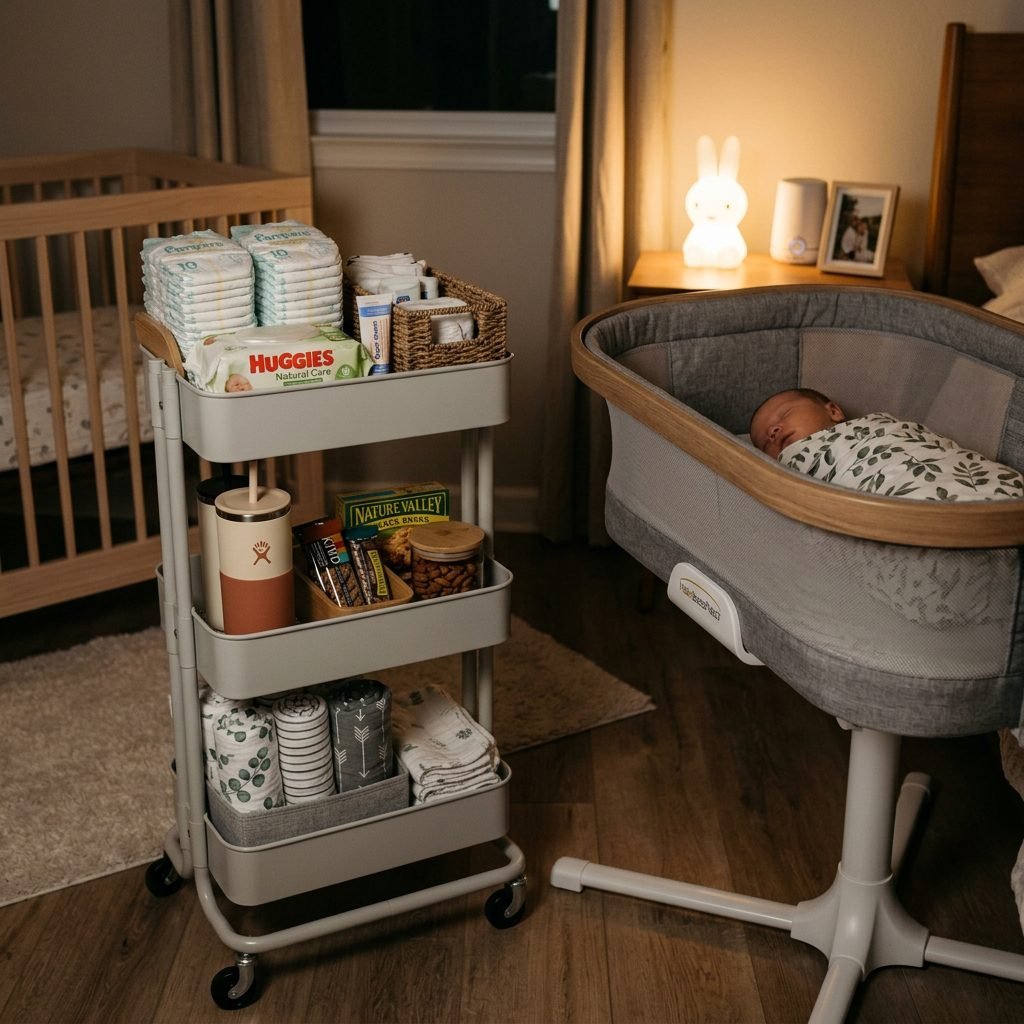
When your baby wakes up at 3:00 AM, the last thing you want to do is turn on the overhead lights, stumble across the room, and dig through a closet for a fresh diaper. You are exhausted, your hormones are fluctuating, and you need everything within arm’s reach. Enter: The 3 AM Survival Station.
If you had to move your nightstand to fit the bassinet, or if your nightstand simply doesn’t have enough drawer space, a 3-tier rolling utility cart (like the famous IKEA Raskog or a clear acrylic rolling cart) is your best friend. It has a tiny footprint, holds a massive amount of supplies, and can be rolled out of the way during the day.
How to Organize Your Postpartum Rolling Cart
We want to organize this cart by urgency. The things you need fastest go on the top tier.
| Cart Level | Items to Include | Why You Need It Here |
|---|---|---|
| Top Tier (Urgent & Frequent) | Diapers, wipes in a weighted dispenser, diaper cream with a spatula, 2-3 burp cloths, pacifiers. | When a blowout happens in the dark, you need immediate, one-handed access to these items without bending down. |
| Middle Tier (Feeding & Mama Care) | Large insulated water tumbler with a straw, one-handed snacks (granola bars), nipple cream, silverettes, nursing pads, or formula dispenser/bottles. | Breastfeeding and pumping make you incredibly thirsty and hungry. Keeping your recovery and feeding supplies together saves your sanity. |
| Bottom Tier (Backups & Extras) | 2 extra bassinet sheets, 2 extra swaddles/sleep sacks, 2 fresh baby footies, a wet bag for soiled clothes. | If the baby spits up all over the bed at 4 AM, you do not want to go to the nursery. Having fresh sheets and pajamas here is a game-changer. |
Sisterly Reminder: Stock your cart before you go to bed every single night. Make it a 5-minute evening ritual. Waking up to an empty wipe dispenser at 2 AM is a form of torture you can easily avoid!
If you prefer not to use a rolling cart, consider an over-the-bed storage caddy that tucks under your mattress and hangs down the side, holding just the absolute essentials like a diaper, wipes, and a burp cloth.
Sensory Sleep Cues: Lighting, Sound, and Air Quality
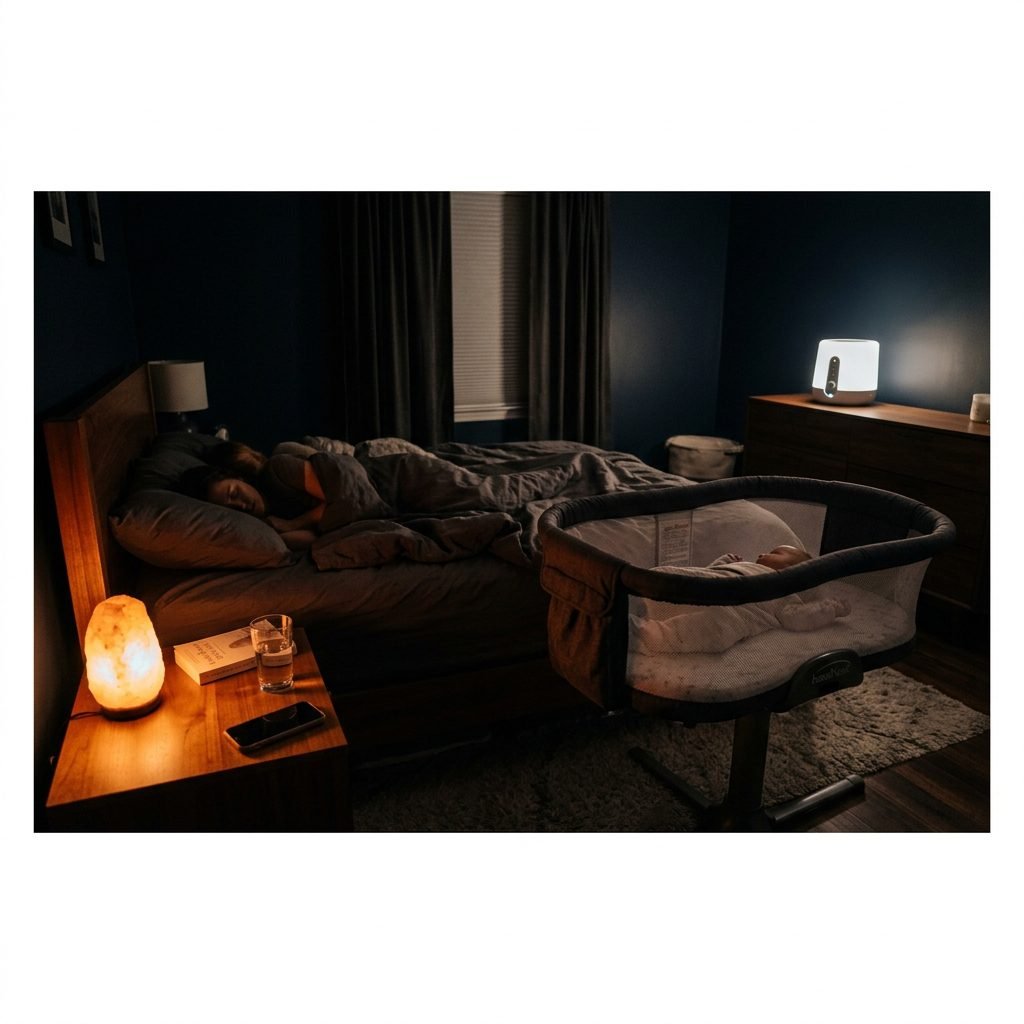
To round out your perfectly styled and safe co-sleeping space, we must address the invisible elements of the room: light, sound, and air. These sensory cues are vital for helping your newborn (and you!) string together longer stretches of sleep.
1. The Magic of Red and Amber Light
Overhead lights and standard blue-toned LED lamps inhibit the production of melatonin, the sleep hormone. When you turn on a bright lamp for a midnight feed, you are signaling to your baby’s brain (and yours) that it is daytime. Instead, invest in a small, dimmable amber or red nightlight. Products like the Hatch Rest or a simple Himalayan salt lamp provide enough visibility for you to change a diaper and latch your baby, without waking up your nervous systems.
2. White Noise Placement and Decibel Limits
The womb was incredibly loud—roughly the volume of a vacuum cleaner! A white noise machine helps recreate that comforting environment and masks the sounds of you and your partner moving in bed. However, safety is key here.
- Place the white noise machine at least 7 feet away from the baby’s head (across the room is perfect).
- Keep the volume below 50 decibels (you can download a free decibel reader app on your phone to test this).
- Opt for continuous, deep brown or pink noise rather than looping sounds like crashing waves, which can stimulate rather than soothe.
3. Temperature and Air Quality
The ideal room temperature for a newborn is between 68°F and 72°F (20°C – 22°C). A room that is too warm increases the risk of SIDS. To keep the air fresh and circulating, consider placing a small, quiet HEPA air purifier in the corner of the bedroom. Not only does it provide a gentle hum of white noise, but it also filters out dust, pet dander, and allergens, ensuring your baby is breathing the cleanest air possible while their tiny lungs develop.
Conclusion
Setting up a co-sleeping bassinet in your master bedroom is one of the most exciting nesting tasks you will undertake. It is the physical manifestation of making space in your life, and your home, for this beautiful new soul. By prioritizing strict safety guidelines, optimizing your room’s layout, and utilizing clever storage hacks like the 3 AM survival cart, you are setting yourself up for a much smoother, more restful postpartum transition.
Remember, mama, this season of room-sharing is fleeting. Soon enough, the bassinet will be packed away, and you will have your master bedroom back to yourself. But for now, embrace the closeness, give yourself grace on the sleepless nights, and enjoy the beautiful, cozy nest you have created for your growing family. You are going to do wonderfully.