
Survival Guide: Handling The Night Shift While Pregnant
Hey there, beautiful mama. If you are reading this, chances are you are currently navigating one of the most uniquely exhausting seasons a woman can face: growing a tiny human while the rest of the world is fast asleep. Working the night shift is already a physical and mental marathon, but adding the profound metabolic demands of pregnancy into the mix? That requires a whole new level of strength, strategy, and self-grace.
As a doula, I have held the hands of night-shift nurses, emergency dispatchers, warehouse managers, and late-night creatives who feel completely overwhelmed by the crushing fatigue that hits around 3:00 AM. You are not just fighting the clock; you are fighting a surge of sleep-inducing hormones, shifting center of gravity, and a circulatory system that is working overtime. It is completely normal if you feel like you are walking through molasses right now.
Remember this: Your body is currently performing the equivalent of a continuous physiological marathon, even when you are just sitting at your desk or walking the floor. Grace is your absolute best friend right now.
This survival guide is designed specifically for you. We are going to dive deep into how you can hack your circadian rhythm, nourish your body to prevent those dizzying blood sugar crashes, advocate for your physical comfort on the job, and create a daytime sleep sanctuary that actually works. Take a deep breath, give your belly a little rub, and let’s build your night shift pregnancy survival plan together.
The Science of Sleep: Why the Night Shift Feels Harder Now

Before we get into the practical hacks, we need to validate exactly what is happening inside your body. You are not being weak, and you are not just “tired”—you are experiencing a profound biological shift. During the first trimester, your body produces massive amounts of progesterone, a hormone that acts as a natural central nervous system depressant. It is literally designed to force you to slow down and rest.
When you combine this natural sedative effect with the disruption of your circadian rhythm, the fatigue can feel paralyzing. Your body’s internal clock is governed by light and dark cycles, which dictate the release of melatonin (the sleep hormone) and cortisol (the waking hormone). By staying awake under artificial lights while pregnant, you are asking your brain to override its deepest evolutionary programming.
The Circadian-Pregnancy Clash
- Temperature Fluctuations: Pregnancy naturally raises your basal body temperature. At night, your body expects to cool down for sleep. Staying awake and active can lead to hot flashes and night sweats on the job.
- Blood Sugar Dips: Your metabolism is working 20% faster to support fetal development. The long stretches of the night shift can easily lead to hypoglycemia if you aren’t grazing constantly.
- Digestive Slowdown: Progesterone relaxes smooth muscle tissue, including your digestive tract. Eating large meals at 2:00 AM can lead to severe heartburn and indigestion because your GI tract wants to be resting.
Understanding these biological realities is the first step in giving yourself permission to modify your routine. You cannot push through this with sheer willpower or an extra shot of espresso (especially since we are watching our caffeine intake!). You need strategic, gentle interventions.
Hacking Your Daytime Sleep Sanctuary

When you work the night shift, your bedroom during the day must become an impenetrable fortress of rest. Because your pregnant body is already battling sleep disruptions like restless leg syndrome, frequent urination, and hip pain, we cannot afford to let sunlight or street noise steal a single minute of your recovery time.
Creating the Perfect Sleep Environment
To trick your brain into releasing melatonin while the sun is shining, you need to manipulate your environment entirely. Here is your step-by-step sanctuary setup:
- Total Blackout: Invest in true, 100% blackout curtains. If light is still peeking through the edges, use blackout window film or even dark construction paper in a pinch. Your room should be so dark you cannot see your hand in front of your face.
- Temperature Control: Keep the room frigid. Aim for a thermostat setting between 65 to 68 degrees Fahrenheit. Since pregnancy makes you run hot, a cool room will signal your brain that it is time to sleep.
- Acoustic Isolation: Use a sound machine playing pink noise or brown noise (which are deeper and more soothing than white noise) to drown out daytime traffic, lawnmowers, and household chatter.
- The Pillow Fort: By your second trimester, a U-shaped or C-shaped pregnancy pillow is non-negotiable. It supports your hips, keeps you safely on your side, and prevents you from rolling onto your back.
The Strategic Pre-Shift Nap
If you have a night off before starting a stretch of shifts, try to stay up as late as possible the night before, and sleep in as long as you can. On the day of your shift, a strategic nap is crucial. Aim for a 90-minute nap right before you start getting ready for work. Ninety minutes allows you to complete one full REM sleep cycle, preventing that groggy, “sleep inertia” feeling you get from waking up mid-cycle.
Midnight Cravings and Crash Prevention
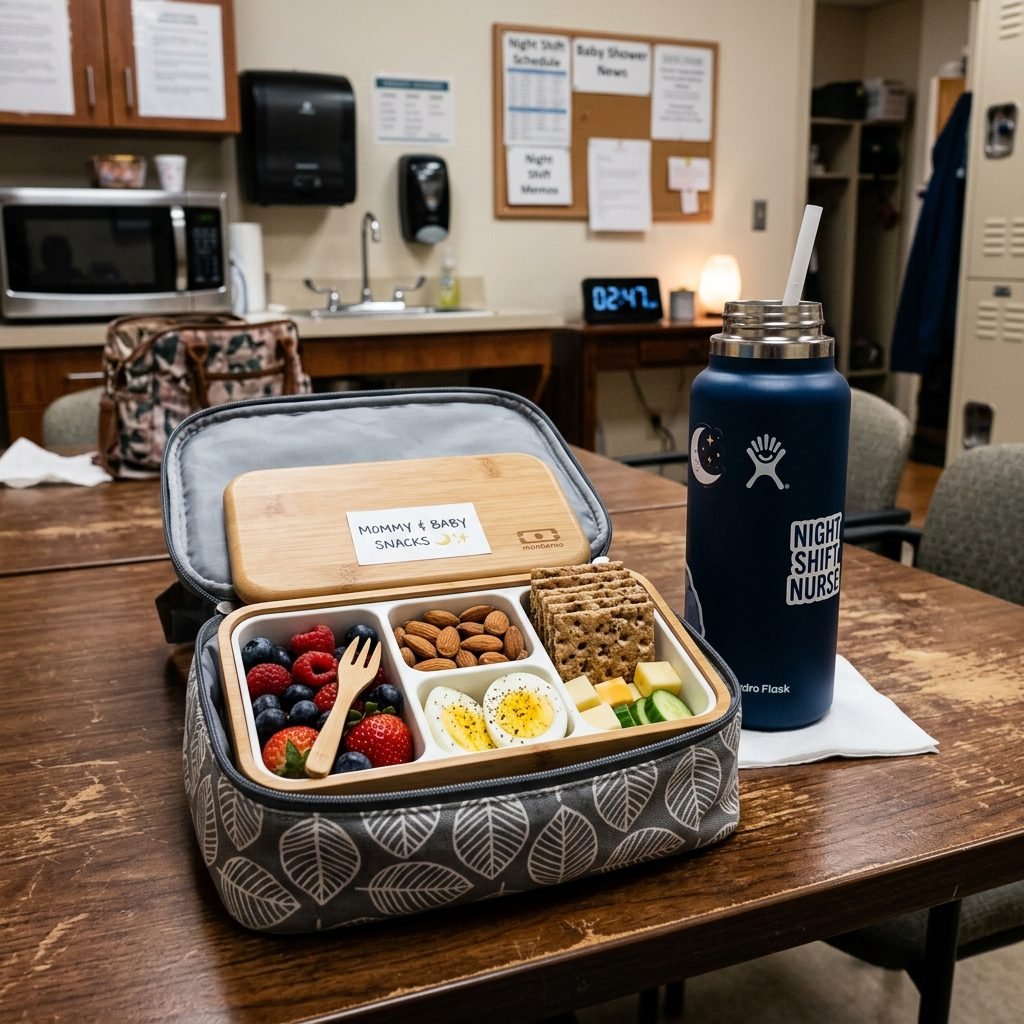
Nourishing your body on the night shift is a delicate dance. If you eat too much, you will trigger agonizing heartburn and sluggishness. If you eat too little, the nausea and dizziness will knock you off your feet. The secret is to shift away from three large meals and embrace the art of “strategic grazing.”
During the night, your digestion is naturally slower. You want to focus on high-protein, complex-carbohydrate combinations that stabilize your blood sugar without overwhelming your stomach.
Hydration is Your Secret Weapon
Dehydration is a leading cause of Braxton Hicks contractions and extreme fatigue. You need to be drinking at least 80 to 100 ounces of water daily. Keep a large, insulated tumbler with a straw at your workstation. Sipping ice-cold water can also serve as a gentle sensory shock to keep you alert when the 3:00 AM slump hits.
Night Shift Pregnancy Fuel: Safe vs. Avoid
| Food Category | Night Shift “Do’s” (Safe & Energizing) | Night Shift “Don’ts” (Avoid & Triggering) |
|---|---|---|
| Proteins | Hard-boiled eggs, Greek yogurt, string cheese, hummus, roasted chickpeas. | Heavy fried meats, spicy sausages, greasy fast-food burgers (triggers heartburn). |
| Carbohydrates | Oatmeal, whole-grain crackers, sweet potatoes, brown rice cakes. | Sugary donuts, pastries, white bread, heavy pastas (causes blood sugar crash). |
| Fruits/Veggies | Apples with almond butter, berries, cucumber slices, baby carrots. | Highly acidic citrus fruits or raw onions in the middle of the night (acid reflux). |
| Beverages | Ice water with lemon, peppermint tea, bone broth, one small cup of coffee (before midnight). | Energy drinks (unsafe), highly caffeinated sodas, large amounts of coffee after 2 AM. |
Pro-Tip for Nausea: If you are battling “morning” sickness on the night shift, keep a stash of ginger candies, plain saltines, and vitamin B6 drops in your pocket. Do not let your stomach get completely empty, as that is the number one trigger for pregnancy nausea.
Surviving the Shift: Ergonomics, Movement & Comfort

Whether you are on your feet doing rounds in a hospital or sitting in an ergonomic chair at a dispatch center, the physical toll of the night shift is magnified by your growing bump. Swelling (edema), lower back pain, and round ligament pain are your primary adversaries here.
Your Night Shift Uniform
Comfort is no longer a luxury; it is a medical necessity. If your workplace allows it, transition to maternity-specific workwear as early as you need to. Do not squeeze into your pre-pregnancy pants.
- Compression Socks: This is a non-negotiable. Invest in medical-grade maternity compression socks (aim for 15-20 mmHg of compression). Put them on before your shift starts, not after your feet are already swollen. They prevent varicose veins, reduce swelling, and literally give you more energy by improving blood return to your heart.
- Supportive Footwear: Your center of gravity is shifting, and the hormone relaxin is loosening your ligaments—including the ones in your feet! Wear wide, supportive shoes with excellent arch support.
- Belly Bands: If you are on your feet, a maternity support belt can take the weight of the baby off your lower back and pelvis.
Micro-Breaks and Physical Relief
You must incorporate movement to prevent stiffness, but also prioritize sitting when you can. Here is a quick, step-by-step physical relief routine you can do in the breakroom at 2:00 AM:
- The Breakroom Pelvic Tilt: Stand with your back against a wall. Inhale deeply, and as you exhale, flatten the curve of your lower back against the wall by tucking your pelvis under. Hold for 5 seconds. Repeat 10 times to relieve lower back pressure.
- The Calf Stretch: Face the wall, place your hands flat against it, and step one foot back, pressing your heel into the floor. Hold for 30 seconds to prevent those dreaded pregnancy leg cramps.
- The Elevated Rest: Whenever you take a break, do not just sit—elevate your feet. Prop them up on another chair or a stool to help drain the fluid from your lower extremities.
Setting Boundaries: Advocating for Your Pregnant Body

One of the hardest parts of pregnancy is learning to say “no” and asking for what you need. As women, and especially as dedicated professionals, we often try to push through the pain to prove we are still capable. But right now, your primary job is protecting your health and your baby’s health.
You are legally and medically entitled to reasonable accommodations in the workplace. This might mean asking for more frequent bathroom breaks, a stool to sit on if you are usually standing, or a temporary reprieve from heavy lifting.
Having the Conversation with Your Boss
Approach your manager with a collaborative, solution-oriented mindset. You are not asking for a favor; you are establishing a safe working environment. If you are nervous about how to frame the conversation, use this template:
“Hi [Manager’s Name], I wanted to touch base regarding my pregnancy and my current night shift duties. I am fully committed to my role and our team, but as my pregnancy progresses, my doctor has advised me to implement a few minor accommodations to ensure my safety and the baby’s health. Specifically, I need to ensure I can take a 5-minute seated break every two hours, and I will need assistance with lifting anything over 15 pounds. I have already spoken with [Coworker’s Name] who is happy to help me with the heavy lifting, and I will ensure my breaks do not disrupt the workflow. Thank you for supporting me during this transition!”
If your workplace is toxic or resistant, remember that you can always bring in a doctor’s note. A simple prescription pad note stating, “Patient requires a stool for sitting and a 10-minute break every 2 hours due to medical necessity” is often all human resources needs to enforce your accommodations.
The Sunrise Surrender: Getting Home and Winding Down

You made it. The sun is coming up, your shift is over, and all you want to do is collapse. But the transition from the workplace to your bed is a critical window that can make or break your daytime sleep.
The Drive Home
The moment you step out of your workplace, the morning sunlight will hit your retinas and signal your brain to halt melatonin production. To combat this, put on a pair of dark, polarized sunglasses—or even blue-light-blocking glasses—before you walk outside. Keep them on for the entire drive home.
Drive safely. Pregnancy fatigue combined with night shift exhaustion is akin to driving under the influence. If you feel your eyes drooping, pull over, roll down the windows, or call your partner to talk you through the drive.
The Wind-Down Routine
When you get home, do not immediately jump into bed, and do not start doing household chores. Treat this time exactly like an evening wind-down:
- Take a warm (not hot) shower to wash off the work shift and relax your muscles.
- Eat a very light, easy-to-digest snack, like a piece of toast or a small bowl of oatmeal, so you don’t wake up hungry two hours later.
- Put your phone on “Do Not Disturb.” Consider putting a physical sign on your front door that says, “Night shift worker sleeping. Please do not ring doorbell unless it is an emergency.”
- Slip into your dark, cool sanctuary, wrap yourself in your pregnancy pillow, and let your body do the incredible work of resting and growing your baby.
Conclusion
Working the night shift while pregnant is undeniably tough, but mama, you are tougher. Every single shift you complete is a testament to your resilience and your deep, innate dedication to your family’s future. Remember to give yourself an abundance of grace. If the laundry piles up, let it. If you need to order takeout instead of cooking on your day off, do it. Your only priorities right now are surviving your shifts, nourishing your body, and resting.
Listen to your body’s whispers before they become screams. Hydrate, advocate for your boundaries, and protect your sleep sanctuary fiercely. You are doing a beautiful, monumental job, and this exhausting season is only temporary. Soon, you’ll be trading the night shift at work for the night shift with your sweet new baby—and trust me, those midnight cuddles make all of this hard work worth it.
Medical Disclaimer: The information provided in this article is for educational and comforting purposes only and should not replace professional medical advice. Every pregnancy is unique. If you are experiencing extreme fatigue, dizziness, severe swelling, or contractions during your shift, please consult your OB/GYN or midwife immediately. Always speak with your healthcare provider before introducing new supplements, compression garments, or major dietary changes.