

Why the Left Side-Lying Burping Technique Works Like Magic on Stubborn Gas
Welcome to the No-Gas Zone, Mama
Oh, sweet mama, I see you. It is 3:00 AM, your coffee is long cold, and your precious little one is arching their back, turning beet red, and letting out those sharp, rhythmic cries that pierce right through your heart. You’ve tried the over-the-shoulder patting until your own back aches. You’ve tried the sitting-up-slump. You’ve even tried the ‘football hold’ while pacing the hallway. But that stubborn air bubble just won’t budge. As a doula, I’ve sat in those quiet, desperate hours with hundreds of families, and I want to share a secret that feels like actual magic: the Left Side-Lying Burping Technique.
Gas isn’t just a physical inconvenience for a baby; it’s an emotional hurdle for the whole family. When a baby is in pain, the cortisol levels in the room skyrocket. Understanding why the left side-lying position works isn’t just about getting a ‘burp’—it’s about restoring peace to your postpartum sanctuary. In this deep-dive guide, we are going to explore the biological ‘why’ behind this method, the exact physical steps to perform it safely, and how to integrate it into your soothing toolkit so you can finally get some well-deserved rest.
The Biology of the ‘Gassy’ Cry: Understanding Your Baby’s Anatomy
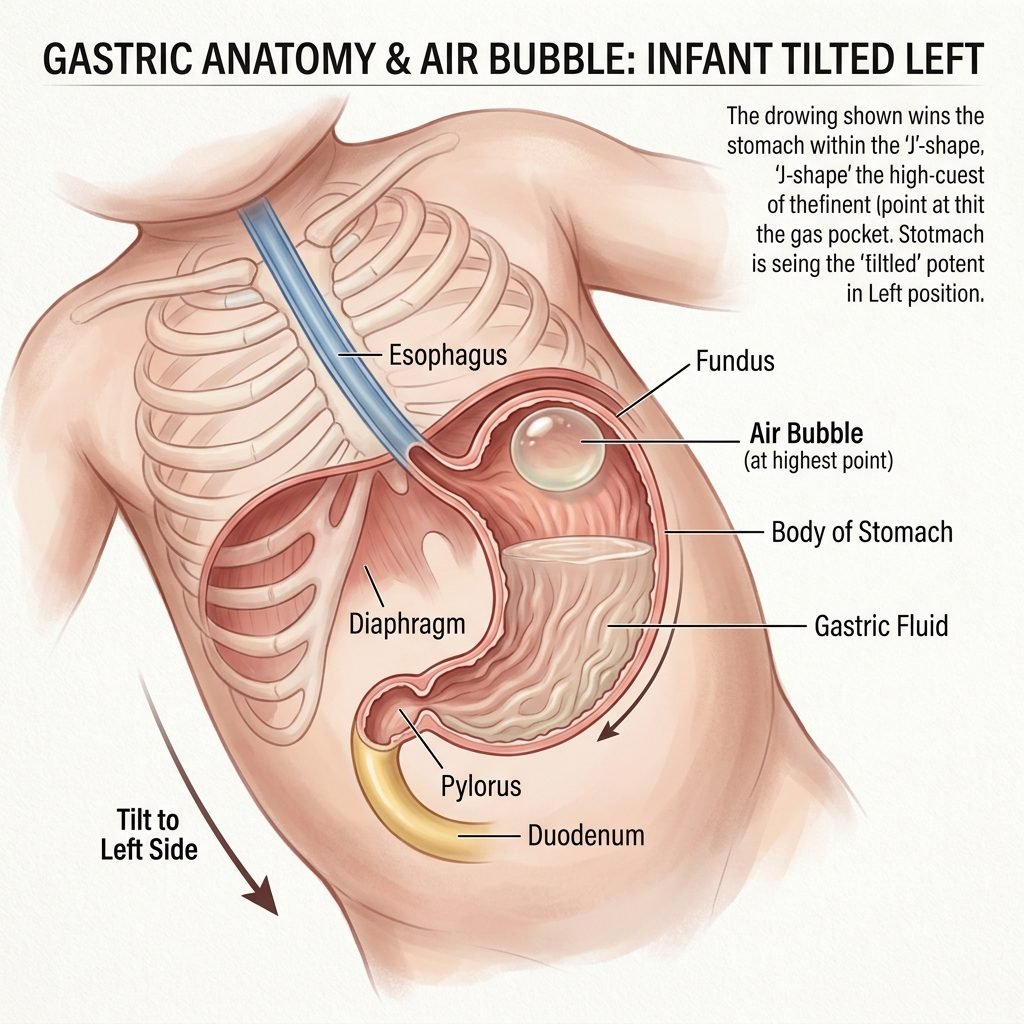
To understand why the left side is so magical, we first have to look at the tiny, developing engine that is your baby’s digestive system. Newborns are born with an immature gastrointestinal tract. Their esophageal sphincter—the little ‘door’ between the throat and the stomach—is often loose, and their ability to move gas through the intestines is still a work in progress. When they swallow air during a feeding (whether by breast or bottle), that air gets trapped under a layer of milk, creating pressure that feels like a heavy weight in their tiny chest.
Why Traditional Burping Sometimes Fails
Traditional burping methods usually rely on verticality. While gravity helps, the shape of the stomach is the real culprit. The human stomach is not a symmetrical bag; it is shaped more like a tilted ‘J’. When a baby is held perfectly upright, sometimes the air bubble gets trapped in the upper curvature of the stomach, where it cannot easily escape through the esophagus. This is why you might pat a baby for twenty minutes with no luck, only to have them spit up the moment you lay them down.
“Remember, mama: your baby isn’t ‘being difficult.’ They are just learning how to navigate a brand-new body. You are their teammate in this learning process.”
By shifting the baby’s physical orientation, we are essentially ‘re-routing’ the air bubble so it has a clear path to the exit. This is where the left side comes into play, utilizing the natural curvature of the stomach to prioritize air over liquid.
The Magic of Gravity: Why the Left Side Changes Everything
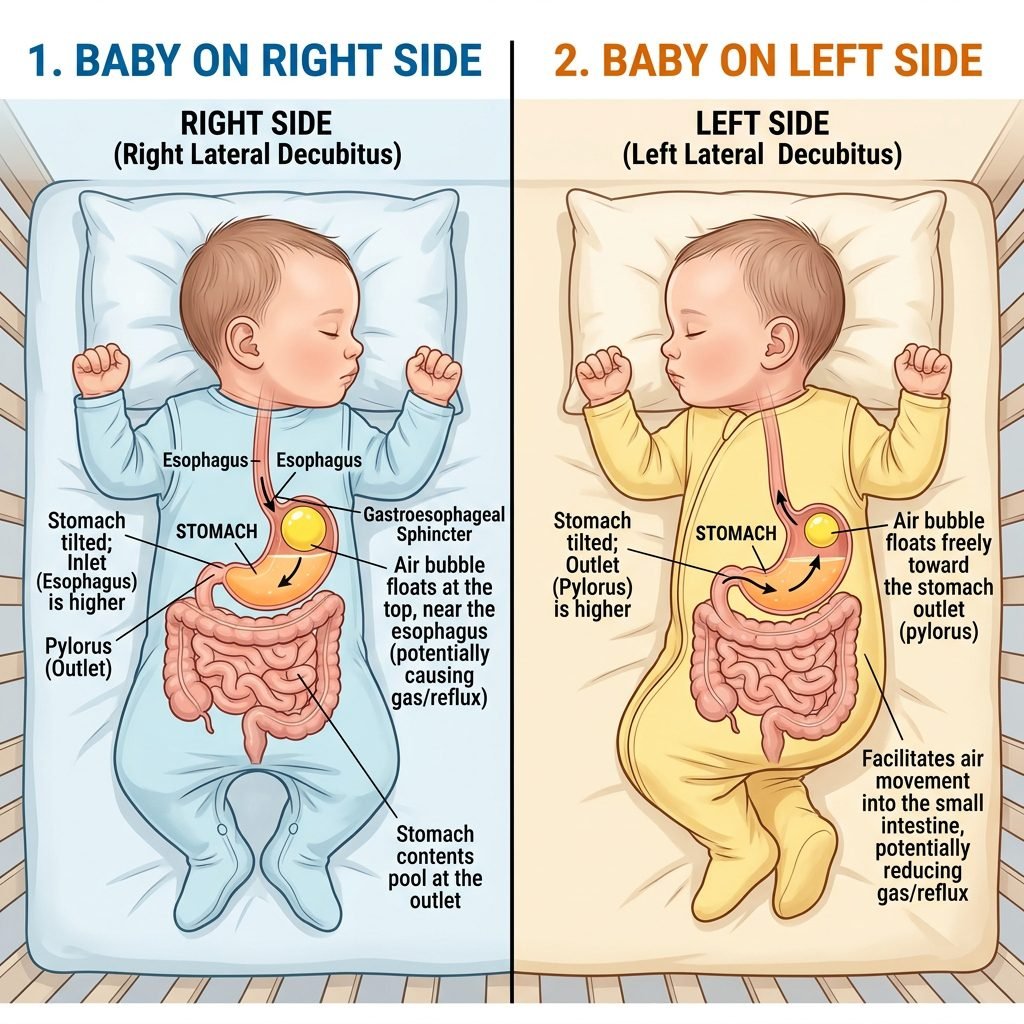
So, why specifically the left side? It all comes down to the pyloric sphincter and the angle of the esophagus. When a baby lies on their left side, the stomach’s ‘greater curvature’ is positioned downward. This allows the heavier milk to settle at the bottom, while the lighter air bubbles rise toward the top—right where the opening to the esophagus is located.
The Science of Gastric Emptying
Pediatric experts often note that left-side positioning can also assist with gastric emptying. While we never want to leave a baby to sleep on their side (always remember: Back to Sleep!), using the left side as a temporary therapeutic position for burping or ‘tummy time’ relief can significantly reduce reflux. When the baby is on their left, the stomach contents stay below the ‘trap door’ of the esophagus, making it much harder for milk to come back up as ‘spit-up’ while making it much easier for gas to escape as a clean burp.
This technique is particularly effective for babies with silent reflux or those who are ‘aggressive’ eaters. If your baby gulps down milk quickly, they are likely swallowing significant amounts of air. The left side-lying position acts as a gentle separator, filtering the air out of the milk before it travels further into the intestines where it becomes much harder (and more painful) to pass as flatulence.
Step-by-Step: Performing the Left Side-Lying Burp Safely

Ready to try it? Let’s walk through the physical mechanics of this move. You’ll want to ensure you are in a comfortable spot—a bed or a wide sofa works best. Stay focused and present during this process to ensure the baby’s airway remains clear at all times.
- Create a Firm, Flat Surface: Clear a space on your bed or use a firm nursing pillow (like a Boppy or My Brest Friend).
- The Transition: After a feeding, hold your baby upright for about 2-3 minutes to let the milk settle. Then, slowly lower them onto their left side on the flat surface.
- The ‘Kickstand’ Support: Place your hand or a rolled-up receiving blanket behind their back to keep them from rolling onto their spine. Their chest should be slightly angled toward the surface.
- Head Alignment: Ensure their head is supported and slightly elevated. Their nose should be clear of any fabric. I like to use my non-dominant hand to cradle their forehead gently.
- The Gentle Compression: Instead of ‘patting’ the back, try a firm, upward stroking motion from the base of the spine up to the shoulder blades. This ‘massages’ the air bubbles upward.
- The ‘Wait and Listen’: Often, you don’t even need to pat. Within 30 to 60 seconds, you will often hear a deep, satisfying ‘man-sized’ burp.
“If the burp doesn’t come within two minutes, don’t sweat it. Simply roll them onto their back for a moment, then back to the left side. This ‘rolling’ motion often dislodges stubborn bubbles.”
Comparison Matrix: Which Burping Method Wins?

Every baby is a little different, and what works for your firstborn might not work for your second. However, when we look at the efficiency of gas removal, the left side-lying technique often outperforms the classics for ‘stubborn’ cases. Use the table below to decide which method to try based on your baby’s current mood and gas level.
| Method | Best For… | Gas Severity | Spit-Up Risk |
|---|---|---|---|
| Over-the-Shoulder | General post-feed routine | Low | Moderate |
| Sitting-Up Slump | Quick daytime feeds | Moderate | High |
| The Football Hold | Fussy, colicky crying | High | Low |
| Left Side-Lying | Night feeds & stubborn gas | Extreme | Lowest |
As you can see, the Left Side-Lying method is your ‘heavy hitter.’ Use it when the other methods have failed or when the baby is too sleepy to be held upright without slumped posture, which can actually compress the stomach and trap gas further.
Troubleshooting Stubborn Bubbles: When the Burp Won’t Come

Sometimes, even with the best technique, that bubble feels like it’s stuck with superglue. If you’ve tried the left side-lying method and your baby is still grunting, don’t panic. Here are a few doula-approved troubleshooting tips:
- The ‘Bicycle’ Intermission: If the gas has moved lower into the intestines, no amount of burping will help. Roll the baby onto their back and perform gentle ‘bicycle legs’ for 30 seconds to help move the gas through the bowels, then return to the left side-lying position.
- Check the Temperature: A cold baby is a tense baby. Ensure the room is warm or use a warm (not hot!) compress on their tummy for a minute before the side-lying burp. Warmth relaxes the abdominal muscles.
- The ‘ILU’ Massage: While the baby is on their left side, you can gently trace the letters ‘I’, ‘L’, and ‘U’ on their right side (which is facing up). This follows the path of the large intestine.
The Emotional Component
If you find yourself getting frustrated, put the baby down in a safe space like their crib for five minutes. Take a drink of water. Your tension travels through your hands into the baby’s body. A relaxed baby burps much more easily than a rigid, crying one. Sometimes the best ‘technique’ is a five-minute reset for Mama.
The Doula’s Toolkit for a Calm Post-Feed Routine

Burping is just one piece of the puzzle. To truly master the art of the ‘Gas-Free Newborn,’ we need to look at the entire feeding environment. As a doula, I recommend creating a ‘Post-Feed Protocol’ that minimizes air intake and maximizes relaxation.
Prevention is Better Than a Burp
If you are bottle-feeding, ensure the nipple is always full of milk, not air. If you are breastfeeding, work with a lactation consultant to ensure a deep latch; a shallow latch often leads to ‘clicking’ sounds, which is the sound of your baby swallowing air. Paced feeding is also a game-changer—slowing down the flow allows the baby’s stomach to signal fullness before it becomes over-distended.
The Sensory Environment
Try to keep the lights low and the noise minimal during the burping process. Using a white noise machine with a low-frequency ‘brown noise’ setting can mimic the sounds of the womb, which naturally encourages the baby to relax their pelvic floor and abdominal wall. When the body is in ‘rest and digest’ mode (the parasympathetic nervous system), gas passes much more naturally.
“You are doing an incredible job. These gassy weeks feel like a lifetime, but they are just a season. Every burp is a win, and every quiet moment is a gift.”
Conclusion
You’ve Got This, Mama
The left side-lying burping technique isn’t just a physical maneuver; it’s a tool of empowerment. It gives you a specific, science-backed action to take when you feel helpless against your baby’s discomfort. By working with your baby’s anatomy rather than against it, you are fostering a deeper connection and a more peaceful postpartum recovery. Remember, every baby is unique, so give yourself the grace to experiment. Some nights the burp will come instantly; other nights it might take a few tries. But with the left side-lying method in your back pocket, you are well on your way to more restful nights and a much happier, less bubbly baby. Sleep tight, mama—you’ve earned it.