

The Lap Burping Method: A Gentle Technique for Relieving Trapped Newborn Gas
Oh, mama. If you are reading this at 2 AM with a fussy, squirming baby on your chest, take a deep, grounding breath. Drop your shoulders away from your ears. You are doing an incredible job, and you are absolutely not alone. There is perhaps nothing quite as heartbreaking—or panic-inducing—as watching your tiny, perfect newborn scrunch up their little face in pain from trapped gas. Their knees pull up to their chest, their little fists clench, and that high-pitched, frantic cry pierces right through your sleep-deprived heart. As a postpartum nurse and doula, I have sat beside countless weeping mothers in dimly lit nurseries, promising them one vital truth: this is normal, this is temporary, and we have tools to help.
Newborn digestion is a messy, noisy, and often uncomfortable process. Your baby’s gastrointestinal tract is brand new, learning how to process milk, coordinate swallowing, and move air through a tiny, immature system. Whether you are exclusively breastfeeding, bottle-feeding with formula, or doing a hybrid of both, your baby is inevitably going to swallow air. And when that air gets trapped in their delicate little tummy, it creates pressure that translates directly into fussiness.
Enter the Lap Burping Method. While the classic “over-the-shoulder” burp is the one we see in all the movies, it isn’t always the most effective strategy for a truly gassy baby. The lap burping technique—where your baby sits upright on your thigh while you support their jaw and gently pat their back—is a gentle, highly effective, and doula-approved secret weapon. It uses gravity to your advantage, straightens out the esophageal sphincter, and allows you to keep a close eye on your baby’s face for spit-up cues.
In this comprehensive guide, we are going to walk through exactly how to master the lap burping method, why it works so beautifully, and what to do when that elusive burp just won’t make an appearance. Grab a glass of water, settle into your glider, and let’s get that trapped gas out so you and your sweet baby can finally get some rest.
Understanding Your Baby’s Tummy: Why Newborns Struggle with Trapped Gas

Before we dive into the mechanics of burping, it helps to understand exactly what is happening inside your baby’s body. Knowledge is power, and knowing the “why” can help alleviate the intense mom-guilt that often creeps in when our babies are uncomfortable. You did not cause this gas, mama. It is simply a physiological reality of the “fourth trimester.”
The Immature Digestive System
When your baby is born, their digestive system is essentially still under construction. The gut flora (the good bacteria that helps break down food) is just beginning to populate. Furthermore, the lower esophageal sphincter—the little muscular valve that sits between the esophagus and the stomach—is weak and uncoordinated. Instead of staying tightly closed to keep milk and air down, it frequently relaxes, allowing air bubbles to travel back up (or get trapped halfway).
Common Culprits of Swallowed Air
Gas doesn’t just appear out of nowhere; it is almost always the result of swallowed air. Here are the most common ways air sneaks into your baby’s tummy:
- The Frantic Feeder: If your baby is overly hungry and crying before a feed, they are gulping down massive amounts of air before they even latch.
- Fast Letdown Reflex: For nursing mothers, a forceful milk ejection reflex can cause the baby to choke, sputter, and swallow air as they try to keep up with the flow.
- Bottle Mechanics: Incorrect bottle angles, un-paced feeding, or vigorously shaking a formula bottle (which creates millions of micro-bubbles) can introduce excess air.
- Lip Ties and Tongue Ties: A shallow latch, often characterized by a clicking sound during feeding, means the baby isn’t forming a proper seal, allowing air to slip in with every suck.
“Remember: A gassy baby is not a reflection of your mothering. It is a reflection of a brand-new digestive system learning how to work outside the womb. Give yourself—and your baby—grace as you figure this out together.”
During the first 12 weeks of life, gas is at its absolute peak. As your baby grows, their core muscles will strengthen, their digestive tract will mature, and they will become much more efficient at moving gas through their system on their own. But until then, manual burping is our best line of defense.
Mastering the Lap Burping Method: A Step-by-Step Guide

The Lap Burping Method is beloved by pediatric experts because it aligns the baby’s digestive tract vertically, using gravity to help the air bubble rise to the top of the stomach. It also prevents the pressure on the baby’s tummy that sometimes happens with the over-the-shoulder method, which can inadvertently cause massive spit-ups. Here is exactly how to execute this technique safely and effectively.
Step 1: Prepare Your Space and Posture
First, ensure you are sitting comfortably. Whether you are on the edge of your bed, in your nursery glider, or on the living room sofa, plant both feet flat on the floor. Drape a soft, absorbent burp cloth over your lap—because where there is a burp, there is often a little “bonus” milk. Take a deep breath to relax your own nervous system; babies are incredibly intuitive and will feed off your tension.
Step 2: Position the Baby
- Gently sit your baby upright on your lap, facing sideways (perpendicular to your body).
- Allow their legs to drape comfortably over your thigh or crisscross gently in front of them, depending on their size and comfort.
- Allow the baby’s torso to lean slightly forward. This slight forward tilt puts gentle, natural pressure on the stomach, which helps force the trapped air upward.
Step 3: The Crucial Jaw Support (The “C-Hold”)
This is the most critical step for safety. You must support the baby’s heavy, wobbly head, but you must never put pressure on their throat or neck.
- Create a “C” or “V” shape with your non-dominant hand.
- Place the web of your fingers (between your thumb and index finger) gently against the baby’s chest, right below their collarbone.
- Let your thumb and index finger cradle the baby’s jawbone and chin. Do not let your hand slip down onto their throat, as this can compress their airway.
- The heel of your hand should be resting flat against their sternum (chest bone), providing a stable base to keep their torso upright.
Step 4: The Pat and Rub Technique
With your baby securely supported and leaning slightly forward, use your dominant hand to address the back.
- Cup your hand slightly (like you are holding a handful of water). A cupped hand creates a gentle pocket of air, making the patting more reverberating and less jarring than a flat smack.
- Pat the baby’s back firmly but gently, starting from the lower back and working your way up toward the shoulders. You are trying to coax the bubbles upward.
- Alternate patting with a firm, circular rubbing motion. Sometimes, a deep massage-like rub up the spine is more effective than patting.
“Doula Tip: Don’t be afraid to use a little bit of firmness! A newborn’s back is sturdy, and a feathery, light touch won’t dislodge a stubborn air bubble. Aim for the rhythm and firmness of a steady heartbeat.”
Continue this method for 2 to 3 minutes. If you don’t get a burp by then, don’t force it. We will discuss troubleshooting in the next sections.
The Ultimate Burping Matrix: Matching the Method to the Gas Severity
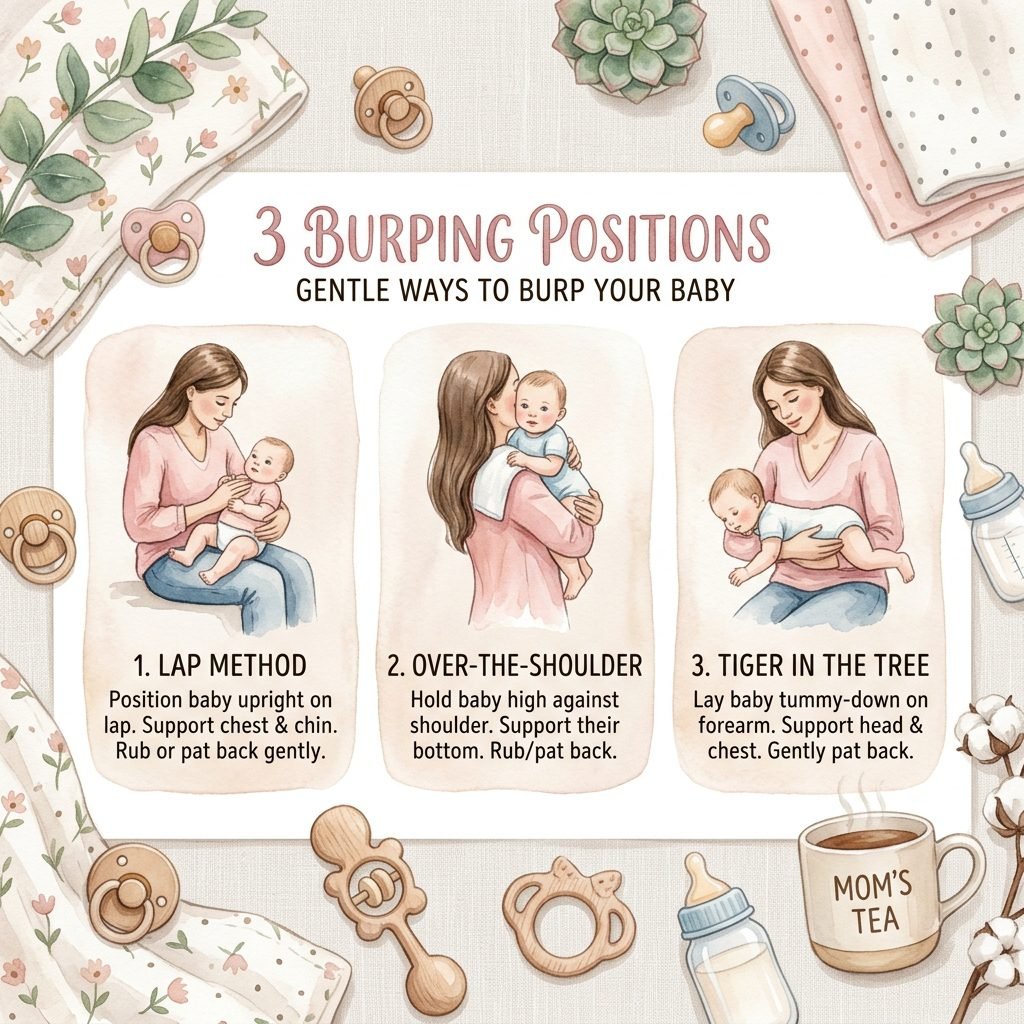
While the Lap Burping Method is a stellar go-to, every baby is different, and their needs may change from feed to feed. Sometimes, a baby requires a change in position to shift the air bubble just right. As a practical mama or caregiver, it is incredibly helpful to have a toolkit of different holds. Below is a detailed breakdown of the three most effective burping methods, comparing when and why to use them.
| Burping Method | Best Used For… | Gas Severity Level | Pros & Cons |
|---|---|---|---|
| The Lap Method (Sitting Upright) | Mid-feed burping, babies prone to heavy spit-up, and sleepy night feeds. | Mild to Moderate | Pro: Easy to see baby’s face; uses gravity well. Con: Requires careful head/jaw support for floppy newborns. |
| Over-the-Shoulder | Post-feed burping, babies who love deep pressure on their tummy, contact nappers. | Moderate to Severe | Pro: Very comforting for the baby; allows mom to walk/bounce. Con: Pressure on the shoulder can trigger large spit-ups down your back. |
| Tiger in the Tree (Slung over forearm) | Colicky babies, severe gas pains, inconsolable crying spells. | Severe | Pro: Excellent counter-pressure on the abdomen; highly soothing. Con: Can be heavy on the wrist/arm as the baby grows; requires practice. |
If your baby is squirming aggressively during the Lap Method, it may be a sign that the air bubble is trapped lower in the intestines rather than in the stomach. In this case, transitioning to the “Tiger in the Tree” hold (laying the baby face down along your forearm, with their head supported by your elbow and your hand gripping their thigh) can provide the exact abdominal counter-pressure they are craving.
Beyond the Burp: Troubleshooting Stubborn Gas and Colic Symptoms

We have all been there: you have been doing the lap burp for 5 solid minutes. You have rubbed, you have patted, you have swayed. Nothing. Meanwhile, your baby is still grunting, arching their back, and acting like they are trying to pass a golf ball. What do you do when the burp just won’t come?
1. Know When to Stop Trying
First, give yourself permission to stop. If a burp hasn’t materialized after 3 to 5 minutes of active effort, the air bubble may have already passed into the lower intestines, meaning it is no longer a burp—it is a fart waiting to happen. Forcing a burp for too long can overstimulate a tired baby and frustrate you both.
2. The “Bicycle Legs” Maneuver
When gas moves lower into the digestive tract, upper body burping won’t help. Lay your baby flat on their back on a safe, firm surface (like a play mat or the center of your bed). Take their little ankles and gently pedal their legs in a bicycling motion toward their tummy. This manual movement helps physically push the trapped gas through their intestines. After a few pedals, gently press both knees together up into their tummy, hold for 3 seconds, and release. (Prepare yourself for some impressive flatulence!)
3. The “I Love You” Tummy Massage
Infant massage is a beautiful, bonding way to relieve lower gas. Ensure the room is warm, and use a baby-safe, unscented oil (like pure jojoba or coconut oil). The “I Love You” (ILU) stroke follows the natural path of the large intestine:
- “I”: Use your fingertips to stroke down the left side of the baby’s belly (your right side as you face them).
- “L”: Stroke across the top of the belly from the baby’s right to left, then down the left side (forming an upside-down L).
- “U”: Stroke up the baby’s right side, across the top, and down the left side (forming an upside-down U).
4. Warm Baths and Tummy Time
Never underestimate the power of warm water to relax tense abdominal muscles. A warm bath can often soothe a colicky baby instantly. Additionally, supervised tummy time while the baby is awake provides excellent natural pressure on the abdomen to help work gas out of the system.
“Postpartum Reminder: If your baby is crying inconsolably for hours, and nothing is working, it is okay to put them down safely in their crib, step out of the room, and take 5 minutes to breathe, cry, or drink water. You are a good mother. A crying baby does not mean you are failing.”
Proactive Gas Prevention: Setting Up for Digestive Success

While knowing how to burp a baby effectively is crucial, preventing the air from getting in there in the first place is the ultimate goal. As we transition from reactive care to proactive care, here are some evidence-based, practical tweaks you can make to your feeding routine to minimize trapped gas.
Paced Bottle Feeding
If you are bottle-feeding, paced feeding is non-negotiable for gas prevention. Instead of laying the baby flat and tipping the bottle vertically (which forces them to gulp rapidly to keep up with gravity), sit the baby upright—similar to the lap burping position. Hold the bottle horizontally, parallel to the floor. Allow the baby to draw the milk out actively, and take breaks every 1 to 2 ounces to perform a lap burp. This mimics the natural flow of breastfeeding and prevents air-guzzling.
Evaluate Your Bottles and Nipples
Not all bottles are created equal. If your baby is struggling with severe gas, consider switching to an anti-colic bottle that features a venting system (like Dr. Brown’s or Philips Avent Anti-Colic). Furthermore, check the nipple flow rate. If the flow is too fast, the baby will choke and swallow air. If the flow is too slow, they will suck too aggressively, drawing in air from the corners of their mouth. Most newborns need a “Level 1” or “Slow Flow” nipple.
Check the Latch and Positioning
For nursing mothers, ensure you are utilizing positions that keep the baby’s head higher than their tummy. The “Laid-Back” (Biological Nurturing) position or the “Koala Hold” (where the baby straddles your thigh upright) are excellent for digestion. If you suspect a fast letdown, try hand-expressing the first forceful ounces into a towel before latching the baby. If you hear a clicking sound while they nurse, consult with an International Board Certified Lactation Consultant (IBCLC) to evaluate for lip or tongue ties.
A Note on Maternal Diet and Gas Drops
It is a common myth that everything a mother eats directly causes gas in her breastfed baby. While dairy or soy proteins can cause intolerances in a small percentage of babies, eating broccoli or spicy food does not transfer “gas bubbles” into breastmilk. Please do not restrict your postpartum diet unnecessarily without consulting a pediatrician. If you are considering over-the-counter remedies like Simethicone gas drops or Gripe Water, speak with your pediatrician first. While many parents swear by them, their efficacy is debated in the medical community, and proper burping techniques remain the gold standard.
Conclusion
Navigating the newborn phase is a beautiful, exhausting, and incredibly demanding journey. Watching your tiny baby struggle with trapped gas can feel overwhelming, but armed with the Lap Burping Method, you now have a gentle, highly effective tool to bring them comfort. Remember to focus on your posture, support that delicate jawline safely, and use firm, rhythmic pats to coax those bubbles upward.
Above all else, mama, give yourself an immense amount of grace. Some days, the burps will come easily, and your baby will drift off into a peaceful milk-drunk slumber. Other days, you will be cycling legs and pacing the floor at 3 AM. Both realities are normal, and neither is a reflection of your worth or capability as a mother. Trust your instincts, lean on your support system, and know that this gassy phase will pass as their little bodies grow stronger.
You are exactly the mother your baby needs. Take a deep breath, grab that burp cloth, and trust that you’ve got this.