

Why We Spent Our Savings On A Postpartum Doula (And Why You Should Too)
When you first see that positive line on the pregnancy test, your mind almost instantly fast-forwards to the nursery. If you are anything like I was, or like the hundreds of expectant mothers I have supported as a doula, you probably spent countless hours agonizing over the perfect aesthetic for your baby’s room. You likely researched the safest, most high-tech bassinets, curated a registry full of organic bamboo onesies, and budgeted for a stroller that costs more than your first car.
We are culturally conditioned to prepare for the baby. But we are woefully, almost dangerously, under-prepared for the mother.
When my partner and I were expecting, we sat down and looked at our savings. We had a modest nest egg set aside for the “baby phase.” But instead of buying the luxury glider or the smart-sock monitor, we made a radical decision: we emptied that specific savings account to hire a postpartum doula. To our friends and family, it seemed like an extravagant luxury. Why pay someone when we had two capable parents and a few baby books? But looking back from the other side of the postpartum trench, I can tell you with absolute certainty: it was the single greatest investment we have ever made in our lives.
The fourth trimester is a sacred, vulnerable, and intensely overwhelming window of time. Your body is navigating a massive drop in hormones, your physical form is healing from a major medical event (whether you delivered vaginally or via Cesarean), and you are learning how to keep a tiny, helpless human alive on fragments of sleep. Today, I want to take you by the hand, sister to sister, and explain exactly why a postpartum doula is not just for celebrities or the ultra-wealthy. It is a fundamental pillar of maternal care, and I am going to show you why you deserve it, what it actually looks like, and how you can make it work for your family’s budget.
The Registry Trap: Why We Focus on Gadgets Instead of Support

It is incredibly easy to fall into what I call the “Registry Trap.” Modern marketing tells expectant parents that the solution to newborn sleep, colic, and maternal anxiety can be bought in a big-box baby store. We are sold the illusion that if we just have the right swing, the right bottle warmer, and the right white noise machine, everything will be seamless.
But here is the gentle, honest truth: a baby swing cannot look you in the eyes while you are sobbing at 3:00 AM and tell you that you are doing a good job. A luxury stroller cannot wash your pump parts, fold your laundry, and hand you a hot plate of scrambled eggs while you are trapped under a cluster-feeding newborn.
Reframing Your Postpartum Needs
Babies actually need very little in the beginning. They need a safe, flat place to sleep, warmth, nourishment, and you. You, on the other hand, need an absolute village. You need hydration, nutrient-dense meals, physical rest to allow your uterus to involute and your pelvic floor to heal, and emotional validation.
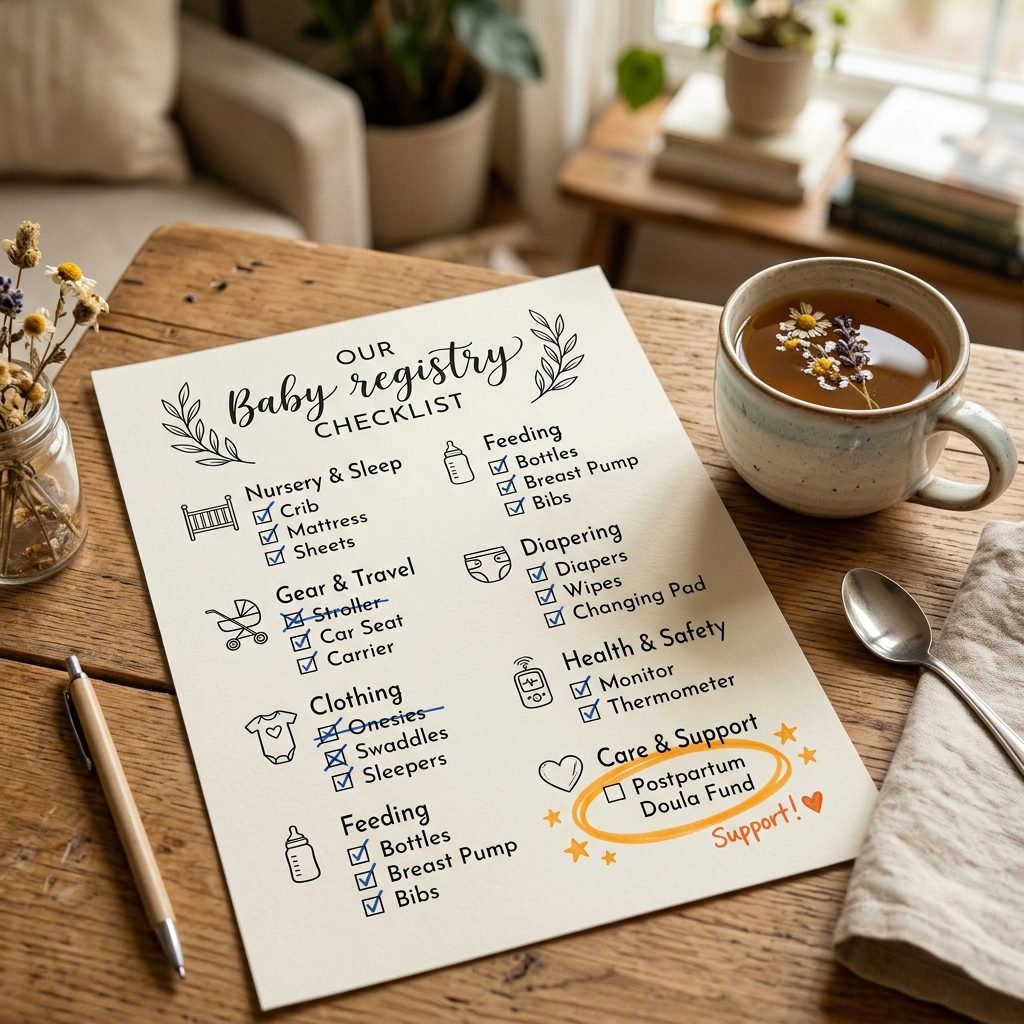
When we decided to hire our postpartum doula, we had to ruthlessly cut our registry. We opted for secondhand clothes, a basic safe bassinet, and a standard stroller. We redirected every single dollar of our “gadget budget” into our “support budget.”
| Popular Registry Item | Average Cost | The Doula Support Equivalent |
|---|---|---|
| High-Tech Smart Bassinet | $1,200 – $1,700 | Approx. 3-4 nights of overnight Doula care (8-hour shifts) |
| Luxury Travel System Stroller | $900 – $1,200 | Approx. 25-30 hours of daytime Doula support |
| Designer Nursery Glider | $600 – $1,000 | A comprehensive Postpartum Care Package (meals, massage, daytime help) |
| Wipe Warmers, Bottle Sterilizers, Gadgets | $200 – $400 | 1-2 Postpartum Planning Consultations + Lactation Support |
Looking at the numbers this way shifts the perspective. The smart bassinet might get you an extra hour of sleep. An overnight doula guarantees you eight hours of unbroken, restorative sleep while knowing your baby is safe in the hands of an expert. When you view it through the lens of maternal health, the choice becomes clear.
Beyond Babysitting: The Anatomy of a Postpartum Doula Shift

One of the biggest misconceptions about postpartum doulas is that they are simply expensive baby nurses or nannies. While infant care is absolutely part of their repertoire, a doula’s primary client is the mother and the family unit. Their goal is to mother the mother, ensuring she is recovering, confident, and supported.
What a Daytime Shift Actually Looks Like
Imagine this: It is 9:00 AM. You have been up since 4:00 AM. Your partner has gone back to work. The house is a mess, you haven’t showered in three days, and your nipples are cracked and bleeding. The doorbell rings, and your doula walks in.
- Triage and Assessment: She doesn’t just ask “How are you?” She asks, “When did you last eat? How is your bleeding today? Are you experiencing any pain with your latch?”
- Physical Nourishment: She takes the baby, settles them, and immediately goes to the kitchen to make you a nutrient-dense, warm meal—think oatmeal with flaxseed for lactation, or a hearty bone broth soup to replenish lost fluids.
- Protecting Your Rest: She gently commands you to go take a hot shower and then get into bed. She promises she will only bring the baby to you if they need to nurse, and otherwise, she will handle the soothing, the diapering, and the rocking.
- Household Magic: While you sleep for three glorious hours, she tackles the “invisible load.” She washes and sterilizes the breast pump parts, folds the mountain of tiny onesies, empties the dishwasher, and preps a snack station for your nightstand.
The Magic of Overnight Shifts
Overnight support is where many families feel they get the most profound return on investment. Sleep deprivation is not just an inconvenience; it is a recognized form of torture and the number one trigger for Perinatal Mood and Anxiety Disorders (PMADs).
During an overnight shift, the doula stays in the nursery or living room with the baby. If you are bottle-feeding, you sleep entirely through the night. If you are nursing, the doula brings the baby to you in bed, helps you latch, and then takes the baby away the second they are done. She burps them, changes their diaper, settles them back to sleep, and you never even have to leave your warm bed. It is nothing short of miraculous.
“You are not failing. You are healing from a massive physical event while learning the hardest job in the world on zero sleep. Accepting help is not a sign of weakness; it is the ultimate act of maternal wisdom.”
The Mental Health ROI: Protecting Your Peace and Sanity

Let’s have a very honest, sisterly conversation about postpartum hormones. In the days following birth, your body experiences the single largest hormonal drop a human being can endure. Estrogen and progesterone plummet, while prolactin and oxytocin surge. This chemical chaos is responsible for the “baby blues”—the weeping, the sudden anxiety, the feeling of being utterly overwhelmed.
When you combine this hormonal crash with the physical pain of a healing perineum or a C-section incision, and layer on profound sleep deprivation, you have a recipe for a maternal mental health crisis. Up to 1 in 5 women will experience Postpartum Depression (PPD) or Postpartum Anxiety (PPA).
The Doula as a Mental Health Buffer
Having a postpartum doula is like having a protective buffer around your mental health. Here is how they actively safeguard your sanity:
- Normalizing the Abnormal: When your baby is cluster feeding for four hours straight and you are convinced your milk supply has dried up and you are starving your child, your doula is there to say, “This is completely normal. This is called cluster feeding. Your baby is putting in an order for tomorrow’s milk. You are doing great.” That expert validation stops the anxiety spiral in its tracks.
- Screening for PMADs: Doulas are trained to recognize the subtle differences between normal “baby blues” and clinical PPD/PPA. They can gently bridge the gap between you and your healthcare provider, advocating for you when you don’t have the energy to advocate for yourself.
- Protecting the Partner Dynamic: The transition to parenthood is notoriously hard on marriages and partnerships. Resentment builds quickly at 3:00 AM. A doula takes the pressure off the non-gestational partner, allowing them to also sleep, recover, and learn how to parent without the crushing weight of being the sole support system.
We spent our savings on a doula because we realized that preventative mental health care is far cheaper than reactive crisis care. The cost of therapy, medication, potential loss of income from extended leave due to severe depression, and the strain on a marriage far outweighs the hourly rate of a trained postpartum professional.
Navigating the Financial Guilt: How We Made It Work
I hear you loud and clear: “This all sounds amazing, but doulas are expensive. How can we possibly afford this?”
It is true. Depending on your location and the doula’s experience, postpartum support can range from $30 to $70+ per hour. It is a significant financial commitment. When we say we spent our savings, we mean it. We sat down, looked at our budget, and realized we had to make sacrifices to prioritize this care.
Creative Strategies to Fund Your Postpartum Doula
If you do not have a massive savings account, do not write off a doula just yet. There are several strategic ways expectant parents are funding this essential support today.
| Funding Strategy | How It Works | Pros & Cons |
|---|---|---|
| The “Doula Fund” Registry | Using platforms like BeFumble or Babylist, you create a cash fund specifically labeled “Postpartum Doula Support” instead of asking for physical gifts. | Pro: Friends and family love contributing to your well-being. Con: Requires letting go of receiving physical baby items. |
| HSA/FSA Accounts | Many Health Savings Accounts and Flexible Spending Accounts now cover doula services with a Letter of Medical Necessity (LMN) from your OBGYN or Midwife. | Pro: Uses pre-tax dollars you already have saved. Con: Requires paperwork and specific medical coding. |
| Payment Plans & Sliding Scales | Many doula agencies and independent doulas offer structured payment plans starting in the first trimester, or sliding scale fees for low-income families. | Pro: Breaks a large lump sum into manageable monthly payments. Con: You must start planning and budgeting early in pregnancy. |
| Shorter, Targeted Shifts | Instead of 40 hours a week, hire a doula for just two 4-hour shifts a week to guarantee you get a nap, a shower, and meal prep. | Pro: Highly budget-friendly while still providing a mental health lifeline. Con: Less comprehensive coverage. |
We ultimately used a combination of our personal savings and a “Doula Fund” registry. When my aunts asked what clothes they could buy the baby, I gently replied, “We are actually fully stocked on hand-me-down clothes, but what we would deeply appreciate is a contribution to our postpartum doula fund. We are prioritizing my physical recovery so I can be the best mom possible.” It took some education, but our loved ones were thrilled to contribute to something so meaningful.
The Interview: Finding Your Perfect Postpartum Match

Inviting someone into your home during your most vulnerable, bleeding, exhausted, and hormonal state requires immense trust. Not every doula is the right fit for every family. You need someone whose energy matches your needs—whether you need a quiet, fly-on-the-wall organizer, or a chatty, sisterly confidant.
Step-by-Step Guide to Hiring Your Doula
- Start Early: Begin your search in your second trimester. Good doulas book up months in advance.
- Determine Your Priorities: Do you need mostly overnight sleep support? Or do you need daytime help with lactation, cooking, and toddler wrangling? Know your primary need before interviewing.
- Conduct Chemistry Checks: The interview should feel like a first date. Pay attention to how your body feels around them. Do you feel relaxed? Do they listen actively, or do they talk over you?
- Check Certifications and Backups: Ask about their training (DONA, CAPPA, ProDoula, etc.), their CPR certification, and crucially, what their backup plan is if they get sick when you go into labor.
The Copy-Paste Interview Script
If you aren’t sure how to start the conversation, use this template to reach out to local doulas or agencies:
“Hi [Doula’s Name],
My name is [Your Name] and I am expecting a baby on [Due Date]. I am planning to prioritize my postpartum recovery and am looking for [daytime/overnight] support for approximately [number] weeks after birth.
I would love to schedule a brief consultation to learn more about your philosophy, your availability around my due date, and your package rates. We are particularly looking for someone who can help with [insert priority, e.g., lactation support, newborn sleep shaping, sibling transition].
Looking forward to connecting,
[Your Name]”
When you are interviewing them, ask the hard questions: “How do you support a mother who is struggling to breastfeed but wants to switch to formula?” (You want a doula who supports YOUR choices without judgment). “What does a typical 4-hour daytime shift look like when you are with a client?” Their answers will tell you everything you need to know about their support style.
Conclusion
Choosing to spend your hard-earned savings on a postpartum doula is not an act of luxury; it is a profound act of self-love and family preservation. We live in a society that expects mothers to bounce back instantly, to host visitors days after giving birth, and to intuitively know how to soothe a colicky newborn while maintaining a spotless house. It is an impossible standard.
By hiring a postpartum doula, you are reclaiming your fourth trimester. You are saying, “My healing matters. My mental health matters. My transition into motherhood is sacred, and it deserves to be protected.”
I look back on my early postpartum days not with trauma or crushing exhaustion, but with a sense of deep, cocooned warmth. I remember the smell of the bone broth my doula simmered on the stove. I remember the gentle way she took my crying baby so I could finally sleep. I remember feeling, fundamentally, that I was not alone.
If you are on the fence, looking at your budget, and wondering if you should buy the fancy bassinet or hire the doula—hire the doula. The bassinet will be outgrown in four months. The confidence, healing, and peace of mind a doula provides will lay the foundation for the rest of your motherhood journey.
Medical Disclaimer: The content provided in this article is for informational and educational purposes only and is not intended as medical advice. While postpartum doulas provide incredible emotional and physical support, they are non-medical professionals. If you are experiencing symptoms of Postpartum Depression (PPD), Postpartum Anxiety (PPA), severe pain, heavy bleeding, or any other medical concerns, please contact your OBGYN, Midwife, or a licensed healthcare provider immediately. You do not have to suffer in silence; medical help is available and effective.