Work Without Pain: Best Office Chair Settings for Pregnancy Back Relief
Hello, beautiful mama. If you are reading this while shifting uncomfortably in your office chair, trying to find a position that doesn’t make your lower back ache or your ribs feel bruised, take a deep breath. You are not alone. Navigating the demands of a desk job while your body is performing the daily miracle of growing a tiny human is no small feat. Between the shifting center of gravity, the surge of pregnancy hormones, and the sheer physical weight of your beautiful growing bump, sitting at a desk for eight hours can quickly transform from a mundane task into an endurance sport.
As a doula and maternal wellness expert, I hear this complaint constantly: “My back is killing me at work, and I still have weeks to go before maternity leave.” The truth is, standard office chairs are designed for standard bodies—and right now, your body is anything but standard. It is expanding, shifting, and adapting in magnificent ways. But that doesn’t mean you have to suffer through your workday. With a few strategic, highly specific adjustments to your office chair settings, and a sprinkle of ergonomic magic, we can significantly reduce that nagging lower back pain, ease sciatic nerve pressure, and create a workspace that actually supports your pregnancy.
Today, we are going to walk through this together, step-by-step. We will decode the exact chair settings you need for pregnancy back relief, explore the holy grail of desk add-ons, and discuss the gentle movements that will keep your blood flowing and your body feeling capable. Grab a glass of ice water, gently roll your shoulders back, and let’s turn your desk into a throne of comfort.
The Culprits: Why Your Desk Job Hurts Right Now
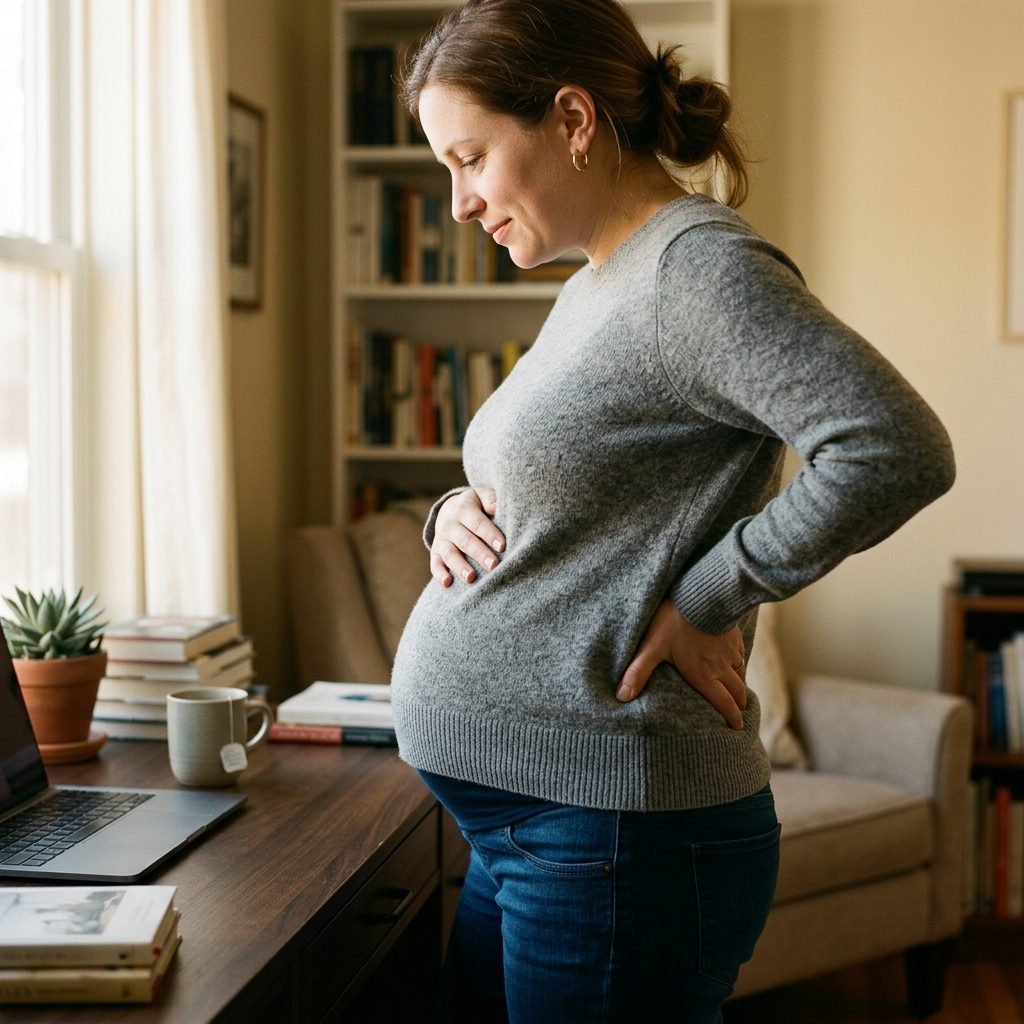
Before we start pulling levers and adjusting knobs on your chair, it is vital to understand why you are experiencing this discomfort. Knowledge is power, mama, and understanding your changing body is the first step toward advocating for your own comfort.
The Magic (and Mischief) of Relaxin
Starting in your first trimester, your body begins producing a hormone called relaxin. Just as the name suggests, its job is to relax the ligaments in your pelvis to eventually allow your baby to pass through the birth canal. However, relaxin is not highly targeted—it relaxes ligaments all over your body, including your spine. This means the joints in your lower back are looser and less stable than usual, forcing your muscles to work overtime just to keep you sitting upright. When you sit in a poorly adjusted chair, those tired muscles quickly spasm and ache.
The Shifting Center of Gravity
As your uterus expands, your center of gravity moves dramatically forward. To compensate for this front-heavy load, you naturally lean back, which increases the curvature of your lower spine (a condition called lordosis). Sitting in a chair that doesn’t support this new, exaggerated curve places immense strain on your lumbar region.
Blood Volume and Swelling
During pregnancy, your blood volume increases by up to 50 percent. When you sit with your legs dangling or crossed, you are restricting blood flow back to your heart, which can lead to swelling (edema) in your feet and ankles, as well as increasing the risk of varicose veins. The way your chair interacts with the back of your thighs and your feet is critical to preventing this.
“Remember, your body is doing the monumental work of growing a human. It is completely normal if sitting in a standard office chair suddenly feels exhausting. Give yourself grace, and let’s adjust your environment to fit your body, not the other way around.”
Step-by-Step Ergonomic Chair Settings for Pregnancy

Now, let’s get hands-on. Most modern office chairs have multiple adjustment levers. We are going to recalibrate your chair specifically for your pregnant body. Follow these steps in order for the best results.
1. Master the Seat Height
Your seat height is the foundation of your ergonomic setup. When your seat is too high, your feet dangle, causing your pelvis to tilt forward and straining your lower back. When it is too low, your knees rise above your hips, compressing your stomach and making it harder to breathe.
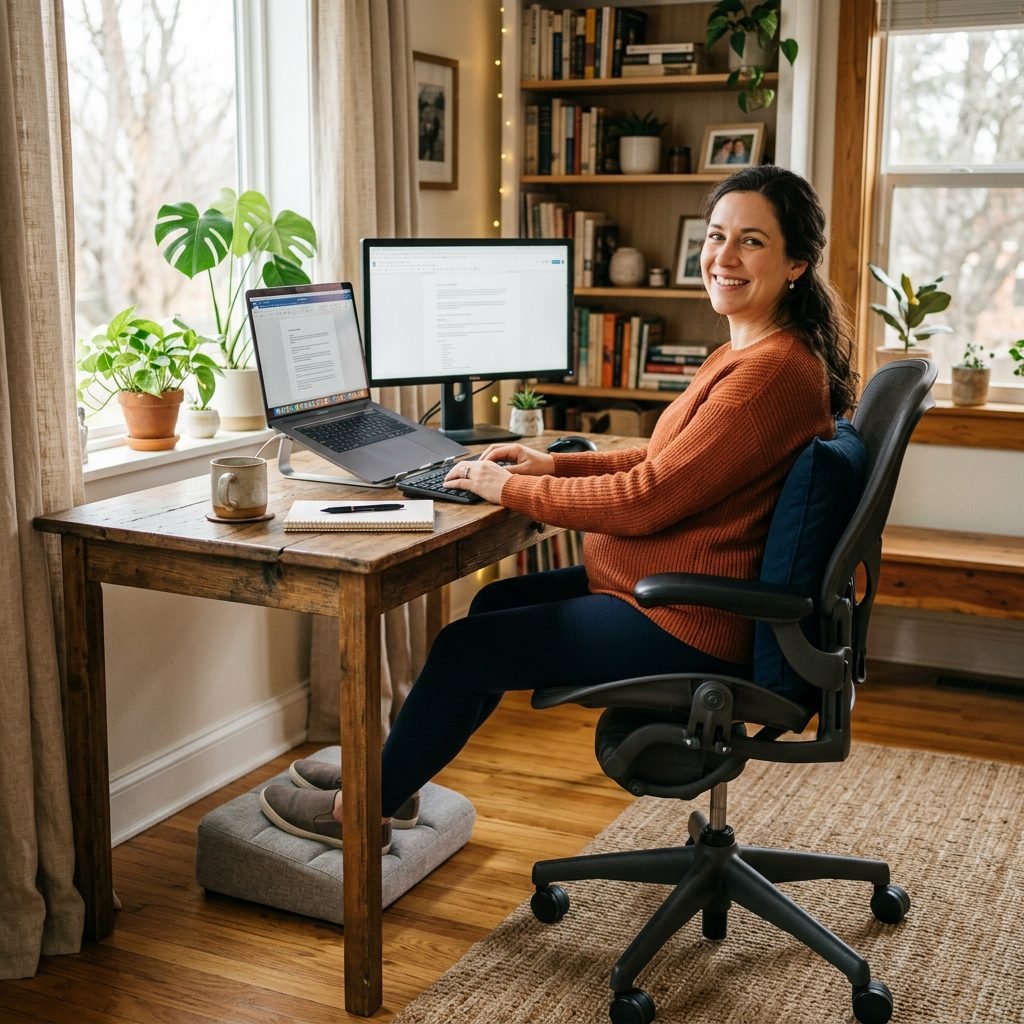
- Stand in front of your chair and adjust the height so the highest point of the seat is just below your kneecap.
- Sit down. Your feet should be completely flat on the floor (or on a footrest).
- Your knees should be bent at a 90 to 110-degree angle, with your hips sitting slightly higher than your knees. This slight downward slope of the thighs opens up the pelvis and gives your growing bump more room.
2. Perfect the Seat Pan Depth
The seat pan is the part of the chair you actually sit on. If it’s too deep, the edge will dig into the back of your calves, cutting off circulation. If it’s too shallow, your thighs won’t have enough support.
- Sit all the way back in your chair so your lower back is firmly against the backrest.
- Check the space between the front edge of the seat and the back of your knees. You should be able to fit exactly two to three fingers in that gap.
- If the chair has a seat slider lever (usually located under the seat on the left or right), use it to slide the seat pan forward or backward until you achieve that perfect two-finger gap.
3. Dial in the Lumbar Support
This is the most critical adjustment for pregnancy back pain. Your lumbar spine (lower back) curves inward, and as we discussed, that curve deepens as your bump grows.
- Locate the lumbar support adjustment on your chair (often a sliding mechanism on the back of the chair or a dial).
- Adjust the height of the lumbar support so it fits snugly into the deepest part of your lower back curve. It should feel like a gentle hand pushing forward, supporting your spine.
- If your chair allows you to adjust the depth or firmness of the lumbar support, increase it. Your pregnant body needs more pronounced support here than it did pre-pregnancy.
4. Adjust the Backrest Tilt and Tension
Sitting perfectly rigid at a 90-degree angle is actually terrible for your spine. Reclining slightly takes the pressure off your lumbar discs.
- Unlock your chair’s tilt mechanism.
- Lean back slightly to an angle of about 100 to 110 degrees. This slightly reclined posture opens up your chest, making it easier to take deep breaths (which becomes harder as baby crowds your diaphragm), and reduces the gravitational pressure on your spine.
- Adjust the tilt tension (usually a large knob under the front of the seat) so that the chair supports your weight when you lean back, but you don’t feel like you are falling backward.
5. Position the Armrests
If your armrests are too high, you will shrug your shoulders, leading to neck and upper back pain. If they are too low, you will slouch forward.
- Drop your shoulders and let your arms hang loosely by your sides.
- Bend your elbows to a 90-degree angle.
- Adjust the armrests so they just barely touch the underside of your forearms. They should support your arms without pushing your shoulders up.
Essential Add-ons: Transforming a Basic Chair into a Pregnancy Throne
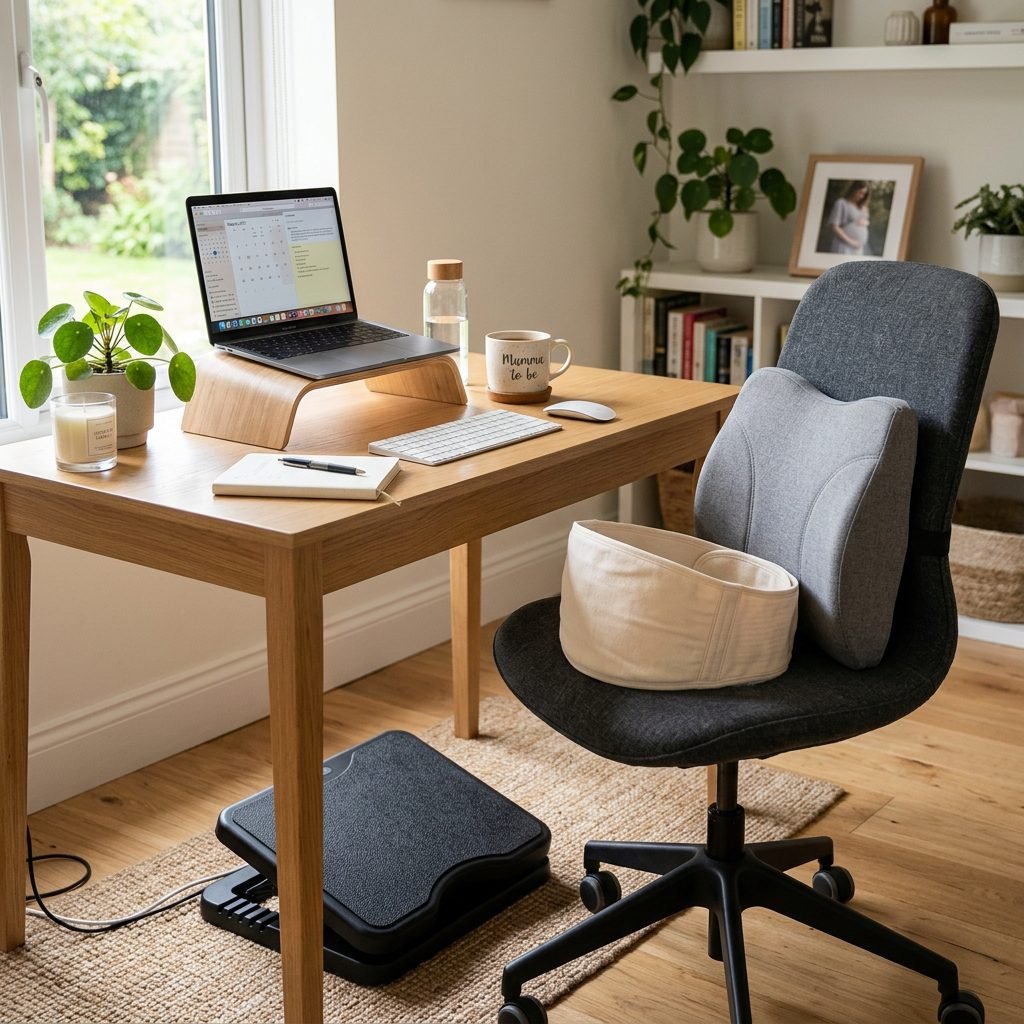
Sometimes, even the most adjustable office chair needs a little extra help to accommodate the unique needs of a pregnant body. If your office chair is older, or if you simply need more targeted relief, these add-ons are absolute game-changers.
The Lumbar Support Pillow
If your chair’s built-in lumbar support isn’t cutting it, invest in a memory foam lumbar pillow. Look for one with adjustable straps so you can secure it at the exact height of your spinal curve. A good lumbar pillow fills the gap between your back and the chair, allowing your muscles to finally stop clenching and relax.
The Ergonomic Footrest
As your baby grows, your blood circulation changes, making you prone to swollen ankles and feet. An ergonomic footrest is a non-negotiable for pregnant desk workers. By elevating your feet slightly, you encourage blood flow back to your heart and take pressure off your lower back.
The Pregnancy Belly Band
While not a chair accessory, a supportive maternity belly band worn while sitting can work wonders. It acts like a gentle hammock for your bump, lifting the weight off your pelvis and lower back, which makes sitting upright significantly easier.
What’s Safe vs. What to Avoid at Your Desk
To keep things simple, I’ve created a quick reference guide for your desk posture. Print this out or keep it in mind as you go through your workday!
| Pregnancy Posture/Setup | What to Avoid | Why It Matters |
|---|---|---|
| Feet flat on a footrest or floor | Dangling feet or crossing legs | Prevents swelling, varicose veins, and sciatic nerve compression. |
| Hips slightly higher than knees | Knees higher than hips (sinking deep into chair) | Opens the pelvis, gives baby room, and prevents lower back rounding. |
| Reclining slightly (100-110 degrees) | Hunching forward over the keyboard | Takes gravitational pressure off spinal discs and allows for deeper breaths. |
| Monitor at eye level | Looking down at a laptop screen | Prevents “tech neck” and upper back/shoulder tension. |
| Taking a 5-minute walk every hour | Sitting completely still for hours | Maintains joint lubrication, prevents stiffness, and promotes healthy circulation. |
Movement and Stretching: The 30-Minute Rule
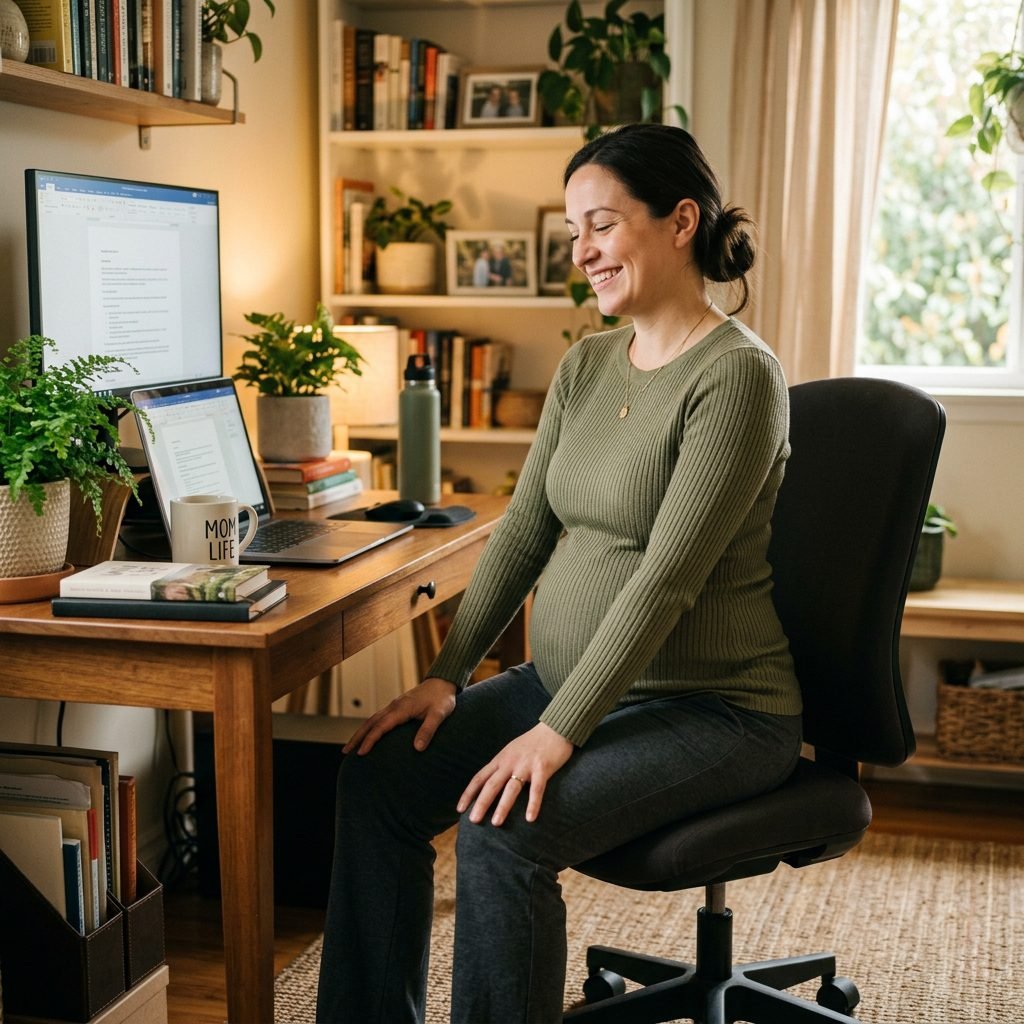
Mama, I need you to hear this: The best posture is your next posture. Even if you have the most perfectly calibrated, thousand-dollar ergonomic chair in the world, sitting in one position for too long will cause pain. Your pregnant body craves movement to keep the blood flowing and to prevent the relaxin-soaked joints from stiffening up.
I recommend the 30-Minute Rule. Every 30 minutes, you need to change your position, even slightly. Set a gentle chime on your phone or computer to remind you. Here are a few highly effective, desk-friendly stretches that you can do without even leaving your cubicle or home office:
- Seated Cat-Cow: Sit on the edge of your chair with your feet flat. Place your hands on your knees. As you inhale, gently arch your back, push your chest forward, and look slightly up (Cow). As you exhale, round your spine, tuck your chin to your chest, and let your shoulders roll forward (Cat). Repeat 5 times to release tension in the entire spine.
- Ankle Pumps and Circles: Extend one leg straight out under your desk. Point your toes away from you, then flex them back toward your face. Do this 10 times, then roll your ankle in a circle. Switch legs. This is a phenomenal way to reduce foot swelling and prevent leg cramps.
- Seated Pelvic Tilts: Sit tall. Gently rock your pelvis forward (creating a slight arch in your lower back), then rock it backward (flattening your lower back against the chair). This subtle movement lubricates the lower lumbar joints and provides immediate relief for aching hips.
- The Figure-Four Stretch (For Sciatica): If you are experiencing sharp, shooting pain down your buttocks and leg (sciatica), this is for you. Sit up straight. Cross your right ankle over your left knee (like a figure four). Gently lean forward with a straight back until you feel a deep stretch in your right glute. Hold for 30 seconds, then switch sides.
Advocating for Your Comfort: Talking to HR
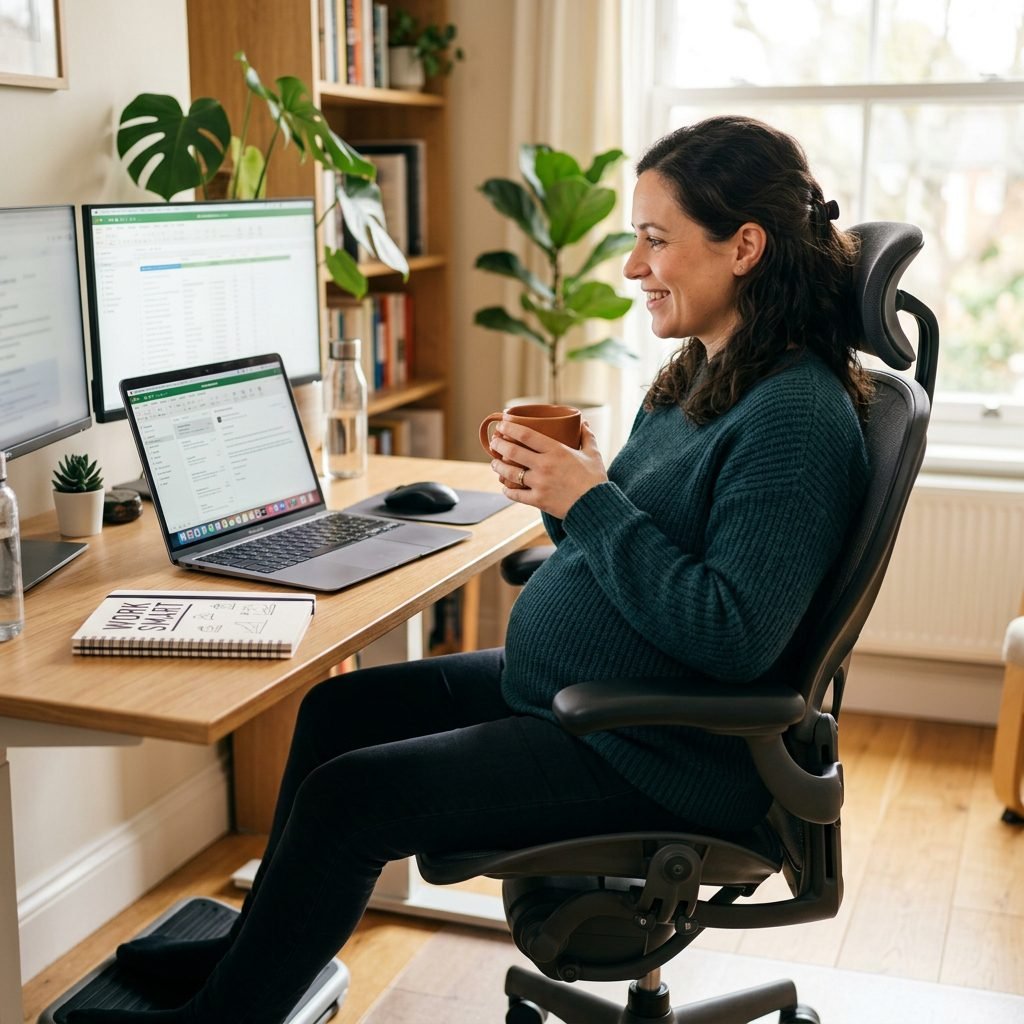
Sometimes, adjusting your current chair simply isn’t enough. If your office chair is broken, lacks lumbar support, or is fundamentally unsuited for your pregnant body, it is time to advocate for yourself. Many women feel guilty asking for accommodations, but remember: asking for a safe, pain-free work environment is not a luxury; it is a necessity for your health and the health of your baby.
Under laws like the Pregnant Workers Fairness Act (in the US), employers are required to provide reasonable accommodations for pregnancy-related conditions. An ergonomic chair or a footrest absolutely falls under this category.
If you are nervous about how to approach your HR department or manager, use this sisterly script to get the conversation started. You can send this via email or use it as a talking point in a meeting:
“Hi [Manager/HR Name],
As I progress in my pregnancy, I am experiencing significant lower back and pelvic pain related to my current desk setup. To ensure I can remain productive and comfortable during my workday, I am requesting an ergonomic assessment of my workstation and a chair that provides adequate lumbar and pelvic support, as well as a footrest to help with circulation.
Could we discuss the process for arranging this accommodation this week? Thank you so much for your support!”
Do not be afraid to stand up for what you need. A supportive employer will want you to be comfortable, focused, and pain-free. If they require a doctor’s note, simply send a quick message to your OB-GYN or midwife—they write these notes all the time and will be more than happy to help you get the support you need.
Hydration and Bathroom Breaks: The Built-In Movers
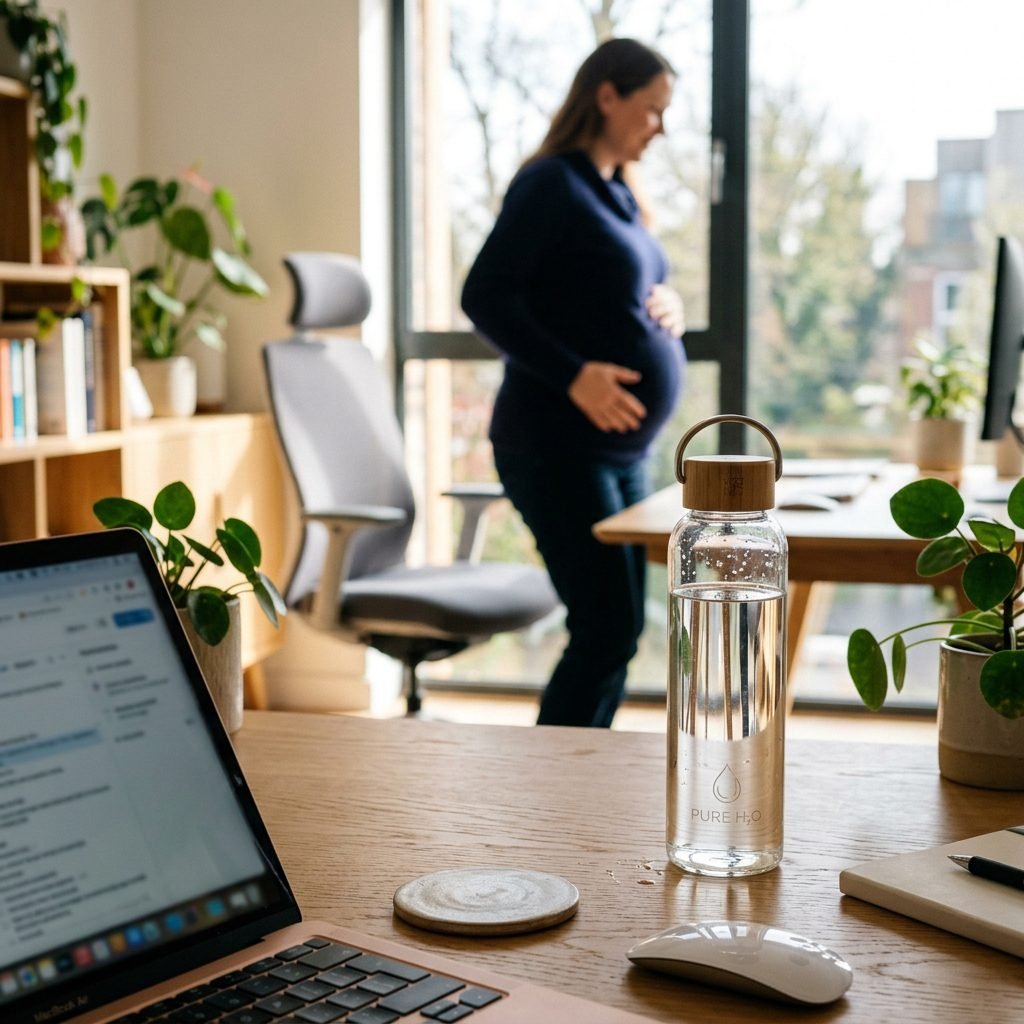
Let’s talk about a highly practical, dual-purpose strategy for staying comfortable at your desk: Hydration. We all know that drinking plenty of water is essential during pregnancy to maintain amniotic fluid levels, support increased blood volume, and prevent preterm contractions. But did you know that your water bottle is also your best ergonomic tool?
When you commit to drinking 80 to 100 ounces of water a day, you are naturally forcing your body to move. First, you have to get up to refill your bottle. Second, and more importantly, you will have to get up to use the restroom—frequently!
Instead of viewing these frequent bathroom trips as an annoyance, reframe them as mandatory, built-in ergonomic breaks. Every time you stand up to walk to the restroom, you are giving your hip flexors a chance to lengthen, allowing your spine to decompress, and encouraging blood to circulate freely through your lower extremities.
- Pro Tip: Keep a smaller water bottle at your desk (like a 16oz glass) instead of a massive jug. This forces you to get up and walk to the kitchen or water cooler more often to refill it, guaranteeing that you are breaking up your sitting time.
Conclusion
You’ve Got This, Mama
Working through pregnancy is a profound display of strength. Your body is performing an incredible, invisible marathon every single day, even while you are just sitting at your desk typing emails. By taking the time to optimize your office chair settings, investing in a few key supportive add-ons, and committing to regular movement, you can drastically reduce your back pain and make your workday feel manageable again.
Remember to listen to your body. If something hurts, adjust. If you need a break, take it. You are doing an amazing job, and every day brings you one step closer to holding your beautiful baby. Take a deep breath, adjust that lumbar support, and know that you have a whole community of mothers cheering you on.