
How to Use Box Breathing to Stay Calm Through Active Labor Contractions
Welcome to Your Calm Within the Storm
Hello, sweet mama. If you are reading this, you are likely preparing for one of the most transformative marathons of your life. As a doula, I have sat beside countless women as they navigate the powerful waves of labor. One of the most effective, science-backed tools I carry in my doula bag isn’t a physical object at all—it is the breath. Specifically, box breathing. When active labor begins and those contractions intensify, it is perfectly normal to feel a surge of adrenaline. However, learning to anchor yourself through rhythmic breathing can transform your experience from one of overwhelm to one of empowered surrender. In this guide, we will walk through exactly how to use this technique to keep your body relaxed and your mind clear as you bring your baby into the world.
Remember, mama: your body is not breaking; it is opening. Each contraction is a wave bringing you closer to your baby.
The Science of Serenity: Why Your Breath Matters
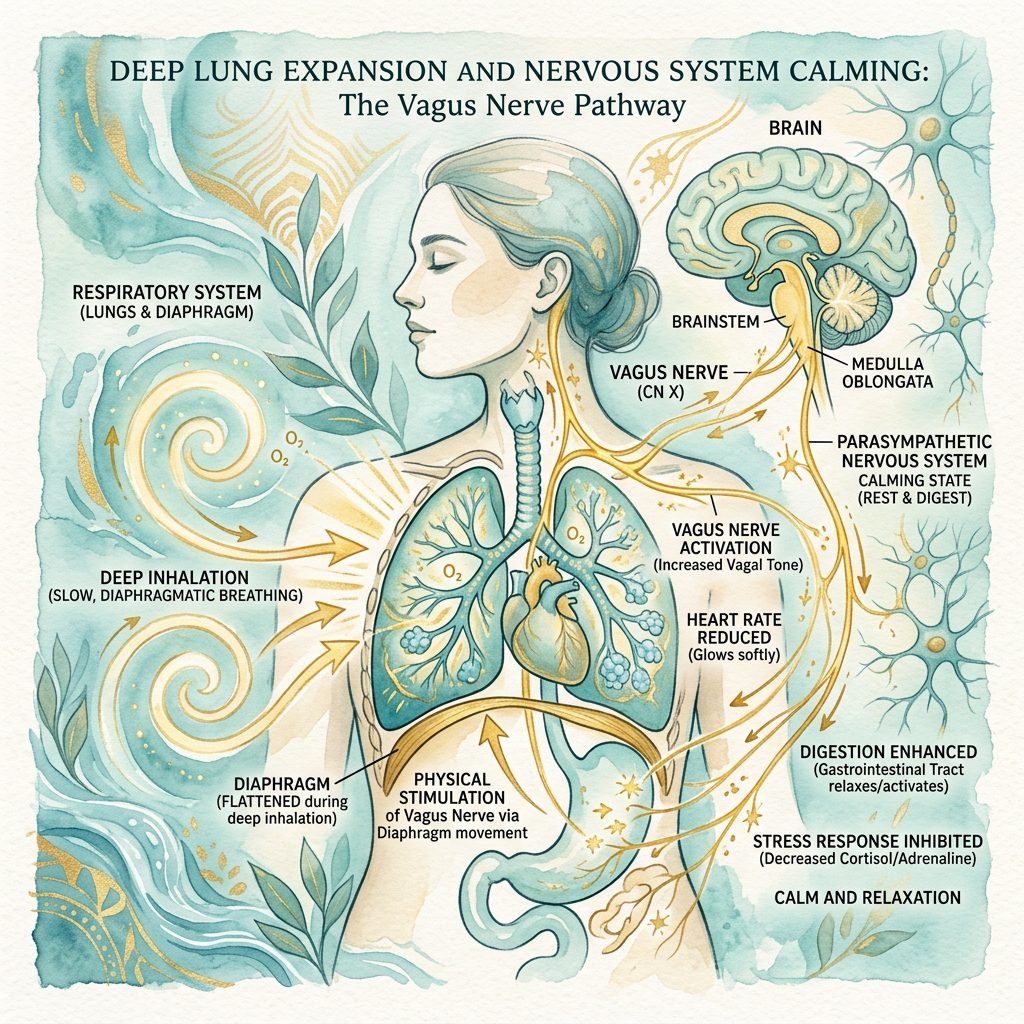
During active labor, your body is a powerhouse of hormonal activity. To keep things progressing smoothly, we want to invite oxytocin (the love hormone) to the party while keeping adrenaline (the stress hormone) at bay. Adrenaline can trigger the ‘fight or flight’ response, which causes muscles to tense—including the muscles of the uterus. This tension can actually make contractions feel more painful and potentially slow down labor.
Box breathing, also known as four-square breathing, works by directly stimulating the vagus nerve. This sends a signal to your brain that you are safe, allowing your parasympathetic nervous system to take the lead. This ‘rest and digest’ state is where labor thrives. By focusing on a structured count, you give your ‘monkey mind’ a job to do, preventing the spiral of panic that often accompanies the transition into active labor.
| Hormone | Effect on Labor | Triggered By |
|---|---|---|
| Oxytocin | Promotes effective contractions and bonding. | Calm, dark environments, touch, and rhythmic breathing. |
| Adrenaline | Can stall labor and increase pain perception. | Fear, bright lights, feeling observed, and shallow breathing. |
Mastering the Box: A Step-by-Step Guide for Labor
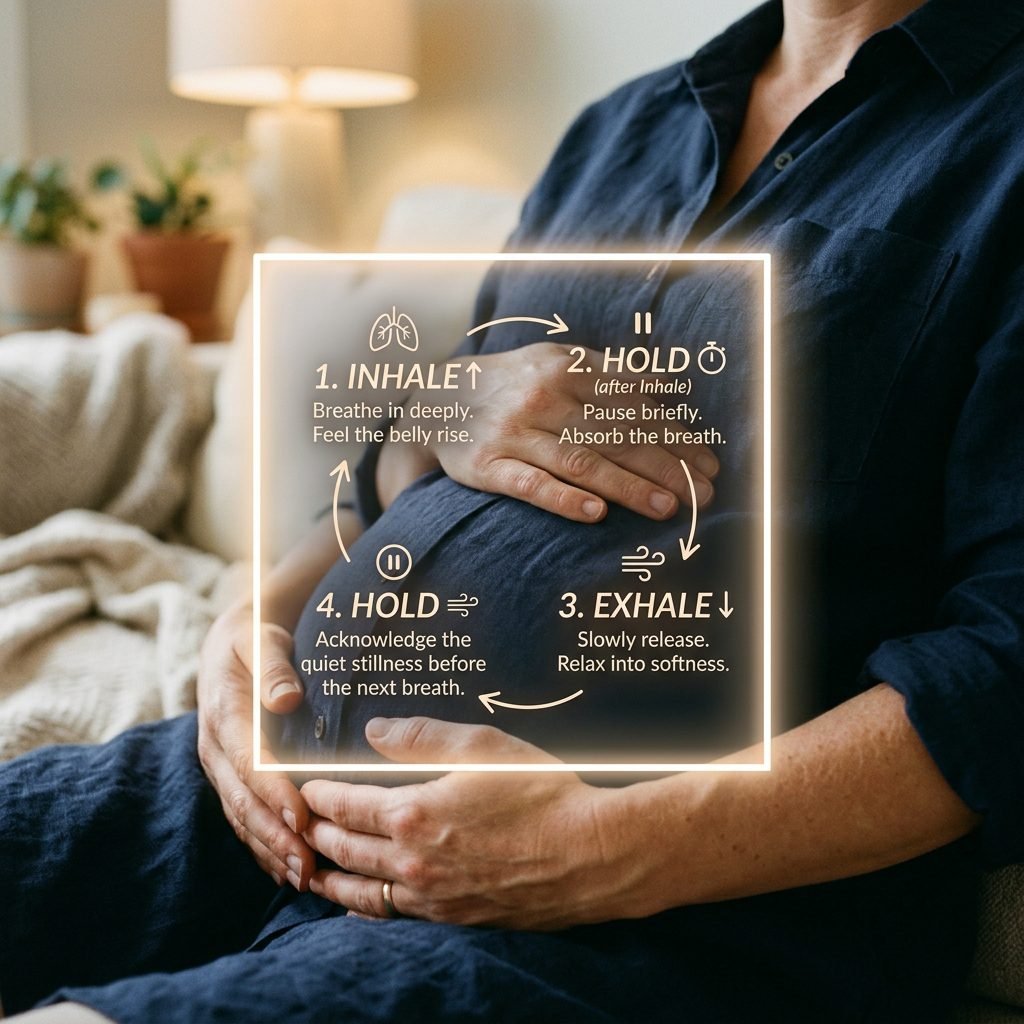
The beauty of box breathing is its simplicity. You can practice this anywhere—in the car on the way to the hospital, in the shower, or while leaning over a birth ball. The goal is to create a perfect square with your breath. Here is how you do it, step-by-step:
- Exhale completely: Start by pushing all the air out of your lungs through your mouth. Imagine you are blowing out a candle.
- Inhale (Count of 4): Slowly breathe in through your nose for 4 seconds. Feel your belly expand, not just your chest.
- Hold (Count of 4): Gently hold that breath for 4 seconds. Do not clamp your throat shut; just pause in the fullness.
- Exhale (Count of 4): Smoothly release the breath through your mouth for 4 seconds, making a soft ‘whoosh’ sound.
- Hold (Count of 4): Pause with empty lungs for 4 seconds before the next inhale.
In the heat of a contraction, 4 seconds might feel too long or too short. Adjust the count to what feels natural for you—the rhythm is more important than the specific number. Some mamas prefer a 3-count during the peak of a contraction and a 5-count during the rest periods.
Navigating the Waves: Applying the Technique to Contractions
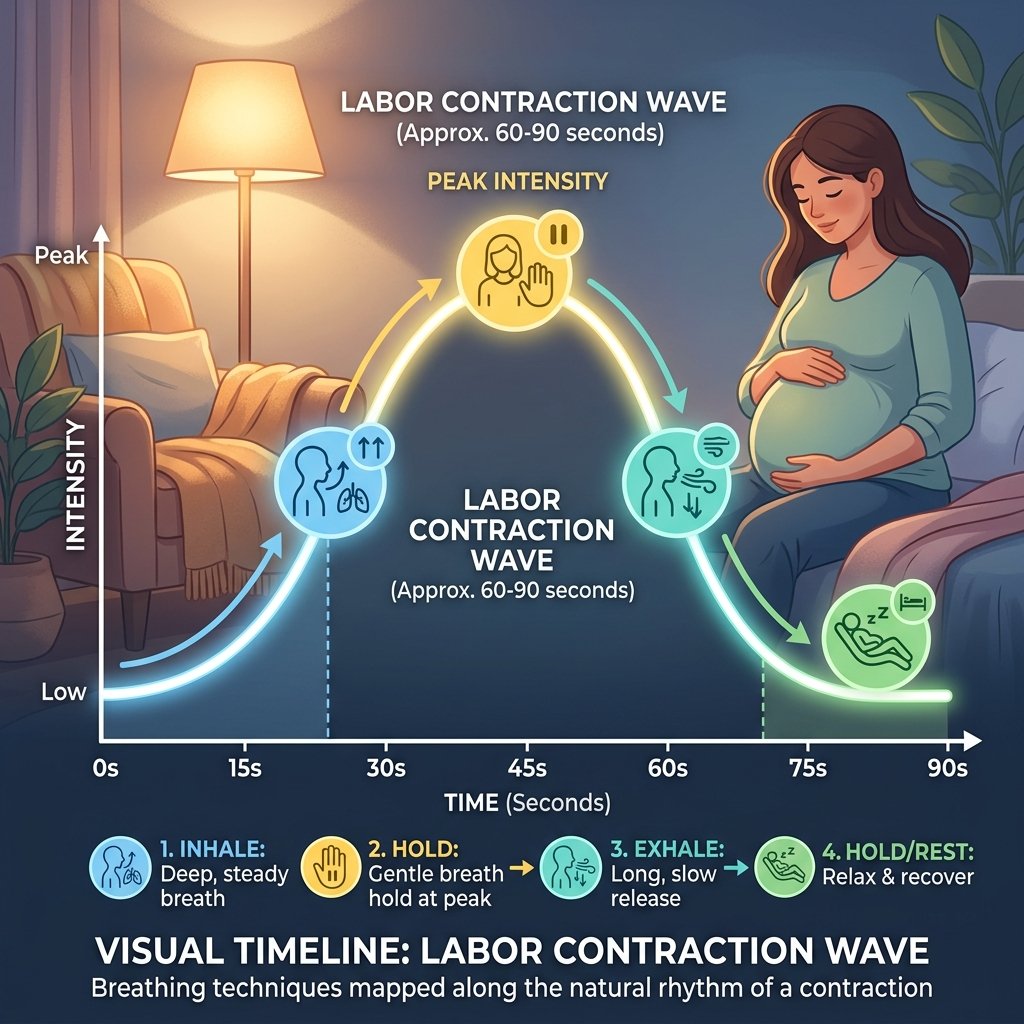
Active labor contractions usually last between 45 to 90 seconds. When you feel a contraction starting, it’s helpful to have a ritual. I always suggest starting with a ‘cleansing breath’—a big, deep inhale and a loud, sighing exhale—to signal to your body that it’s time to work. Then, move immediately into your box breathing.
As the contraction peaks, your instinct might be to hold your breath or take short, panting breaths. Resist this! Use the count of the box to anchor yourself. If you get off track, don’t worry. Just find the next ‘corner’ of the square and start again. Between contractions, use a longer box (maybe a 5 or 6 count) to deeply nourish your muscles with oxygen and rest your mind.
| Labor Phase | Contraction Length | Breathing Strategy |
|---|---|---|
| Early Labor | 30-45 seconds | Gentle, slow box breathing; focus on relaxation. |
| Active Labor | 45-70 seconds | Strict 4-count box breathing to maintain rhythm. | 70-90 seconds | Shorten the count if needed, but keep the square pattern; focus on the exhale. |
The Partner’s Role: Being the Breath Anchor

Mama, you don’t have to do this alone. Your partner or doula can be your ‘breath anchor.’ When the intensity rises, it can be hard to remember how to count. This is where your support team steps in. They can breathe with you, making their breaths audible so you can follow their lead. They can also use gentle touch to remind your body to soften.
“Breathe with me, mama. In… two, three, four. Hold… two, three, four. You are doing it. You are bringing our baby home.”
Partners should watch for signs of tension: Is her jaw clenched? Are her shoulders up by her ears? A gentle reminder to ‘relax the jaw’ can help, as a relaxed jaw often leads to a relaxed pelvic floor. Partners can also use their fingers to draw a square in the air or on the mama’s back to provide a visual and tactile guide for the box breathing rhythm.
Enhancing the Breath: Positions for Active Labor
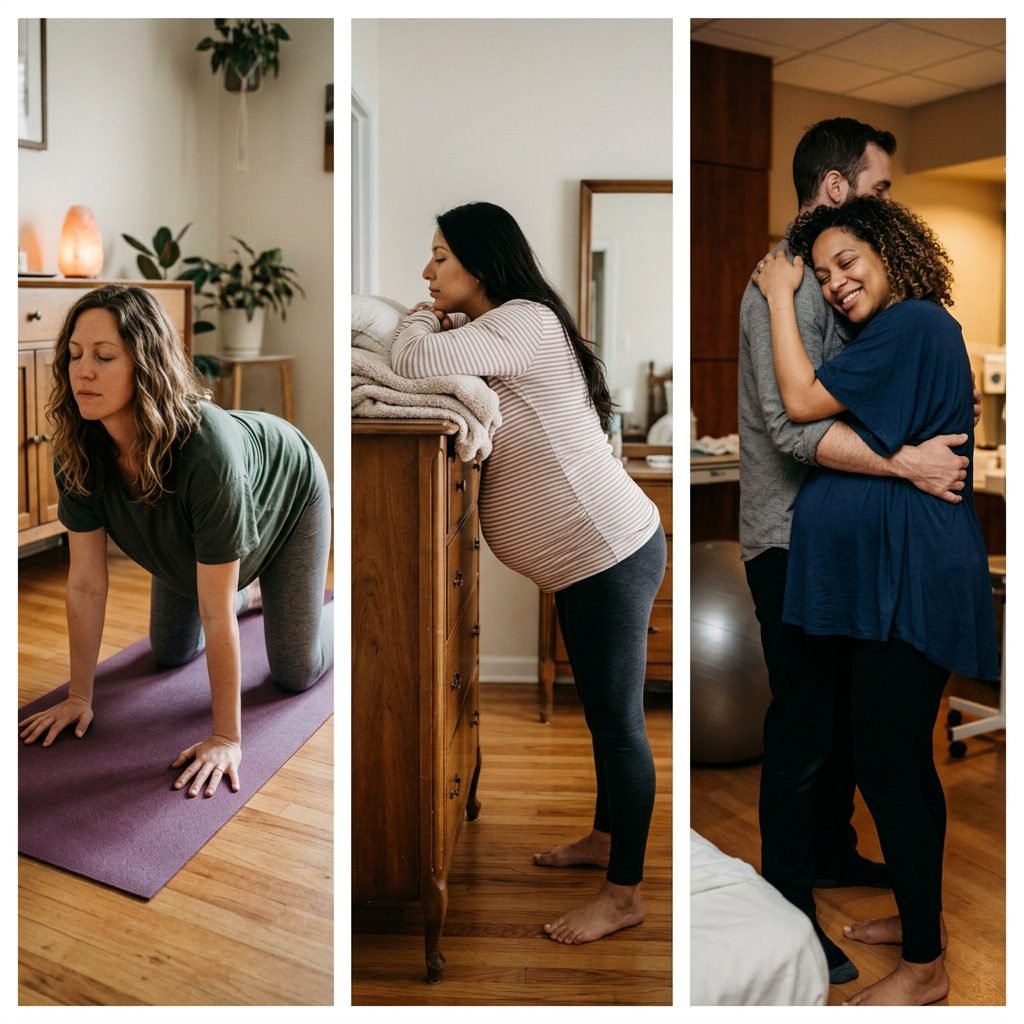
Breathing is most effective when your body is in a position that encourages the baby to descend. Combining box breathing with upright, forward, and open (UFO) positions can significantly reduce discomfort. When you change positions, take a moment to reset your breathing rhythm.
| Position | Best For… | Breathing Tip |
|---|---|---|
| Hands and Knees | Relieving back labor and rotating the baby. | Let your belly hang heavy and breathe into your lower back. |
| Sitting on Birth Ball | Pelvic floor relaxation and gentle movement. | Use the bounce to find a rhythm for your 4-count. |
| Standing Lean | Using gravity to help baby descend. | Lean on your partner; let them take your weight while you focus on the box. |
| Side-Lying | Resting during long active labor phases. | Focus on the ‘Hold’ part of the box to find deep stillness. |
Always remember to keep your movements fluid. If a position feels wrong, move! Your breath will tell you when you’ve found a ‘sweet spot’ where you can manage the intensity effectively.
Conclusion
You Are Capable and Strong
Mastering box breathing is like training for a marathon; it takes practice, but the rewards are immeasurable. By giving yourself this tool, you are taking an active role in your birth story, creating a pocket of peace amidst the power of labor. Practice your 4-count square tonight before you go to sleep, or while you’re sitting in traffic. Make it a second nature so that when the big day arrives, your body knows exactly what to do. You’ve got this, mama. We are all cheering for you!