5 Deep Sacrum Opening Stretches for Natural Labor Pain Relief
Embracing the Power of Your Pelvis
Welcome, sweet mama. If you are reading this, you are likely navigating the incredible, transformative season of late pregnancy or perhaps you are already feeling the first gentle waves of labor. As a doula, I want you to take a deep breath and remember one thing: your body was designed for this. The journey of birth is a dance between you and your baby, and the pelvis is the ballroom where this dance takes place. Specifically, the sacrum—that shield-shaped bone at the base of your spine—holds the key to creating space, reducing intensity, and helping your baby navigate the birth canal with more ease.
During labor, the sacrum needs to move backward (a process called counternutation) to allow the baby’s head to pass through the pelvic outlet. However, modern life—sitting in cars, lounging on soft sofas, and general tension—can leave our sacrum feeling ‘stuck’ or tight. By practicing deep sacrum-opening stretches, you aren’t just managing pain; you are actively inviting your baby down and out. These movements are evidence-based, doula-approved, and designed to help you tap into your primal strength while keeping your comfort at the forefront.
“Birth is not only about making babies. Birth is about making mothers—strong, competent, capable mothers who trust themselves and know their inner strength.”
In this guide, we will walk through five essential stretches that target the sacrum and pelvic floor. Whether you are aiming for a completely unmedicated birth or simply want tools to stay comfortable until your epidural, these positions will be your best friends. Let’s prepare that beautiful body of yours for the most important meeting of your life.
The Anatomy of Opening: Why the Sacrum Matters
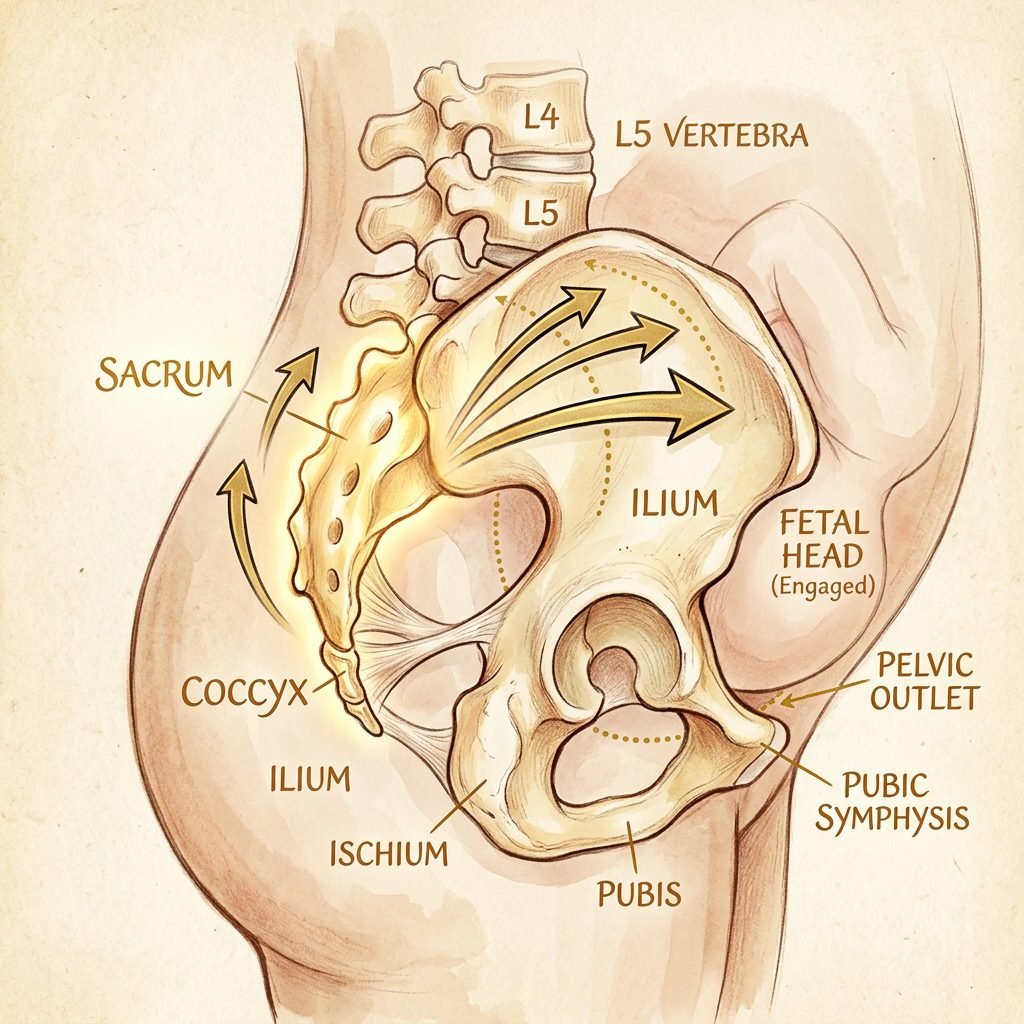
To understand why these stretches work, we have to look at the ‘Sacral Swing.’ Your pelvis isn’t a solid, unmoving ring of bone; it is a dynamic system of joints and ligaments. The Sacroiliac (SI) joints connect your sacrum to your hip bones, and during pregnancy, the hormone relaxin makes these joints more pliable. This is nature’s way of ensuring the ‘door’ can open.
The Nutation/Counternutation Balance
In the early stages of labor, as the baby engages in the brim, the top of the sacrum tips forward (nutation). As the baby moves into the mid-pelvis and toward the outlet, the bottom of the sacrum must swing out of the way (counternutation). If the muscles surrounding the sacrum—like the piriformis and the pelvic floor—are tight, this swing is restricted. This is often what causes the dreaded ‘back labor’ sensation.
- Increased Pelvic Diameter: Proper stretching can increase the pelvic outlet by up to 2 centimeters.
- Pain Management: Opening the sacrum reduces direct pressure on spinal nerves.
- Fetal Positioning: Space allows the baby to rotate into the optimal ‘occiput anterior’ (face down) position.
| Labor Phase | Sacral Movement Goal | Focus Area |
|---|---|---|
| Early Labor | Engagement | Opening the Pelvic Inlet (Top) |
| Active Labor | Rotation & Descent | Mid-Pelvis Mobility |
| Transition/Pushing | Expansion | Opening the Pelvic Outlet (Bottom) |
Stretch 1: The Deep Garland Squat (Malasana)
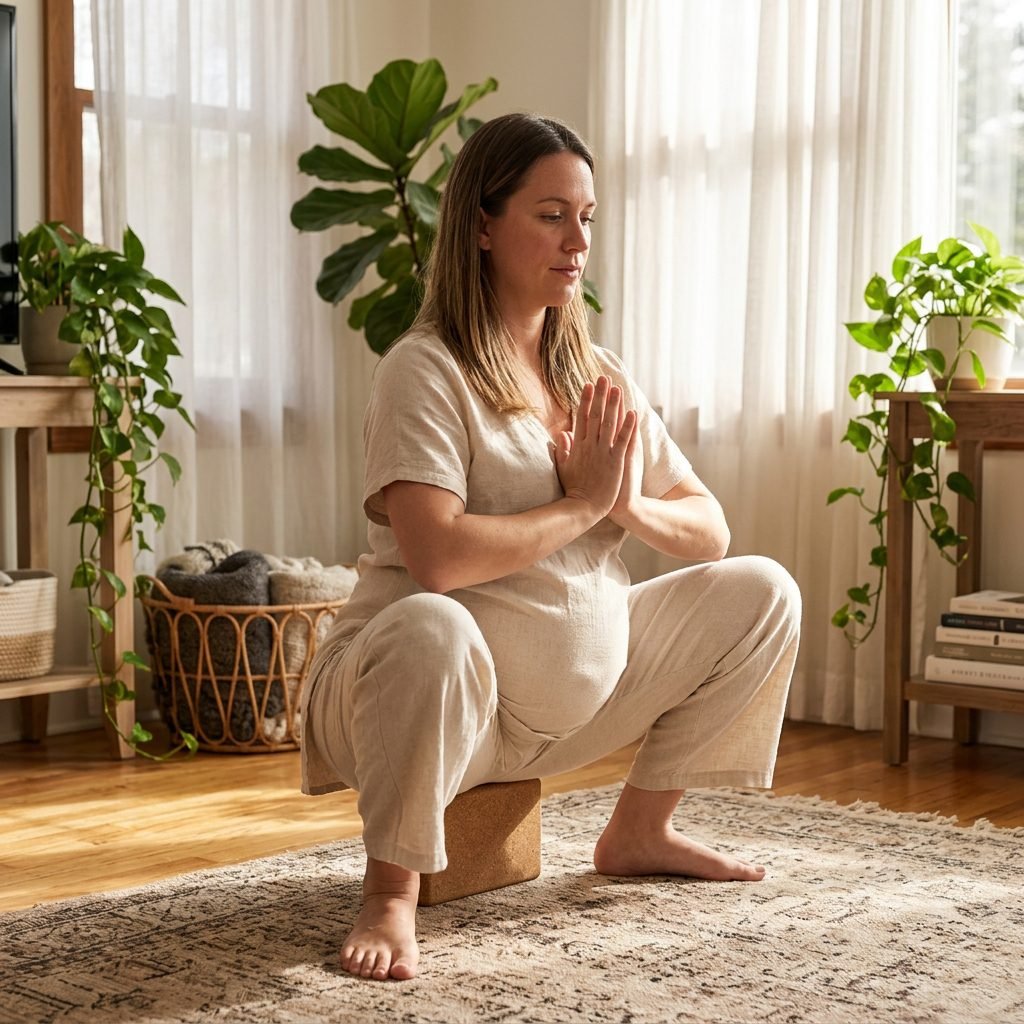
The Deep Garland Squat, or Malasana, is the gold standard for pelvic outlet expansion. This position uses gravity to pull the baby down while the weight of the torso helps to widen the sit-bones, effectively pulling the sacrum into a more open position.
How to Perform the Deep Squat:
- Stand with your feet slightly wider than hip-width apart, toes turned out at a 45-degree angle.
- Slowly lower your hips toward the floor. If your heels lift, place a rolled-up yoga mat or towel under them for support.
- Bring your elbows inside your knees and press your palms together at your chest.
- Use your elbows to gently nudge your knees wider, feeling the stretch in your inner thighs and the base of your spine.
- Hold for 5 to 10 deep breaths, imagining your pelvic floor softening like a blooming flower.
Doula Tip: If this feels too intense during active labor, use a birth ball or the edge of a sturdy bed for support. Lean your upper body forward onto the ball while staying in the squat. This takes the pressure off your ankles while keeping the sacrum free to move.
Stretch 2: Wide-Knee Child’s Pose with Pelvic Rocking

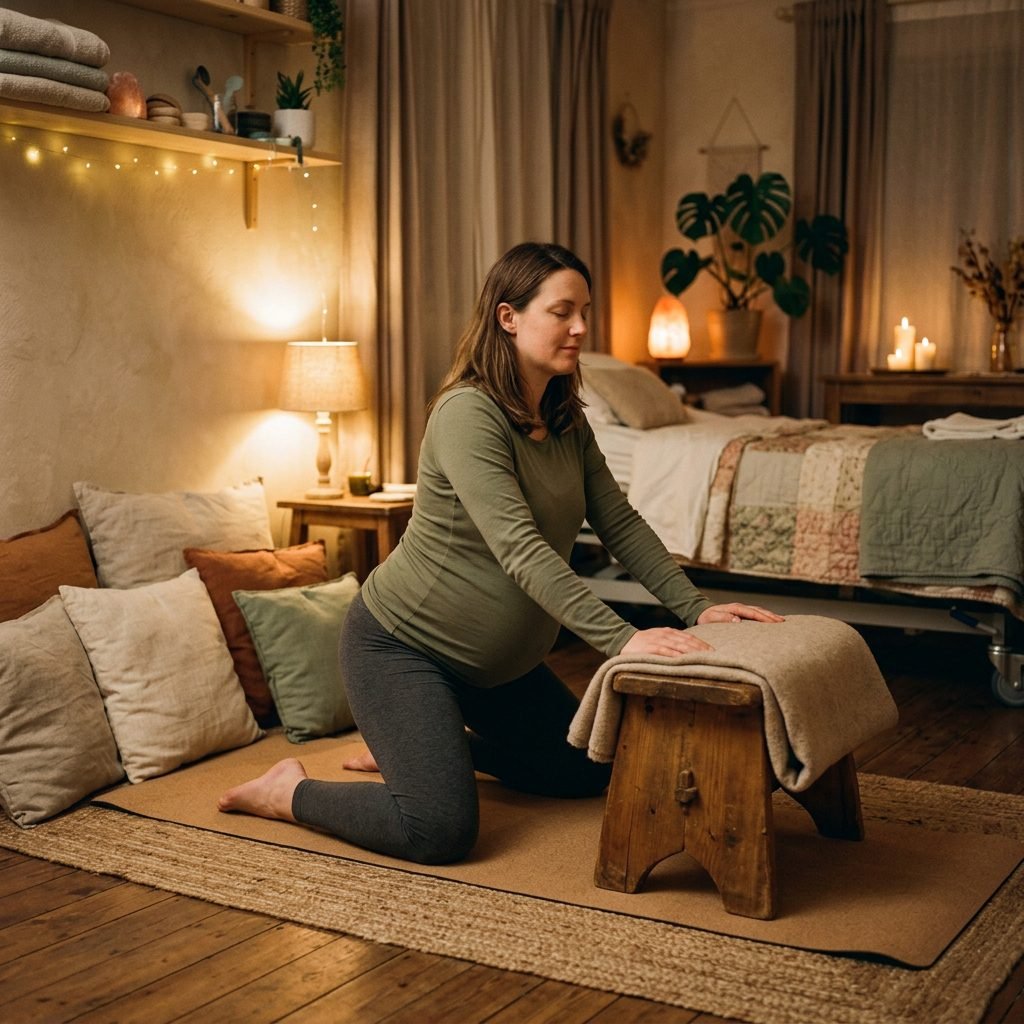
When labor waves become intense, many mothers instinctively move toward the floor. The Wide-Knee Child’s Pose is a restorative position that allows the sacrum to broaden while providing a safe space for the mother to turn inward. By adding a gentle ‘rocking’ motion, we encourage the baby to shift off the maternal spine.
Step-by-Step Instructions:
- Kneel on a soft surface (a rug or yoga mat).
- Bring your big toes together and spread your knees as wide as your belly comfortably allows.
- Lower your hips toward your heels and stretch your arms forward, or rest your head on a stack of pillows.
- Once comfortable, begin to gently rock your hips from side to side. Think of this as a rhythmic ‘wagging’ of your tailbone.
- Focus on exhaling through ‘horse lips’ (fluttering your lips) to release tension in the jaw, which is directly connected to the tension in the pelvic floor.
“Relax your jaw, relax your floor. The mouth of your face is the mirror to the mouth of your birth canal.”
This stretch is particularly effective for back labor. If your baby is ‘sunny-side up’ (OP position), this forward-leaning posture encourages them to rotate their heavy back toward your belly, relieving the pressure on your sacrum.
Stretch 3: The Side-Lying Release (The Doula’s Secret Weapon)
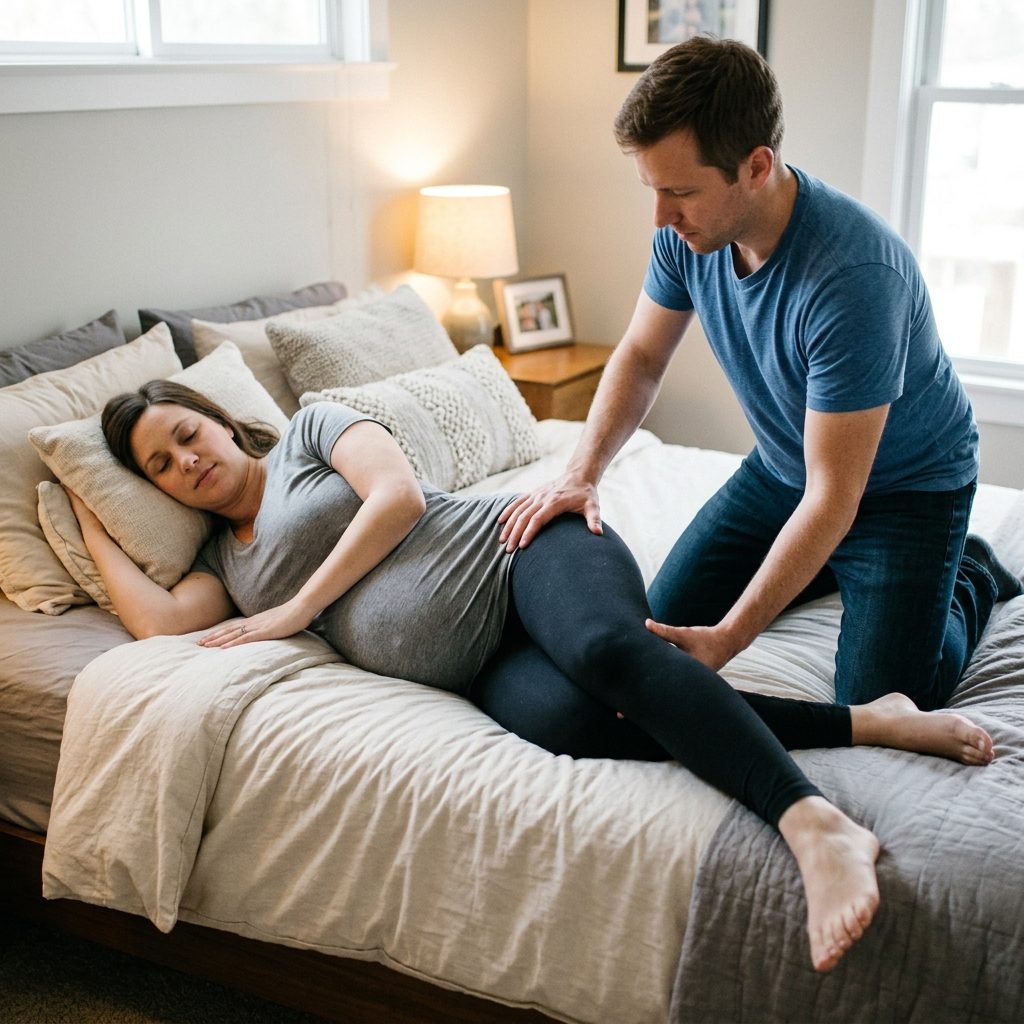
The Side-Lying Release is a hallmark of the Spinning Babies® approach and is incredibly powerful for opening the mid-pelvis and sacrum. It works by temporarily stretching the pelvic floor muscles on one side, allowing the sacrum to shift and create a ‘roomier’ environment for the baby.
How to Perform the Side-Lying Release:
- Lie on the very edge of a firm bed or massage table. You will need a partner for safety!
- Your bottom leg should be straight. Your head should be neutral on a pillow.
- Your partner stands in front of you, bracing your hips so you don’t roll off.
- Slowly bring your top leg forward and let it hang off the edge of the bed. The key is to let the leg hang completely heavy; do not hold it up.
- Hold this for 2 to 3 minutes (or through 3 contractions) per side.
Warning: You must keep your hips ‘stacked’ (one directly over the other). Do not let your top hip tilt forward. This stretch creates a subtle twist in the lower segment of the uterus, which, when released, helps the sacrum find its optimal alignment.
Stretch 4: Asymmetrical Lunges (The Captain Morgan)
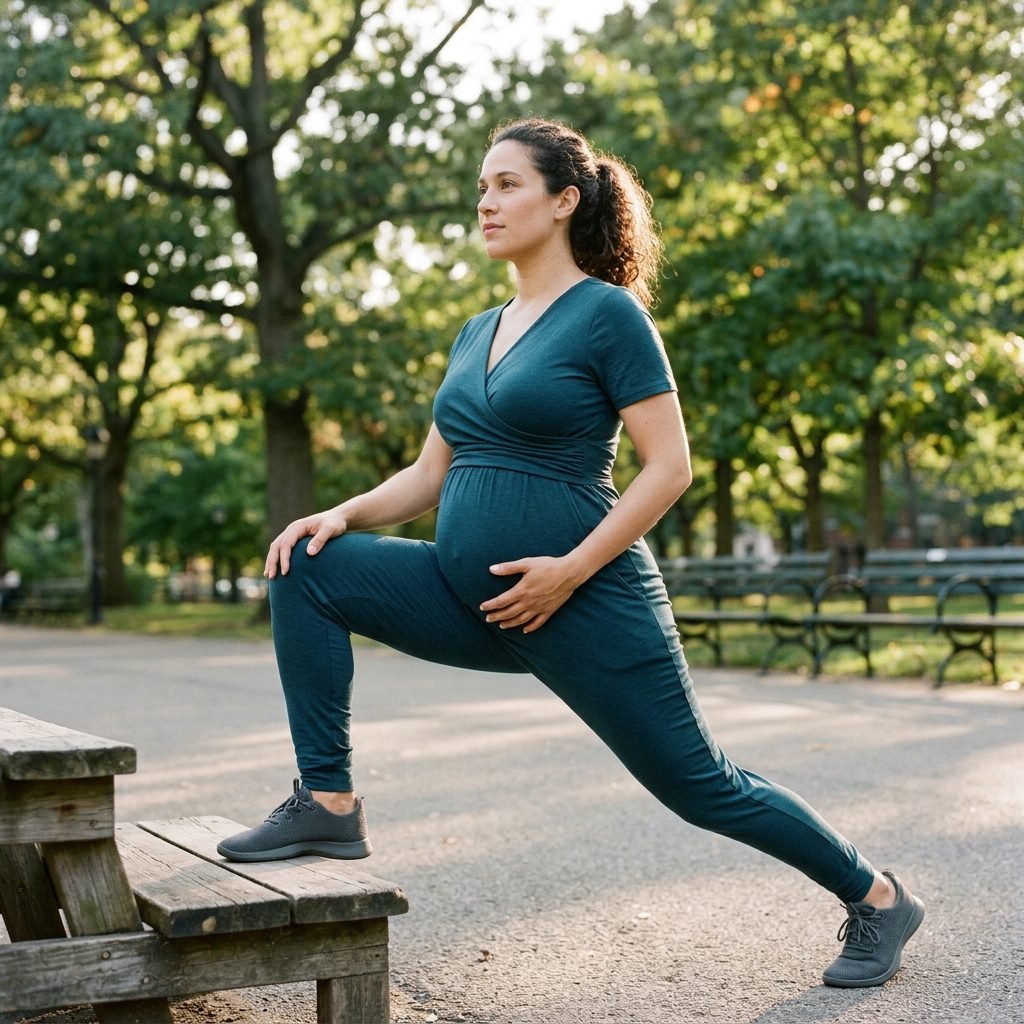
Asymmetry is your best friend when a baby is stuck or labor is stalling. By lifting one leg, you change the shape of the pelvis, opening one side of the sacrum more than the other. This often provides the ‘wiggle room’ a baby needs to tuck their chin and descend.
Executing the Lunge:
- Place one foot up on a sturdy chair, a birth stool, or even a few stairs.
- Keep your standing foot pointed forward. Your raised knee should be turned out to the side.
- Gently lean your weight into the raised leg, feeling the opening in the groin and the lower back.
- You can do this while standing or while kneeling on one knee (the ‘Captain Morgan’ pose).
- Rhythm is key: Lean in for the duration of a contraction, and ease back during the rest.
| Movement | Why it Works | Best For… |
|---|---|---|
| Symmetrical (Squat) | Widens outlet evenly | Final descent |
| Asymmetrical (Lunge) | Shifts pelvic bones | Stalled labor/Rotation |
Stretch 5: Hands and Knees with Pelvic Tilts (Cat-Cow)
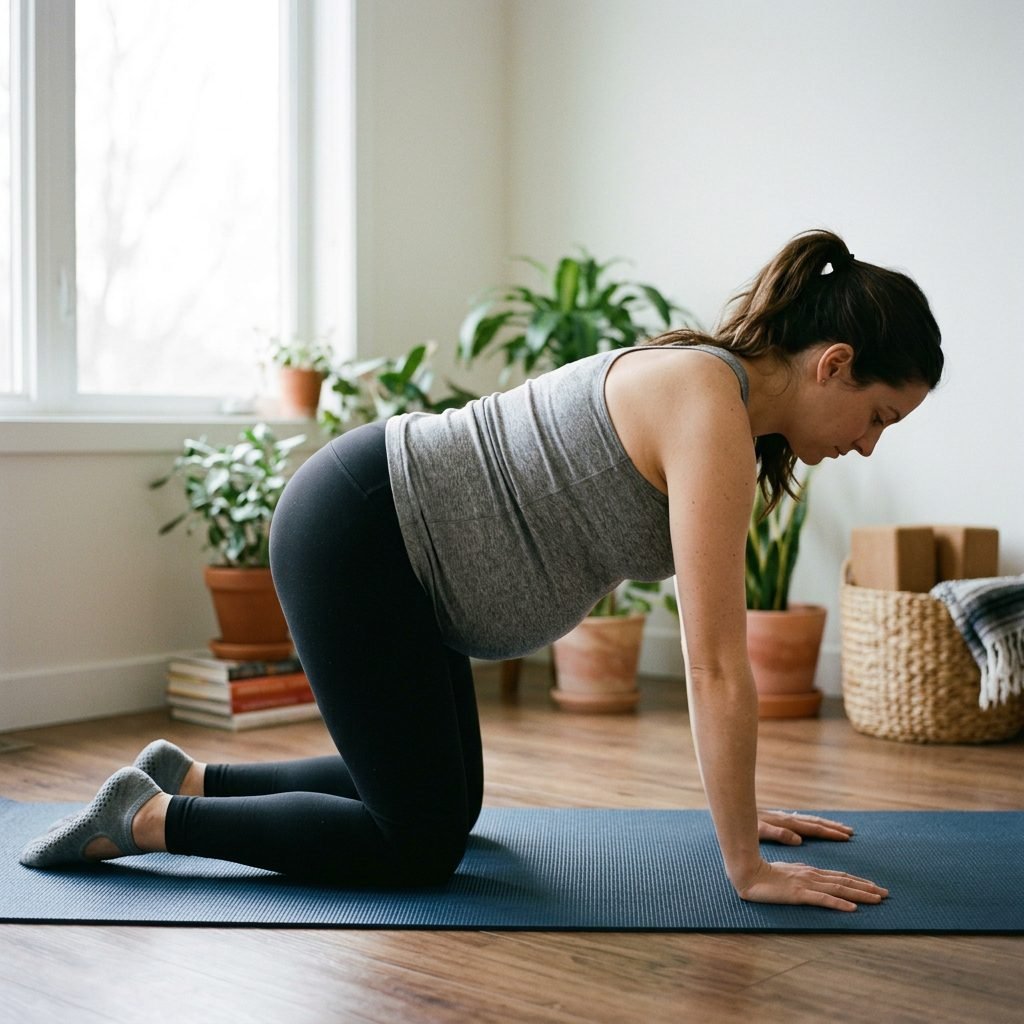
The Hands and Knees position is the most versatile labor pose. It takes the weight of the baby entirely off your back, allowing the sacrum to ‘float’ and expand. Adding Pelvic Tilts (often called Cat-Cow in yoga) keeps the joints lubricated and the muscles supple.
The Technique:
- Get down on all fours, with your wrists under your shoulders and knees under your hips.
- As you inhale, let your belly drop slightly (don’t over-arch) and look forward.
- As you exhale, tuck your tailbone and round your back toward the ceiling, like a stretching cat. Focus specifically on the tucking and untucking of the sacrum.
- For an extra sacral release, move your hips in large, slow circles, as if you are drawing a circle on the wall behind you with your tailbone.
This position is excellent for monitoring (most wireless monitors work great here) and allows your partner or doula easy access to your back for massage or counter-pressure.
Partner Support: The Double Hip Squeeze
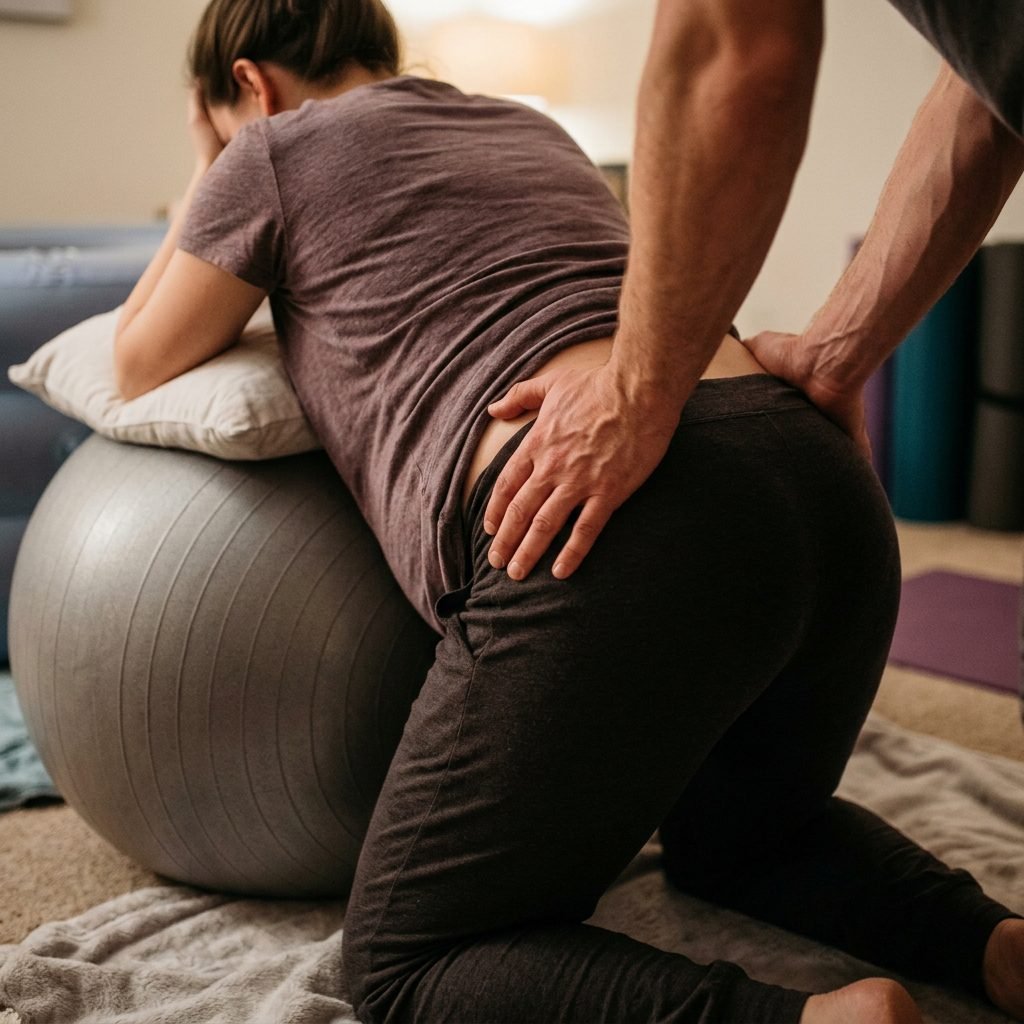
While you do the hard work of stretching, your partner can provide manual relief that feels like heaven. The Double Hip Squeeze is a technique that physically creates more space in the sacral area by pressing the iliac crests (hip bones) together, which causes the bottom of the pelvis to flare open.
Partner Instructions:
- Have the mother lean forward onto a birth ball or bed.
- Place your hands on the fleshy part of her hips (the glutes), right where the hip bones are widest.
- Apply firm, steady pressure inward toward her spine and slightly upward.
- Ask her, “Higher? Lower? Harder?” to find the sweet spot.
- Hold the pressure for the entire duration of the contraction. Do not let go until she says the wave has passed.
This technique is a game-changer for women experiencing intense sacral pressure. It mimics the opening movement of the stretches and provides a physical ‘container’ for the intensity of the labor wave.
Conclusion
You are Ready for the Dance
Mama, as you practice these 5 deep sacrum-opening stretches, remember that labor is not something to be feared, but a process to be moved through. By creating space in your sacrum, you are giving your baby a clear path and giving yourself the gift of comfort. These movements are more than just physical exercises; they are a way to stay connected to your body and your baby during the most powerful experience of your life.
Whether you find yourself squatting in the shower, lunging on the stairs, or rocking in a child’s pose, trust your instincts. Your body will tell you which way to move. Listen to it. Honor it. And soon, you will be holding your little one in your arms, knowing that you moved mountains (and bones!) to bring them here. You’ve got this, sister.