

What Dads Should Actually Do During A C-Section (It’s Not Just Holding Hands)
When you hear the words “Cesarean section,” your mind might jump to a clinical, sterile environment where your role as a birth partner feels diminished. It’s a common fear for dads: in a room full of medical experts, where do you fit in? Will you be relegated to a chair in the corner, a nervous spectator tasked only with holding a hand? Let me be clear: your role during a C-section is active, vital, and profoundly important.
You are not just a support person; you are your partner’s anchor, advocate, and the first familiar voice your baby will hear. A C-section is major abdominal surgery, and your partner will be navigating a mix of physical sensations, powerful emotions, and anesthesia. Your calm presence, informed actions, and unwavering support can transform the experience for both her and your baby. This guide moves beyond the basics, offering a detailed playbook for what you can—and should—do at every stage of a surgical birth. You are an integral part of this birth story, and this is how you can be the co-pilot she needs.
Before the Curtain Goes Up: Your Role in Preparation

From Decision to Delivery Room
Whether a C-section is planned for weeks or becomes necessary in the middle of labor, the time leading up to the surgery is critical. Your partner is likely feeling a whirlwind of emotions—relief, disappointment, anxiety, or all of the above. Your first job is to be her emotional ballast.
- Become the Information Hub: The medical team will be throwing a lot of information around. Grab a notebook or use your phone. Write down names, ask questions, and repeat back what you hear to confirm understanding. Key questions to ask include: “Can you walk us through the procedure?” “What type of anesthesia will be used?” and “What are the policies for me and the baby in the OR and recovery?”
- Advocate for Her Preferences: A C-section might not have been Plan A, but some elements of a birth plan can often still be honored. Is a “gentle” or “family-centered” C-section an option? This can include things like a clear drape to see the birth, placing ECG leads on her back to free her chest for immediate skin-to-skin, or playing your own music. Voice these preferences calmly and respectfully. You are her advocate.
- Provide Physical and Emotional Grounding: While she’s getting the spinal block or epidural, she’ll need to sit very still, often hunched over and feeling vulnerable. This is a key moment for your support. Stand in front of her, let her lean on you, make eye contact, and talk her through it. Remind her to breathe. Your steady presence is more powerful than you can imagine.
Remember, your calmness is contagious. She will look to you to gauge the situation. By being a steady, informed presence, you create a bubble of safety for her in a highly clinical setting.
In the Operating Room: More Than a Spectator

Once you’re gowned up and led into the operating room, the environment can be intimidating. It’s bright, busy, and full of unfamiliar sounds. Your place is on the stool right beside your partner’s head, behind the sterile drape. This is your command center.
Your Active Roles During Surgery:
- Be Her Eyes and Ears: From her position on the table, she can’t see much besides you and the ceiling. Narrate what’s happening in a positive and reassuring way. Say things like, “The team is working together so well,” “I can hear them talking, everything sounds routine,” or “We’re getting so close to meeting our baby.”
- Watch Her, Not the Surgery: While curiosity is natural, your primary focus is your partner. The anesthesiologist will be monitoring her vitals, but you are monitoring her emotional state. Is she feeling nauseous? Anxious? Scared? Let the anesthesiologist know immediately. They can often provide medication for nausea or help manage anxiety.
- Manage the Atmosphere: You are the guardian of her headspace. Talk to her about your hopes for the baby, remind her of how strong she is, or simply breathe with her. If you discussed playing music, get it ready on your phone. You are in charge of the personal, human element of this birth.
- Document the Moment (If Allowed): Check the hospital’s policy on photos or videos beforehand. If permitted, be ready to capture those first moments—the baby being lifted, the first cry. These are memories you will both cherish forever.
A C-section is a birth, not just a medical procedure. Your presence and active participation help honor the significance of the moment. You are not a passive observer; you are actively co-creating a positive birth experience.
The Moment of Birth: Your First Job as a Dad

This is it. You’ll hear the team say the baby is about to be born. In a matter of moments, your world will change. Your role now shifts to being the bridge between your partner and your new baby.
Welcoming Your Baby:
- Announce the Arrival: You will likely see the baby before your partner does. Announce the moment with joy! “He’s here!” or “I can see her!” Then, be the first to tell her the baby’s sex if you don’t already know. Your excited reaction will be her first confirmation that the baby has arrived safely.
- Go With the Baby: In most C-sections, the baby is taken to a nearby warmer to be checked by the pediatric team. Your partner cannot go. You can. It is vital that you accompany your baby. You are the familiar presence in a new, bright world. Speak to your baby, let them hear your voice. This continuity of care is incredibly important.
- Facilitate the Introduction: Once the baby is stable, the team will usually bring them over to your partner. Help facilitate this meeting. Make sure the baby is brought close to her face so she can see, smell, and kiss her child. This is a moment of pure magic you help create.
- Step Up for Skin-to-Skin: If your partner is unable to do immediate skin-to-skin (sometimes due to shaking, nausea, or other medical reasons), you are the next best person. Ask the nurse if you can do skin-to-skin with the baby. Unbutton your gown and hold your baby against your bare chest. This practice, known as “kangaroo care,” helps regulate the baby’s temperature, heart rate, and breathing, and it’s a powerful bonding experience for you both.
Post-Op & Recovery: Your Most Critical Role Begins

The surgery is over, but your most hands-on job is just beginning. Your partner is now a post-operative patient and a new mother simultaneously. She will be moved to a recovery room for monitoring for the next couple of hours, and she needs you more than ever.
Being the Primary Support in Recovery:
- Become the Gatekeeper: You are in charge of communication. Field the texts, calls, and updates to excited family and friends. This allows your partner to focus entirely on resting and bonding with the baby. Protect this sacred time.
- Advocate for Pain Management: Your partner has just had major surgery. Stay on top of her pain levels. Don’t wait for her to be in agony. Be the one to proactively ask the nurse, “It’s been a few hours, is it time for more pain relief?” or “She’s starting to look uncomfortable, what are our options?”
- Facilitate Breastfeeding: If your partner plans to breastfeed, the first hour after birth is a prime time for the first latch. Because her mobility is limited, you will be instrumental. Help her get comfortable with pillows, bring the baby to her breast, and offer encouragement. Ask for a lactation consultant to visit as soon as possible.
- Take Over Baby Care: For the first few hours, you may be the primary baby caregiver. You’ll hold the baby, do skin-to-skin, change the first diaper, and swaddle them. Embrace this. This is not just “helping out”; this is parenting. Your confidence in handling the baby will give your partner immense peace of mind, allowing her body to heal.
In the fog of anesthesia and exhaustion, your partner is relying on you to be her memory, her voice, and her hands. Your capable support during these first hours sets the tone for your co-parenting journey.
A Dad’s C-Section Action Plan: A Quick Reference
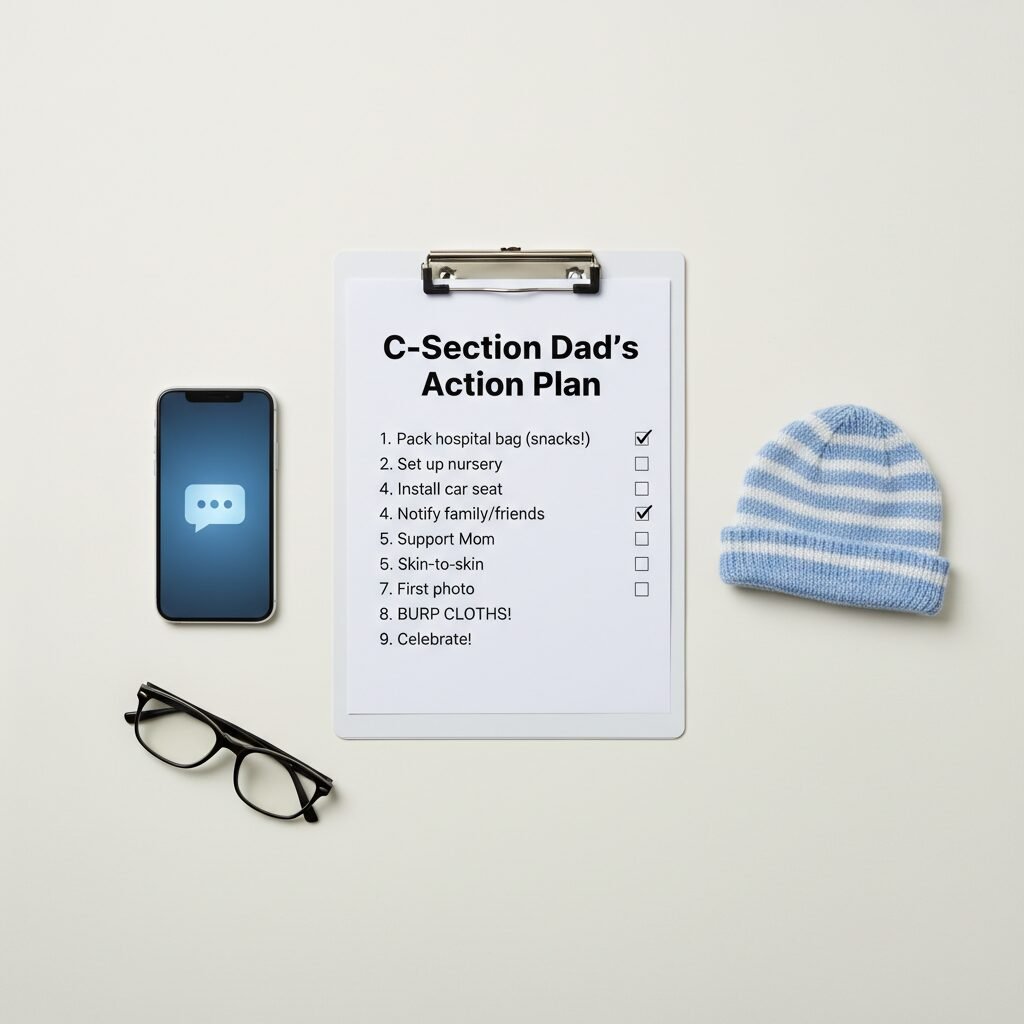
It’s a lot to remember, especially in a high-stakes environment. Use this table as a quick reference guide to your key roles and responsibilities during the C-section journey. Think of it as your game plan for being the ultimate birth partner.
| Phase | Your Key Action | Why It Matters |
|---|---|---|
| Pre-Op (The Prep Phase) | Serve as the Information Hub & Advocate. Ask questions, clarify procedures, and voice her birth preferences (e.g., gentle C-section options). | Reduces her anxiety by ensuring she feels heard and understood. Your informed presence creates a sense of control and safety. |
| During Surgery (In the OR) | Stay by her head. Narrate positively, watch her for signs of distress, and be her emotional anchor. Your focus is 100% on her. | Transforms a clinical procedure into an intimate birth experience. Your calm demeanor directly impacts her emotional and physical state. |
| The Birth (Baby’s Arrival) | Go with the baby to the warmer. Be the first familiar voice. Perform skin-to-skin if mom is unable. | Provides crucial continuity for the baby, aids in their physiological regulation, and kickstarts your own powerful bond. |
| Immediate Post-Op (Recovery Room) | Manage communications, advocate for pain relief, facilitate the first feeding, and take the lead on baby care. | Allows your partner to focus solely on physical healing. Your competence builds her confidence and solidifies your role as a co-parent from minute one. |
Conclusion
Your role during a C-section is multifaceted and indispensable. You are the advocate, the communicator, the emotional support, the memory-keeper, and the first line of defense for your new family. By stepping into these roles with confidence and purpose, you do more than just hold a hand—you actively shape the birth experience, making it more positive, memorable, and empowering for the person you love.
You will be the one she looks to for reassurance, the steady presence in her peripheral vision, and the one who places your baby on her chest for the first time. This is not a passive role. It is a profound responsibility and a deep honor. Welcome to fatherhood; you are already doing an amazing job.
Disclaimer: This article is intended for informational purposes only and does not constitute medical advice. The information provided is not a substitute for professional medical advice, diagnosis, or treatment. Always seek the advice of your physician or other qualified health provider with any questions you may have regarding a medical condition.