The Magic Hour: Why The First 60 Minutes After Birth Change Everything
The moment your child is born is a whirlwind—a crescendo of effort, emotion, and anticipation that culminates in a single, life-altering breath. In the flurry of activity that often follows, there exists a protected, sacred space in time known as the ‘Magic Hour’ or ‘Golden Hour.’ This isn’t just a sentimental concept; it’s a critical, biologically-driven period of about 60 to 90 minutes immediately following birth. During this time, uninterrupted skin-to-skin contact between mother and baby orchestrates a symphony of physiological and emotional events that can profoundly shape the health and relationship of your new family.
As a doula and maternal health educator, I have witnessed the transformative power of this hour countless times. It’s a quiet, primal reconnection after the separation of birth, where baby and parents can regulate, bond, and begin their journey together on the calmest possible footing. This article will guide you through the science behind the magic, explain the benefits for baby, mother, and partner, and provide you with the knowledge to advocate for this vital experience. We’ll also explore what happens when birth doesn’t go as planned, offering reassurance that the path to bonding is a journey, not a single moment.
The Science of Skin-to-Skin: What’s Happening to Your Baby?
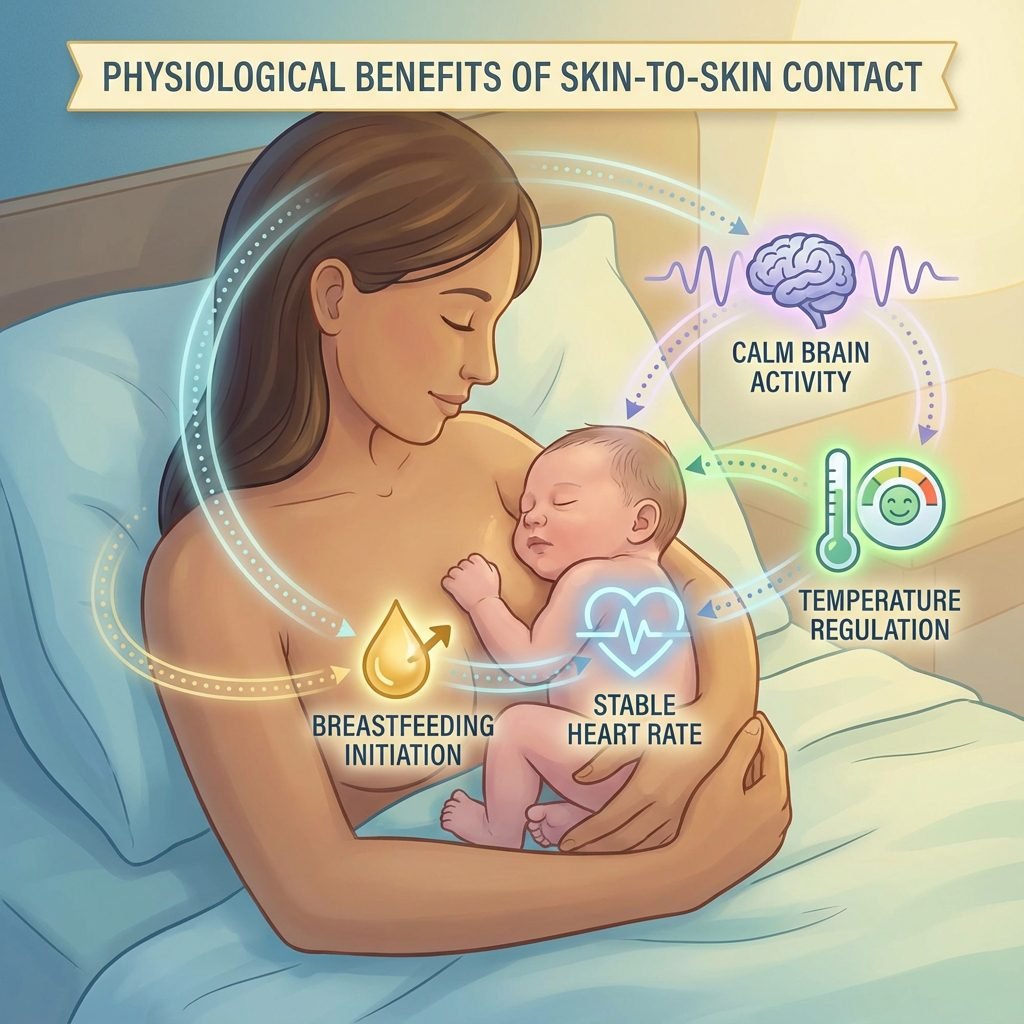
When your newborn is placed directly on your bare chest, it’s far more than just a sweet cuddle. It is the continuation of the womb environment, a vital bridge from internal to external life. This simple act triggers a cascade of neurological and physiological benefits for your baby, ensuring their smoothest possible transition into the world.
Key Physiological Benefits:
- Thermoregulation: A mother’s chest is a brilliant natural incubator. Studies show that her body temperature will fluctuate—warming up or cooling down—to perfectly regulate her baby’s temperature, which is a crucial task for a newborn who cannot yet do it efficiently on their own. This conserves precious energy the baby would otherwise use just to stay warm.
- Cardio-Respiratory Stability: Lying against you, hearing your familiar heartbeat and feeling the rhythm of your breathing, helps stabilize your baby’s own heart rate and respiratory patterns. They experience fewer episodes of apnea (pauses in breathing) and bradycardia (slow heart rate).
- Blood Sugar Stabilization: Skin-to-skin contact helps regulate a baby’s blood glucose levels. This reduces the risk of hypoglycemia (low blood sugar), which is particularly important for babies who are small, large, or born to mothers with gestational diabetes.
- Reduced Stress and Crying: The comfort of your touch and scent dramatically lowers your baby’s levels of the stress hormone cortisol. A baby experiencing skin-to-skin contact will cry significantly less than a baby who is swaddled in a bassinet. They are in their safe space, which promotes calm and a feeling of security.
- Microbiome Colonization: As your baby lies on your skin, they are colonized by your unique, healthy family bacteria. This is the first step in building a robust immune system and a healthy gut microbiome, which has lifelong health implications.
Initiating the First Feed: The ‘Breast Crawl’
Perhaps one of the most incredible events during the Magic Hour is the ‘breast crawl.’ When left undisturbed on their mother’s abdomen, many newborns will instinctively use their stepping reflex and sense of smell to navigate their way to the breast, latch on, and begin their first feeding all on their own. This baby-led process is associated with greater breastfeeding success and duration. The smells of the amniotic fluid on the baby’s hands and the colostrum from the nipple are chemically similar, providing a perfect map for their journey.
The Mother’s Transformation: Hormones, Healing, and Connection

The Magic Hour is just as critical for the birthing parent as it is for the baby. Your body has just accomplished an incredible feat, and this first hour of closeness is nature’s way of initiating recovery, bonding, and the next phase of motherhood. The process is driven by a powerful hormonal cocktail, with oxytocin playing the lead role.
The Power of Oxytocin
Often called the ‘love hormone’ or ‘bonding hormone,’ oxytocin surges during skin-to-skin contact. This has several immediate and profound effects:
- Reduces Postpartum Bleeding: The high levels of oxytocin stimulate strong uterine contractions. While you are holding your baby, you are also naturally helping your uterus clamp down, which constricts blood vessels and significantly reduces the risk of postpartum hemorrhage. It’s a perfect biological feedback loop.
- Promotes a State of Calm and Euphoria: Oxytocin counteracts stress hormones like adrenaline, creating feelings of calm, love, and protectiveness. Many mothers describe a sense of euphoria and an intense focus on their baby, which helps them bond and recover from the intensity of labor.
- Facilitates Breastfeeding: Oxytocin is also responsible for the ‘let-down’ reflex, which releases milk. The early and frequent stimulation from your baby during the Magic Hour helps establish a strong milk supply from the very beginning.
The Emotional Imprint
Beyond the measurable hormones, the emotional impact of this first meeting cannot be overstated. After months of carrying, dreaming, and wondering, you finally have your baby in your arms. Having this time be uninterrupted allows you to fully process the experience of birth and begin to learn your baby’s cues and personality. It validates your maternal instincts and builds confidence. This protected time allows you to simply be with your child, to gaze at their face, to feel their weight on your chest, and to solidify the connection you’ve been building for nine months. It is a moment of pure presence that will be imprinted on your memory forever.
This first hour is where the transition from being pregnant to being a parent truly begins. It’s a gentle landing for everyone.
The Partner’s Vital Role: Guardian of the Golden Hour

The Magic Hour is a transformative experience for the entire family unit, and the partner’s role is absolutely crucial. While the mother and baby are engaged in a primal, biological dance, the partner acts as the protector of this sacred space, the advocate, and a participant in the bonding process.
More Than a Spectator: A Key Participant
New fathers and partners also experience hormonal shifts when holding their newborn. Research shows that their oxytocin levels rise while testosterone levels temporarily decrease, a combination that promotes nurturing and bonding behavior. This is your first hour as a family, and your presence is a key ingredient.
Your Role as the Guardian:
- Communicate Your Wishes: You are the primary advocate for the birth plan. Beforehand, you and your partner should be aligned on the desire for an uninterrupted Magic Hour. During and after birth, you can be the one to gently remind the medical staff of your preferences.
- Buffer Interruptions: Your primary job is to create a peaceful bubble around your partner and baby. This means fielding non-urgent questions from staff, managing excited family members who want to call or visit, and keeping the room calm and quiet. You can say things like, “Could we please have the next hour for ourselves before any procedures that aren’t medically urgent?”
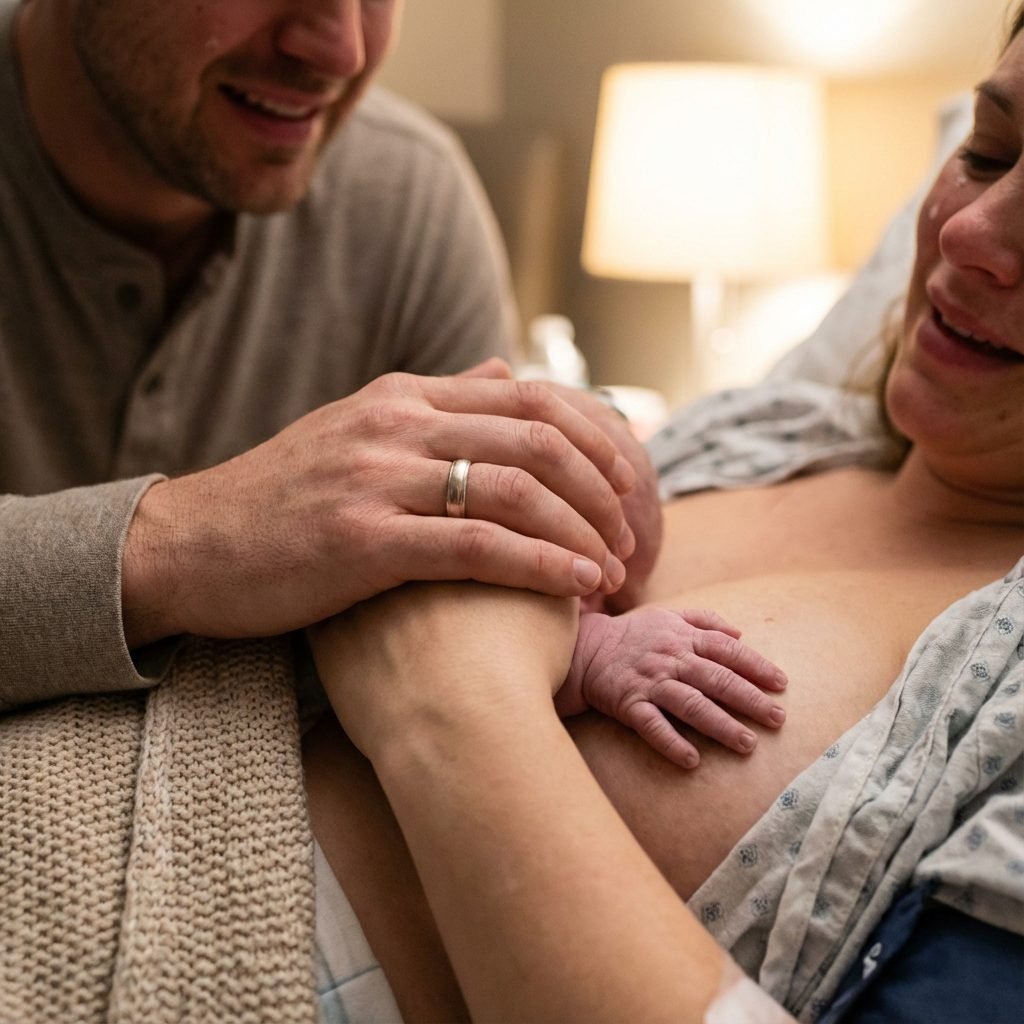
- Provide Physical and Emotional Support: Offer your partner sips of water, adjust her pillows, and whisper words of encouragement and awe. Your calm, loving presence is incredibly grounding for her after labor. Place your hands over hers and the baby’s, enveloping them in your love.
When the Partner Steps in for Skin-to-Skin
If the mother is unable to do immediate skin-to-skin due to a medical necessity like recovery from a C-section or a complication, the partner is the next best person. The baby already knows your voice. Skin-to-skin with a partner provides nearly all the same benefits of regulation and stress reduction. It’s a powerful way for you to bond with your baby and keep them warm and calm until they can be reunited with their mother. This isn’t a ‘second-best’ option; it’s a beautiful and vital act of co-parenting from the very first minute.
Navigating Hospital Protocols and Your Birth Plan

Advocating for your Magic Hour requires a bit of preparation. While most hospitals and birthing centers are now aware of the benefits, standard protocols can sometimes get in the way. Discussing your preferences with your provider ahead of time and clearly stating them in your birth plan is the best strategy for success.
Adding the Magic Hour to Your Birth Plan
Be clear and concise. Use phrases like:
- “We request an uninterrupted period of at least 60 minutes for skin-to-skin contact immediately after birth, provided mother and baby are stable.”
- “We would like to delay all non-urgent newborn procedures (e.g., weighing, measuring, bath, eye ointment, Vitamin K shot) until after the first hour of skin-to-skin and/or the first breastfeeding session.”
- “In the event of a C-section, we would like to practice skin-to-skin in the operating room or as soon as possible in the recovery room.”
Understanding Newborn Procedures
It can be helpful to understand what the routine procedures are and why they can often be delayed. The APGAR score, a quick assessment of the baby’s well-being at 1 and 5 minutes, can and should be done while the baby is on the mother’s chest.
| Procedure | Purpose | Can it Be Delayed for the Magic Hour? |
|---|---|---|
| Weighing & Measuring | To get baseline growth measurements. | Yes. This is not time-sensitive and can easily wait an hour. |
| Vitamin K Shot | To prevent a rare but serious bleeding disorder. | Yes. This is important but can be administered after the first hour. |
| Erythromycin Eye Ointment | To prevent eye infections from gonorrhea or chlamydia. | Yes. It can be delayed. It also temporarily blurs the baby’s vision, which can interfere with early eye contact and bonding. |
| First Bath | To clean the baby. | Yes. The vernix (the white, waxy coating on a newborn’s skin) is a natural moisturizer and has protective properties. It’s best to delay the bath for 24 hours or more. |
What About a Cesarean Birth?
A C-section doesn’t have to mean missing out. Many hospitals now offer ‘gentle cesareans,’ where the drape can be lowered for you to see the birth, and the baby can be brought directly to your chest in the OR. If this isn’t possible, your partner can do skin-to-skin while you are being stitched and you can be reunited in the recovery room for your own Magic Hour. The key is to discuss these possibilities with your OB-GYN and the anesthesiologist beforehand.
What If My Magic Hour Wasn’t ‘Magical’?

Birth is unpredictable. Sometimes, despite the best plans and intentions, medical situations arise that prevent an immediate, uninterrupted Magic Hour. A baby may need the attention of the NICU team, or a mother may need urgent medical care. If your experience didn’t look like the peaceful ideal, it is essential to give yourself grace. Your feelings of disappointment, sadness, or even grief are completely valid.
Please hear this: Bonding is not a one-time event. It is a continuous, ongoing process built through thousands of small moments of connection. The first hour is a wonderful kick-start, but it does not define your entire relationship with your child.
If you missed out on that initial time, you have not failed. You can recreate the benefits and foster that deep connection at any time. Here are some ways to create your own ‘Magic Hours’ in the days and weeks that follow:
- Prioritize Skin-to-Skin at Home: As soon as you and your baby are stable and together, you can create your own golden hour. Turn down the lights, put away the phones, and settle into a comfortable chair or bed. Place your baby, wearing only a diaper, on your bare chest and cover yourselves with a warm blanket. Do this as often as you can.
- Incorporate Baby-Wearing: Using a soft wrap or carrier keeps your baby close to your chest, where they can hear your heartbeat and feel secure while you go about your day. This is a wonderful way for both parents to bond.
- Try a Co-bathing Experience: Once the umbilical cord stump has fallen off and any maternal incisions are healed, taking a warm bath together can be a beautiful, womb-like experience. It’s calming for both of you and a fantastic way to do skin-to-skin.
- Focus on Responsive Care: The essence of bonding is trust. Responding to your baby’s cues—feeding them when they are hungry, comforting them when they are upset, making eye contact, and speaking to them in a loving tone—builds the secure attachment that will last a lifetime.
Your journey into parenthood is uniquely yours. Release any guilt or pressure to have had a ‘perfect’ experience. The love and connection you build with your child are woven through every feeding, every diaper change, and every sleepy cuddle, far beyond the first 60 minutes.
Conclusion
The Magic Hour is a profound gift—a quiet pause between the world of the womb and the world outside. It is a scientifically supported, instinct-driven period that offers immense benefits for the health, well-being, and connection of the entire family. By understanding its importance and advocating for this protected time, you are giving your baby the gentlest welcome and your family the strongest start.
Remember, whether your first hour is a peaceful dream or a challenging reality, it is just the first page in a beautiful, lifelong story. The real magic of parenting unfolds in the countless hours that follow, filled with love, learning, and the incredible journey of getting to know the new person in your life. Welcome to parenthood. You are ready.
Medical Disclaimer
The information provided in this article is for educational and informational purposes only and is not intended as medical advice. It is not a substitute for professional medical advice, diagnosis, or treatment. Always seek the advice of your physician or other qualified health provider with any questions you may have regarding a medical condition. Never disregard professional medical advice or delay in seeking it because of something you have read in this article.