

The “J-Breathing” Trick That Can Cut Your Labor Pain in Half
The anticipation of childbirth brings a whirlwind of emotions, and for many, a primary concern is the intensity of labor pain. It’s a valid and universal worry. But what if you had a tool, something you already possess, that could fundamentally change how you experience those sensations? A technique so effective that many who use it describe it as cutting their pain in half? Enter J-Breathing. This isn’t just about taking deep breaths; it’s a specific, physiological trick that works with your body’s natural processes. As a doula and maternal health educator, I’ve witnessed the transformative power of this technique firsthand. It helps birthing people move from a state of fear and resistance to one of surrender, focus, and incredible strength. In this guide, we will break down exactly what J-Breathing is, the science behind why it’s so effective, and how you and your partner can master it to prepare for a more positive and empowered birth experience.
What Exactly is J-Breathing and Why Does It Work?
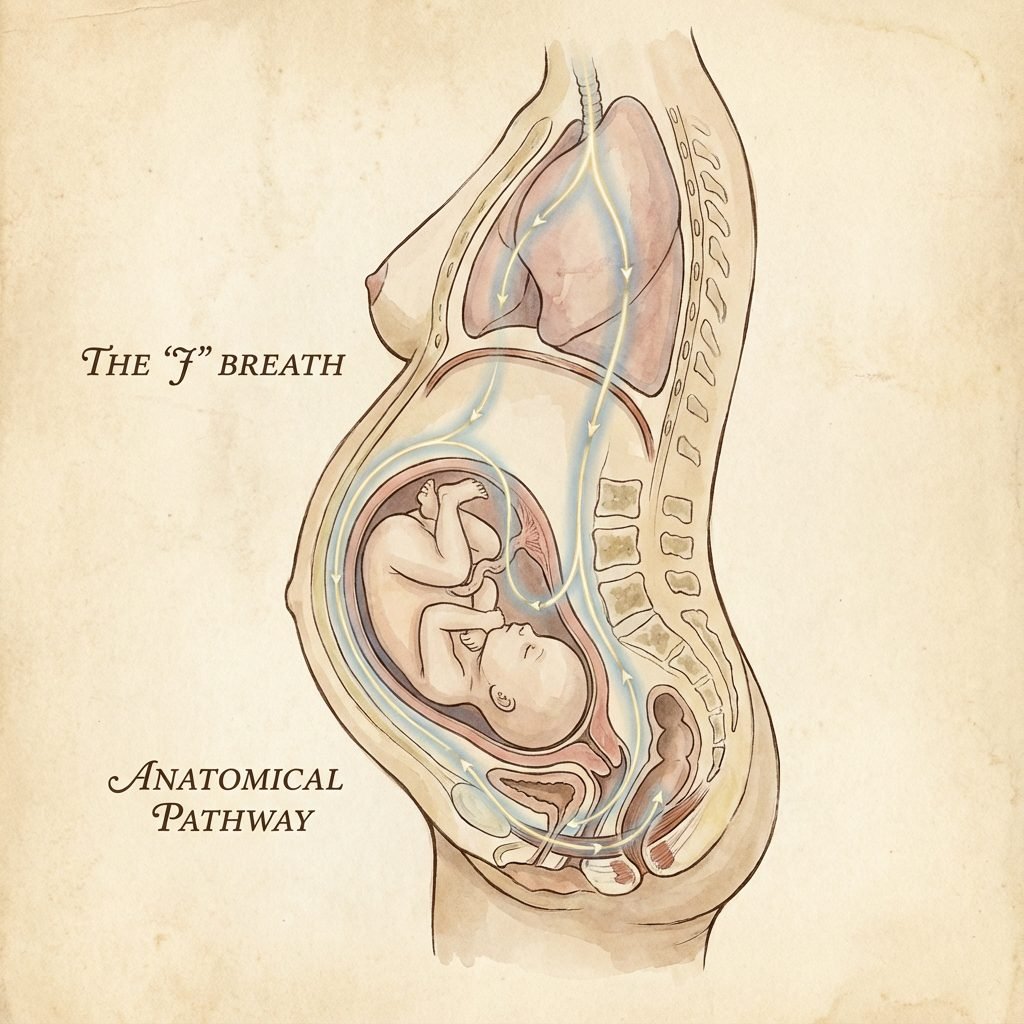
What Exactly is J-Breathing and Why Does It Work?
J-Breathing, sometimes called ‘birth breathing’ or ‘breathing down,’ is a deep, visceral breathing technique specifically designed for the active stages of labor. The ‘J’ refers to the path you visualize your breath taking: in through your nose, down into your belly, and then curving forward and out through your pelvis, like the shape of the letter J. It’s often accompanied by a low, deep vocalization—a moan or a hum—that vibrates through the body.
But this isn’t just a visualization exercise; it’s rooted in physiology. Here’s the science behind its effectiveness:
- It Activates the Parasympathetic Nervous System: When we experience pain or fear, our body’s ‘fight-or-flight’ response (sympathetic nervous system) kicks in, releasing adrenaline and causing muscles—including the uterus and pelvic floor—to tense up. This tension can stall labor and intensify pain. J-Breathing, with its slow, deep exhales, does the opposite. It stimulates the vagus nerve, activating the ‘rest-and-digest’ system (parasympathetic nervous system). This floods your body with calming hormones like oxytocin and endorphins (your body’s natural painkillers), counteracting the stress response.
- It Promotes Pelvic Floor Relaxation: A tight pelvic floor is like a locked door your baby has to push against. The deep, low-pitched sounds made during a J-breath create vibrations that travel down to your perineum, encouraging the pelvic floor muscles to relax and open. This creates more space for your baby to descend, making contractions more productive and potentially easing the sensations of pressure.
- It Oxygenates Your Muscles: Labor is a marathon for your uterine muscle. Like any working muscle, it needs a steady supply of oxygen to function efficiently. Shallow, panicked breathing starves the uterus of oxygen, leading to more painful, less effective contractions. J-Breathing ensures a rich supply of oxygen for you and your baby, helping the uterus work smarter, not harder.
- It Provides a Powerful Focal Point: The combination of deep breathing, visualization, and vocalization gives your brain a crucial job to do. It helps you stay present and focused on the task at hand, rather than being overwhelmed by the intensity of the sensations. It anchors you to the moment and helps you ride the wave of each contraction, instead of being pulled under by it.
In essence, J-Breathing isn’t about ignoring the pain; it’s about giving the sensation a new meaning and purpose. You are actively breathing your baby down and out, participating in the process with power and intention.
A Step-by-Step Guide to Mastering J-Breathing
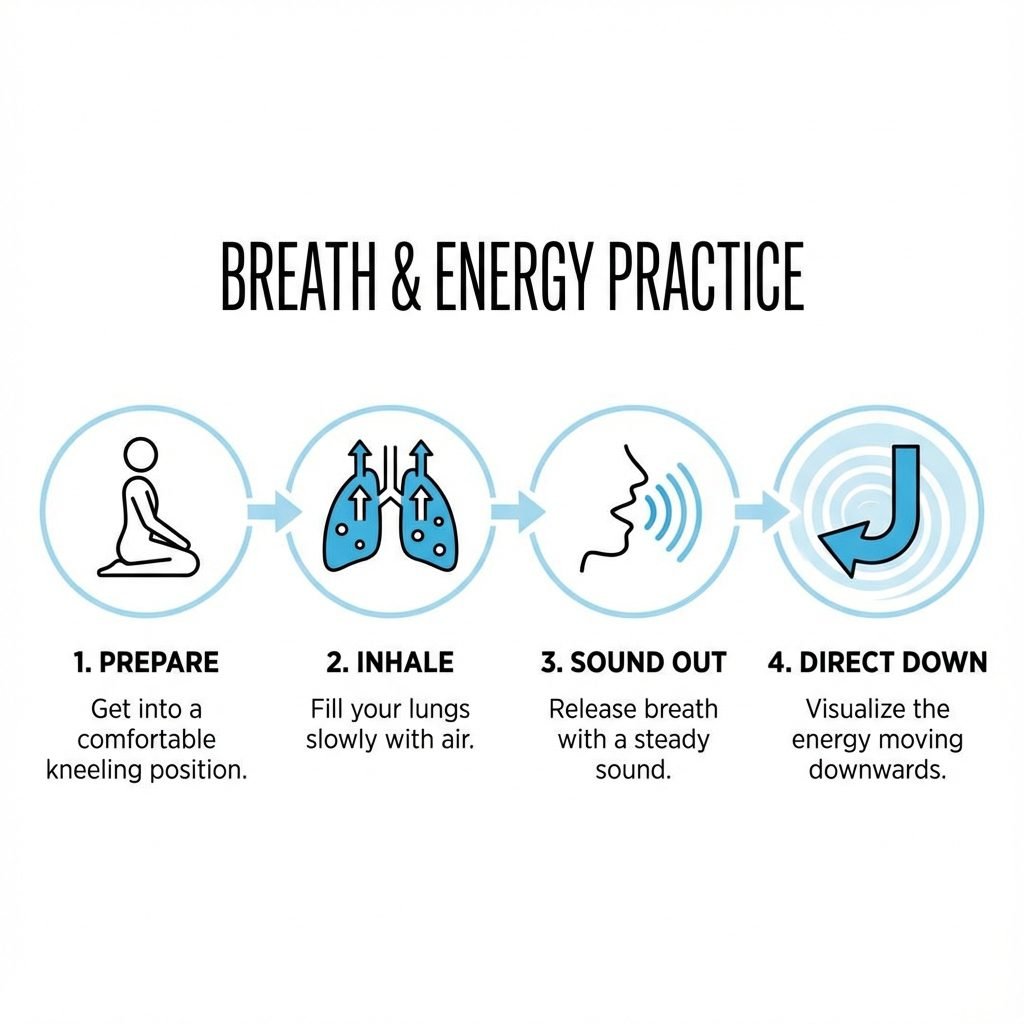
A Step-by-Step Guide to Mastering J-Breathing
Practice is the key to making J-Breathing an instinctual response during labor. Aim to practice daily, even for just 5-10 minutes, especially in the last trimester. This builds muscle memory so you can rely on it when you need it most. Here’s how to do it:
-
Find Your Position
Get into a comfortable and upright position that allows your belly to be loose and your pelvis to be open. Good options include sitting on a birth ball, kneeling on the floor leaning over a couch or bed, or standing and leaning against your partner. Avoid lying flat on your back, as this can compress blood vessels and work against gravity.
-
The Inhale: Fill the Tank
Close your eyes and let your jaw go slack. Take a slow, deep, calming breath in through your nose. Don’t just fill your chest; imagine the breath traveling all the way down to your diaphragm, expanding your belly and ribs outward. Think of it as gathering all the energy and oxygen you need for the work ahead. This inhale should be quiet and relaxed, lasting for a count of about 4.
-
The Exhale: The ‘J’ Release
This is the most important part. Exhale slowly and steadily through a soft, open mouth. As you exhale, begin to make a low-pitched, deep sound. It can be an ‘ahhhh,’ ‘ooohhh,’ or a deep hum. The key is to keep the tone low and rumbling, not high-pitched. A high-pitched sound tenses the throat and pelvic floor; a low sound relaxes them. Your exhale should be significantly longer than your inhale—aim for a count of 8 or more.
-
The Visualization
As you are exhaling and vocalizing, visualize the ‘J’ path. Picture your breath and the sound traveling down your torso, past your baby, and curving out through your open cervix and vagina. Imagine your breath gently nudging your baby downwards and your cervix softening and opening with each exhale. This mental focus is incredibly powerful.
-
Syncing with Contractions
When you practice, imagine a contraction. As it begins to build, start your first J-breath. Take your slow inhale as the wave starts to rise. Use the long, vocal exhale to ride through the peak of the contraction. As the contraction subsides, your breathing can return to normal. For a 60-second contraction, you might take 3-4 full J-breaths. The goal is to meet the intensity with your breath, not to run from it.
Partner Tip: Your role is crucial. Practice with the birthing parent. Place your hands on their lower back or shoulders and breathe with them. Your calm presence and rhythmic breathing can be an invaluable anchor. You can even make the low humming sound with them to help them keep their pitch deep and resonant.
Integrating J-Breathing into Your Birth Plan and Partnership

Integrating J-Breathing into Your Birth Plan and Partnership
Mastering the technique yourself is one thing; ensuring you have the space and support to use it during labor is another. This is where planning and teamwork come in. J-Breathing should be a central part of your preparation, not an afterthought.
For the Birthing Person: Make it Your Mantra
Your body and your breath are your greatest tools. Trust in their ability to work together. Practice in different positions and at different times of the day. Try it in the shower, with the warm water providing extra relaxation. The more you normalize the practice, the easier it will be to access that state of calm focus when labor begins. Remind yourself: ‘My breath is powerful. My body is opening. I am breathing my baby down.’
For the Partner: Become the Breath Coach
Your support can make or break the effectiveness of this technique. Your role isn’t passive; it’s actively co-regulating and creating a safe container for the birthing process.
- Be the Cue: In the intensity of labor, your partner might forget the technique. Your calm voice saying, ‘Okay, let’s start our J-breath now,’ can be the perfect reminder.
- Breathe With Them: Don’t just tell them to breathe; do it with them. Let them hear your low, steady exhale. This provides an auditory anchor and a profound sense of ‘we’re in this together.’
- Provide Physical Grounding: Apply firm counter-pressure to the hips or lower back (a ‘hip squeeze’) during contractions while you breathe. This physical sensation paired with the breathing can dramatically decrease pain perception.
- Advocate for Your Space: Protect the birthing environment. Keep the lights low, minimize interruptions, and quietly remind nurses or providers about your birth plan, stating, ‘We’re focusing on our breathing techniques right now to manage the contractions.’
Communicating with Your Care Team
Discuss your intention to use J-Breathing with your midwife, doula, or OB-GYN ahead of time. You can include a simple line in your birth plan, such as: ‘We have been practicing J-Breathing (deep, low-vocalization breathing) as our primary coping mechanism for labor. We would appreciate support and minimal interruptions to help us maintain focus.’ This informs your team that you have a plan and empowers them to support you effectively. A supportive provider will see this preparation as a huge asset to your birth.
J-Breathing vs. Other Labor Breathing Techniques
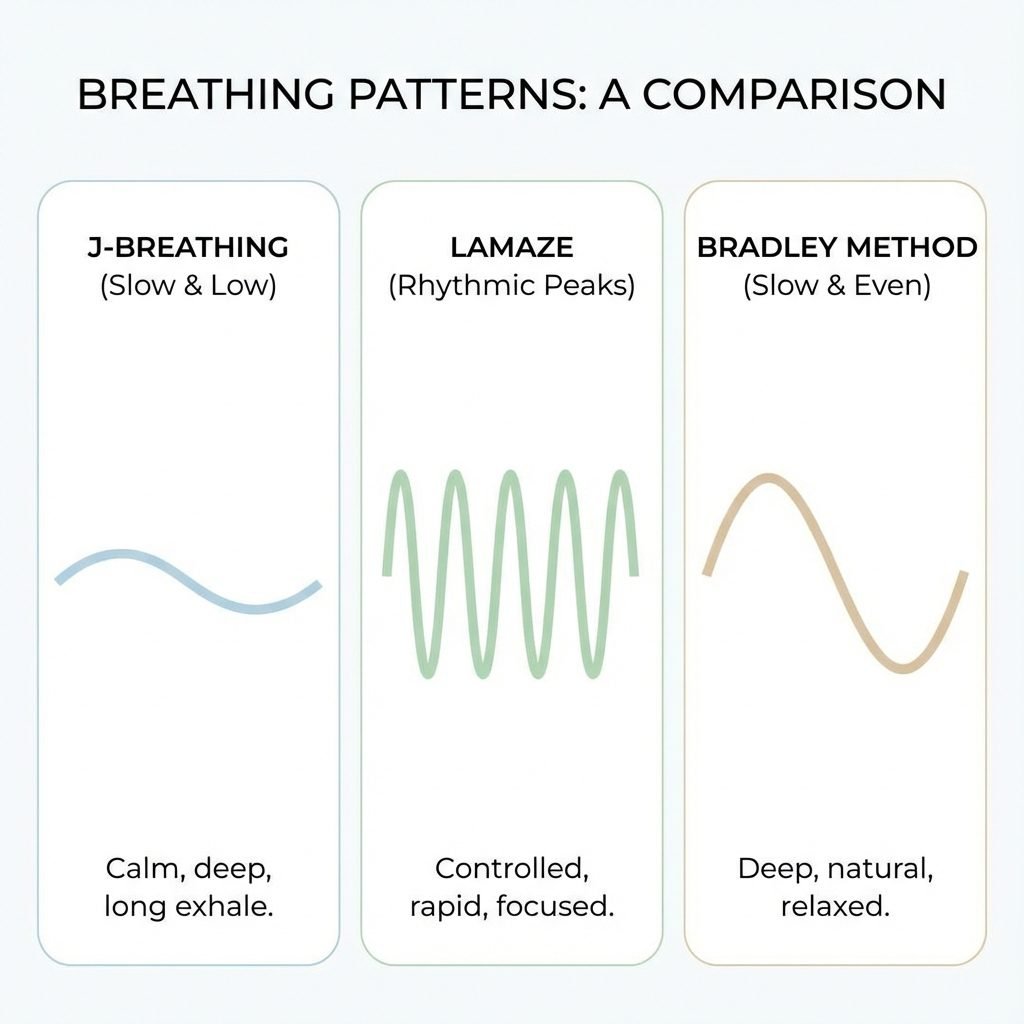
J-Breathing vs. Other Labor Breathing Techniques
While J-Breathing is incredibly effective, it’s helpful to understand how it fits into the landscape of other well-known childbirth breathing methods. Each has its own philosophy and application, and many people find themselves blending techniques depending on the stage of labor. Here’s a comparison to help you understand the unique strengths of J-Breathing.
| Technique | Primary Focus | Sound/Vocalization | Best For |
|---|---|---|---|
| J-Breathing | Pelvic floor relaxation, downward energy, and working with contractions. | Deep, low-pitched moans or hums (‘ahhh’, ‘oooh’). Sound is a tool for relaxation. | Active labor and the transition/pushing stage. Helps to open the body and breathe the baby down. |
| Lamaze | Distraction and preventing the holding of breath. Uses patterned breathing to manage pain perception. | Rhythmic, often lighter sounds like ‘hee-hee-hoo’. The focus is on the pattern. | Early and active labor. The patterns give the brain something to focus on other than the sensation. |
| The Bradley Method® | Deep relaxation and trust in the natural process. Emphasizes partner coaching. | Typically quiet, slow, deep abdominal breaths, similar to sleep breathing. | The entire labor process. It’s a comprehensive method focused on maintaining a state of deep calm. |
As you can see, the core difference lies in the intention. Lamaze uses breath as a distraction. The Bradley Method uses breath to achieve total relaxation. J-Breathing uses breath as an active, productive force to open the body and guide the baby out. It’s less about escaping the sensation and more about leaning into it with a powerful tool. Many find that the quiet, relaxing breaths of the Bradley Method are perfect for early labor, while the active, vocal power of J-Breathing becomes essential as contractions intensify and it’s time to work with gravity and pressure.
Conclusion
Your Breath, Your Power, Your Birth
The journey of childbirth is one of the most profound experiences in life. While we can’t predict every twist and turn, we can prepare ourselves with tools that foster a sense of calm, confidence, and control. J-Breathing is more than just a ‘trick’; it is a profound way to connect with your body, your baby, and your own innate power. It transforms the breath from an automatic function into a conscious act of creation and surrender.
Practice it, trust it, and allow it to be your anchor through the waves of labor. Whether it cuts your pain in half or simply makes you feel more present and capable, you are giving yourself an incredible gift. You have the strength, you have the power, and you have your breath. You can do this.
Medical Disclaimer: The information provided in this article is for educational and informational purposes only and is not intended as medical advice. It is not a substitute for professional medical advice, diagnosis, or treatment. Always seek the advice of your physician or other qualified health provider with any questions you may have regarding a medical condition. Never disregard professional medical advice or delay in seeking it because of something you have read in this article.