Stop Hackers: Why You Need A Non-WiFi Baby Monitor In 2024
Bringing a new baby home is a whirlwind of profound love, excitement, and a powerful, instinctual need to protect. As you meticulously plan every detail of their nursery, from the crib’s safety standards to the softness of their first blanket, you’ll inevitably consider a baby monitor. It’s a modern parenting essential, a window into your baby’s world that offers reassurance during those precious, quiet moments. But in our hyper-connected age, the very technology designed to bring peace of mind can introduce a hidden vulnerability into the most sacred space in your home: your baby’s room.
Many popular baby monitors today connect to your home’s WiFi network, promising the convenience of checking in from your smartphone, wherever you are. While this sounds appealing, it opens a digital door that, if not properly secured, can be exploited. News stories of hacked baby monitors are every parent’s nightmare, turning a tool of security into a source of anxiety. As a maternal health educator who has guided countless families through these early decisions, I want to provide a clear, fact-based perspective on this crucial choice. This isn’t about fear-mongering; it’s about empowerment. It’s about understanding the technology so you can make an informed decision that truly protects your family’s privacy and safety. In 2024, the most secure choice is often the simplest: a dedicated, non-WiFi baby monitor.
The Unseen Vulnerability: Understanding WiFi Baby Monitor Risks
Why Are Internet-Connected Devices a Target?
Any device that connects to the internet is, by nature, part of a vast network. This includes your smart TV, your laptop, and yes, your baby monitor. For hackers, these Internet of Things (IoT) devices can be attractive targets because they are often less secure than a personal computer. The primary risks stem from several key areas:
- Weak or Default Passwords: Many users fail to change the default username and password that come with the device. Hackers have lists of these default credentials and can use automated programs to rapidly test them against devices, granting them instant access.
- Unsecured Home WiFi Networks: If your home WiFi network itself is not protected with a strong, unique password and modern encryption (like WPA3), it becomes the weak link. A hacker who gains access to your network can then potentially see and control other devices connected to it, including your monitor.
- Manufacturer Security Flaws: The security of your monitor is only as good as the company that made it. Some manufacturers may not release regular security updates (known as patches) to fix vulnerabilities discovered after the product is sold. In other cases, the data stored on the company’s servers—which might include video feeds or account information—could be compromised in a large-scale data breach.
“Parents understandably want to use technology to keep their children safe, but they need to be aware of the security risks associated with connected devices. A baby monitor is essentially a camera and microphone in the most private part of a home; ensuring it cannot be accessed by unauthorized individuals is not just a feature, it’s a fundamental requirement.” – Cybersecurity Expert Statement
The Real-World Consequences
A hacked baby monitor is more than a theoretical risk. It can lead to terrifying invasions of privacy, from strangers watching your child sleep to, in some documented cases, speaking to them through the monitor’s two-way talk feature. It exposes your family’s daily routines and compromises the sanctity of your home. While manufacturers are getting better at security, the risk is inherent to any device that relies on an internet connection. The fundamental question for parents is: Is the convenience of remote viewing worth this potential vulnerability?
The Secure Alternative: How Non-WiFi (FHSS/DECT) Monitors Work
A Closed-Circuit System for Ultimate Peace of Mind
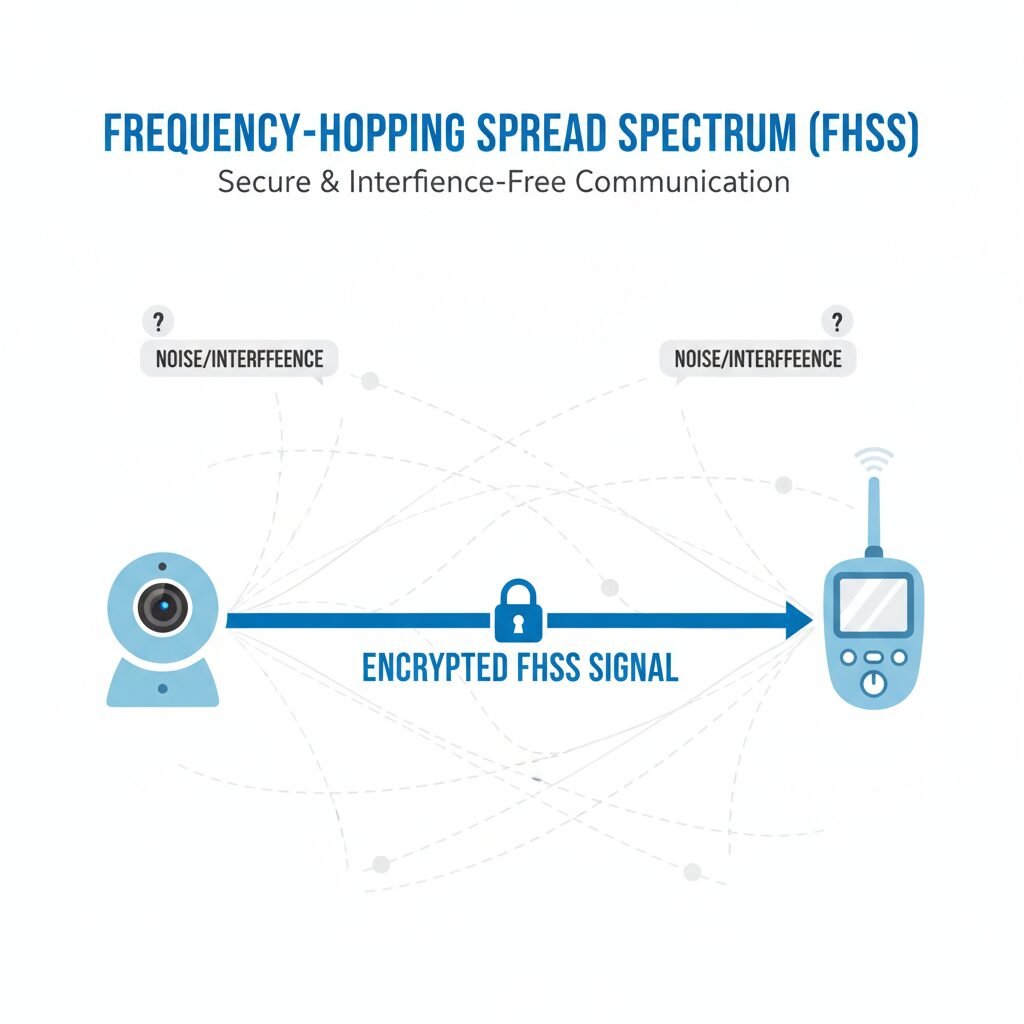
If WiFi monitors are an open door to the internet, non-WiFi monitors are a locked, closed-circuit system. They operate on a simple, powerful principle: a direct, private connection between the camera (the transmitter) and the parent unit (the receiver). They do not connect to your home router or the internet at all. This is typically achieved using one of two trusted technologies:
- Frequency-Hopping Spread Spectrum (FHSS): This is the gold standard for non-WiFi monitors. Imagine the camera and the parent unit are having a private conversation. With FHSS, they are constantly and rapidly changing the channel (frequency) on which they are talking, in a predetermined, secret pattern. An outside device trying to listen in would only catch a tiny, unintelligible fraction of a second of the signal before it ‘hops’ to a new frequency. This makes the signal incredibly difficult to intercept and ensures a private, secure video and audio feed.
- Digital Enhanced Cordless Telecommunications (DECT): Primarily used for audio-only monitors, DECT technology offers a dedicated, encrypted, and interference-free channel for audio. It operates on its own low-frequency band, ensuring that your neighbor’s baby monitor or your cordless phone won’t interfere with your signal.
The Core Advantage: No Internet, No Hacking
The beauty of this technology lies in its simplicity. Because a non-WiFi monitor never connects to the internet, it is virtually immune to remote hacking. A hacker halfway across the world cannot access your monitor because it simply isn’t accessible from the web. The only way to intercept the signal would be to be physically near your home with sophisticated and specialized equipment, a scenario that is practically impossible and far beyond the scope of typical internet-based hacking. This fundamental design difference is what makes non-WiFi monitors the most secure option for parents whose primary concern is privacy and protection against external threats.
Feature-by-Feature: WiFi vs. Non-WiFi Monitors
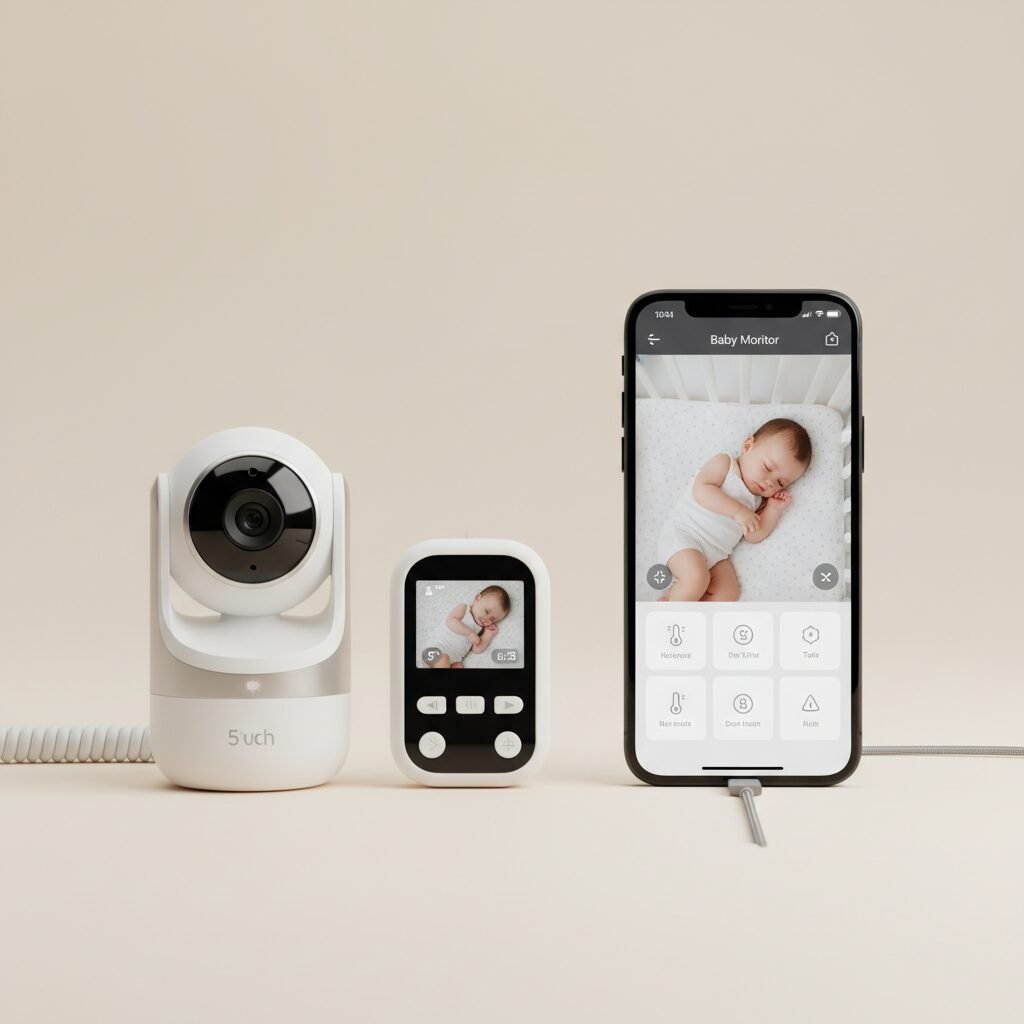
When choosing a baby monitor, understanding the practical trade-offs is essential. While security is a major factor, day-to-day usability, reliability, and features also play a crucial role. Here’s a direct comparison to help you decide which type fits your family’s needs best.
| Feature | Non-WiFi (FHSS/DECT) Monitor | WiFi (IP) Monitor |
|---|---|---|
| Security | Extremely High. Closed-circuit system is nearly impossible to hack remotely. | Variable. Depends on user setup (strong passwords), home network security, and manufacturer support. |
| Range | Limited to a specific distance (e.g., 1000 ft). Confined to your home and immediate property. | Unlimited. Can be accessed from anywhere in the world with an internet connection. |
| Reliability | Very High. Not dependent on internet speed or uptime. Immune to WiFi outages. | Dependent on WiFi signal strength and internet service. Can lag, freeze, or disconnect if connection is poor. |
| Setup | Simple Plug-and-Play. Turn on the camera and parent unit, and they connect automatically. | More Complex. Requires downloading an app, creating an account, and connecting the camera to your home WiFi network. |
| Parent Unit | Dedicated Handheld Screen. Always on, always ready. | Your Smartphone or Tablet. Requires the app to be open. |
| Privacy | Guaranteed. The video feed never leaves the closed system. No data is stored on external servers. | Potential Risk. Video may be routed through or stored on manufacturer servers, which could be breached. |
| Convenience | Easy for anyone to use (babysitters, grandparents). No app or password needed for caregivers. | High convenience for parents who travel or want to check in from work. Can be shared with relatives remotely. |
Pros and Cons at a Glance
Non-WiFi Monitors
- Pros: Unmatched security and privacy, extremely reliable signal, simple setup, no impact on your phone’s battery, easy for caregivers to use.
- Cons: Limited range (cannot check in from outside the home), parent unit is another device to carry and charge.
WiFi Monitors
- Pros: Ability to monitor from anywhere, often includes advanced features like motion tracking and cloud storage, no extra parent unit to carry.
- Cons: Significant security vulnerabilities, dependent on WiFi reliability, drains your smartphone battery, can be complex to set up securely.
Choosing Your Secure Monitor: Key Features to Look For in a Non-WiFi Model

Once you’ve decided that a non-WiFi monitor is the right choice for your family, the next step is to select a model with the features that will serve you best. Modern non-WiFi monitors are far from basic; they offer a host of sophisticated functions to help you care for your baby. Here is a checklist of what to look for:
- FHSS Technology: This should be non-negotiable. Ensure the packaging or product description explicitly states it uses Frequency-Hopping Spread Spectrum for the most secure connection.
- Clear Screen and Night Vision: Look for a parent unit with a screen size and resolution that you find comfortable to view. High-definition (HD) screens are becoming more common. Equally important is the quality of the infrared night vision, which should provide a clear, detailed image of your baby in a completely dark room.
- Pan, Tilt, and Zoom (PTZ): As your baby grows and starts to move around the crib, the ability to remotely control the camera’s direction and zoom in is invaluable. This allows you to get the best view without having to physically enter the room and risk waking them.
- Two-Way Talk: This feature allows you to speak to your baby through the monitor. The sound of your voice can be incredibly soothing and may help you calm them back to sleep without a trip to the nursery.
- Temperature Sensor: A built-in thermostat displays the nursery’s temperature on your parent unit, helping you ensure your baby is not too hot or too cold, which is a key aspect of safe sleep.
- Battery Life of the Parent Unit: Consider how you’ll use the monitor. If you plan to carry the parent unit around the house with you, look for a model with a long-lasting rechargeable battery to avoid being tethered to an outlet.
- Signal Range: Check the manufacturer’s stated range (e.g., up to 1000 feet) and consider the size and construction of your home. Thick walls can sometimes interfere with the signal, so a robust range is always a plus.
- Expandability: Some non-WiFi systems allow you to add multiple cameras that can be viewed on a single parent unit. This is a fantastic feature for growing families or for monitoring multiple rooms, like a nursery and a playroom.
Conclusion
Choosing the right baby monitor is a decision that rests at the intersection of technology, convenience, and your deepest parental instincts to protect. While the allure of checking in on your baby from a restaurant or the office is strong, it’s crucial to weigh that convenience against the indelible risks to your family’s privacy. The documented cases of hacked WiFi monitors serve as a stark reminder that our digital and physical worlds are more intertwined than ever.
By opting for a non-WiFi baby monitor that uses FHSS technology, you are choosing a solution that is fundamentally more secure. You are creating a private, impenetrable bubble around your child’s nursery, ensuring that the only people watching over them are the ones you trust. Beyond the superior security, you gain reliability that isn’t at the mercy of your internet connection and the simplicity of a dedicated device that just works, every time. In 2024, true peace of mind doesn’t come from an app on your phone; it comes from knowing, with absolute certainty, that your child is safe and your private moments remain just that—private. Making this choice is a powerful first step in building a secure and loving environment for your new baby to thrive in.