

How To Shut Down Rude Pregnancy Comments Without Being A Bridezilla
Pregnancy feels like you’ve suddenly become public property. From the moment your bump begins to show, the floodgates open for opinions, advice, and stories from well-meaning relatives, curious colleagues, and even total strangers. While often shared with good intentions, these comments can feel intrusive, critical, and downright rude. They can question your choices, comment on your changing body, and instill fear with unsolicited horror stories.
You’re navigating one of the most transformative experiences of your life—a time of immense physical and emotional change. The last thing you need is to feel judged or stressed by someone else’s thoughtless words. But how do you push back without causing a family feud or being labeled as overly sensitive or a ‘Pregnancy-zilla’?
This guide is your permission slip to protect your peace. We’ll explore why these comments sting so deeply and provide you with a comprehensive toolkit of graceful, firm, and effective strategies. You’ll learn how to categorize the comments, deploy scripted responses, and unite with your partner to create a protective bubble of support. This isn’t about being confrontational; it’s about mastering the art of the gentle shutdown—a skill that will serve you well into parenthood and beyond.
The ‘Why’ Behind the Sting: Understanding the Emotional Impact of Unsolicited Advice

If you’ve ever felt a surge of anger or burst into tears over a seemingly innocent comment about your bump size, you are not alone, and you are not overreacting. Pregnancy is a period of profound vulnerability. Your body is changing in ways you can’t control, your hormones are on a rollercoaster, and your identity is shifting as you prepare for motherhood. Your internal world is already in flux; external commentary can feel like a personal attack.
Hormonal Heightens and Emotional Rawness
Let’s start with the science. Pregnancy hormones like progesterone and estrogen don’t just help grow a baby; they significantly impact your brain chemistry and mood regulation. This can leave you feeling more sensitive, emotionally raw, and quicker to feel overwhelmed. A comment you might have brushed off pre-pregnancy can now land with the weight of a thousand bricks. It’s not a weakness; it’s a biological reality of creating a new life.
The Public Nature of a Private Journey
Your body, once your own, is now a vessel for new life, and society often treats it as such. People feel a strange sense of ownership or expertise over a pregnant person’s body and choices. Comments on your weight gain (‘Are you sure there’s only one in there?’), your food choices (‘You shouldn’t be eating that!’), or your birth plan (‘Just get the epidural, don’t be a hero.’) can feel like a violation of your personal autonomy. It’s an intensely private journey being subjected to public scrutiny, and that dissonance is jarring.
Your feelings are valid. Setting a boundary to protect your emotional well-being is not selfish; it is a fundamental act of self-care and responsible preparation for parenthood.
Understanding these underlying factors is the first step toward self-compassion. It allows you to acknowledge your feelings without judgment and recognize that your reaction is a normal, protective response to an intrusion on your personal space and emotional safety.
Decoding the Comments: A Guide to Identifying the Type of Unsolicited Advice
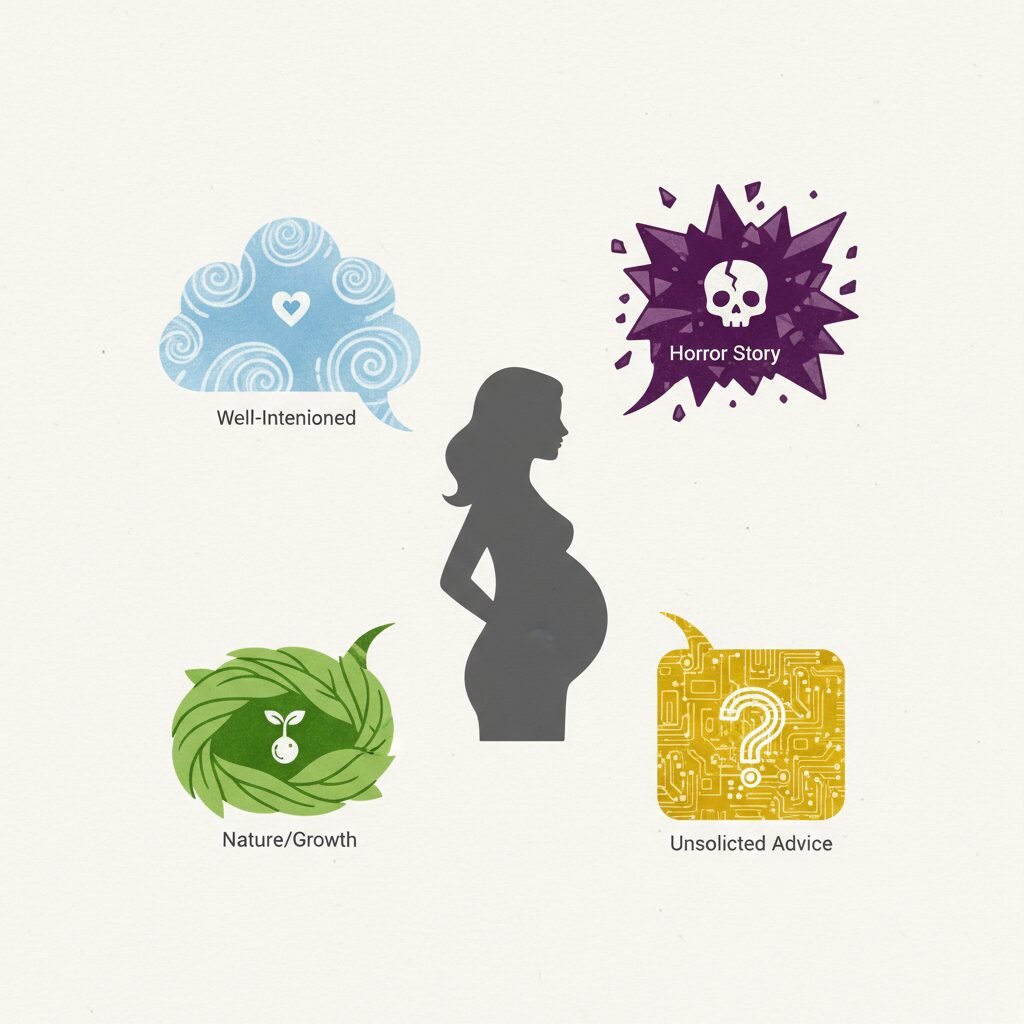
Not all unwelcome comments are created equal. Before you can choose the right response, it helps to quickly analyze the intent behind the words. By categorizing the comment, you can depersonalize it and react strategically rather than emotionally. Think of it as emotional triage for conversations.
Category 1: The Well-Intentioned but Clumsy
This is the most common type. It comes from people who genuinely care about you but express it poorly. They might share outdated advice or ask personal questions without realizing they’re crossing a line. Their goal is to connect or help, but their delivery is off.
- Examples: ‘You look tired, you should be sleeping more!’ or ‘My sister swore by this weird tea to start labor.’
- Their Motivation: A desire to be helpful and share knowledge.
Category 2: The Horror Story Sharer
This person seems compelled to share the most terrifying birth or postpartum story they know, often with graphic detail. They may think they’re ‘preparing’ you for reality, but the impact is pure anxiety induction.
- Examples: ‘My friend’s labor was 72 hours long and ended in an emergency…’ or ‘Just wait until the sleep deprivation hits. You’ll never sleep again!’
- Their Motivation: Often, it’s a way for them to process their own traumatic experiences or a misguided attempt to give you a ‘realistic’ picture.
Category 3: The Body Police
These individuals feel entitled to comment on the size, shape, and changes of your pregnant body. Their observations are presented as fact, with no regard for your feelings.
- Examples: ‘Wow, you’re huge! Are you due tomorrow?’ or ‘You’re so tiny, are you sure you’re eating enough for the baby?’
- Their Motivation: A mix of social awkwardness, a lack of filter, and a societal obsession with women’s bodies.
Category 4: The Back-in-My-Day Critic
This commenter, often from an older generation, compares your modern pregnancy choices to how things were done ‘in their day.’ Their advice can feel judgmental and dismissive of current medical guidance.
- Examples: ‘We didn’t have fancy birth plans; we just did what the doctor said.’ or ‘You’re going back to work? I stayed home with my kids.’
- Their Motivation: A combination of nostalgia and a desire to feel that their own experiences and choices are still valid and relevant.
By identifying the category, you can tailor your response to the likely motivation, allowing you to address the comment more effectively and with less personal frustration.
Your Diplomatic Toolkit: Graceful Scripts and Strategies for Every Scenario

Once you’ve identified the type of comment, you can deploy a response from your toolkit. The goal is to be clear, kind, and firm, ending the conversation without escalating it. Practice these in the mirror so they feel natural when you need them.
Strategy 1: The Brief & Breezy Redirect
Perfect for the ‘Well-Intentioned but Clumsy’ or for when you just don’t have the energy to engage. Acknowledge and pivot.
- ‘Thanks for thinking of me! We’re feeling really good about the plan we have with our doctor. Anyway, did you see that new movie that just came out?’
- ‘I appreciate you sharing! So much to think about. On another note, I love your new haircut.’
- ‘That’s an interesting thought, I’ll keep it in mind. So, how has your week been?’
Strategy 2: The ‘Thank You, We’re Covered’ Boundary
Ideal for the ‘Back-in-My-Day Critic’ and persistent advice-givers. This response is polite but clearly states that decisions have been made.
- ‘That’s so kind of you to share your experience. We’re getting a lot of advice, so we’ve decided to stick to the guidance from our medical team to keep it simple.’
- ‘We really appreciate your concern. My partner and I have put a lot of thought into this and have made the decisions that feel right for our family.’
- ‘Thank you, but we’re not looking for advice on this topic right now. We’ve got it covered.’
Strategy 3: The Gentle Shutdown
This is your go-to for the ‘Horror Story Sharer’ and the ‘Body Police.’ It directly but gently stops the conversation in its tracks.
- For Horror Stories: ‘I know you mean well, but I’m trying to stay really positive about my upcoming birth. Could we talk about something more cheerful?’
- For Body Comments: ‘My body is doing exactly what it needs to do to grow a healthy baby, and I’m not focusing on its size.’ Then, change the subject.
- For Intrusive Questions: ‘That’s a bit personal, and I’d rather not get into it.’ A simple, direct statement is often all that’s needed.
Strategy 4: The Humorous Deflection
When you’re feeling up to it, a little lighthearted humor can disarm a situation instantly.
- In response to ‘Are you having twins?’: ‘Nope, just one very talented baby who’s an expert at maximizing space!’
- In response to a horror story: ‘Whoa, let’s keep this a G-rated conversation! My sensitive pregnant ears can’t handle it!’
Remember, your tone is everything. A warm smile while delivering a firm boundary makes it much easier for the other person to receive.
Building a United Front: How Your Partner Can Be Your Best Advocate

You are not in this alone. Your partner is your co-pilot on this journey, and they can be your most powerful ally in navigating unwelcome social commentary. For new dads and partners, understanding how to provide this support is one of the most meaningful ways to contribute during pregnancy. A united front not only protects the pregnant person’s peace of mind but also strengthens your bond as a couple preparing for parenthood.
Have the ‘Game Plan’ Conversation
Don’t wait until you’re in an awkward situation. Proactively sit down with your partner and discuss the issue. Talk about which types of comments bother you the most and decide on a shared strategy. This isn’t about creating drama; it’s about being a team.
- Identify the Triggers: Tell your partner specifically what hurts. Is it comments about your weight? Questions about your birth plan? The constant horror stories from their aunt?
- Agree on Your Go-To Responses: Practice some of the scripts together. Decide who will say what. Sometimes, a comment is easier to deflect when it comes from the non-pregnant partner.
- Create a Non-Verbal Cue: Establish a subtle signal—a hand squeeze, a specific glance, a touch on the arm—that means ‘I need help, please step in.’ This allows you to call for backup without making a scene.
The Power of the Partner Interception
Often, an interception from a partner is more effective and feels less confrontational. It shifts the dynamic and shows that you are a unified team with shared boundaries.
| Situation | What the Partner Can Say |
|---|---|
| A relative comments on the pregnant person’s body size. | ‘She looks absolutely beautiful, doesn’t she? We’re so proud of how strong she is and the amazing job she’s doing growing our baby.’ |
| Someone starts telling a birth horror story. | ‘Hey, we’re actually keeping all of our focus on positive stories right now to stay in a great headspace. But on that note, have you seen [Recent Sporting Event/Movie]?’ |
| Intrusive questions about medical decisions or feeding choices. | ‘We’re keeping those decisions between us and our doctor, but we appreciate you thinking of us. We’re really excited about the path we’ve chosen.’ |
For the Supporting Partner: Your Role is Protector
Your primary job is to be a buffer and a source of unwavering support. Listen to your pregnant partner’s concerns without dismissing them as ‘overly sensitive.’ Your validation is crucial. After a difficult interaction, check in with them. A simple ‘I’m sorry that happened. You handled it really well. Are you okay?’ can make a world of difference. Your role as protector of your new family starts now.
Protecting Your Peace: Long-Term Strategies for a Serene Pregnancy

While individual scripts are essential for in-the-moment situations, creating a foundation of peace requires a broader, more proactive approach. It’s about curating your environment—both physical and digital—to minimize stress and maximize support. This is the long game of boundary setting.
Curate Your Social Circle and Your Social Media
You have the right to choose who you spend your energy on. If a particular friend or family member is a chronic source of stress and negativity, it is perfectly acceptable to limit your time with them during this sensitive period. This doesn’t have to be a dramatic confrontation. It can be as simple as being ‘busy’ more often or opting for shorter visits.
The same applies to your digital life. Your social media feed should be a source of inspiration and support, not anxiety.
- The Mute/Unfollow Button is Your Friend: Do not hesitate to mute or unfollow accounts that share fear-based content, promote unrealistic ‘bounce-back’ body standards, or otherwise make you feel bad about yourself.
- Seek Out Positive Communities: Find online groups or influencers who align with your philosophy and offer genuine, non-judgmental support. Fill your feed with positivity.
Build Your Village Intentionally
Everyone talks about ‘finding your village’ in parenthood, but that process starts during pregnancy. This is your trusted inner circle—the people whose opinions you actually value.
- Identify Your Go-To People: Make a mental list of the 2-3 people you can go to for advice or a listening ear without fear of judgment.
- Communicate Your Needs: Let this trusted circle know what you need. You might say, ‘I’m feeling really overwhelmed with advice right now. Could you be someone I can just vent to without getting suggestions?’
Practice Mindful Detachment
Ultimately, you cannot control what other people say, but you can control how you internalize it. Mindfulness practices can help you create a buffer between someone’s words and your emotional reaction.
Remember this affirmation: ‘Their words are a reflection of their own experiences and anxieties, not a judgment on my capabilities as a mother.’
Take a deep breath before responding. Remind yourself that you are the expert on your own body and your own baby. This internal boundary is the most powerful one you can build. By implementing these long-term strategies, you’re not just surviving pregnancy; you’re actively creating a sanctuary of peace for yourself and your growing family.
Conclusion
Navigating the sea of comments and advice during pregnancy is a challenge no one fully prepares you for. It can be exhausting to constantly feel like you have to defend your body, your choices, and your feelings. But learning to set boundaries is one of the first and most important skills you will develop as a parent. It is not about being a ‘bridezilla’ or being difficult; it is about being a fierce protector of your family, and that family starts with you and your well-being.
By understanding the emotions behind the sting, identifying the types of comments, and equipping yourself with a toolkit of graceful responses, you can reclaim your pregnancy journey. Leaning on your partner and building a united front transforms the experience from a solitary battle into a team effort. Remember, every boundary you set is an act of love for yourself and your baby.
You are the authority on your own experience. Trust your intuition, honor your feelings, and don’t be afraid to draw a line in the sand to protect your peace. You are growing a human being—you have more than earned the right to do so in a calm, respectful, and supportive environment of your own making.