

Baby Stuck Heads Up? Top Techniques To Flip A Breech Baby Naturally
Hearing the words “your baby is breech” can send a wave of anxiety through any expectant parent. Your mind might immediately jump to worst-case scenarios or the possibility of a birth plan that looks very different from what you envisioned. Take a deep breath. You are in the right place, and what you’re feeling is completely normal. As a doula, I’ve sat with countless parents who have received this news, and the first thing I always say is: this is not a final verdict, but an invitation to connect with your body and your baby in a new way.
A breech presentation, where your baby is positioned bottom or feet-first in the uterus, is actually quite common earlier in pregnancy. While most babies naturally turn head-down by 36 weeks, about 3-4% remain breech. This article is your supportive, fact-based guide to understanding why this happens and exploring gentle, natural techniques that may encourage your little one to flip. We’ll walk through these methods together, always emphasizing the most important step of all: partnering with your trusted healthcare provider to ensure every choice you make is safe for you and your baby.
Understanding Breech Presentation: What It Is and Why It Happens

Understanding Breech Presentation: What It Is and Why It Happens
Before we explore solutions, it’s essential to understand what a breech presentation truly means. It’s simply a variation of normal. Your baby is healthy and thriving; they’ve just settled into a different position. There are several types of breech positions, and your provider can usually tell you which one your baby is in through an ultrasound or by feeling your abdomen.
The Main Types of Breech Positions:
- Frank Breech: This is the most common type. The baby’s bottom is down, with their legs pointing straight up in front of their body, feet near the head. Think of a little acrobat in a pike position.
- Complete Breech: The baby’s bottom is down with their hips and knees flexed, sitting cross-legged.
- Footling Breech: One or both of the baby’s feet are pointing downwards, positioned to come out first. This is less common.
It’s natural to wonder, “Why is my baby breech?” Sometimes there’s no clear reason. Other times, certain factors can make it more likely:
- Uterine Shape: A heart-shaped (bicornuate) uterus or the presence of fibroids can sometimes influence a baby’s position.
- Placenta Position: A low-lying placenta or placenta previa can occasionally block the baby’s path to a head-down position.
- Amniotic Fluid Levels: Both too much (polyhydramnios) and too little (oligohydramnios) fluid can affect the baby’s ability to move freely.
- Previous Pregnancies: If you’ve had multiple pregnancies, your uterine muscles may be more relaxed, giving the baby more room to move around.
- Multiples: With twins or more, there’s less space for everyone to get into the optimal head-down position.
It’s crucial to release any feelings of guilt. You did not do anything to cause this. Your body is the perfect home for your baby, and this is just one of the many twists and turns on the path to meeting them.
Your First and Most Important Step: Partnering With Your Provider

Your First and Most Important Step: Partnering With Your Provider
Before you try a single inversion or play music to your lower belly, your first action should be to have a thorough conversation with your doctor or midwife. They are your partner in this journey. They can confirm the baby’s position, rule out any contraindications for specific techniques, and discuss all available options with you.
Questions to Ask Your Healthcare Provider:
- Can you confirm the baby’s specific breech position and where the placenta is located?
- Are there any medical reasons I should not try gentle techniques like inversions or pelvic tilts?
- What are your thoughts on complementary therapies like chiropractic care (Webster Technique) or acupuncture?
- At what week do you typically consider a medical intervention like an External Cephalic Version (ECV)?
- Could you explain the ECV procedure, its success rates, and its risks?
- If the baby remains breech, what are my birthing options with you or at this hospital/birthing center? Do you have experience with vaginal breech birth?
An External Cephalic Version (ECV) is a medical procedure where a provider applies firm, guided pressure to your abdomen to manually help the baby turn from breech to a head-down position. It’s typically performed in a hospital setting around 36-37 weeks and has about a 58% success rate. It’s a valid option for many, but it’s important to discuss it fully to understand if it’s right for you. Your provider is your best resource for personalized, safe advice.
Gentle At-Home Techniques to Encourage Your Baby to Turn
Gentle At-Home Techniques to Encourage Your Baby to Turn
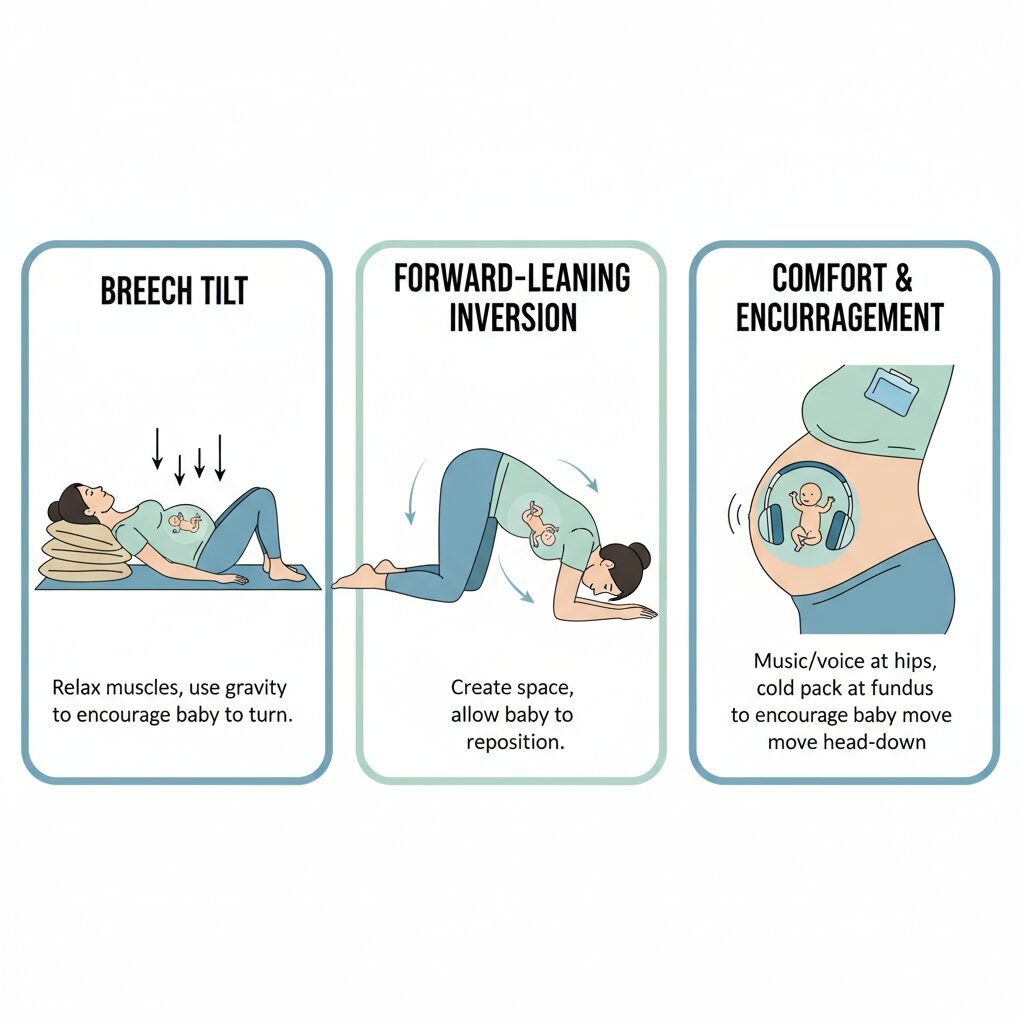
Once you have the green light from your provider, you can begin exploring gentle methods to create space and encourage your baby to move. The goal of these exercises is not to force the baby to turn, but to relax the pelvic muscles and ligaments, use gravity to your advantage, and make it easier for the baby to reposition themselves. Consistency is key; try to incorporate these into your daily routine.
The Breech Tilt
This simple technique uses gravity to encourage the baby to lift their bottom out of your pelvis, which is the first step to turning.
- Find a firm surface. An ironing board propped securely against a couch works well, or you can use a large stack of firm pillows on the floor.
- Lie on your back on the board or pillows, so your hips are elevated about 12-18 inches above your head.
- Keep your knees bent and feet flat on the surface. Focus on deep, relaxing breaths. Try to relax your belly completely.
- Stay in this position for 10-15 minutes, 2-3 times a day, ideally on an empty stomach.
Forward-Leaning Inversion
Popularized by Spinning Babies®, this technique helps to untwist and release tension in the utero-sacral ligaments. Important: This is a brief, 30-second inversion. It should not be held for long periods.
- Kneel on the edge of a sturdy couch or bed.
- Slowly and carefully lower your hands to the floor, walking them out until your forearms are resting on the floor. Your knees should remain on the couch.
- Let your head hang freely and keep your back straight. You will be in a steep inverted position.
- Hold for just 30 seconds (or 3 deep breaths).
- To come up, walk your hands back towards the couch and push yourself up slowly to a kneeling position to avoid dizziness.
- Do this once a day.
Using Sound and Temperature
While less evidence-based, many parents have found success with these simple, non-invasive methods. The theory is that a baby may move away from cold and towards sound or light.
- Sound: Place headphones on the lower part of your belly, near your pubic bone, and play calming music or a recording of your or your partner’s voice.
- Temperature: Place a bag of frozen peas or a cold pack wrapped in a thin towel at the top of your uterus (the fundus), where the baby’s head is. The baby might move away from the cold sensation, tuck their chin, and somersault downwards.
The Webster Technique
This is not an at-home technique but is worth mentioning. The Webster Technique is a specific chiropractic analysis and adjustment. The goal is to reduce sacroiliac joint dysfunction and balance the pelvic muscles and ligaments. This can optimize uterine space, making it easier for the baby to turn on their own. It is essential to seek out a chiropractor who is certified in the Webster Technique and has experience with pregnant patients.
The Mind-Body Connection: How Relaxation Can Make a Difference

The Mind-Body Connection: How Relaxation Can Make a Difference
Never underestimate the power of your mind. Stress and fear create physical tension in the body, including the pelvic floor, uterine muscles, and supporting ligaments. When these areas are tight, there’s less room for your baby to maneuver. Creating intentional moments of deep relaxation can be one of the most effective things you do.
Visualization and Affirmations
Your baby is intelligent and connected to you. Spend quiet time each day talking to them, either out loud or in your mind. Visualize your baby in detail: see them tucking their chin, pushing off with their feet, and making a graceful somersault into the head-down position. Picture your uterus as a spacious, welcoming place for this movement to happen.
“My body has the space my baby needs. I release all tension, and trust my baby to find their way. We are a perfect team.”
The Partner’s Role
For dads and partners, this can be a time where you feel helpless, but your role is incredibly important. Your calm, steady presence is an anchor. You can help by:
- Giving Massages: Gently massage her lower back, hips, and glutes to help release tension.
- Guiding Meditations: Lead her through a guided visualization or simply read a calming script while she focuses on her breathing.
- Providing Reassurance: Remind her that you are in this together and that the ultimate goal is a healthy baby, no matter how they arrive. Your emotional support creates a safe space for her to relax.
- Assisting with Positions: Be a spotter and helper for the Breech Tilt or Forward-Leaning Inversion, ensuring she feels safe and secure.
Navigating Your Options: What if Baby Stays Breech?

Navigating Your Options: What if Baby Stays Breech?
It is a profound act of love to try everything you can to help your baby turn. It is an equally profound act of love to accept that sometimes, for their own wise reasons, babies stay breech. If you approach your estimated due date and your baby is still head-up, it is not a failure. It is simply a change in the birth plan. You still have options, and you are still in control.
Planned Cesarean Birth
For many, a planned Cesarean is the safest and most recommended option for a breech baby, particularly in regions where providers are not trained or experienced in vaginal breech birth. A planned C-section is very different from an emergency one. It is a calm, controlled, and often beautiful experience. You can work with your care team to create a “gentle Cesarean” birth plan, which can include:
- A clear or lowered drape so you can see your baby being born.
- Immediate skin-to-skin contact in the operating room.
- Playing your own music.
- Delayed cord clamping, if possible.
Vaginal Breech Birth
Finding a provider skilled and experienced in vaginal breech birth is rare in many parts of the United States, but it is a valid option for some candidates. This requires a provider who is not just willing, but highly competent in this type of delivery, as well as a hospital that supports it. If this is a path you wish to explore, it is critical to have open conversations about the specific criteria for being a good candidate, and the potential risks and benefits involved.
The table below outlines some general considerations, which you should discuss in detail with your provider.
| Birth Option | Key Considerations | What to Discuss with Your Provider |
|---|---|---|
| Planned Cesarean Birth | A scheduled, controlled surgical birth. Often recommended for first-time moms with a breech baby. Recovery involves healing from major abdominal surgery. | Gentle C-section options, recovery timeline, pain management, and support for breastfeeding initiation. |
| Vaginal Breech Birth | Requires a highly skilled and experienced provider. Not all breech positions or situations are suitable. May involve a faster physical recovery than a C-section. | Their specific experience and success rates, criteria for a safe candidate, hospital policies, and potential for emergency C-section. |
Ultimately, the “right” choice is the one that leads to a healthy baby and a healthy parent. Trust your intuition and the guidance of the medical team you have built.
Conclusion
The journey with a breech baby is a powerful lesson in letting go of expectations and embracing the path that unfolds. You have learned about your baby’s position, partnered with your provider, and lovingly tried to give them every opportunity to turn. That is incredible work. Whether your baby flips at the last minute or you move forward with a beautiful Cesarean birth, you are a strong, capable parent. Trust your body, trust your baby, and trust your team. You are ready to meet your little one, no matter which direction their feet are pointing.
Medical Disclaimer: The information provided in this article is for educational and informational purposes only and is not intended as medical advice. It is not a substitute for professional medical advice, diagnosis, or treatment. Always seek the advice of your physician, midwife, or other qualified health provider with any questions you may have regarding a medical condition. Never disregard professional medical advice or delay in seeking it because of something you have read in this article.