

Anterior Placenta? Why You Can’t Feel Kicks Yet (And When To Panic)
You’ve read the books, downloaded the apps, and talked to friends. You’re eagerly awaiting that first flutter, that undeniable kick that transforms your pregnancy from an abstract concept into a tangible reality. But the weeks tick by, and the movements are faint, muffled, or maybe not there at all. A wave of anxiety washes over you: Is something wrong? Before you let worry take over, take a deep breath. The answer might be as simple as the position of your placenta.
If your doctor or sonographer mentioned the term ‘anterior placenta’ during an ultrasound, you’ve come to the right place. This common, and usually completely normal, variation in pregnancy is one of the most frequent reasons for feeling kicks later or less intensely. It’s like having a soft cushion placed between your baby and the front of your belly.
In this guide, we’ll demystify the anterior placenta. We’ll explore exactly what it means, how it impacts your experience of fetal movement, address the common myths and fears, and provide clear, fact-based guidance on when to simply be patient and when it’s time to call your healthcare provider. Your peace of mind is paramount, and understanding your body is the first step toward a more confident pregnancy journey.
Understanding Your Placenta’s Position: What Does ‘Anterior’ Mean?
The Role of the Placenta
First, let’s talk about the placenta itself. This incredible, pancake-shaped organ is your baby’s lifeline. It attaches to the uterine wall and provides essential oxygen and nutrients via the umbilical cord while also removing waste products from your baby’s blood. It’s a temporary organ, developed specifically for your pregnancy, and where it decides to implant in your uterus is largely a matter of chance.
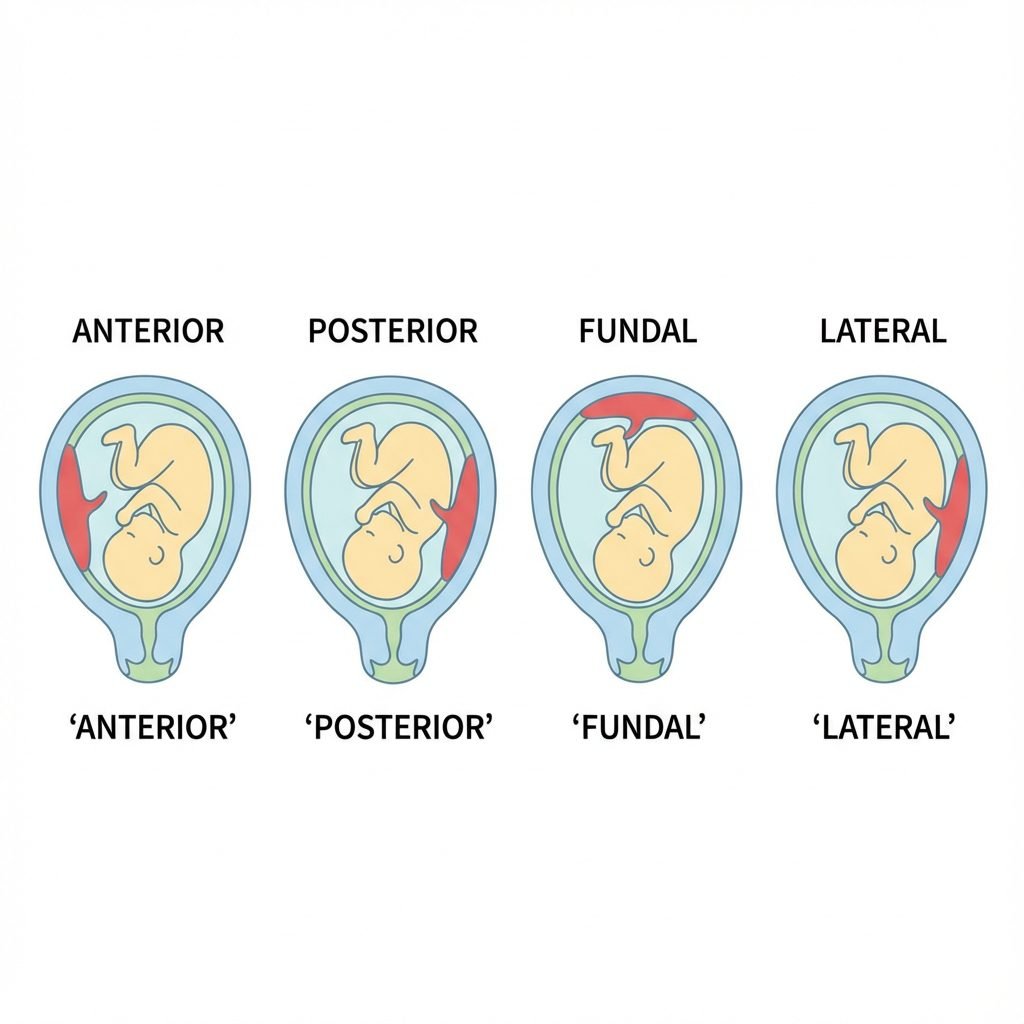
During your mid-pregnancy anomaly scan (usually between 18 and 22 weeks), the sonographer will assess your baby’s development and also note the placenta’s location. There are several common positions:
- Posterior Placenta: Attached to the back wall of the uterus, closest to your spine. This is a very common position.
- Anterior Placenta: Attached to the front wall of the uterus, closest to your abdominal wall. This is also very common, occurring in up to 50% of pregnancies.
- Fundal Placenta: Attached to the top wall of theuterus.
- Lateral Placenta: Attached to the right or left side of the uterus.
Think of your uterus as a room. The placenta is like a large cushion that can attach to the front wall, back wall, side walls, or ceiling. An anterior placenta simply means your ‘cushion’ is on the front wall. This position does not change the placenta’s function; it works just as effectively to nourish your baby regardless of its location.
The ‘Cushion Effect’: Why You Might Not Feel Kicks as Early or as Strongly
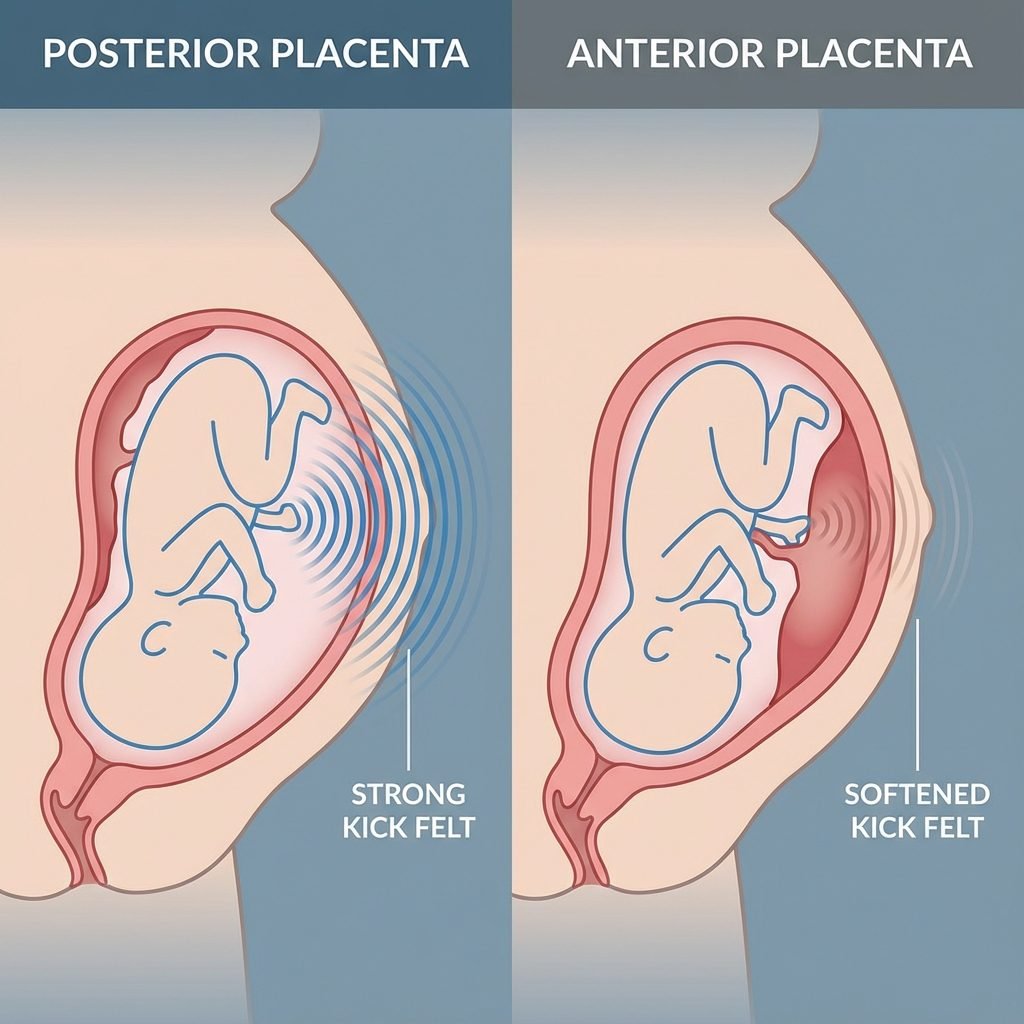
The most significant way an anterior placenta affects your pregnancy experience is in the perception of fetal movement. This is the core reason you might be feeling anxious, and it all comes down to what we call the ‘cushion effect’.
How the Anterior Placenta Muffles Movement
When your baby kicks, punches, and rolls, those movements must travel through the amniotic fluid and the uterine wall to reach the nerves in your skin. With a posterior placenta, the baby’s movements are directed right at your abdominal wall, making them easier to feel. However, with an anterior placenta, there’s an extra layer—the placenta itself—that acts as a shock absorber. Your baby is kicking into a thick, spongy cushion before those movements can reach the front of your belly.
This can lead to a few common experiences:
- Delayed Quickening: ‘Quickening’ is the term for feeling the first fetal movements. While some parents feel these flutters as early as 16 weeks, those with an anterior placenta may not feel definitive movement until 22, 24, or even 25 weeks.
- Muffled or Weaker Sensations: When you do start feeling kicks, they might seem softer or less distinct than you imagined. You’re more likely to feel movements on the sides of your belly, down low near your pubic bone, or up high under your ribs, where the placenta isn’t in the way.
- Difficulty for Partners: It can be particularly frustrating for partners who are excited to feel the baby kick. The ‘cushion effect’ makes it much harder for someone to feel movement from the outside, often until much later in the third trimester when the baby is larger and stronger.
Remember, your baby is just as active as any other. You just have a front-row seat with a pillow in your lap. The show is still happening; it’s just a little muffled.
Addressing Common Concerns: Does an Anterior Placenta Pose Risks?
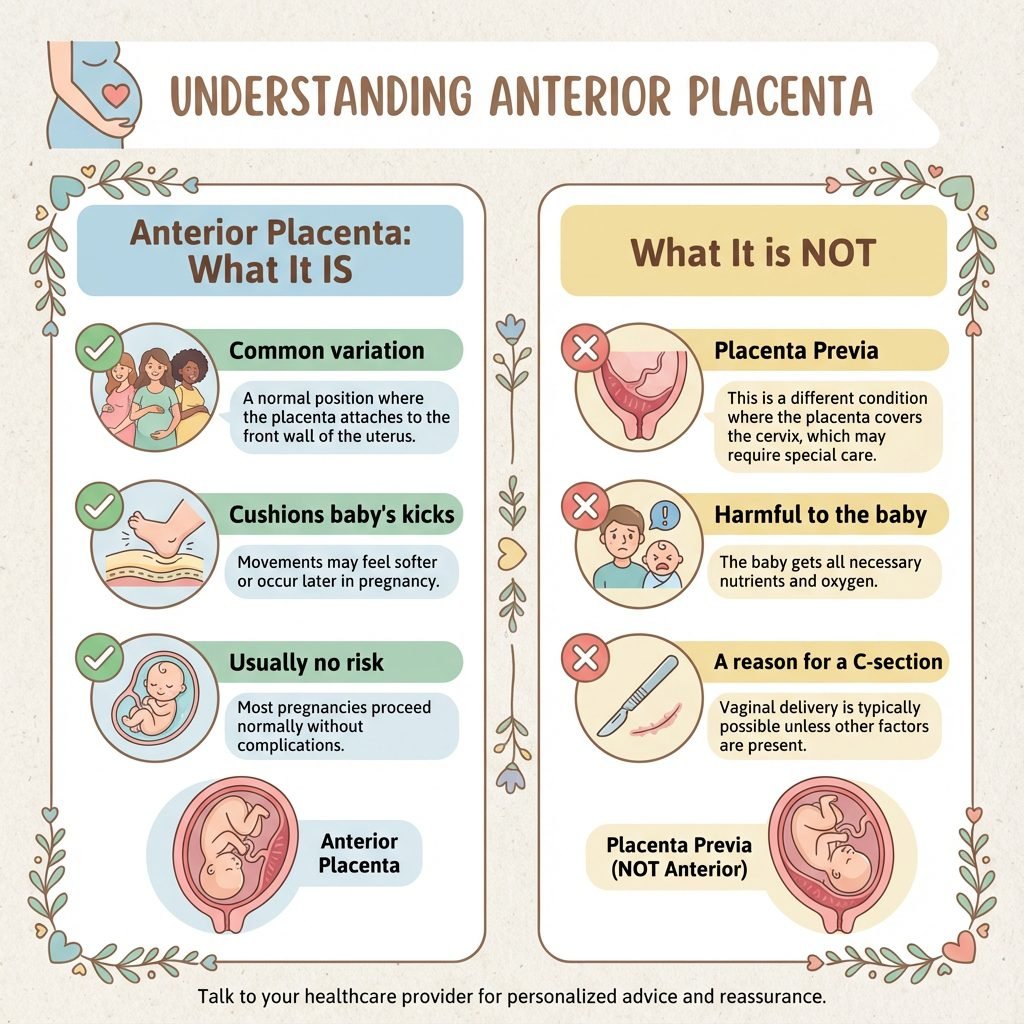
It’s natural to wonder if an ‘atypical’ placement could mean something is wrong. Let’s address and debunk the most common fears associated with an anterior placenta.
Is My Baby Okay?
Absolutely. The location of the placenta does not impact its ability to deliver nutrients and oxygen. Your baby is happily growing and developing, unaware that their kicks are being softened. The placenta’s function is the same regardless of its position.
Does It Mean I’ll Need a C-Section?
No. An anterior placenta, on its own, is not an indication for a cesarean section. The vast majority of women with an anterior placenta have successful vaginal births. In the rare event a C-section is needed for other reasons, your surgeon will use an ultrasound to locate the placenta’s edge and make the incision accordingly. It is a routine consideration they are well-prepared for.
Is it the Same as Placenta Previa?
This is a critical distinction: No, it is not. An anterior placenta refers to its placement on the front uterine wall. Placenta previa is a separate, more serious condition where the placenta is low in the uterus and partially or completely covers the cervix. Placenta previa can cause bleeding and often requires a C-section for safe delivery. While a placenta might be both anterior and low-lying early in pregnancy, in over 90% of cases, the placenta ‘migrates’ up and away from the cervix as the uterus expands. Your healthcare provider will monitor this carefully.
| Condition | What It Means | Impact on Pregnancy |
|---|---|---|
| Anterior Placenta | Placenta is on the front wall of the uterus. | Common variation. Primarily affects feeling kicks. Generally low-risk. |
| Placenta Previa | Placenta is low and covers the cervix. | A medical complication that requires monitoring and may necessitate a C-section. |
What About Back Labor?
Some studies have suggested a slight correlation between an anterior placenta and babies settling into a posterior or ‘sunny-side up’ position (head down, but with the back of their skull against your spine). This position can sometimes lead to ‘back labor,’ which is characterized by intense lower back pain. However, this is not a guarantee. Many factors influence a baby’s final position, and many women with anterior placentas do not experience back labor.
Tuning In: How and When to Monitor Fetal Movement

While an anterior placenta can make feeling kicks tricky, it doesn’t change the fundamental importance of monitoring your baby’s movements once a pattern has been established. This is the most reliable way to check on your baby’s well-being between appointments.
Forget Comparisons, Find Your Baby’s Normal
The key is to stop comparing your experience to others. Your friend with a posterior placenta might feel like she has a soccer player in training, while you feel gentle rolls. Both are normal. Your goal is to learn your baby’s unique rhythm. Are they more active after you eat? Do they have a dance party at 10 PM every night? Pay attention to these patterns.
How to Do ‘Kick Counts’
Around 28 weeks, your provider will likely advise you to start paying more formal attention to fetal movements, often called ‘kick counts.’ Here’s a common method:
- Pick a time of day when your baby is usually active. Often this is after a meal or when you’re resting in the evening.
- Get comfortable. Lie on your left side, which can increase blood flow to the placenta and may encourage movement.
- Focus on your baby. Note the time you start. Count every distinct movement—kicks, swishes, rolls, jabs. Hiccups don’t count.
- Time how long it takes to feel 10 movements. Ideally, you should feel 10 movements within two hours. Most of the time, you’ll feel them much more quickly.
When to Call Your Doctor or Midwife (The Real ‘When to Panic’ Answer)
The word ‘panic’ can be scary. Let’s reframe it as ‘When to be proactive and advocate for your baby.’ You should never hesitate to call your healthcare provider if you are concerned about your baby’s movement. They would much rather you call and everything be fine than have you wait at home and worry.
Call immediately if you notice:
- A significant change in the pattern: If your usually active baby has become very quiet, that’s a reason to call. You know your baby’s routine best.
- A marked decrease in strength: If the movements suddenly feel much weaker than usual.
- Fewer than 10 movements in 2 hours: If you’ve been actively counting during a time your baby is normally active and you don’t reach 10 movements, it’s time to call.
Trust your instincts. Your intuition is a powerful tool in pregnancy. If something feels ‘off,’ it deserves a phone call. There is no prize for waiting it out. Your care team is there to support you and ensure you and your baby are safe.
Conclusion
Having an anterior placenta is, for the vast majority, simply a variation of normal pregnancy. While it can be emotionally challenging to feel those reassuring kicks later or less strongly than you’d hoped, understanding the ‘why’ can transform anxiety into patience. The cushion effect is real, but it doesn’t diminish the incredible activity happening inside. Your baby is thriving, and their movements are just as powerful—they’re just being softened on their way to you.
The most important takeaway is to tune into your baby’s unique rhythm. Once you establish that pattern, you become the expert on your baby’s well-being. Empower yourself with knowledge, learn how to monitor movement effectively, and never be afraid to reach out to your medical team. They are your partners on this journey.
Medical Disclaimer: The information in this article is intended for educational and informational purposes only and does not constitute medical advice. It is not a substitute for professional medical advice, diagnosis, or treatment. Always seek the advice of your physician or other qualified health provider with any questions you may have regarding a medical condition.