

Nurses Love This Simple One-Page Birth Plan (Free Template Inside)
As your due date approaches, the nesting instinct kicks in, and so does the planning. You’re packing the hospital bag, installing the car seat, and trying to envision one of the most significant days of your life. Amidst this whirlwind, you’ve likely heard about creating a ‘birth plan.’ For many expecting parents, this task can feel daunting—another item on an already long to-do list, and one filled with uncertainty. What should you include? Will the hospital staff even read it? Will they think you’re being difficult?
Take a deep breath. We’re here to reframe the birth plan, not as a rigid script, but as a powerful tool for communication and a bridge to a more positive, empowered birth experience. And we’ll let you in on a little secret we’ve learned from years of working with labor and delivery teams: they prefer it when you keep it simple.
This guide is dedicated to helping you craft a concise, respectful, and effective one-page birth plan. The kind of plan that a busy nurse can scan in a minute, understand your core preferences, and immediately see you as a collaborative partner in your care. Forget the multi-page binders. We’re going to build a clear, simple document that honors your wishes while respecting the dynamic nature of childbirth. And yes, there’s a free template waiting for you inside.
Beyond the Checklist: What a Birth Plan Truly Represents

Before we dive into what to write, let’s talk about the ‘why.’ A birth plan is often misunderstood as a set of demands or a script that must be followed perfectly. This mindset can set parents up for disappointment if and when labor takes an unexpected turn. It’s time for a perspective shift.
A birth plan is, at its core:
- A Communication Tool: It’s a conversation starter. It’s your way of introducing yourself and your preferences to the team of people who will be caring for you during a vulnerable and powerful time.
- An Educational Journey: The real magic of a birth plan happens during its creation. The process of researching and discussing your options—from pain management techniques to newborn procedures—is an incredible form of prenatal education. It helps you and your partner get on the same page and understand the ‘why’ behind your choices.
- A Guide for Your Support Person: In the intensity of labor, it can be hard to advocate for yourself. Your birth plan is a clear guide for your partner, doula, or other support person to reference, helping them remember and voice your preferences on your behalf.
Conversely, a birth plan is not:
- A Contract or Guarantee: Childbirth is unpredictable. The primary goal for everyone in the room—including you and your care team—is a healthy baby and a healthy parent. Your birth plan should be a map of your preferred route, but you must be prepared for detours, roadblocks, or even a completely different highway if safety requires it.
- A Reflection of Your Success or Failure: Your birth experience is valid and worthy of celebration, no matter how closely it aligns with your original plan. A C-section can be as beautiful and empowering as an unmedicated vaginal birth. Let go of the pressure for a ‘perfect’ birth and embrace the journey as it unfolds.
Think of your birth plan as a ‘preference sheet.’ It tells your team, ‘In an ideal scenario, this is what we hope for, and we are excited to work with you to make it happen safely.’
The ‘Nurse-Approved’ Secret: Why Less Is More
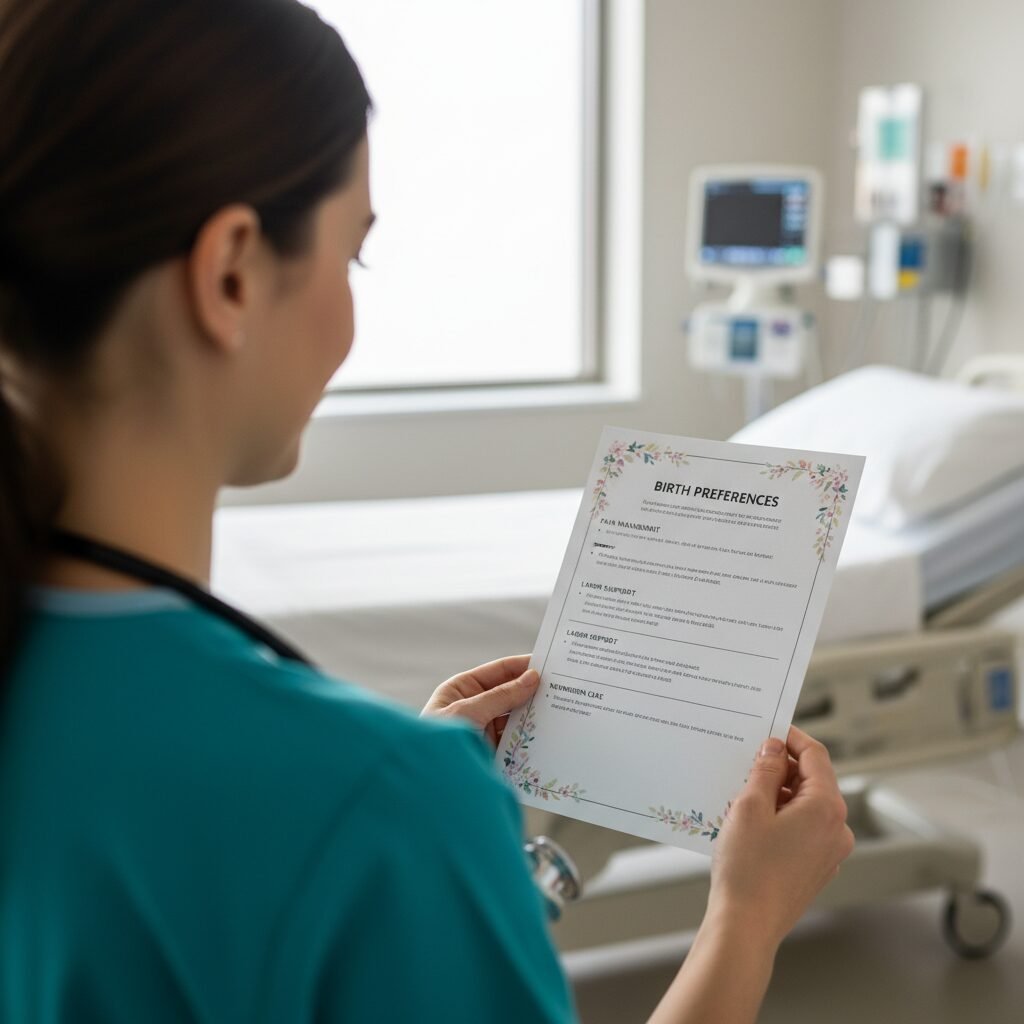
Imagine you’re a labor and delivery nurse. You’re managing multiple patients, monitoring vitals, communicating with doctors, and providing constant physical and emotional support. A new patient arrives, and her partner hands you a five-page, double-sided document in a plastic sleeve. While well-intentioned, the reality is that you simply don’t have time to study it in detail.
Now, imagine the next patient hands you a single, clean, well-organized page with clear headings and bullet points. You can scan it in 60 seconds and immediately grasp the most important points: ‘Wants to labor in the tub,’ ‘Hopes to avoid an epidural but is open to it,’ ‘Requesting delayed cord clamping,’ ‘Partner will announce the gender.’ You instantly feel connected to this family’s goals and can begin a productive conversation.
This is why a one-page birth plan is the gold standard. It demonstrates:
- Respect for the Team’s Time: It shows that you understand the realities of a hospital environment and want to make it easy for them to help you.
- Clarity and Focus: It forces you to distill your wishes down to what truly matters most. This clarity is helpful not only for the staff but for you and your partner as well.
- A Collaborative Spirit: A concise plan feels less like a list of demands and more like an invitation to a partnership. It communicates confidence and flexibility.
What Nurses and Doctors Say
We’ve spoken with countless L&D professionals, and the sentiment is nearly universal. A veteran labor nurse shared her perspective:
“When I get a one-page plan, I feel like I can truly honor it. I’ll often tape it to the wall in the room as a reminder for me and any other staff coming in. It becomes our shared goal. The long, detailed plans often get put in the chart and, honestly, might not get looked at again after the initial read-through. Brevity is a gift in a busy unit.”
By keeping your plan simple, you are actually increasing the chances that your preferences will be seen, remembered, and respected.
Crafting Your Plan: The Essential Components
Ready to build your plan? The key is to use clear, simple language and a bulleted format. Avoid long paragraphs and focus on actionable preferences. Here are the key sections to include.
1. A Brief, Positive Introduction
Start on a collaborative note. This sets a warm, respectful tone for everyone.
Example: “Thank you for being a part of our birth experience. We have prepared these preferences to help us communicate our wishes. Our primary goal is a healthy baby and a healthy parent, and we trust your guidance to achieve that. We are excited to work with you as a team.”
- Your Name:
- Partner/Support Person’s Name:
- Doula’s Name (if applicable):
- Doctor/Midwife’s Name:
2. Preferences for Labor
This section covers the time from when you’re admitted until you’re ready to push. Think about the environment and your coping strategies.
- Environment: I would appreciate low lighting, a quiet room, and the ability to play our own music.
- Movement: I would like the freedom to walk around, change positions, and use a birthing ball or tub if available.
- Hydration/Nourishment: Please let me know what is available for me to eat or drink during labor.
- Fetal Monitoring: We prefer intermittent monitoring if the baby and I are doing well, to allow for more freedom of movement.
- Pain Management: Please describe your preferences clearly. There is no right or wrong answer!
- Example 1: “I plan to manage labor without medication and would appreciate suggestions for positions and comfort measures. Please don’t offer me pain medication; I will ask for it if I decide I need it.”
- Example 2: “I am open to an epidural. I would like to labor for as long as I can without it, but I would like to know about the process in advance.”
- Example 3: “Please offer me pain relief options before I am in extreme distress.”
3. Preferences for Delivery (Pushing Stage)
This is for the moment of birth itself.
- Pushing: I would prefer to follow my body’s cues for pushing (instinctive pushing) rather than coached counting, if possible.
- Delivery Positions: I am open to exploring different pushing positions, such as squatting or side-lying.
- Visuals: We would appreciate a mirror to watch the birth. I would like to be able to touch the baby’s head as they are crowning.
- Immediate Post-Birth: We would like immediate, uninterrupted skin-to-skin contact for at least the first hour. Please delay all non-urgent newborn procedures until after this time.
- Cord Clamping: We request delayed cord clamping for at least 60 seconds or until the cord stops pulsating.
4. In Case of a Cesarean Birth
Including this section is crucial. It shows your team that you have considered all possibilities and are prepared to be flexible. Even in a C-section, you can have preferences.
- Partner’s Presence: We would like my partner/support person to be with me at all times.
- Atmosphere: We would appreciate it if you could lower the drape when the baby is born so we can see them.
- Skin-to-Skin: If possible, we would like to have skin-to-skin contact in the operating room.
5. Preferences for Newborn Care
This covers the immediate postpartum period for your baby.
- Feeding: I intend to breastfeed/chestfeed exclusively. Please, no pacifiers or formula unless medically necessary and discussed with us first. (Or: “We plan to formula feed and would appreciate support with this.”)
- Newborn Procedures: We consent to the Vitamin K shot and erythromycin eye ointment. We would prefer these to be administered while the baby is on my chest.
- Bathing: We would like to delay the baby’s first bath for at least 24 hours.
- Location of Care: We would like all newborn exams to take place in our room.
Your Free Template: Download and Customize
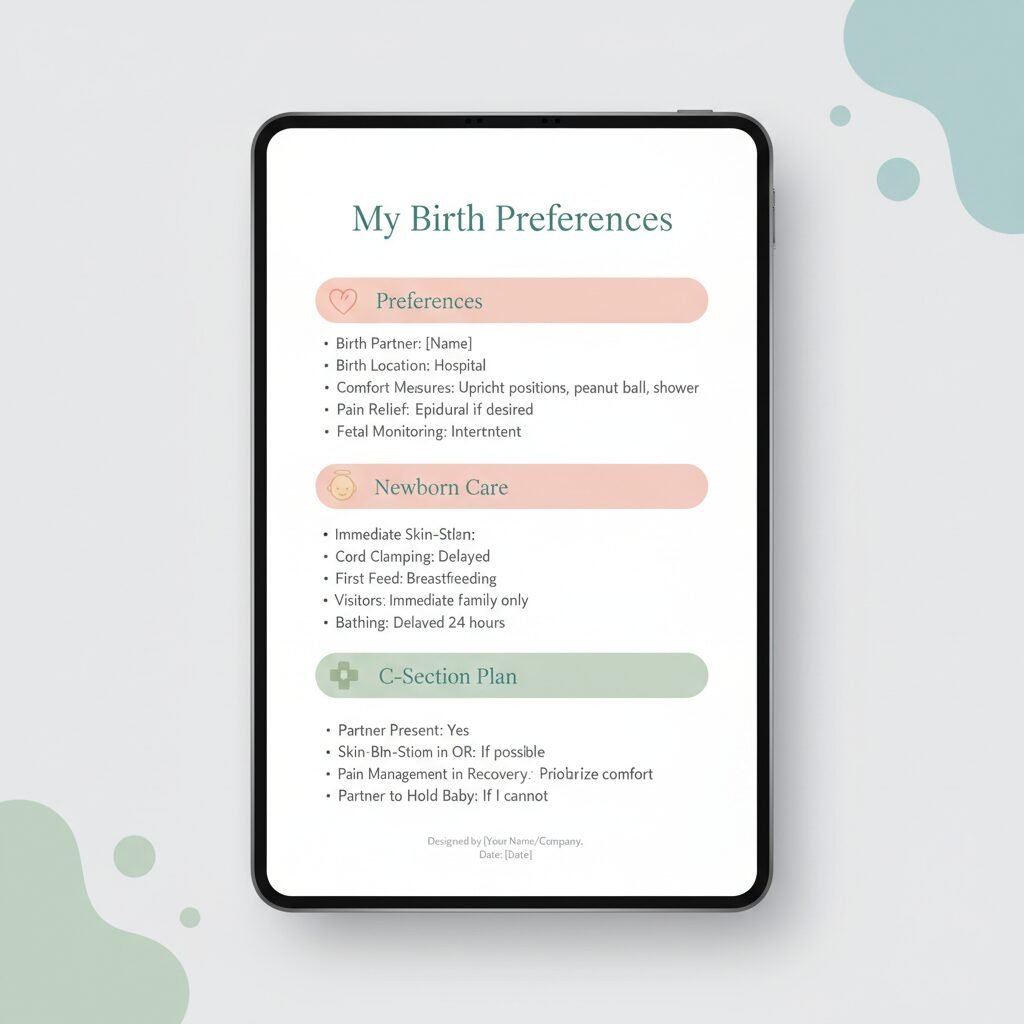
To make this process even easier, we’ve created a simple, copy-and-paste template. Use this as your starting point. Fill it in with your own words, delete what doesn’t apply, and adjust it to reflect your unique hopes for your birth. Remember to discuss each of these points with your partner and your healthcare provider well before your due date.
Instructions: Simply copy the text from the table below into a document, edit it to fit your needs, and print it out. Keep it to one page!
| Our Birth Preferences for Baby [Last Name] | |
|---|---|
| Our Information | Parents: [Your Name] & [Partner’s Name] Support Team: [Doula’s Name, if any] Provider: Dr./Midwife [Name] A Quick Note: Thank you for your support! Our main goal is a healthy baby and a healthy parent. We look forward to working with you and trust your expertise. |
| During Labor |
|
| During Delivery |
|
| If a C-Section is Needed |
|
| For Our Newborn |
|
Beyond the Paper: Making Your Plan a Powerful Tool

Creating the document is only the first step. How you use it is what truly makes it effective. A piece of paper in a bag is useless; a tool for conversation is priceless.
- Discuss it with Your Provider Early: Do not show up to the hospital with a birth plan your doctor or midwife has never seen. Bring a draft to one of your third-trimester appointments (around 36 weeks is ideal). This allows you to have an open conversation, ask questions about hospital policies, and ensure you and your provider are aligned. This single step can alleviate so much anxiety.
- Pack Multiple Copies: Things get lost in the shuffle. Pack at least 3-4 copies in your hospital bag. You might give one to your primary nurse, one might get taped to the wall, and your partner can keep one to reference.
- Initiate a Warm Hand-Off: When you get to the hospital and are settled in your room, your nurse will introduce themselves. This is the perfect moment. Instead of just handing them the paper, use it to start a dialogue. Say something like, “Hi, it’s so nice to meet you. We’re so excited and a little nervous! We put together a one-page sheet with some of our preferences, just to help guide our conversation. Could we take a minute to go over it with you?”
- Empower Your Partner/Doula: Your support person is your advocate. Make sure they know the birth plan inside and out. Their job is to help remind the staff of your preferences in a polite and respectful way, especially when you are deep in ‘laborland’ and can’t speak for yourself.
- Hold it Loosely: Remember, the ultimate goal is a safe and healthy outcome. If your medical team recommends a deviation from the plan for a medical reason, listen, ask questions, and be prepared to be flexible. Trusting the team you’ve chosen is part of the plan, too.
Conclusion
Preparing for childbirth is an act of profound love and courage. Creating a birth plan is not about controlling an uncontrollable process; it’s about educating yourself, understanding your choices, and learning how to communicate effectively with the people who will be by your side. By focusing on a simple, clear, one-page document, you are setting the stage for a collaborative and respectful birth experience.
You are stepping into your power as a parent, ready to advocate for yourself and your baby with grace and confidence. Remember to hold your plans with open hands, ready to adapt to the beautiful and unpredictable journey of birth. You have prepared thoughtfully, you have built your team, and you are ready.
You’ve got this. We wish you a safe, healthy, and empowering birth.
Disclaimer: The information provided in this article is for educational purposes only and is not a substitute for professional medical advice, diagnosis, or treatment. Always seek the advice of your physician or other qualified health provider with any questions you may have regarding a medical condition or your pregnancy.


