

Stuck in False Labor? 5 Birthing Ball Moves to Get Things Moving NOW
You’ve reached the final stretch of your pregnancy. The hospital bag is packed, the nursery is ready, and every twinge sends a jolt of anticipation through you. Then, it starts: contractions. They’re regular for a while, getting your hopes up, only to fizzle out hours later. This frustrating, emotional rollercoaster is often called ‘false labor,’ but a more accurate and compassionate term is prodromal labor. It’s not false; it’s your body’s intelligent way of preparing for the real event. Your cervix is softening, and your baby is getting into the perfect position.
But knowing it’s productive doesn’t make it any less exhausting. If you’re feeling stuck in this stop-and-start pattern, you might be looking for a gentle, effective way to encourage your body to transition into active labor. Enter your best friend for these final days: the birthing ball.
As a doula and maternal health educator, I’ve witnessed the transformative power of the birthing ball time and again. It’s more than just a place to sit; it’s a dynamic tool that uses gravity and movement to open your pelvis, encourage optimal fetal positioning, and help labor progress. This guide will provide you with five specific, safe, and effective birthing ball movements designed to help you and your baby work together to get things moving. Let’s turn that frustration into productive action.
First, Let’s Decode Your Body’s Signals: Is It Prodromal or Active Labor?

Before you begin any exercises, it’s crucial to understand what your body is telling you. Prodromal labor can mimic early labor so closely that it can be confusing. The key difference lies in whether the contractions are causing progressive cervical change. While you can’t check that at home, you can track the patterns of your contractions. Understanding these patterns can save you a premature trip to the hospital and help you conserve precious energy.
Remember, prodromal labor is real work. Be kind to yourself. Your body is not failing; it is preparing intelligently for the marathon ahead.
Here is a breakdown to help you distinguish between the two phases. Use this as a guide, but always trust your intuition and call your healthcare provider if you are unsure.
| Characteristic | Prodromal Labor (“False Labor”) | Active Labor (“True Labor”) |
|---|---|---|
| Contraction Timing | Irregular and unpredictable. They might come every 10 minutes, then 20, then 7, and then stop for an hour. | Consistent and progressively closer. They follow a predictable pattern, like the 5-1-1 rule (lasting 1 minute, every 5 minutes, for at least 1 hour). |
| Contraction Strength | Usually mild to moderate and do not intensify over time. You can often talk or walk through them. | Steadily increase in strength and intensity. They will eventually require your full focus to breathe through. |
| Contraction Location | Often felt primarily in the front of the abdomen or in one specific area. | Typically begins in the lower back and radiates around to the front of the abdomen. |
| Effect of Activity | Contractions may slow down or stop completely when you change position, walk, or rest. | Contractions continue and often intensify regardless of changes in activity or position. |
| Cervical Change | May cause slow, gradual softening and thinning (effacement) of the cervix, but little to no dilation. | Causes progressive, measurable dilation and effacement of the cervix. This is the ultimate sign of true labor. |
If your symptoms align more with prodromal labor, the following exercises can be a wonderful way to manage discomfort and potentially nudge your body toward the next stage.
Safety and Setup: Your Birthing Ball Pre-Flight Check
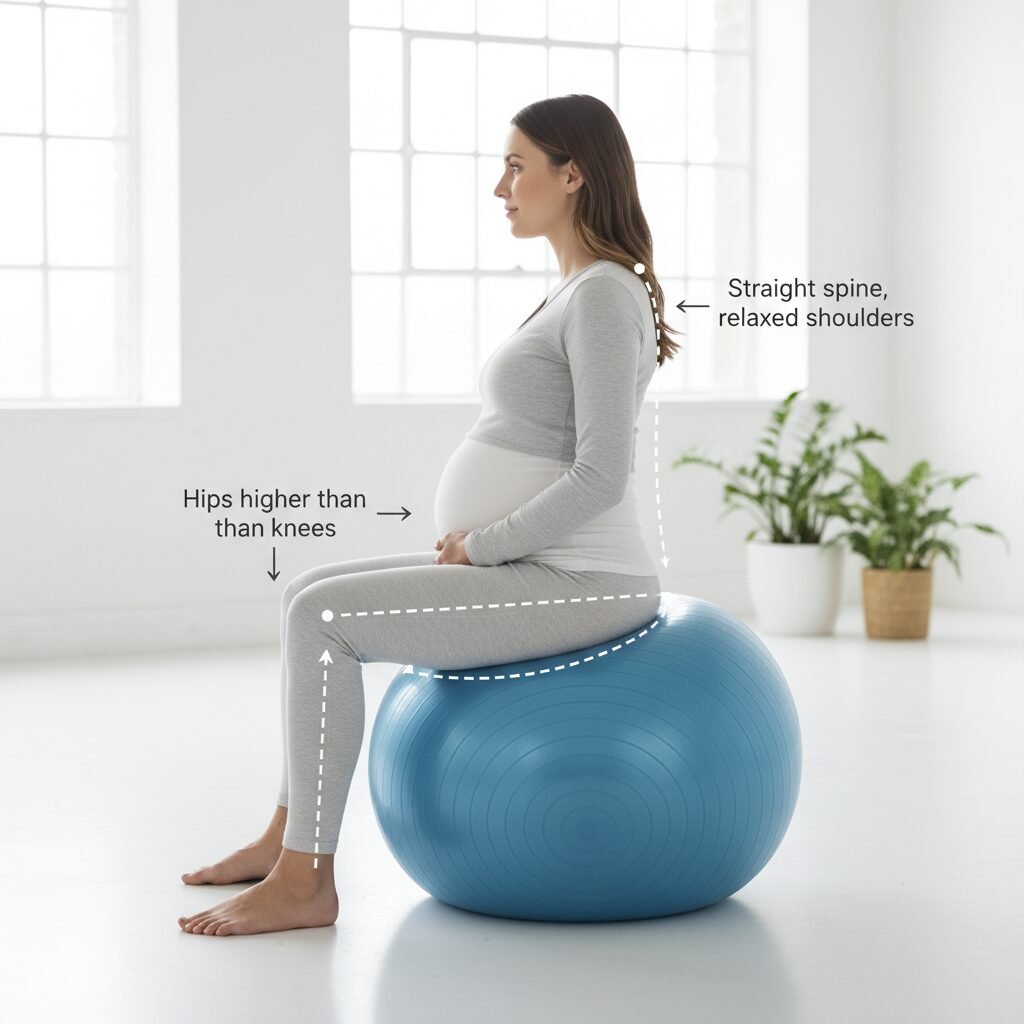
Before you begin, let’s ensure you’re set up for success and safety. Using a birthing ball correctly is key to reaping its benefits without risking injury.
Choosing the Right Size
Your ball should be sized to your height to ensure proper pelvic alignment. When you sit on a fully inflated ball, your hips should be level with or slightly higher than your knees, creating a gentle downward slope with your thighs. This open position gives your baby maximum room in the pelvis.
- If you are under 5’4″ (163 cm): Choose a 55 cm ball.
- If you are between 5’4″ and 5’10” (163-178 cm): Choose a 65 cm ball.
- If you are over 5’10” (178 cm): Choose a 75 cm ball.
Proper Inflation and Environment
Make sure your ball is firm and fully inflated. A soft, squishy ball won’t provide the right support. Place the ball on a non-slip surface, like a rug or yoga mat, and clear the area around you of any obstacles. It’s also a great idea to have your partner or a sturdy piece of furniture nearby for extra stability, especially when you’re first getting used to the movements.
Listen to Your Body
This is the most important rule. These movements should feel good and provide relief. If you experience any sharp pain, dizziness, or significant discomfort, stop immediately. And, as always, it’s a good idea to discuss any new exercise regimen with your doctor or midwife, especially if you have a high-risk pregnancy.
The Main Event: 5 Gentle Moves to Encourage Labor
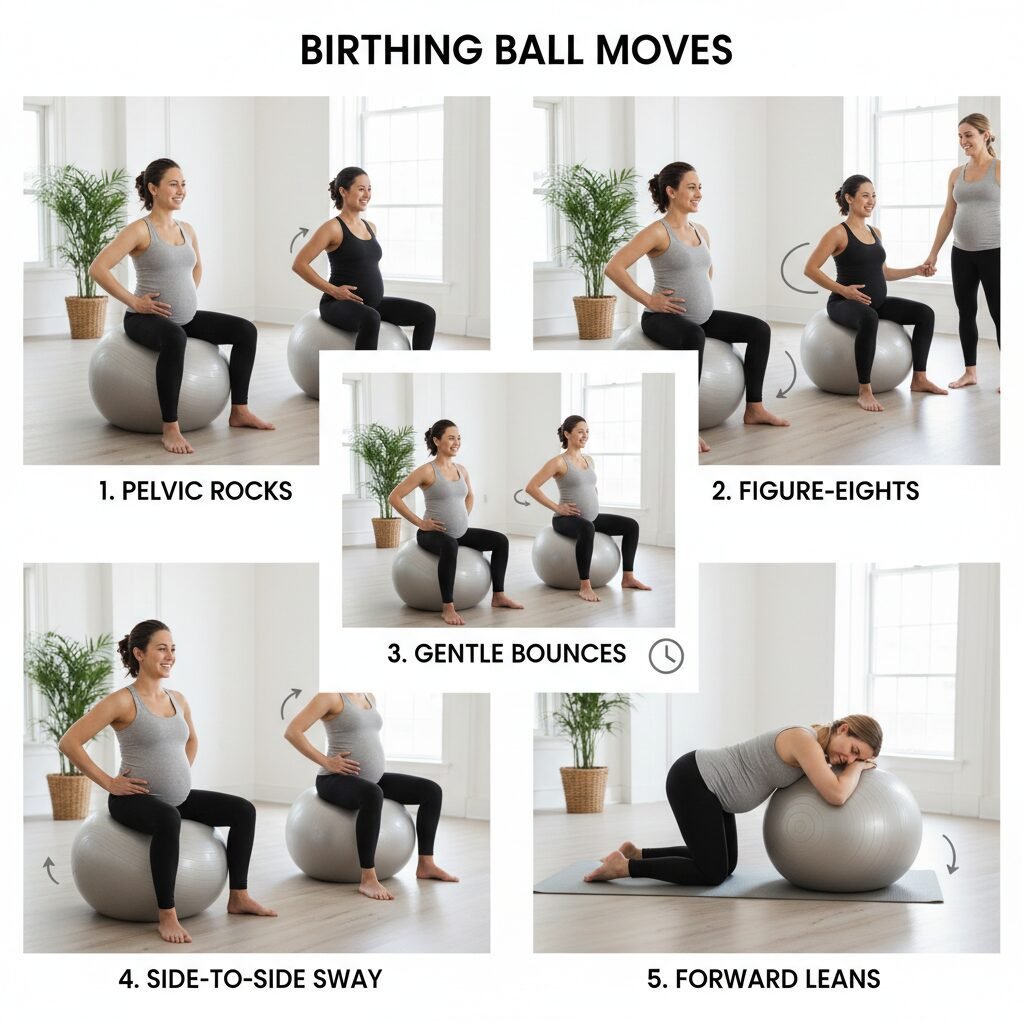
Once you are set up safely, you can begin to explore these movements. The goal is gentle, rhythmic motion. Put on some calming music, focus on your breathing, and visualize your baby moving down and into the optimal position for birth. Perform each of these for as long as feels comfortable, taking breaks as needed.
-
Simple Seated Bounces
This is the most basic and often most intuitive movement. How to do it: Sit comfortably on the ball with your feet flat on the floor, about shoulder-width apart, for a stable base. Gently bounce up and down. The motion should be soft and controlled, not jarring. Why it works: The gentle, rhythmic pressure of your baby’s head on your cervix can help stimulate the release of oxytocin, the hormone that drives contractions. It also helps your pelvic floor muscles relax.
-
Gentle Hip Circles
This movement feels incredible on a tired lower back and is fantastic for opening the pelvis. How to do it: While seated on the ball, plant your feet firmly on the floor. Slowly begin to circle your hips, first in one direction, then the other. Imagine you are drawing a large circle on the ball with your sitz bones. Make the circles as wide as feels comfortable. Why it works: Hip circles create space in your pelvic inlet and outlet, encouraging your baby to rotate and descend. The movement is fluid and helps release tension in your hips and lower back.
-
Pelvic Tilts (Cat-Cow on the Ball)
If you’ve done prenatal yoga, this will feel familiar. It’s a wonderful way to improve fetal positioning. How to do it: Seated on the ball, place your hands on your knees. As you inhale, arch your back, push your belly forward, and look up slightly (Cow pose). As you exhale, round your spine, tuck your pelvis under, and bring your chin toward your chest (Cat pose). Repeat this fluidly with your breath. Why it works: This movement helps to wiggle the baby out of a posterior position (sunny-side up) and into a more optimal anterior position, which can lead to a more efficient labor. It also relieves back pain.
-
The Supported Forward Lean
This position uses gravity to your advantage and gives your back a much-needed break. How to do it: Kneel on a soft surface (like a pillow or mat) and place the birthing ball in front of you. Lean forward, draping your arms and upper body over the ball. You can rest your head on your forearms. From here, you can gently rock your hips from side to side. Why it works: Leaning forward takes the pressure of the baby off your spine (especially helpful for back labor) and creates more room in the back of your pelvis. This encourages the baby to rotate and engage deeply in the pelvis.
-
The Deep Supported Squat
Squatting is the ultimate pelvic opener, but it can be tiring. The ball provides excellent support. How to do it: Stand with your back to a sturdy wall, with the birthing ball positioned between your lower back and the wall. Place your feet slightly wider than your hips, with your toes pointed slightly outward. Slowly lower yourself into a deep squat, letting the ball roll up your back to support you. Go only as low as is comfortable. Hold for 30 seconds, breathing deeply, then slowly push back up to standing. Why it works: This position fully opens the pelvic outlet, giving your baby the maximum amount of space to descend. It uses gravity to its full potential while the ball provides stability and reduces the strain on your leg muscles.
For the Partner: Your Crucial Role in This Process

To the partners, new dads, and support people: your role during this time is invaluable. Prodromal labor can be just as emotionally draining for you as you watch your loved one in discomfort. But you are not helpless. Your active support can make all the difference.
How You Can Help:
- Be the Stabilizer: When she is on the ball, stand nearby to offer a steadying hand. Your physical presence provides both safety and emotional reassurance.
- Provide Counter-Pressure: While she is leaning forward over the ball, use the heel of your hand or a tennis ball to apply firm, steady pressure to her lower back or hips. Ask her where it feels best. This can provide immense relief.
- Create a Calming Oasis: Take charge of the environment. Dim the lights, put on a calming playlist, light a candle with a scent she loves, and make sure she has plenty of water and nutritious snacks. Your goal is to create a space where she can relax and let her body do its work.
- Offer Words of Affirmation: Remind her how strong she is. Tell her you see how hard she is working and that she is doing an amazing job. Your belief in her is powerful.
- Be the Timekeeper and Advocate: If she wants to time contractions, you can take on that role so she can focus on her body. Be the one to communicate with your doula or provider if she is too focused to talk.
Your calm, confident, and loving support is one of the most effective forms of pain relief available. You are a team, and you are in this together.
Important Safety Signals: When to Pause and Call Your Doctor or Midwife

While these exercises are gentle and safe for most low-risk pregnancies, it is vital to be aware of your body’s signals and know when to seek professional medical advice. The goal is to encourage labor, not force it. Stop any exercises and call your healthcare provider immediately if you experience any of the following:
- Your Water Breaks: This could be a large gush or a slow, continuous trickle of fluid. Note the color and time, and call your provider.
- Vaginal Bleeding: While a small amount of bloody show (mucus tinged with blood) is normal, bright red bleeding similar to a period is not.
- A Significant Decrease in Fetal Movement: You know your baby’s patterns best. If you notice a significant reduction in movement, try drinking some cold juice and lying on your side. If the baby still isn’t moving as usual, call right away.
- Intense or Overwhelming Pain: While labor is intense, pain that feels sharp, constant, or unbearable is a reason to call.
- Contractions Become True Active Labor: If your contractions become regular, strong, and follow the 5-1-1 pattern, it’s time to call your provider and let them know you’re on your way!
- Any Other Concerning Symptoms: This includes a severe headache, vision changes, sudden swelling, or a fever. These could be signs of other complications.
Trust your instincts. It is always better to call and be reassured than to wait and worry.
Conclusion
You Are Strong, You Are Capable, and You Are So Close
The waiting game of prodromal labor is undoubtedly one of the most challenging mental and emotional hurdles of pregnancy. It can make you question your body and your strength. But please remember: your body is not broken. It is preparing, aligning, and setting the stage for a beautiful birth. By using a birthing ball, you are actively participating in this process, working with your body and your baby to ease this transition.
Whether these movements tip you into active labor or simply provide comfort and relief during this waiting period, you are doing incredible work. Be patient with yourself, lean on your support system, and trust in the profound wisdom of your body. You are on the very cusp of meeting your baby. You’ve got this.
Medical Disclaimer: The information provided in this article is for educational and informational purposes only and is not intended as medical advice. It is not a substitute for professional medical advice, diagnosis, or treatment. Always seek the advice of your physician or other qualified health provider with any questions you may have regarding a medical condition. Never disregard professional medical advice or delay in seeking it because of something you have read in this article.