

The Pregnancy Line: What The Linea Nigra Says About Your Baby’s Gender
As you journey through pregnancy, you become an intimate observer of the miraculous changes happening within your own body. From the gentle flutters that turn into powerful kicks to the beautiful rounding of your belly, each new development is a milestone. One of the most common and curious of these changes is the appearance of a dark, vertical line running down the center of your abdomen—the linea nigra, often affectionately called the ‘pregnancy line.’
You may have heard whispers or read in online forums that this line holds a secret clue, a natural gender test painted right onto your skin. It’s a captivating thought! But what’s the real story behind this fascinating feature? As a doula and maternal health educator, I want to walk with you through the science, separate the delightful folklore from the facts, and help you embrace this beautiful symbol of your pregnancy journey. Let’s explore what the linea nigra really is and what it says about the incredible work your body is doing.
What Exactly Is the Linea Nigra?

Before we dive into the myths, let’s get to know the linea nigra itself. The term is Latin for ‘black line,’ but its color can range from a light tan to a deep brown, depending on your skin tone. This line typically runs from your pubic bone up to your navel (belly button), though for some, it can extend all the way up to the sternum (the bone between your breasts).
Interestingly, this line isn’t new. It’s always there, but before pregnancy, it’s called the linea alba, or ‘white line.’ It’s the connective tissue where your abdominal muscles meet. During pregnancy, hormonal changes cause this line to darken and become visible. Think of it less as something new appearing and more as something that was always a part of you becoming more prominent to mark this special time.
When Does It Typically Appear?
You probably won’t see the linea nigra in the first few weeks of pregnancy. It most commonly makes its debut during the second trimester, around the 20-week mark, as pregnancy hormones really ramp up. It’s a completely normal and harmless physiological change experienced by an estimated 75-80% of pregnant people. It’s not a sign of anything being wrong; rather, it’s a clear signal that your body is deep in the process of growing and nurturing your baby.
The Science Behind the Line: What Causes the Linea Nigra?
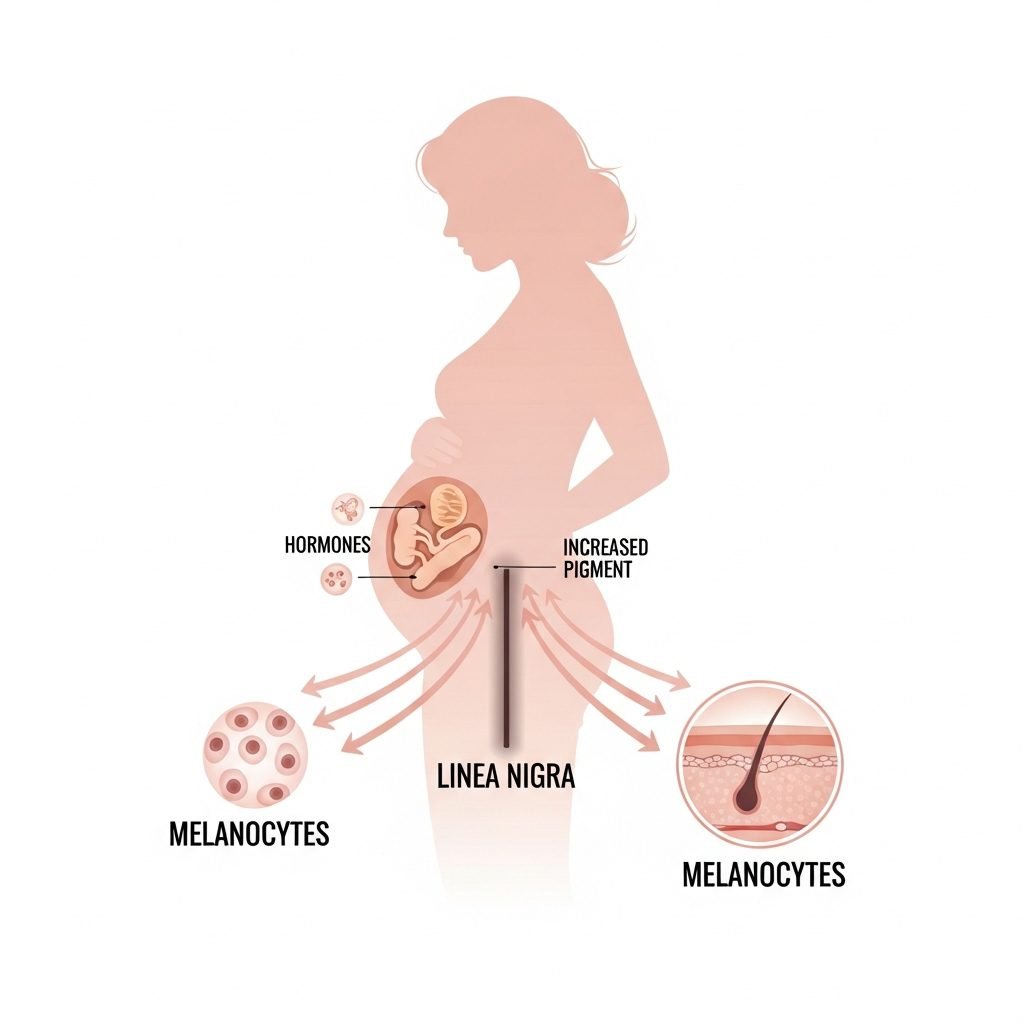
The appearance of the linea nigra isn’t magic; it’s biology at its most fascinating. The primary cause is a surge in pregnancy hormones, specifically estrogen and progesterone. Here’s a simple breakdown:
- Hormonal Influence: Your placenta produces a significant amount of hormones during pregnancy. These hormones, especially estrogen, stimulate an increase in a hormone called melanocyte-stimulating hormone (MSH).
- Melanin Production: MSH, as its name suggests, tells your body’s pigment-producing cells, called melanocytes, to kick into overdrive. These cells produce melanin, the substance that gives color to your skin, hair, and eyes.
- Hyperpigmentation: With more melanin being produced, certain areas of your skin can become darker. This process is called hyperpigmentation. The linea alba is particularly susceptible to this darkening, transforming it into the visible linea nigra.
This is the very same process that can cause other common skin changes during pregnancy, such as:
- Melasma: Often called the ‘mask of pregnancy,’ these are darkened patches of skin that can appear on the face.
- Darkening Areolas: The skin around your nipples may become significantly darker.
- Darker Freckles or Moles: Existing freckles or moles might become more pronounced.
Seeing these changes can be surprising, but they are all connected to the same hormonal symphony that is supporting your baby’s development. Your body is intelligently adapting, and the linea nigra is just one outward sign of this incredible internal process.
The Big Question: Can the Linea Nigra Predict Your Baby’s Gender?

Now, let’s address the question that likely brought you here. For generations, old wives’ tales have been a fun way for expecting families to guess their baby’s gender. They’re part of the culture and excitement of pregnancy, and the linea nigra has one of the most popular myths attached to it.
The Old Wives’ Tale
The folklore generally goes like this:
- If your linea nigra stops at your belly button, you are having a girl.
- If your linea nigra extends all the way up past your belly button to your ribcage, you are having a boy.
It’s a simple, definitive-sounding prediction, which is why it has remained so popular. In a time of so much waiting and anticipation, it’s natural to look for clues, for any little sign that might give you a hint about the little person you’re so excited to meet.
The Scientific Verdict
While it’s a delightful piece of folklore, there is absolutely no scientific evidence to support the idea that the length or darkness of the linea nigra can predict a baby’s gender. It is purely a myth.
The characteristics of your linea nigra—its length, its darkness, and even whether it appears at all—are determined by your unique hormonal levels, your genetics, and your natural skin pigmentation. They have no connection to the chromosomal makeup (XX for female, XY for male) of your baby. Some people get a long, dark line, some get a short, faint one, and some don’t get one at all, regardless of whether they are carrying a boy or a girl.
So, feel free to have fun with the guess! Ask your friends, poll your family, and enjoy the speculation. But when it comes to a reliable answer, you’ll need to wait for your anatomy scan ultrasound or genetic testing results.
Beyond the Myth: What the Linea Nigra *Really* Tells You

If the linea nigra isn’t a secret gender decoder, what is it? It’s time we reframe this beautiful line for what it truly represents. The linea nigra is a testament to the power and intelligence of your body. It’s a visible marker that tells you:
- Your hormones are working hard: The presence of the line is a clear sign that your body is producing the right hormones in the right amounts to sustain your pregnancy and help your baby grow.
- Your body is adapting: Every change, from your expanding uterus to your darkening skin, is part of a coordinated effort to create a safe and nurturing environment for your little one.
- You are part of a timeless tradition: For centuries, pregnant people have watched this line appear on their own bodies. It connects you to a long lineage of parents who have gone through this same beautiful transformation.
Instead of seeing it as a puzzle to be solved, try to see it as a badge of honor. It’s a temporary mark of a truly profound and life-changing experience. It’s a love line, tracing the path to your baby.
Caring for Your Skin and When to Expect the Line to Fade

The linea nigra requires no special treatment. It’s a natural change that will resolve on its own. However, there are a few things to keep in mind for your overall skin health during pregnancy.
Can You Prevent It or Make It Go Away?
Since the linea nigra is caused by internal hormones, there’s nothing you can do to prevent it. It’s important to avoid using bleaching creams or harsh chemical treatments to try and fade it during pregnancy, as these can be harmful. The best approach is patience and gentle care.
Sun Protection is Key
Sun exposure can make hyperpigmentation, including the linea nigra and melasma, darker and more pronounced. If your belly is exposed to the sun, it’s crucial to use a broad-spectrum, pregnancy-safe sunscreen. This is a good practice for all your skin, not just your abdomen.
When Does the Linea Nigra Go Away?
For most people, the linea nigra begins to fade in the weeks and months following childbirth. As your hormone levels return to their pre-pregnancy state, the extra melanin production ceases, and the line gradually lightens until it’s no longer visible. For some, especially those with darker skin tones, a faint line may remain for longer, or may never completely disappear. This, too, is normal. It’s a gentle, permanent reminder of the journey you took to bring your child into the world.
Conclusion
The linea nigra is one of the many beautiful mysteries of pregnancy. While the old wives’ tale about it predicting your baby’s gender is a fun piece of folklore to enjoy with loved ones, the truth lies in the incredible science of your body. This ‘pregnancy line’ is not a crystal ball, but rather a beautiful, temporary stripe earned on the amazing journey to parenthood. It’s a sign that your body is doing exactly what it needs to do to grow a healthy baby.
Embrace it. Admire it. See it as a symbol of your strength and the life you are creating. Every change your body undergoes is part of your unique story. As you await the arrival of your little one, cherish these moments and these markers of the incredible transformation you are experiencing.
Disclaimer: This article is for informational purposes only and is not intended to be a substitute for professional medical advice, diagnosis, or treatment. Always seek the advice of your physician or another qualified health provider with any questions you may have regarding a medical condition.