
Boy or Girl? How to Use the Nub Theory to Predict Gender at 12 Weeks
The journey to parenthood is filled with milestones, and few are as eagerly anticipated as the 12-week ultrasound. Seeing your tiny baby on that screen for the first time—a wiggling, living being with a beating heart—is a moment of pure magic. For many expectant parents, this scan also sparks a burning question: is it a boy or a girl?
While the definitive anatomy scan is still weeks away, a popular and surprisingly insightful method has captured the imagination of parents-to-be everywhere: the Nub Theory. It’s a way of predicting your baby’s gender based on a tiny clue visible during this early scan. It’s a blend of science, observation, and a little bit of fun that can make the wait for the big reveal feel a bit shorter.
We understand the excitement, the nerves, and the deep desire to connect with your baby in every way possible. This guide is here to walk you through the Nub Theory with empathy and clarity. We’ll explore what it is, how to try it for yourself, how accurate it really is, and most importantly, hold space for the emotions that come with this special part of your pregnancy journey. Let’s explore this fun little secret together.
What Exactly Is the Nub Theory?
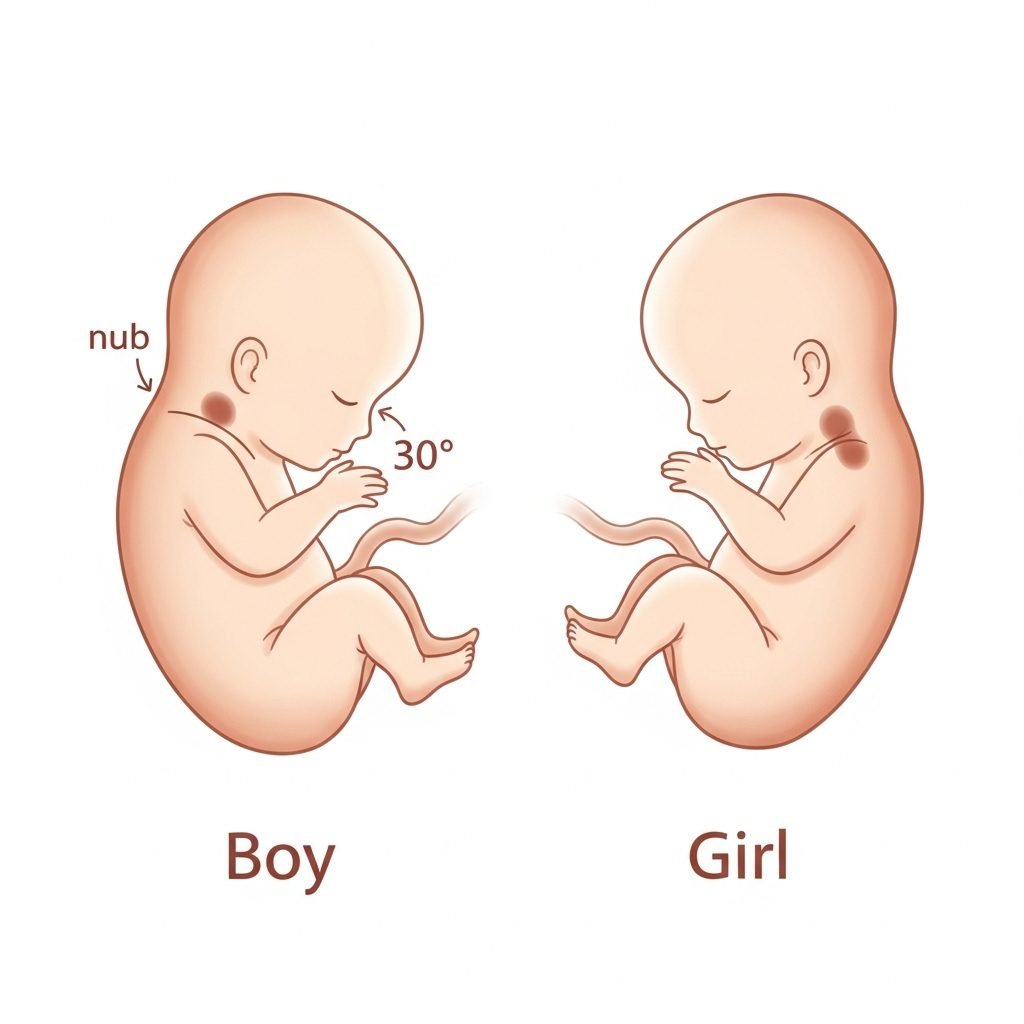
At its heart, the Nub Theory is all about looking at the ‘angle of the dangle.’ It sounds playful, but it’s based on early fetal development. Between 11 and 14 weeks of gestation, both male and female fetuses have a small protuberance between their legs called the genital tubercle. To the untrained eye, they look virtually identical. However, the secret lies in the direction this ‘nub’ is pointing in relation to the baby’s spine.
Think of it as the very first sign of differentiation. Before the genitals are fully formed and clearly identifiable as male or female, the angle of this tubercle offers a significant clue. Here’s the basic principle:
- For a Boy: The genital tubercle (nub) will be pointing upwards, at an angle of 30 degrees or more relative to the lower part of the spine.
- For a Girl: The genital tubercle (nub) will be pointing straight out, nearly parallel to the spine, at an angle of less than 30 degrees.
It’s a subtle difference, but one that becomes more pronounced as the weeks go by. The theory relies on observing this specific anatomical relationship in a clear profile image of the fetus. It’s a fascinating glimpse into the intricate process of development happening inside the womb, turning a standard medical check-up into a moment of playful detection for hopeful parents.
How to Spot the Nub on Your 12-Week Ultrasound

Ready to play detective with your own ultrasound scan? It can be a fun bonding experience for you and your partner. Remember to approach it with a light heart—this is for fun, not a diagnosis! Here’s what you need to look for:
- Get the Right Picture: The key to the Nub Theory is a clear, side-profile (sagittal) view of your baby. The baby needs to be lying relatively flat. An image of the baby curled up in a ball or facing forward won’t work. Ask your sonographer if they can capture a good profile shot for you.
- Identify the Spine: First, locate your baby’s spine. It will look like a bright, white line running along their back. You need this as your baseline for measuring the angle.
- Find the Nub: Look towards the bottom end of the baby, between the legs. You should see a small, bright white nub sticking out. This is the genital tubercle.
- Assess the Angle: Now, imagine a line running through the lower part of the spine. Then, imagine another line running through the nub. What is the angle between them? Is the nub pointing up (like a little ski jump) or is it running flat and parallel to the spine?
Factors That Can Make It Tricky
Sometimes, spotting the nub and its angle isn’t straightforward. Several factors can interfere with a clear reading:
- Baby’s Position: If your baby is moving a lot, curled up, or has their legs in the way, it can be impossible to get the clear view needed.
- Image Quality: The clarity of the ultrasound machine and the skill of the sonographer play a big role. A fuzzy or poorly angled image won’t give you a reliable clue.
- Gestational Age: The theory is most effective between 12 and 14 weeks. Before 11 weeks, the nub is often too similar in both sexes. After 14 weeks, the genitals are usually developed enough to be identified more directly.
- Umbilical Cord: Sometimes, a loop of the umbilical cord can be mistaken for the nub, leading to an incorrect guess.
Don’t be discouraged if you can’t tell from your scan. It’s very common! The primary purpose of this scan is to check on your baby’s health and development, and that’s the most beautiful picture of all.
How Accurate Is the Nub Theory? A Look at the Science

While the Nub Theory feels like an old wives’ tale, it’s actually backed by a surprising amount of scientific observation. Several studies have examined its reliability, and the results are quite compelling, especially as gestation progresses.
A landmark study published in the journal Ultrasound in Obstetrics & Gynecology found that gender assignment was correctly made in:
- 70.3% of cases at 11 weeks.
- 98.7% of cases at 12 weeks.
- 100% of cases at 13 weeks.
Other studies have found slightly more conservative numbers, often placing the accuracy at around 75% at 12 weeks and over 95% by 13-14 weeks. The key takeaway is that timing is everything. The later in that 11-14 week window the scan is performed, the more developed the nub is and the more accurate the prediction is likely to be.
It’s also important to remember that the accuracy depends heavily on the skill of the person interpreting the image. A trained sonographer who knows what to look for will have a much higher success rate than an excited parent trying to decipher a grainy photo at home.
Comparing Gender Prediction Methods
How does the Nub Theory stack up against other methods? It’s a great non-invasive option for an early *guess*, but it’s not a medical test. Here’s a comparison:
| Method | When It’s Done | Accuracy | Purpose |
|---|---|---|---|
| Nub Theory | 12-14 Weeks | ~75-95% (increases with gestational age) | For fun / non-medical prediction |
| NIPT (Non-Invasive Prenatal Testing) | 10+ Weeks | >99% | Screens for chromosomal abnormalities; can also identify sex chromosomes |
| Anatomy Scan (Ultrasound) | 18-22 Weeks | ~98-99% | Medical scan to check baby’s anatomy and development; gender is often visible |
| Amniocentesis / CVS | 10-20 Weeks | >99.9% | Invasive diagnostic tests for genetic conditions; carry a small risk |
The Nub Theory fits into a unique niche: it’s the earliest non-invasive way to get a reasonably good guess about your baby’s gender, long before the 20-week anatomy scan. Just hold the results lightly and wait for official confirmation before you start painting the nursery!
The Emotional Side of Gender Prediction: Hopes, Fun, and Disappointment

Beyond the angles and the science, let’s talk about the heart of the matter. The desire to know your baby’s gender is deeply human. It’s a way of moving from the abstract idea of ‘the baby’ to the more concrete reality of ‘my son’ or ‘my daughter.’ It helps us dream, plan, and feel a deeper connection. Sharing your nub theory guess with family and friends can be a joyful and exciting part of the pregnancy journey.
However, this anticipation can sometimes come with complex emotions. Many parents have a preference, even a secret one, for a boy or a girl. This is completely normal and nothing to be ashamed of. These feelings can stem from family dynamics, personal experiences, or simply a picture you’ve held in your mind for years.
If your nub theory guess—or even the confirmed gender later on—isn’t what you were hoping for, it’s okay to feel a sense of disappointment. This is often called ‘gender disappointment,’ and it’s a real and valid experience. It doesn’t make you a bad parent or mean you won’t love your baby fiercely. It simply means you need a moment to adjust your expectations and grieve the future you had imagined.
“Allow yourself the grace to feel what you feel. The love for your child isn’t measured by your initial reaction to their gender, but by the lifetime of care, connection, and support you will give them. Your heart will make room.”
Be gentle with yourself. Talk to your partner, a trusted friend, or a support group. Remember that the bond you will build with your unique child will transcend any preconceived notions. The most important discovery you’ll make on this journey isn’t your baby’s gender, but who they are as a person. The Nub Theory is a fun chapter in the story, but the real adventure is just beginning.
Conclusion
The Nub Theory offers a wonderful window into your baby’s development and a fun way to engage with your pregnancy in those early, exciting weeks. It’s a beautiful blend of folklore and science that allows you to speculate and dream about the little person you’re waiting to meet. Whether your guess is right or wrong, the process itself is a memorable part of the journey.
As you look at your 12-week scan, remember what it truly represents: a healthy, growing baby and a major milestone in your path to parenthood. Enjoy the fun of the guess, share the excitement with your loved ones, but hold the results with an open heart. The greatest joy will come not from being right about the gender, but from finally holding your healthy, beautiful baby in your arms.
—
Medical Disclaimer
The information provided in this article, including discussions about the Nub Theory, is for entertainment and informational purposes only. It is not intended to be a substitute for professional medical advice, diagnosis, or treatment. The Nub Theory is not a diagnostic tool. Always seek the advice of your physician or other qualified health provider with any questions you may have regarding a medical condition or your pregnancy. Never disregard professional medical advice or delay in seeking it because of something you have read here.