
EMFs and Baby: Do You Really Need Belly Armor? The Honest Truth
Welcome, expecting parents. As you embark on this incredible journey, your world suddenly fills with new questions and concerns. You’re meticulously reading labels, researching car seats, and doing everything in your power to create a safe, nurturing environment for your growing baby. It’s a testament to your love and dedication. In this digital age, a new worry has surfaced for many: electromagnetic fields, or EMFs. You see ads for EMF-shielding belly bands and blankets, and a question starts to form: Do I need this? Is my phone, my laptop, my Wi-Fi router a threat?
First, take a deep breath. Your concern comes from a place of deep love, and it’s completely valid to ask these questions. You are not alone. This article is here to walk alongside you, not to create fear, but to provide clarity and comfort. We will gently unpack the science behind EMFs, look at what major health organizations say about pregnancy, and have an honest conversation about products like Belly Armor. Our goal is to replace anxiety with understanding, empowering you to make choices that feel right for your family, based on balanced information, not just marketing claims.
Understanding EMFs: A Simple Guide for Worried Parents
What Are We Actually Talking About?
Let’s start by demystifying the term ‘EMF.’ It stands for Electromagnetic Fields. Think of them as invisible areas of energy, often referred to as radiation, that are associated with the use of electrical power and various forms of natural and man-made lighting. It sounds intimidating, but EMFs are a natural part of our world.
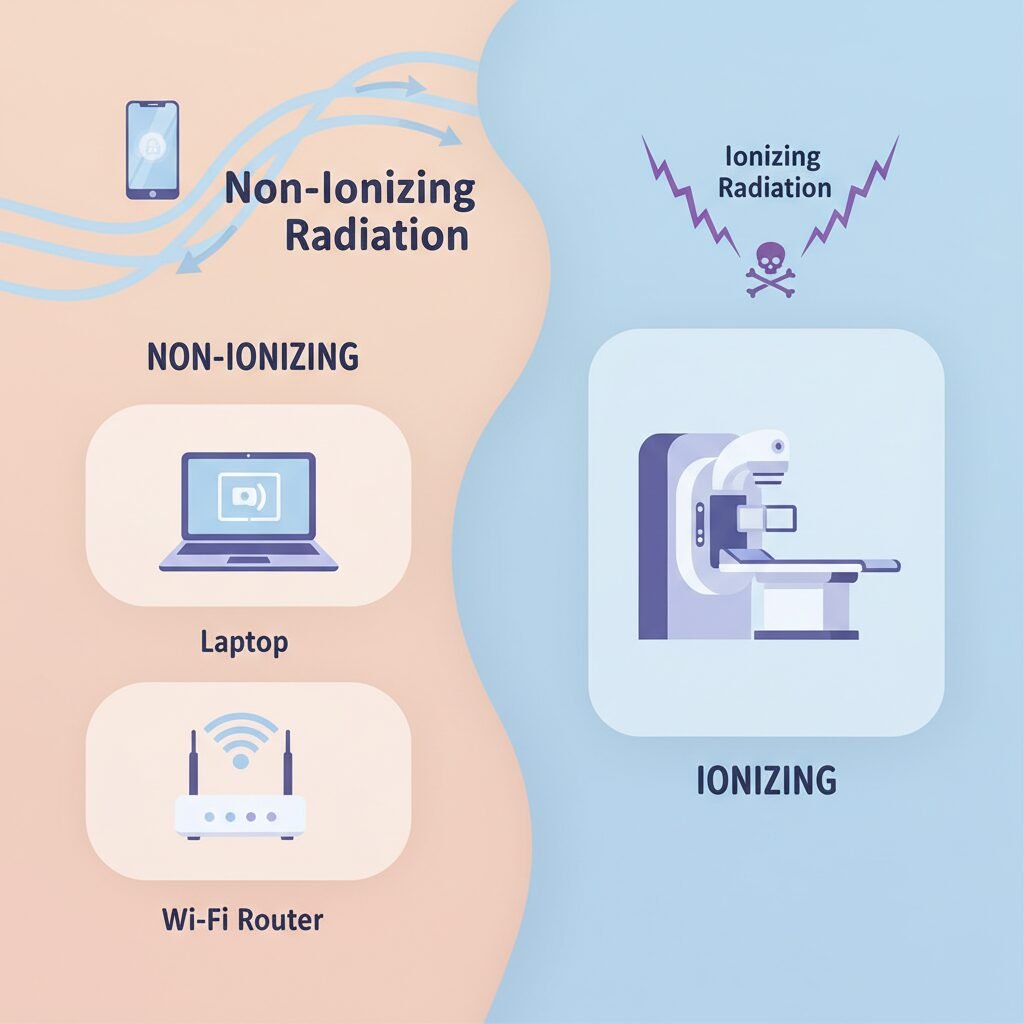
The most important thing to understand is that not all radiation is the same. Scientists split EMFs into two main categories:
- Ionizing Radiation: This is high-frequency, high-energy radiation. Think of X-rays and gamma rays. We know for a fact that high doses of ionizing radiation are harmful, which is why your dentist puts a lead apron on you for an X-ray, and why medical staff take significant precautions.
- Non-Ionizing Radiation: This is low-frequency, low-energy radiation. This is the type of EMF emitted by your everyday household devices: cell phones, laptops, Wi-Fi routers, Bluetooth devices, power lines, and microwaves. This is the category at the center of the pregnancy debate.
The fundamental difference is that ionizing radiation has enough energy to knock electrons out of atoms (a process called ionization), which can damage DNA and cells. Non-ionizing radiation does not have enough energy to do this. Its main effect on the body is heating tissue, which is how a microwave oven works at very high power. The levels emitted by your phone or Wi-Fi are thousands of times lower than what would be needed to have a significant heating effect.
Think of it like this: Ionizing radiation is like a bowling ball hitting a single pin—it has enough force to send it flying and cause a major disruption. Non-ionizing radiation is like a gentle breeze blowing on that same pin; it might cause a slight wobble, but it doesn’t have the energy to knock it over.
Understanding this distinction is the first step in moving from a place of fear to a place of informed awareness. The conversation around EMFs and pregnancy is exclusively about the potential effects of long-term, low-level exposure to non-ionizing radiation.
The Science So Far: What Research Says About EMFs and Pregnancy

Sifting Through the Studies
When you’re expecting, you want definitive answers, but in some areas of science, the research is still evolving. This is certainly the case with EMFs and pregnancy. Here’s a balanced summary of what the current body of evidence suggests.
Major health organizations like the World Health Organization (WHO), the U.S. National Cancer Institute (NCI), and the Centers for Disease Control and Prevention (CDC) have reviewed the scientific evidence. The general consensus is that, based on current data, there is no established, consistent evidence that the low-level, non-ionizing EMFs from common household devices cause harm to a developing fetus. The vast majority of studies have not found a causal link between a pregnant person’s typical cell phone use or proximity to Wi-Fi and adverse outcomes like miscarriage, birth defects, or developmental issues.
However, you may have seen headlines about studies that do suggest a link. It’s important to look at these with a critical eye. Some studies have found a correlation (a statistical relationship) between higher EMF exposure and certain issues, but correlation does not equal causation. For example, a study might find that people with higher cell phone use also have higher rates of a certain outcome, but it could be due to other lifestyle factors common to heavy phone users (like higher stress levels or poorer sleep habits), not the phone’s EMFs themselves.
Many of these studies rely on self-reported data (asking people to remember their device usage), which can be inaccurate. Research is ongoing, and the scientific community continues to study this topic. But the weight of the evidence, for now, is reassuring.
| EMF Source | Type | General Guidance & Perspective |
|---|---|---|
| Cell Phone | Non-Ionizing (Radiofrequency) | Held to the head, exposure is higher. Major health agencies have not found a definitive link to health issues at levels below safety limits. |
| Wi-Fi Router | Non-Ionizing (Radiofrequency) | Exposure drops significantly with distance. A few feet away, exposure is extremely low. |
| Laptop Computer | Non-Ionizing (Extremely Low Frequency & Radiofrequency) | Placing it directly on the body results in higher exposure. It’s best to use it on a table or desk. |
| Microwave Oven | Non-Ionizing (Radiofrequency) | Modern microwaves are shielded to prevent leaks. Exposure drops to almost nothing a few feet away. |
| Medical X-ray | Ionizing | Known risk. Used only when medically necessary during pregnancy, with shielding to protect the fetus. |
The key takeaway is that while we can’t say the risk is absolute zero (science rarely deals in absolutes), the risk is considered very low by mainstream medical and scientific bodies. The focus remains on managing known, proven risks to pregnancy.
Decoding ‘Belly Armor’: How Do EMF-Shielding Products Work?

The Promise of Protection
Enter the world of EMF-shielding products, from belly bands and blankets to maternity wear. The most well-known brand is Belly Armor, but many similar products exist. They are marketed as a simple way to protect your baby from everyday radiation. But how do they work, and do they deliver on their promise?
These products are typically made with comfortable fabrics, like cotton or bamboo, interwoven with microscopic silver or copper fibers. These metallic fibers create a conductive mesh that forms what is essentially a soft, wearable Faraday cage. This mesh works by blocking and reflecting the radiofrequency (RF) waves from devices like phones and laptops before they can reach your body.
Lab tests, often cited by the manufacturers, show that the fabric itself can be very effective, often blocking over 99% of radiation. On the surface, this sounds incredibly protective. However, the real-world application is more complex.
Pros vs. Cons: An Honest Assessment
Deciding whether to invest in one of these products is a personal choice. Here’s a breakdown to help you weigh the factors:
- Pro: Peace of Mind. For many parents, this is the single biggest benefit. Pregnancy can be a time of heightened anxiety, and if using a shielding product helps you feel calmer and more secure, that emotional benefit has real value. Reducing stress is unequivocally good for both you and your baby.
- Pro: Reduces Direct Exposure. The fabric does work. If you must rest a laptop or tablet on your lap, placing a shielding blanket or wearing a band between the device and your belly will reduce the direct exposure to that specific area.
- Con: May Create a False Sense of Security. This is the most significant drawback. A belly band only covers your front. EMFs can come from all directions and can even be reflected off surfaces, reaching your baby from the sides or back. This phenomenon, known as the ‘wrap-around effect,’ means you are never fully shielded. Believing you are completely protected might lead to riskier behavior, like keeping a phone in your pocket 24/7, thinking the shield negates any potential risk.
- Con: The Question of Necessity. As we discussed, major scientific bodies do not currently recommend shielding as a medical necessity for a healthy pregnancy. Spending money on these products may divert funds from other items that are proven to be beneficial for you and your baby.
- Con: Cost. These specialized products can be expensive, adding another financial pressure during a time that is already costly for many families.
Ultimately, these products are a tool. They can reduce some exposure and provide emotional comfort, but they are not a magic forcefield. Their value is highly subjective and depends on your personal comfort level and budget.
Practical, No-Cost Steps to Reduce EMF Exposure (If You’re Still Concerned)

Whether you decide to use a shielding product or not, there are simple, free, and evidence-supported habits you can adopt to reduce your overall EMF exposure. These practices are about creating sensible distance and mindful use, which can provide peace of mind without any cost.
Simple Habits for Greater Peace of Mind
- Create Distance. This is the single most effective strategy. EMF strength decreases dramatically with distance. Instead of resting your laptop or tablet on your belly, place it on a desk or table. Use a pillow to prop it up on the couch. Avoid carrying your phone in a front pocket; keep it in a purse or on a nearby surface.
- Use Speakerphone or Headphones. When making calls, try to use the speakerphone function or wired headphones. This keeps the phone’s antenna, which is its strongest EMF source, away from your body.
- Text More, Talk Less. Sending a text message results in a much shorter, lower burst of EMF emission compared to a lengthy phone conversation.
- Don’t Sleep With Your Phone. Make your nightstand a phone-free zone. If you use it as an alarm, place it across the room. This not only reduces nighttime exposure but also promotes better sleep hygiene—something every expectant parent needs!
- Turn Off What You’re Not Using. Turn off your Wi-Fi router at night. Switch your phone to airplane mode when you don’t need to be connected. Power down devices instead of leaving them in standby.
- Pay Attention to Signal Strength. Your phone has to work much harder (and emits more radiation) to maintain a connection when the signal is weak (one or two bars). Try to make calls or download large files when you have a strong, stable signal.
Putting It All in Perspective
While taking these small steps, it’s crucial to remember the bigger picture. The proven pillars of a healthy pregnancy are well-established: excellent nutrition, gentle exercise, adequate rest, managing stress, and avoiding known risks like alcohol, smoking, and certain medications. Pouring your energy into these areas will have the most significant and scientifically-backed impact on your baby’s health and development. Worrying excessively about EMFs can increase stress, which is a known negative factor in pregnancy. Be gentle with yourself and focus on what’s proven to matter most.
Conclusion
The Honest Truth: Trust, Empowerment, and Personal Choice
So, do you really need Belly Armor? The honest truth is, for most people, the answer is likely no—at least not from a standpoint of medical necessity based on current scientific evidence. The consensus from major health organizations is that everyday EMF exposure does not pose a proven risk to your pregnancy. The most effective ways to have a healthy baby lie in the choices you make every day: the nourishing food you eat, the rest you get, and the love and support you surround yourself with.
However, this journey is deeply personal. If the idea of EMFs causes you significant anxiety, and using a shielding product brings you a sense of peace and allows you to worry less, then it may be a worthwhile investment for your emotional well-being. Think of it less as a medical device and more as a comfort item, like a favorite pregnancy pillow.
Ultimately, the power is in your hands. You can adopt simple, free habits like increasing distance from your devices to ease your mind. You can choose to invest in a shielding product for that extra layer of comfort. Or you can review the science and decide to release this specific worry, focusing your energy elsewhere. None of these choices are wrong. What matters is that you feel informed, supported, and empowered.
You are already a wonderful parent because you care so deeply. Trust that instinct, lean on the facts, and be kind to yourself through this beautiful, complex process. You’ve got this.
Medical Disclaimer
The information provided in this article is for educational and informational purposes only and is not intended as medical advice. It is not a substitute for professional medical advice, diagnosis, or treatment. Always seek the advice of your physician or other qualified health provider with any questions you may have regarding a medical condition or your pregnancy. Never disregard professional medical advice or delay in seeking it because of something you have read in this article.