

20 Week Scan Cheat Sheet: Exact Questions To Ask The Technician
The 20-week anatomy scan is one of the most anticipated appointments of your entire pregnancy. It’s a magical milestone—a detailed, feature-film-length glimpse of the tiny human you’ve been dreaming of. You might see them wiggle, suck their thumb, or even kick. But alongside the excitement, it’s completely normal to feel a flutter of anxiety. This scan is a crucial diagnostic tool, and the amount of information can feel overwhelming.
We are here to walk with you through this moment. Think of this article as your personal doula-approved cheat sheet. It’s designed to transform any apprehension into empowerment, helping you understand what’s happening on the screen and giving you the exact questions to ask. You are your baby’s first and most important advocate, and being prepared for this appointment is a beautiful first step in that role. Let’s get you ready for your close-up.
Understanding the 20-Week Anatomy Scan: What Are They Looking For?

Before we dive into the questions, let’s demystify the anatomy scan itself. This isn’t just about counting fingers and toes (though they do that, too!). It’s a comprehensive medical examination of your baby from head to toe, designed to check their growth and development and ensure everything is progressing as it should. The sonographer, a highly trained medical professional, will use the ultrasound transducer to capture hundreds of images and measurements.
Their primary goal is to assess the following key areas:
- Fetal Anatomy: This is the main event. The sonographer will carefully examine the baby’s major organs and structures to ensure they have formed correctly. This includes a detailed look at the brain, heart, spine, stomach, kidneys, and bladder.
- Growth and Measurements: They will take several measurements, including the head circumference (HC), abdominal circumference (AC), and femur length (FL). These data points help confirm your baby is growing at a healthy rate and can sometimes be used to refine your estimated due date.
- Heartbeat: You’ll get to see and hear that strong, steady heartbeat. The sonographer will also check the heart’s four chambers, valves, and the major arteries and veins to ensure blood is flowing correctly.
- Placenta Location: The position of your placenta is crucial. The sonographer will check to make sure it isn’t covering the cervix (a condition known as placenta previa), which could affect delivery.
- Amniotic Fluid Levels: They will measure the pockets of amniotic fluid around the baby. The right amount of fluid is essential for your baby to move, grow, and maintain a stable temperature.
- Umbilical Cord: A standard check includes confirming the umbilical cord has two arteries and one vein, which is the normal and optimal structure for nutrient and waste exchange.
- Number of Babies: While usually confirmed earlier, this scan will definitively confirm if you’re carrying a single baby, twins, or more!
It’s important to remember that the sonographer’s role is to gather this information. They are experts at capturing the best possible images, but they are typically not permitted to interpret the results or provide a diagnosis. That role belongs to a radiologist and your primary care provider (doctor or midwife), who will review the full report.
Before the Appointment: How to Prepare for a Smooth Scan

A little preparation can go a long way in making your anatomy scan a positive and stress-free experience. Here are a few simple steps you and your partner can take before you head to the appointment:
Logistical & Physical Prep
- Hydrate, Hydrate, Hydrate: Many clinics will ask you to arrive with a full bladder. While it can be uncomfortable, a full bladder pushes the uterus up and provides a clearer acoustic window for the ultrasound, leading to better images. Check your clinic’s specific instructions when you book the appointment.
- Dress for Success: Wear comfortable, loose-fitting clothing. A two-piece outfit (like a top and pants or a skirt) is ideal, as you will likely only need to expose your abdomen.
- Eat a Little Something: Having a small snack or some natural fruit juice about 30 minutes before your scan can sometimes encourage the baby to be a little more active, which can help the sonographer get images from different angles.
Emotional & Mental Prep
- Discuss Your Hopes and Fears: Talk with your partner beforehand. Are you hoping to find out the baby’s sex? Are you nervous about anything in particular? Getting on the same page reduces in-the-moment stress and ensures you are a united team.
- Prepare Your Questions: This is where your cheat sheet comes in! Read through the questions below and decide which ones are most important to you. Write them down in a notebook or on your phone. Having them ready shows you’re engaged and helps ensure you don’t forget anything in the excitement of the moment.
- Manage Expectations: Remember the primary purpose of the scan is medical. While it’s a beautiful bonding experience, the sonographer’s focus is on getting clear diagnostic images. They may be quiet and concentrated for long periods. Also, be prepared that your baby might not be in the perfect position to see everything. It’s not uncommon for a follow-up scan to be scheduled if a clear view of a specific organ, like the heart, isn’t possible. This is very common and usually not a cause for alarm.
The Ultimate Cheat Sheet: Questions to Ask During the Scan
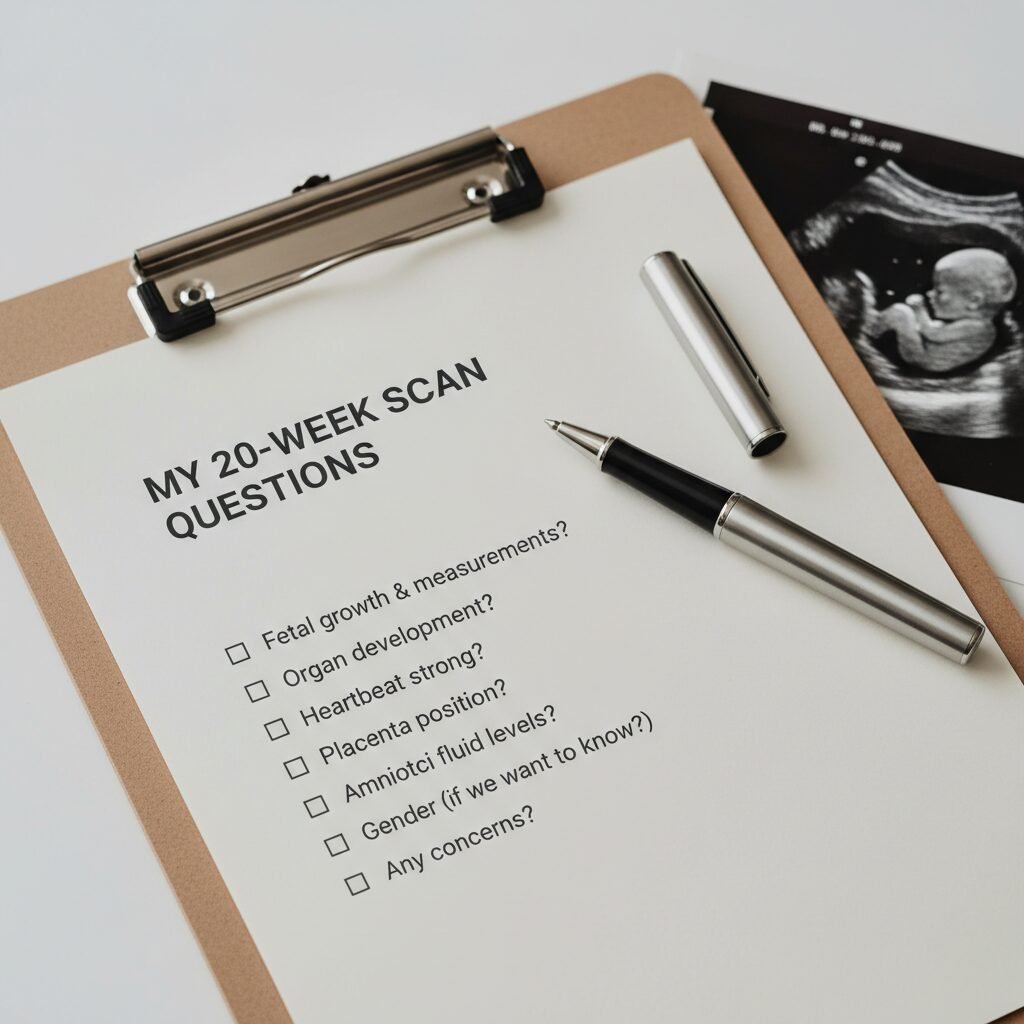
This is your moment. Don’t be shy about asking questions. A good sonographer will be happy to explain what they are looking at (within the limits of their role). Frame your questions with curiosity and an understanding that they are the technician, not the diagnostician. Use these as a guide to spark conversation and deepen your understanding.
Questions About Your Baby’s Growth & Development
These questions focus on the core purpose of the scan—assessing your baby’s health.
- “Is the baby’s growth measuring consistently with my due date?”
- “Could you show us the four chambers of the heart? Does the blood flow look normal?”
- “Are you able to get a clear view of the brain and the spine today?”
- “Are the kidneys and stomach visible and appearing to function as expected?”
- “We’d love to see them if you get a chance—have you been able to count all the fingers and toes?”
Questions About Your Body & The Support System
These questions relate to the environment your baby is growing in.
- “Where is the placenta located? Is it in a good position away from the cervix?” (This is especially important to ask if you’ve had any bleeding.)
- “How does the amniotic fluid level look?”
- “Have you checked the umbilical cord? Does it have the normal three vessels?”
Questions About the Experience & What You’re Seeing
These questions can help you connect with the images on the screen.
- “Could you point out what part of the baby we are looking at right now?”
- “Is that the baby’s foot/hand/face?”
- “Do you have any tips for getting the baby to move into a different position if needed?”
- “Is it possible to get a 3D or 4D glimpse if the equipment allows it?”
- (If you want to know): “Are you able to tell the baby’s sex today? We would love to know.” Or, if you don’t: “We’d like the sex to be a surprise, so could you please let us know when you’re examining that area so we can look away?”
Questions for Follow-Up & Next Steps
These questions prepare you for what comes after the appointment.
- “Is there anything you weren’t able to get a clear view of today?”
- “Based on what you’ve seen, do you anticipate we might need a follow-up scan?”
- “When and how will we receive the official results from our doctor/midwife?”
- “Is there anything in particular you’d suggest we discuss with our care provider based on today’s scan?”
Navigating Unexpected News: What If Something Is Flagged?

This is the part of the scan that worries every parent. Hearing the words, “The doctor will want to discuss this with you,” can send your heart into your throat. If you find yourself in this situation, here is a gentle guide to help you through the initial moments.
“Breathe. Your only job in this moment is to breathe and remember that you are not alone. Whatever comes next, you will face it with love and strength.”
1. Remember the Sonographer’s Role
The sonographer is a skilled technician, but they are not a diagnostician. Their job is to find and measure, not interpret. They are legally and ethically bound from giving you a diagnosis, which can feel frustrating but is designed to protect you from misinformation. Any potential concerns must be reviewed by a radiologist or maternal-fetal medicine specialist before being discussed with you by your doctor or midwife.
2. Ask for Clarification, Not a Diagnosis
It is fair to ask clarifying questions. You can say something like:
- “Could you spell the name of what you noted down for the doctor?”
- “Which part of the baby’s body were you looking at when you made that note?”
- “When can we expect to hear from our doctor?”
This gives you tangible information you can write down, which can help you feel a small sense of control and prepare you for the conversation with your care provider.
3. Avoid the Google Spiral
It is incredibly tempting to rush to your phone and search for the term you heard. We urge you, with all the compassion in the world, to resist this if you can. The internet is filled with worst-case scenarios and outdated information that is not specific to your unique situation. It will almost certainly cause more anxiety than clarity. Wait to speak with your doctor, who has the full picture.
4. Lean on Your Partner and Support System
Turn to your partner in the room. Hold their hand. Acknowledge your fear together. Once you leave, call a trusted friend or family member—not necessarily for advice, but just to have someone listen. You do not have to carry this worry by yourself.
5. Understand ‘Soft Markers’
Many findings on an ultrasound are what’s known as “soft markers.” These are not defects or definitive problems but are variations from the norm that can sometimes be associated with other conditions. Many soft markers resolve on their own by a later ultrasound or turn out to be nothing at all. Your doctor will explain the specific finding, the degree of concern, and what the next steps for monitoring or further testing might be.
Receiving unexpected news is deeply challenging. Be gentle with yourself. Allow yourself to feel whatever emotions come up—fear, anger, confusion. Your feelings are valid. The path forward will become clearer once you have a full conversation with your trusted medical team.
Conclusion
Your 20-week anatomy scan is so much more than a medical appointment; it’s a profound checkpoint on your journey to parenthood. It’s an opportunity to connect with your baby and to actively participate in their care. By walking in with this cheat sheet, you are not being difficult or demanding; you are being an informed, engaged parent. You are demonstrating the love and advocacy that will define your relationship with your child for a lifetime.
We hope these questions serve as a foundation, empowering you to have a rich, informative, and reassuring conversation during your scan. Cherish the moment you see that tiny profile or a little hand waving. No matter what, you have a community of parents and professionals standing with you, cheering you on every step of the way.
Medical Disclaimer: The information provided in this article is for informational and educational purposes only and is not a substitute for professional medical advice, diagnosis, or treatment. Always seek the advice of your physician or other qualified health provider with any questions you may have regarding a medical condition. Never disregard professional medical advice or delay in seeking it because of something you have read here.